Showing posts with label dring. Show all posts

Sunday, August 10, 2008

Flute Chamber Music Is Not All Serious

Madeleine Dring
M  adeleine Dring … was born [I was born] on the moon and can therefore claim to be a pure-bred lunatic. Arriving on a speck of cosmic dust, she  [I] came face to face with the human race and never really recovered.”
  — Madeleine Dring, humorous autobiographical diary fragment, quoted in Ro Hancock-Child’s biography of Dring, p. 1.
Flutist Leslie Marrs performed a wonderful set of new music chamber works by Robert Fruehwald and Wil Offermans as part of the National Flute Association annual meeting today, attended by about 2,000 flutists and a few composers.

  • Fruehwald: Hymntunes IV: Imenetuki; Three Fantasies on Irish Folk Tunes; Duo on Bulgarian Folk Songs;
  • Offermans: Tsuru-No-Sugomori
The Bulgarian Duo pieces featured guitarist Robert Trent accompanying Leslie. The first movement, marked Allegro, is almost in a flamenco rhythm: demonstrative. The second movement (Adagio-Andante) is pastoral, with a pensive feel—initially with a melodic lead in the flute part, evolving to more conversational interchange between flute and guitar, and concluding with a soli flute passage at the end. The vivace third movement is an engaging dance piece. The entire Duo is about 8 minutes in length, which makes it compatible in many recital/concert programs.

The ‘Hymntunes IV’ and ‘Three Fantasies’, atmospheric essays performed on alto flute and bass flute, respectively, evoke ancient, ethereal folk epics and legends. Their strophic story-telling idiom is made especially vivid by subversive colors that the low registers of these instruments lend to the endeavor. In ‘Hymntunes IV’ the flutist produces thumping percussive effects by the protrusion of tongue suddenly into the flute headjoint aperture. Additional intriguing percussion is created by rapid, repetitive clapping of right-hand flute keys—not changing the pitch but merely clamping the pads quickly against the openings on the flute body. The acoustic effect is (as heard from a distance of about 5 meters from the stage, anyhow) like moist bamboo chopsticks plunging hungrily into a bowl mostly emptied of rice—subtle and evocative of the first large raindrops of an arriving storm hitting a metal roof. The resonance of the column of air accessed by the pads clapping down over their respective holes generates un-voiced clear pitches—similar to effects we sometimes hear in pizzicato strings or harp.

The solo piece by Wil Offermans is likewise an atmospheric meditation, replete with harmonics produced by over-blowing, tongue-flutters, pitch-bending, and undulating ‘tremolo’ dynamics. Bravo, to both Marrs and Trent!

Flutist Donna Shin performed the following flute-oboe-piano trio pieces:

  • Demersseman-Berthélemy: Duo Brilliant ‘Guillaume Tell’
  • Dring: Trio for Flute, Oboe, and Piano
with the able assistance of her University of Washington friends Shannon Spicciati (oboe and English horn) and Regina Yeh (piano).

The William Tell (arranged in 1865; adapted by flutist Jules Demersseman and oboist Felix Berthélemy from Rossini’s 1829 opera score) was delightful—an animated and inspiring display of rapid-tempo artistry by the three, playing in tight, crisp ensemble.

The trio by Madeleine Dring was remarkable—with rich sonorities, rapid chase ‘scenes’ between the flute and oboe, and wry humor powered by the fine balance achieved by Shin, Spiccati, and Yeh.

Madeleine Dring studied composition under Ralph Vaughan Williams, Herbert Howells, and Gordon Jacob. Although her output was substantially incidental music for television, radio, and films, she did compose a number of pieces that merit consideration in chamber music programming. Her husband Roger Lord, an orchestral oboist, provided Madeleine ample stimuli (domestic provocations?) for her several chamber music pieces for oboe as well as flute, clarinet, bassoon, and other wind instruments. The Trio performed at the NFA convention today is one of the better known of these works. (Madeleine died suddenly of a stroke at age 54, in 1977.)

Besides her accomplishments as a composer, Dring was also a singer, pianist, lyricist, actress, and—and cartoonist? This last avocation is amazing, especially considering the era in which she lived! How many women can you find—in England or anywhere else in the 1940s through 1970s—who were actively creating cartoons?

Madeleine had a remarkable sense of humor. It is a shame that this aspect of her personality is not more widely known. Many of her cartoons and line-drawings manifest an irreverence and hilarity that the passage of time does not diminish. Have a look at Ro Hancock-Child’s biography of Dring, which includes a number of Dring’s cartoons. In addition to drawing cartoons of her own, she also wrote incidental music for TV animation. She clearly enjoyed the challenge of creating music that is suitable for young audiences, in addition to the more serious works by which she is primarily remembered.

Dring’s composerly methods, especially in her miniatures (like the three movements of this Trio), are basically descended from “English Renaissance” style. But the content of her melodic and thematic writing often incorporates elements of English folk music.

Since the time of her death 30 years ago, Dring has been under-recognized as a woman composer. Madeleine’s work has been curiously neglected in many of the anthologies of music by women (see links below), penalized possibly because of the idioms that she favored, which do not conform to elite notions of ‘seriousness’. But any composer who has written works in chamber music idioms for the stage or for film or TV as Dring did so extensively—must consider such an omission to be ‘conspicuous’ and unfortunate. Not every composition has to be a warhorse for display of technical virtuosity for it to have value and become part of the chamber music repertoire!

Composed in 1968, much of this Trio is comprised of exchanges between the flute and oboe over a jocular piano part. The second movement, marked Andante, supposedly symbolizes a duet between lovers. It opens with romantic chords in the piano part, which gives way to a poignant oboe solo—very fable-like. In fact, one can readily imagine a ‘Little Mermaid’ or other Disney-type animated feature as one listens to this beautiful melody. Donna Shin’s flute enters, taking over the melody, and, subsequently, we have a respectful dialogue between the flute and oboe—evoking images of a world free of serious conflict, promising nothing but harmonious adventures and happy endings.

The Trio’s final movement, marked Allegro giocoso, is the most playful of the piece, with highly animated lines for the oboe and flute and a ‘conspiratorial’ piano. The piano is substantially in a minor mode, with incidental major seconds and the occasional erratic/ironic chord. The wild passages in the piano part set the stage for flute-oboe caricatures that follow. Late in the movement the flute and oboe play a crazed cadenza with maniacal unison playing and chasing, ending in a sweet duet in major thirds.

Without doubt Dring was gifted in her abilities to write miniatures for children’s plays and for TV and radio. But her droll wit is evident in her more serious compositions as well. None of her drawings and cartoons is profane, but they instead manifest a thoroughly British sense of humor. They have an edginess and faux self-deprecation that were, maybe, about 50 years ahead of their time. This flute-oboe-piano Trio is a much-appreciated ‘window’ through which to glimpse the fun-loving, comical temperament of Madeleine Dring. Shin, Spicciati, and Yeh did a brilliant job of bringing this piece to life. Bravo!
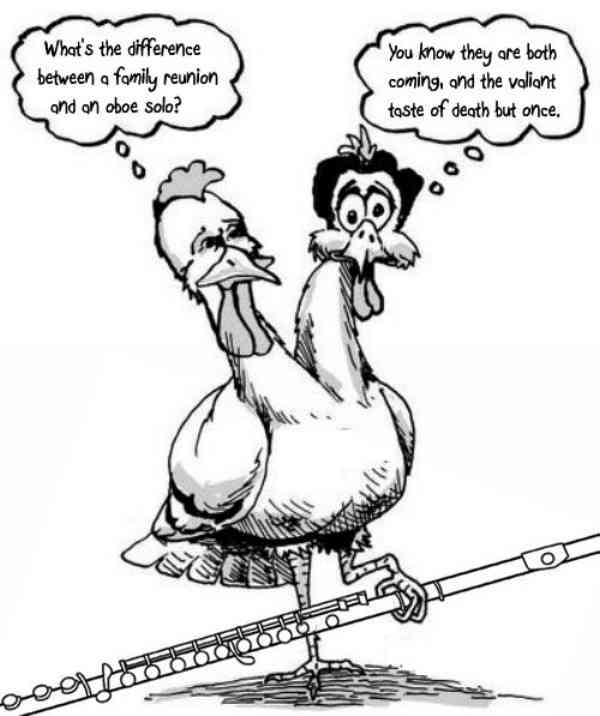
Madeleine Dring’s ambiguous sarcasm. No one shall be spared.


Tuesday, March 18, 2008

Allégresse: Situated Talk and the Piano-Flute-Oboe Trio Repertoire

 Allégresse
Piano-flute-oboe (PFO) trios are a distinctive orchestration for chamber music. The texture is relatively thin, which lends extra transparency and vulnerability to the sonic palette.

Paradoxically, the fact that it’s so difficult ever to achieve a formal understanding of conversation is what makes conversational analysis a worthy science, according to the Dutch linguist-sociologist Paul ten Have. Listening to Madeleine Dring's PFO trio, I am led to wonder whether linguists would find their task easier if they studied musical conversations in chamber music performance, instead of (or in addition to—) studying the spoken word. PFO trio is synonymous with clarity!

Representing a conversation as conforming to a closed set of rules—a deterministic pattern in which each ‘move’ is predictable and coherent—is notoriously inadequate and widely misses the mark. Instead, every conversational ‘move’ restores our sense of open-endedness and and indirection. Each conversational turn (re-)orients or references the preceding ones, but not uniformly so. There is no context-free understanding; each turn reveals the agency and autonomy of the current speaker(s). We discern the inter-subjectivity of the participants as each reorients himself/herself to the social action. The timbre and gestures of piano, flute, and oboe are so dramatically different that inter-subjectivity is an especially prominent feature—for performers as well as listeners. The ‘situatedness’ of each of the three voices is in general more direct, say, than in a string trio or a piano trio.

The genius of this PFO trio music is that the listener is generally unaware of the craftsmanship. When well done, the timbral and narrative balance between the voices achieves a spontaneity and lightness that don’t draw attention to the composer or to the performers unduly. Extroverted crispness and panache abound in well-written, well-performed PFO trios.

Madeleine Dring (1923-1977) exemplifies PFO trio form. Dring studied at the Royal College of Music, where her composition teachers included Ralph Vaughan Williams, Herbert Howells, and Gordon Jacob. In 1947, she married Roger Lord, an oboist. They had a son in 1950. Insofar as family responsibilities precluded her undertaking large-scale works, most of Dring’s compositions are smaller pieces. Many other works in the PFO trio repertoire are also miniatures, ranging from 3 minutes to 10 minutes in length.

Madeleine Dring’s style is particularly conversational—idiomatically resembling the writing of Francis Poulenc and George Gershwin. Interestingly, she didn’t exert herself to make her voice-leading ‘easy’, ostensibly because she herself had perfect pitch and found few intervals ‘hard’. And this disparity—the fact that either the flute or the oboe part is endowed with superior intervallic sense and the other part is not—is a feature of some of her PFO trio; this feature characterizes some of the conversations that Dring’s PFO trio enacts. As such, it becomes clear that some parts are more autonomous than others. The inter-subjectivity of the voices is not rigorously symmetrical. The capabilities and endowments are no more ‘fair’ or ‘just’ than other aspects of real life are ever truly fair or just. We experience the vital honesty of that in the PFO trio literature. That realism is, in fact, a major part of its charm.

Here is a list of PFO trios. You can scroll through it in this panel, or you can download it as HTML file here. I come up with more than 80. But probably I have missed some—I only spent an afternoon compiling this at home. I have not plowed through a conservatory’s library, only Google and Secrest-Schmedes’s book.

There are surely some of these pieces that merit more frequent performance and recording. Such a relevant and approachable conversational idiom, the PFO trio is a form that’s light yet satisfying for audiences. The short durations of most of the PFO trio works enable construction of varied programs around diverse periods and attractive themes. In terms of PFO trio repertoire, Allégresse’s programs are excellent examples of what is possible and readily marketable.


A


John Addison
  • Trio for Piano, Flute, and Oboe

Juriaan Andriessen
  • Trio No. 1 (1955)


B


Johann Christian Bach
  • Divertimento

Johann Sebastian Bach
  • Trio for Piano, Flute, and Oboe

Hector Berlioz
  • Trio of the Young Ishmaelites

Gerard Boedijn
  • Folklorische Suite, Op. 87


C


Espirit Chedeville
  • Scherzo

Domenico Cimarosa
  • Concerto in G Major

Adrian Cruft
  • Concertante, Op. 25


D


W. Dahlhoff
  • Idyll

Jean Damase
  • Trio (1961)

Frederick Delius
  • Intermezzo

Madeleine Dring
  • Trio for Piano, Flute, and Oboe


F


Johann Fasch
  • Konzert in e minor

Gottfried Finger
  • Trio

Peter Fricker
  • Trio, Op. 35 (1959)

Johann Fux
  • Nurnberger Partita


G


Ph. Gaubert
  • Tarantelle

Eugene Goossens
  • Pastorale and Harlequinade (1924)


H


Johan Heinichen
  • Sonata in G Major

Gustav Holst
  • Fugal Concerto, Op. 40, No. 2 (1923)

Bertold Hummel
  • Trio, Op. 95c (1992)


J


Gordon Jacob
  • Trio (1960)

Johan Janich
  • Kammersonate ‘Echo’ (1757)

Kelsey Jones
  • Sonata da Camera (1957)


K


Johan Kalliwoda
  • Concertino

Piet Ketting
  • Sonata

Jan Koetsier
  • Rural Suite, Op. 13

Franz Krommer
  • Concerto, Op. 65


l


Paul Lacombe
  • Serenade, Op. 47

Walter Leigh
  • Trio (1935)

Ignace Lilien
  • Trio ‘Music for the Smiling Tomorrow’

Jean Baptiste Loeillet
  • Sonata in F Major, Op. 1, No. 1
  • Sonata in G Major, Op. 1, No. 2
  • Sonata in g minor, Op. 1, No. 3
  • Sonata in c minor, Op. 1, No. 5
  • Sonata in e minor, Op. 1, No. 6
  • Trio Sonata, Op. 2, No. 2
  • Sonata in d minor, Op. 2, No. 4


M


Quinto Maganini
  • Concert Album
  • Paris Soir

Frank Martin
  • Ballade
  • Piece Breve

Jean Paul Martini
  • Plaisir d’amour

William Mathias
  • Divertimento, Op. 24 (1963)

Ignaz Moscheles
  • Concertante in F Major

David Moule-Evans
  • Suite

Thea Musgrave
  • Trio (1960)


O


L. Otten
  • Musette et Pastourelle


P


Willem Pelemans
  • Sonata No. 1 (1955)
  • Sonata No. 2 (1956)

Johann Pepusch
  • Six Trio Sonatas
  • Trio Sonata in G Major

Gordon Phillips
  • Pastorale

Thomas Baron Pitfield
  • Trio in d minor (1953)

Giovanni Platti
  • Trio Sonata in G Major

Francis Poulenc
  • Sonata for Oboe


Q


Johann Quantz
  • Trio in C Major
  • Trio Sonata in c minor
  • Trio Sonata in e minor


R


Jean Philippe Rameau
  • Pieces de Clavecin

Alan Rawsthorne
  • Sonatina (1936)

Franz Reizenstein
  • Trio in A Major, Op. 25 (1949)

Geoffrey Robbins
  • Pastorale and Bagatelle (1949)

Daniel Ruyneman
  • Amatarasu (1953)
  • Kobune (1953)


S


Antonio Salieri
  • Danse (1787)
  • Konzert in C Major (1774)

Ethel Smyth
  • Two French Folk Melodies (1928)

William Grant Still
  • Miniatures (1963)

Philipp Scharwenka
  • Trio No.1 in c-sharp minor, Op. 100

Gottfried Stolzel
  • Sonata in e minor, Op. 1


T


P.C. Tak
  • Trio

Georg Phillip Telemann
  • Trio Sonata in a minor
  • Trio Sonata in c minor
  • Trio Sonata in e minor
  • Trio Sonata in g minor


V


A. Verhaar
  • Trio, Op. 18

Antonio Vivaldi
  • Gigue

Alexander Von Kreisler
  • Trio Sonata (1965)


W


Jean Weckerlin
  • Pastorale

Richard Wilson
  • Deux Pas de Trois (1979)


Z


Henri Zagwijn
  • Pastorale and Scherzo


 Allégresse
    Allégresse Trio
  • Annie Gnojek, flute
  • Margaret Marco, oboe
  • Ellen Bottorff, piano
Allégresse Trio performs much of the PFO repertoire, including Quantz, Telemann, transcriptions of W.F. Bach and Rossini, plus trios by Madeleine Dring, Thea Musgrave, Jean-Michel Damase, Frank Martin, and William Grant Still.

[Annie holds a master’s degree from the University of Kansas. She is currently Adjunct Professor of Flute at Ottawa University and principal flutist of the Lawrence Chamber Orchestra. Margaret serves as co-principal oboe for the Kansas City Chamber Orchestra and performs regularly with the Kansas City Symphony, the Kansas City Lyric Opera, and the Kansas City Ballet Orchestra. She is Associate Professor of Oboe at K.U. A graduate of University of Missouri Kansas City Conservatory of Music, Ellen is currently interim Professor of Piano at the University of Kansas.]


 Allégresse