Showing posts with label tenor. Show all posts

Saturday, November 19, 2011

REBEL Baroque with Rufus Müller: Luminous, Numinous

Henry Ossawa Tanner, Annunciation
G    ood art reveals what we are usually too selfish and too timid to recognize—the minute and absolutely random detail of the World—and reveals it together with a sense of unity and form... the belief that the work of art reveals something of which the natural world is an imperfect image or symbol, and can reveal it more luminously if not more truly than [inartistic; uninterpreted] Nature.”
  —  Richard Elfyn Jones, p. 29.
L ast night’s Friends of Chamber Music REBEL performance with Rufus Müller (tenor)—a program entitled ‘Out of the Eclipse: Music of Transformation and Revelation’—was really excellent.

T he program was a meditation on Baroque idioms in terms of the Baroque chronotope of formation, the dynamics of space-time/dark-light interactions. Such interactions test the boundaries between truth and fiction, creation and destruction, conformity and iconoclasm.
  • Handel – Overture to Agrippina in G minor, HWV 6
  • Vivaldi – Sinfonia al Santo Sepolcro in B minor, RV 169
  • Handel – ‘Total Eclipse’ and ‘Your Charms to Ruin’ from Samson, HWV 57
  • Purcell – Chacony in G minor, Z 730
  • Telemann – ‘Wie? Kehren sich bei Jesus Krippen’ from Cantata No. 2 in C minor, TWV 1:1625
  • Bach – Concerto in A major, BWV 1055
  • Bach – ‘Zerschmettert mich, ihr Felsen und ihr Hügel’ from St. John Passion, BWV 245
  • Vivaldi – Sonata à quartetto al Santo Sepolcro in E-flat major, RV 130
  • Telemann – ‘Bei heißer Tränen dickem Regen’ from Cantata No. 13 in B minor, TWV 1:862a
  • Blow – Chacony in G major
  • Telemann – ‘Was gleicht dem Adel wahrer Christen’ from Cantata in F major, TWV 1:1511
  • Purcell – Fantasia No. 13 in F major ‘upon one note’, Z 745
  • Handel – ‘Tune Your Harps’ from Esther, HWV 50a
  • Handel – ‘His Mighty Arm’ from Jephtha, HWV 70
Q uestion’ figurations in ‘Wie? Kehren’ and ‘Bei heißer Tränen’ and elsewhere [much like mm. 8-9 of the tenor recitative ‘Wie hast du dich, mein Gott’ (Bach’s Cantata No. 21) or mm. 7-8 of the tenor recitative ‘Der Heiland ist gekommen’ (Bach’s Cantata No. 61] involve exchanges between the tenor part and the ‘contratenor’ line (viola in TWV 1:1625; violin in TWV 1:862a; oboe in TWV 1:1511). The questions—and the accompaniments to the answers—unfold a contrasting melodic pattern and a contrasting rhythmic pattern—which is how the composer creates structural contrasts among the motivic statements and develops depth. Constructing contrapuntal links out of the countersubject is a powerful method—a canon use-case that evokes a ‘receptive’ posture in the audience.

L eading/leaning tones abound, as we heard in the pre-concert lecture—especially in the pieces in the ‘dark’ keys (more than 2 sharps or flats), but the effect is not a cadential one. Instead, the melodic line moves in a peripatetic way... voice-leading that captures our attention by suggesting a self who has not made up her/his mind, or who is still discovering or questioning Life and the Divine... interrupted cadences on a large, “meta” scale that transcends the scope of individual works. This program—juxtaposing these pieces, strung together with hardly a pause between them—generates ‘hypercadences’, cosmic-scale implied plagal cadences. (Am I stupid for only now figuring out that that is what we mean by an excellent program or a good playlist?)

H andel’s cantatas have the women characters speaking/singing in their own voices, revealing a lot about their inner mental state, while the men tend to be detached, obscured by form and narrative. Stereotypically circumspect male, voluble woman. Lucrezia, Armida, Clori, or Diana, for example, versus Samson or Abdolonymus or Ruspoli [Harris, p. 51; presents arguments for interpreting the encoding and restraint used to veil same-sex meanings, while presenting alternative interpretations as well]. Müller’s Bach, Telemann, and Handel were powerful, inspiring, luminous.

I ndeed, as we listened our thoughts were wingèd, full of luminous hopes and dreams. And the dramatic changes in lighting in the darkened Grace & Holy Trinity sanctuary where REBEL performed helped to construct and reinforce the narrative authority that the music revealed to us... Revelations: by definition, novel; like dreams, they are subjective, and not readily corroborated by ‘evidence’. They persuaded us listeners to all-out belief, rather than reasoned with us or prove a specific predicate. One of my favorite performances! Bravo!

O  , zerschmettert mich, ihr Felsen und ihr Hügel! Wirf, Himmel, deinen Strahl auf mich! [O, crush me, ye rocks and mountains! O, Heaven, cast your bright beam upon me!]”   —  Bach, aria from St. John Passion.
T his is a peculiar passage that occurs several places in the Bible, notably Revelation 6:16... I imagine that Karen Marie Marmer (REBEL violinist who curated this ‘Transformation & Revelation’ program) selected this aria for inclusion in part because of this (compare Isaiah 2:19). This is not some Romantic, intellectual, filial, reverent ‘Crush me, please!’ This is a servile, prostrate Fear-of-the-Almighty-consuming-fire-and-brimstone-before-whose-alienness-and-majesty-none-can-stand ‘Crush me now, then!’ wish of a prey animal for the predator to just finish it off. The voice grows silent, no protection or security for her/him. Because Christ is now unfurling the once and future scroll that had been closed with seven seals. William Cowper (1731-1800) was fascinated by this same passage and used it in his poem ‘Truth’. I wonder whether the pietistic, Lutheran Bach ever read Cowper.
P   ieces of music are like any other form of human construction: whatever the patterns of intention lying behind them [sacred or secular], they instantaneously acquire an element of autonomy whether we wish them to or not... music, or any art for that matter, can affect us in ways that we could not expect—not because they have some secret property that only posterity reveals, or purely because our climate of reception predisposes us to see or value something that was irrelevant before, but because there is an unpredictable and circulating relation between the piece and its reception—it is not a one-way process.”   —  John Butt, p. 27.

Sunday, March 6, 2011

Art Song, Youth, and Omniscience: Stephen Costello, Tenor, & Danielle Orlando, Piano

Stephen Costello Danielle Orlando
W   hen I decided to go for vocal music in college, I didn’t know what I wanted to do. I was afraid of classical music. I didn’t understand it because of the languages. It seemed really long—like a lot of work, and everyone was singing all the time. Plus, how do you memorize all that music, right? [A chorus of nods around the table.]
I was into Broadway music for a while, but you know that whole ‘dancing’ thing didn’t work for me. [Laughter by other interviewees, at Costello’s dry delivery and self-effacing humor.] So I auditioned at AVA. There was something that the maestro saw that was very raw, which he really liked. Teachers can work with it and develop you, so I decided to go... It was kind of overwhelming at first. I think I was the only one at the school who had never sung a complete operatic role before. To be with these people who have sung two or three or more roles—it was intimidating! But, no matter: just dive into it and work your ass off. For me, if I hadn’t had music in my life during my public school system days, I don’t know what I’d be doing right now. I don’t know if I would have gone to college. No one in my family went to college. Through music, I made connections in school that helped me excel in places I wasn’t the most comfortable with.”
  — Stephen Costello, interview with Marilee Vergati, Dallas Examiner, 05-NOV-2010.
T he synergies between Stephen Costello’s tenor voice and Danielle Orlando’s piano last night were incredible.
  • Verdi - Questa o quella (Rigoletto)
  • Liszt - Tre sonetti di Petrarca, S. 270
  • Rossini – La danza
  • Lehár – Dein ist mein ganzes Herz
  • Quilter – Drink to me only with thine eyes
  • Quilter – Over the mountain
  • Traditional – Danny Boy, arr. Brodszky
  • Brodszky – I’ll walk with God
  • Tosti – Non t’amo più
  • Tosti – A vucchella
  • Tosti – Pierrot’s Lament
  • Tosti – Goodbye
  • Tosti – Ideale
  • Tosti – Aprile
O rlando’s piano provided poignant contrast and astringency to counterbalance Costello’s warm singing. The effect was like that of a third-person omniscient narrator in a novel. Orlando’s piano: theotic; godlike; expressing an all-knowing perspective; telling us listeners things that the main character, Costello, does not know—things that that few mortals (or none) can fully know—the meaning of Life; the mystical depth and transcendence of True Love—short of attaining Buddhahood or assumption into Heaven. Through the piano, we appreciate what the human species feels like and how much we humans stand yet to learn, as this young male exemplar sings his account of, say, what Tosti says ‘Love’s Gift’ is. The almighty Piano has seen it all and knows Everything. The mortal singer is earnest and true, but has only learnt as much as his youth has so far afforded opportunities for him to experience.

T he whole program was excellent, but the Tosti pieces were especially interesting. So I go and read Francesco Sanvitale’s biography of Tosti (link below), to try to figure out why these compositions fascinate me so. Francesco Paolo Tosti was from Ortona, a town of 11,000 in Adriatic mid-coastal Italy. He was born in April 1846, the youngest of 9 children. He attended the Conservatorio di Napoli when he was twelve, studied violin with Pinto, and went on to become a gifted violinist and teacher as well as achieving fame and wealth as a singer, attracted royal sponsorship and employments, and enabled his success as a composer. He lived in Rome from 1870 through 1874 and was teacher to Princess Margherita of Savoy before moving to London in 1875 where he served as singing master to Queen Victoria’s kids. Tosti figured prominently with the Ricordi publishing house, who published all of Tosti’s art songs except for a few released by Thomas Patey Chappell & Frank Chappell (Chappell & Co) and Emile Enoch (Enoch & Sons) in London. In all, Tosti composed more than 400 works, including some that are way-droll or humorous—comedic in their coupling a jocular text with a ‘formal’ setting or delivery.

Paolo Tosti
S   ignor Tosti is an agreeable and amiable composer. He has discovered the great weakness of the English for sentimental songs, and his ‘For Ever and For Ever’ is massacred in every schoolroom and drawing-room in the British Isles.”
  —  Vanity Fair, 14-NOV-1885.
B ut for all his outward humor and public drollery, we know that Tosti suffered from angina for a number of years. Early letters suggest that his cardiac symptoms began in his mid-30’s. He died of a heart attack at age 70, on 02-DEC-1916 at the Hotel Excelsior in the via Veneto in Rome. Possibly it was the recurrent cardiac reminders of his mortality and the chest pain dogging him through his productive middle age that imbued these piano parts with poignancy and paradoxical ‘omniscience’.

T his song ‘Aprile’ was one of two Romanze that Tosti wrote in 1882, when he was 36 (‘Aprile’ was in October and ‘Ideale’ was completed in December).

N   on senti tu ne l’aria—
il profumo che spande Primavera?
Non senti tu ne l’anima—
il suon de nova voce lusinghiera?
È l’April! È la stagion d’amore!
Deh! vieni, o mia gentil su’ prati’n fiore!

Il piè trarrai fra mammole,
avrai su’l petto rose e cilestrine;
e le farfalle candide
t’aleggeranno intorno al nero crine.
È l’April! È la stagion d’amore!
Deh! vieni, o mia gentil su’ prati’n fiore!

[Do you not smell the air—
the perfume of Spring?
Do you not hear the soul—
the sound of a new, enchanting voice?
Welcome, April, season of Love!
Ah! Come, my dear! Here, on this grass and on my flowers!

The feet will tread among violets,
while at your breast petals of rose and pale blue cavort;
and white butterflies
hover amorously around your adorable high black ponytail.
Hi-ho, April, season of Love!
Ah! Come, sprawl gently on my lawn and these here flowers!]”
  —  Francesco Paolo Tosti, ‘Aprile’, text by Rocco E. Pagliara.
C ostello excels when he’s portraying human emotions at their extremes and most over-the-topness. The program last night provided opportunities to sing with candor, lust, longing, righteous youthful enthusiasm, loss, and sorrow. (As he enters at least into his 30’s, he will be able to more fully inhabit roles that are propelled by greed, malice, deception, jaded cynicism, illness, and depression?)

T he Italian lyrics for ‘Aprile’: far more sensuous and suggestive than the standard English translation. Costello captures this and nails it.

Tosti ‘Aprile’ A fter the voice enters, the piano either supports the melodic line or intervenes during the vocal part’s rests and ‘volumizes’ the production at the cadences. Sometimes the piano modestly doubles the melodic line—a gesture that is prominent at the end of the first stanza and becomes more so—more insistently so—in the second one. The effect welds the timbre of the piano to the tenor melody. The orchestration and this emphatic gesture is, surely, part of the ‘melodramatic school’ of Tosti’s late-19th Century training.

N o mere accompanist, Orlando had as many great ‘lines’ as Costello, and she delivered them with great ‘sparkle and wit and wry social commentary’. Her brilliant performance reminded us of how spoiled we can be with truly great collaborative piano.

T he vocal writing is syllabic and, apart from the ‘Ah!’s and ‘Oh!’s and other spots where the text doesn’t have to be intelligible per se, Tosti indulges the singer and the listener by spinning out highly-embellished fioritura passages and small-scale vocalizations that are plain fun to sing (and to listen to), as well as vehicles for displaying the technical prowess of the singer. The piano part offers its own sort of ‘fioratura’ opportunities, which Orlando executes with perfect poise—with godlike virtuosity that is not anxious to prove its divinity and never steals the show from the vocalist.

W hat I mean is—the supreme ‘omniscience’ of Orlando’s narratorly interpretations was not so astringent as to be indifferent toward mortals, toward the singer. When you, a poor mortal singer, need something; when your prayerful glance meets hers, she can be relied upon to bless you and keep you; to make Her face to shine down upon you and be gracious unto you. She lifteth up Her countenance upon you and giveth you peace. As collaborative piano goes, Orlando is one hell of a kindly personal god, one Who does not hesitate to answer urgent prayers and intervene from time to time in the still-young world below.

T he blessings of The Piano—spiritual (Nerves!); physical (Memory!)—ought never to be taken for granted. And so it came to pass at the conclusion of the recital Costello offered a heart-felt benediction, one that recognized the Pianistic source of all good things and of salvation itself.

A nd we were lifted up, and went forth! Nunc dimittis servum tuum, Domina, quia viderunt oculi mei salutare tuum quod parasti ante faciem omnium populorum, lumen ad revelationem gentium. Artsong and opera without end, Amen!

B orn in Philadelphia in 1982, Costello is a 2007 graduate of the Academy of Vocal Arts (AVA). Costello is the recipient of the 2009 Richard Tucker Award. Additionally, he won First Prize in the 2006 George London Foundation Competition, First Prize and Audience Prize in AVA’s Giargiari Competition, and First Prize in the Licia Albanese-Puccini Foundation Competition. Costello has established himself as one of the current generation’s most impressive artists, with a prolific schedule of performances both in the U.S. and throughout Europe.

O rlando began her piano studies at the Settlement Music School in Philadelphia and continued at the Eastman School of Music. She earned a Master of Music in Piano Performance at Temple University. She currently serves as Master Coach on the music faculty of The Academy of Vocal Arts and is currently the Principal Opera Coach at the Curtis Institute of Music. Ms. Orlando collaborated for many years with Luciano Pavarotti as accompanist, judge, and artistic coordinator for all of the Luciano Pavarotti International Voice Competitions. Additionally, she spent nine seasons with the Festival dei Due Mondi in Spoleto, Italy, as the Artistic Coordinator and Coach for the operas, in addition to editing and arranging some of the compositions and performing recitals with the Festival.


Wednesday, February 4, 2009

Love Is Blind: Representational Art and Amative/Amatory Symbols in Chamber Music

 Catherine McMichael
A   m•a•tive (æm´•ə•tɪ v)
adjective: disposed to love; amorous; symbolizing amorous intent.
1630–40; < ML amātīvus, equiv. to amāt(us) [ptp. of amāre to love] + -īvus –ive.
S cores of Love’, a piece by Catherine McMichael for alto saxophone, tenor voice, and piano—is a fine Valentine’s Day chamber work you may like to try. As is the case with many art songs, this piece draws attention to how music is able to ‘mean’ things—how the intertextuality between the words and the music works; how the ‘representation’ of the emotions happens, specifically, the constellation of sentiments that denote love.


    [30-sec clip, Catherine McMichael, ‘Scores of Love…, Love at 20: Love Is Not All, Lynn Klock (saxophone), Jon Humphrey (tenor), 1.0MB MP3]


    [30-sec clip, Catherine McMichael, ‘Scores of Love…, Love at 40: April Rain Song, Lynn Klock (saxophone), Jon Humphrey (tenor), 1.0MB MP3]


    [30-sec clip, Catherine McMichael, ‘Scores of Love…, Love at 60: Send Her a Valentine, Lynn Klock (saxophone), Jon Humphrey (tenor), 1.0MB MP3]

I n some ways, this piece is in the great tradition of Robert Schumann… the ‘Spanisches Liebes-Lieder’ (Spanish Love Songs), op. 138. But with Catherine McMichael’s piece we have the three-way interaction of voice and sax and piano. The relationship of music to words is cultivated with great intimacy in each of the three movements, and there is a meta-intimacy that comes from the juxtaposition of three ‘chapters’ of life, advancing 20 years at a time (hence, the word-play of the title ‘Scores’ = spanning 20 years), represented by the texts of the three poets. The result is a kind of declamation that is propelled as much by the music as by the poetry. The colors and rhythms in the instrumental parts are not mere accompaniment—they disclose propositions of their own, on a par with the expressions of the tenor’s words—and this fact leads me to revisit my uneasiness with the question of whether and how deeply and accurately musical motifs can represent or allude to specific things.

L    ove is not all: It is not meat nor drink
Nor slumber nor a roof against the rain,
Nor yet a floating spar to men that sink
and rise and sink and rise and sink again.
Love cannot fill the thickened lung with breath
Nor clean the blood, nor set the fractured bone;
Yet many a man is making friends with death
even as I speak, for lack of love alone.
It well may be that in a difficult hour,
pinned down by need and moaning for release
or nagged by want past resolution's power,
I might be driven to sell your love for peace,
Or trade the memory of this night for food.
It may well be. I do not think I would.”
  —  Edna St. Vincent Millay, ‘Love Is Not All’ (age 20).
L    et the rain kiss you
Let the rain beat upon your head with silver liquid drops
Let the rain sing you a lullaby
The rain makes still pools on the sidewalk
The rain makes running pools in the gutter
The rain plays a little sleep song on our roof at night
And I love the rain.”
  — Langston Hughes, ‘April Rain Song’ (age 40).
S    end her a valentine to say
You love her in the same old way.
Just drop the long familiar ways
And live again the old-time days
When love was new and youth was bright
And all was laughter and delight—
And treat her as you would if she
Were still the girl that used to be.

Pretend that all the years have passed
Without one cold and wintry blast;
That you are coming still to woo
Your sweetheart as you used to do.
Forget that you have walked along
The paths of life where right and wrong
And joy and grief in battle are,
And play the heart without a scar.

Be what you were when youth was fine
And send to her a valentine;
Forget the burdens and the woe
That have been given you to know
And to the wife, so fond and true,
The pledges of the past renew
‘Twill cure her life of every ill
To find that you’re her sweetheart still.”
  —  Edgar A. Guest, ‘Send Her a Valentine’ (age 60).
A llusions, like symbols, strengthen and localize the cognitive and emotional experience for the performer or listener. In literary theory, allusions fall under the rubric of ‘intertextuality’. Intertextuality refers to the relationships between two or more texts that refer to each other. “Intertextuality is therefore the textual exploitation of another text. It would include satire, parody, pastiche, imitatio, refacimento, reference, allusion, modeling, borrowing…” as William Rothstein has written. The synthesis or reconstruction of narratives is a fundamental part of the interpretive process and performance practice. If you’re interested, have a look at Rothstein’s ‘Analysis and the Act of Performance,’ in John Rink, ed., ‘The Practice of Performance’, pp. 217-40. An extended thread assessing these issues runs through Kendall Walton’s writings as well, which are a joy to read.

H ave a look, for comparison, at Roger Scruton’s ‘Aesthetics of Music’. After ending his sojourn in the U.S. at Boston University and repairing to his native Wiltshire English countryside, Scruton has in recent years been somewhat notorious as a conservative political philosopher and ruralist, but Scruton is also an amateur composer. “When we hear music, we do not hear sound only; we hear something in sound, something which moves with a force of its own.”

O ne might imagine from his expressions in this vein that Scruton would hold that music can be representational. After all, he says that metaphors in music are “indispensable ... because we are using them to describe something other than the material world; in particular because we are attempting to describe how the world seems, from the point of view of active imagination ... The indispensable metaphor occurs when the way the world seems depends upon an imaginative involvement with it, rather than on our ordinary cognitive goals. And this is the case when we listen to music” (p. 92). And he asserts that “We are all to some extent sentimentalists” (p. 488). But sentimentality in Scruton’s reading turns out to be a kind of defense against the postmodern world by way of ‘make-believe’ or ‘language games’. In this respect, Scruton’s view intersects with Kendall Walton’s.

W alton famously holds that all effective fictions arise from our playful use of symbols and signifiers: what Wittgenstein once called ‘language games’ or ‘language-play’. When we experience fiction, we suspend our disbelief, enter into the realm of play, and act as if the fictional world were real. Walton charts what amounts to an epistemology of fiction, a virtual world where ‘it is fictionally present’ is equivalent to ‘it is true’ in the real world.

W    ollheim’s purpose in connecting ‘seeing-in’ with seeing depth in flat surfaces is not so much to clarify seeing-in as to indicate the range of cases in which it occurs. In viewing many paintings regarded as non-representational, one sees one plane or shape or line in front of another. Many of the works of such artists as Hans Hoffman, Piet Mondrian, and Mark Rothko demand ‘seeing-in’, Wollheim claims, and qualify as representational along with portraits and landscapes, although the former are not ‘figurative’ as the latter are... [Audience members] participate in what I call perceptual games of make-believe. ‘Seeing-in’ ... [is] an experience characterized by the phenomenology of twofoldness: an experience with two aspects—a ‘recognitional’ aspect and a ‘configurational’ one.”
  —  Kendall Walton, Marvelous Images, p. 136.
A  century ago ‘Vom Musikalish-Schönen’, Eduard Hanslick argued that it’s impossible to represent emotions in music because music can’t provide enough specificity—can’t convey the specific cognitive content associated with emotions. “The feeling of hope cannot be separated from the representation of a future happy state which we compare to the present ... Love cannot be thought without the representation of a belovèd person, without desire and striving after felicity, glorification and possession of a particular object.” If music can’t represent these ideas or objects but only some ‘dynamic’ aspects of emotional life, then (according to Hanslick) it can’t be seriously representational at all.

S usanne Langer maintained this conservative view, too, in the mid-20th Century. And, in his own way, so now, it seems, does Scruton. By contrast, Peter Kivy is an exponent of the view that music can indeed express particular emotions. [I have had in these past few days more Scrutonization than is probably healthy; I think I (and, maybe, you) can find the antidote by rereading and being re-persuaded by Kivy, just in time for Valentine’s Day.]

T    he expressive character of art is connected with its role in the Entäußerung or ‘realization’ of our feelings. We encounter works of art as perfected icons of our felt potential, and we appropriate them in order to bring form, lucidity, and self-knowledge to our inner life. The human psyche is transformed by art, but only because art provides us with the expressive gestures towards which our emotions themselves lean in their search for sympathy—gestures which we seize, when we encounter them, with a sense of being carried at last to a destination that we could not reach alone...”
  —  Roger Scruton, Aesthetics of Music, p. 352.
T o be a proper ‘representation’, a work must ‘express specific thoughts about its subject’. To be interested in the work is to be interested in ‘understanding those thoughts.’ By ‘thoughts’, Scruton means, “the sense or content of a declarative sentence,” which can either be true or false. A representational work must generate propositions with truth-values that are accessible to and, by consensus, agreed upon by [a majority of] those who experience the work: “Representation... is essentially propositional.” N.B.: Wittgensteinian language-games, ballast even on philosophers’ social networks, positively fatal on Valentine’s Day.

P eter Kivy elegantly rebuts Scruton’s arguments that music can’t be representational. Kivy accepts Scruton’s criteria for something to be representational and for a representation to be aesthetically relevant, but disagrees that music fails to meet these criteria.

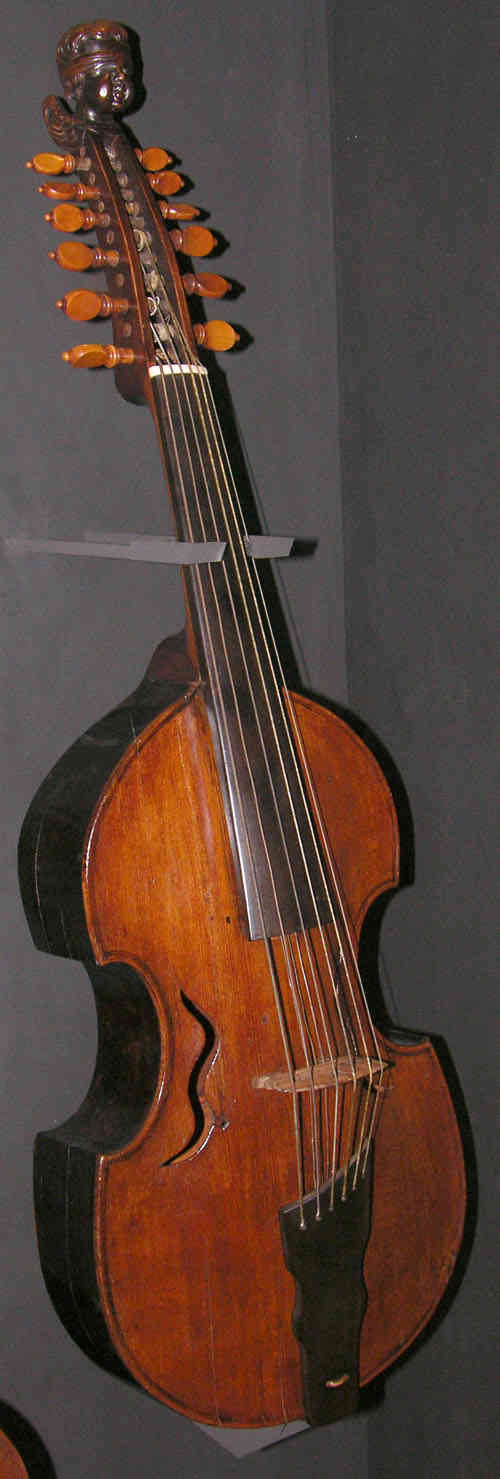
 Viola d’amore, Stadelmann, 1777
A    traditional painting depicts something, and if the painting is a good one, every part of the canvas contributes to the effectiveness of the visual message that the artist is trying to convey. In traditional literature every passage has its purpose – fleshing out a character, setting the mood, developing the plot, and so on. The same is generally true of music in the European tradition: the composition is considered to be greater than the sum of its parts, a work of art in which each passage has a function that is vital to the overall plan of a work. Think of any tonal work that you know well, and imagine what it would be like if its parts, themes, transitions and so forth—were randomly rearranged. It might be interesting to see how it would turn out, but the piece would almost certainly not be as effective as a whole.”
  —  Stefan Kostka, Materials and Techniques of Twentieth-Century Music, p. 152.
 Viola d’amore, Hulinsky, 1785
S cores of Love’ by Catherine McMichael is a composition through which the respective contributions of the vocal text and instrumental parts to the work’s meaning can be dissected and understood, maybe more clearly or dramatically than other examples allow. Here’s an experiment for you: Have a viola perform the tenor part—preferrably while reading from the tenor part—or transposed to alto clef, but with the lyric retained below the staves for the violist to see. Better yet, use a viola d’amore—one with an anatomically correct carved head at the top of the peg box, complete with the blindfolded eyes to represent Love. See if the sense of the piece doesn’t convey substantially the same meaning as it does when the words are sung. Do you not agree that it is as fine and precisely evocative a Valentine when arranged in that way, as it would be in its original mixed trio form?

I t’s like my violin teacher periodically reminds me (odious keyboard/brass/woodwind player and erstwhile tenor that I am): “The string contact-point ... is, at best, like your vocal cords. The instrument and the bow should be your voice. You must remember to make them sing; every note must sing.” The tone quality or sound color of viola can be a wonderful substitute for the tenor voice. Your make-believe mind (the mind of your listener as well) imagines the fictional words and automatically fills in the correct representations, the accurate intertextual truths. It’s enough to know the poems that inspired the setting—that caused the music to be constructed as it is...

I    have performed the piece with viola (in place of the saxophone, not the singer), and it’s just as effective. In fact, the tenor at that performance was 60. His wife was in the audience, and it was his valedictory performance ... Several people came up to me at the intermission, literally weeping, exclaiming how grateful they were that contemporary music by a living composer could still be beautiful and moving.”
  —  Catherine McMichael, email to CMT.
 Viola d’amore, Wassern, 1707
I    have to pour unrequited love into bar 100 and not forget a touch of fear and loathing at bar 210.”
  —  Jonathan Dunsby, Performing Music: Shared Concerns, p. 24. [an interesting on-point quote, I thought; has nothing to do with McMichael’s ‘Scores of Love’, though]

 Wagner, Tristan chord, unresolved je n’est sais quoi of longing