Showing posts with label B minor. Show all posts

Sunday, August 17, 2008

Memes of Exile: Composer vs. Performers/Listeners & Strategic Choice of Key

Allatson – McCormack book
H  ome’ is not just the place where we now live; it’s also the place where we first lived, and it’s the source of everything that our childhood meant to us.”
  —  Janet Schmalfeldt, keynote remarks at the 26th Society of Music Theory Conference, 2003.
Chopin’s piano Etude in G-flat major (6-flats key signature), Op. 10, No. 5 ‘lays so well’ under the hand. All black-keys and visually dense, sure. F-sharp (G-flat) major [D-sharp (E-flat) minor], all black keys, cognitively challenging. But, surprisingly, that Chopin Etude is as biomechanically natural as can be.

But what about timbrally and cadentially ‘natural’? What key signatures present expressive or rhetorical challenges, instead of cognitive or biomechanical ones? How about B minor (2-sharps key signature) for cello or viola? The tonic B puts this key a semitone below the pitch of the open bottom string on these instruments (C2 and C3, respectively). For a composer to sacrifice the gestural option of the low-note sonority on those instruments creates a unique sort of expressive tension or ‘challenge’.

I think a composer does not sacrifice the open low string unless the intent is specifically to deprive the player and the listeners of that sonority; unless the composer’s intent were to create an acoustic homeland where it is impossible to go, and to concomitantly make us aware of the land’s existence and attractiveness.

The ear and mind yearn to go to that note; the destination beckons. The transcultural naturalness of this is nearly universal. The metaphor of the tonic as a natural, cadential resolution is intuitive. Our familiarity with the timbres of each instrument makes us acutely aware of what registers are and are not being traversed; and the harmonies and voice-leading in the composition set up conditions that pull and pull toward the inevitable low. But the homeland stays impossibly beyond our reach. It is a powerful state of (psychic) exile.


    [50-sec clip, Aurora Quartet, Prokofiev String Quartet No. 1, Allegro, 1.4MB MP3]

And in fact Prokofiev’s String Quartet No. 1, Op. 50 (1931) was commissioned by the U.S. Library of Congress, during his period of ‘exile’ in Japan, the U.S., and Europe. The Andante is a tremendously veiled, circumspect thing. It has a ‘pinched’ quality about it, emotionally constrained, un-forthcoming, yet thin-skinned and approachable—we feel immediate empathy for the character embodied by each instrument’s part. The Quartet No. 1 is pensive in a way that is more ‘epic’ than the notes that comprise it.

Sergei Prokofiev
Compare the pensive, political effect to other B minor pieces for cello or viola:
  • Dvorák’s Cello Concerto in B minor, Op. 104
  • Casadesus’s Viola Concerto in B minor
  • Vivaldi’s Concerto in B minor for 4 Violins & Cello No. 10, Op. 3
  • Rota’s Intermezzo in B minor for Viola and Piano
  • Paganini’s Caprice No. 16 in B minor for Cello
  • Piatti’s Caprice No. 10 in B minor for Cello, Op. 25
  • Zemlinsky’s Quintet for Clarinet and String Quartet B minor, Op. 115.
The gesture of the Prokofiev quartet’s Andante—what strikes me as an ‘exile’ theme/meme—rises only to retrace its steps and return to a ‘form-fruste’ ledge in the lower register—hardly a home, psychologically, and barely a resting-place. More musical representations of exile and longing or ‘striving in vain’ take the form of motions from inner voices towards the main melody. Within the ascending arcs, an inner voice supporting the melody note begins a connecting motion to the next main melodic note. But it continues beyond this to reach into the octave above: the highpoint of the phrase and another tenuous ledge.


    [50-sec clip, Aurora Quartet, Prokofiev String Quartet No. 1, Andante, 1.4MB MP3]

Founding members of the Aurora String Quartet [Sharon Grebanier (violin), Mariko Smiley (violin), Margaret Tait (cello), Don Ehrlich (viola)] recorded a wonderful version of this Quartet in 1995. There are other versions, of course, but this one remains my favorite—for evoking this pensiveness and frustrated longing of diaspora, the boundary between what one wants and what can never ‘be’: the cadential low B of home.

Bard College’s Festival of Music this Fall is on Prokofiev. The Festival volume edited by Simon Morrison is a wonderful compilation of essays on topics that will be addressed at the Festival. Have a look, too, at the new book edited by Paul Allatson and Jo McCormack—for more ideas on the aesthetic theory of exile; David Goodman’s chapter on northwest China and ‘exile as quasi-nationality without a nation’ is especially good.

Morrison book

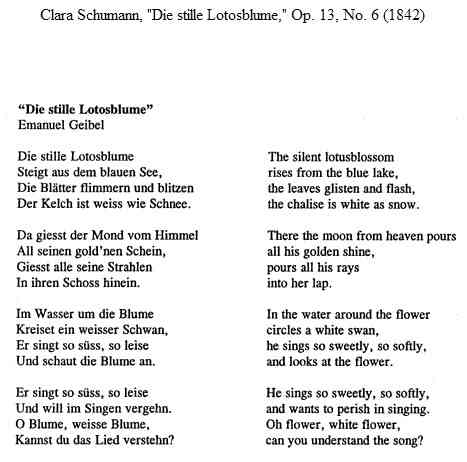
Emanual Geibel poem, Clara Schumann Op. 13; exile; liminality


Sunday, October 15, 2006

Spooky Piano Tableaux

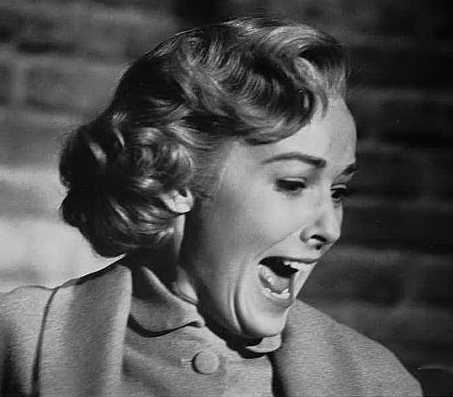
Hitchcock, 1960. Psycho. Vera Miles.
DSM: I was invited to a Halloween party the other day, an intimate gathering of about 10 people, and the people hosting it asked if I could come up with a suitably spooky piece to play after dessert.


CMT: Brother. Surely you begged off.

DSM: Well, the couple have been friends of mine for more than 10 years. And they’re not obtuse people. In fact, the request was posed as a question, “What is the scariest, the most seriously disturbing piece of music you’ve ever played?” And off-hand, I couldn’t really say. I’d never thought about it. I tend to stay away from overtly programmatic pieces. And it seems to me that trying to pigeon-hole the meaning and mood of a given work is naïve (in the case where a piece is first-rate, and the attempted categorization over-simplifies it and does violence to the expressive scope of it). Or else the piece in question is in fact second-rate and really does admit of a simplistic (and therefore aesthetically inferior) interpretation. Uggh.

CMT: So—you can be suckered by a throw-down challenge, is that it? What did you do—wrack your brain trying to recall especially sinister and diabolical motifs?

DSM: No—too tedious. But the typology of horror is pretty broad—there are many sub-types in the genre. So I started thinking of creepy movies—genuinely scary movies I've seen over the years—and then I took inventory of the composers whose biographies strike me as sufficiently unhinged—deviant in a way that is undeniably fright-o-genic.

CMT: Liszt has always impressed me as having an Anthony Perkins-like Psycho Norman Bates-ish quality. If you were looking for a satanic schizoid personality—an abject psychopath—Liszt in full bloom would be hard to beat, don’t you think? Late in life, didn’t he buy himself a bishopric or arrange for himself to be ordained as an Abbé or something? A rich man with a maniacal piety about him—now that’s scary!

DSM: Liszt definitely made it on my list! In fact, I think the Sonata in B minor is one of the spookiest things ever written.

CMT: Well, Charles Rosen considers the Sonata in B minor scary for its odd mix of dramatic bombast and preacherly sentimentality. (Charles Rosen. The Romantic Generation. Harvard Univ, 1998.)

DSM: Claudio Arrau, interviewed by Joseph Horowitz, clearly thought that the B minor Sonata was constructed by Liszt as a piece of programmatic drama—as a rendering of the Faust legend. (Joseph Horowitz. Conversations with Arrau. Knopf, 1992.) Brendel has thought so, too. (Alfred Brendel. Music Sounded Out. Robson, 1990.)

CMT: Let’s look at the score. It begins with these ominous, muffled groans. There is this eerie hallucinatory motif, in the Phrygian mode, that inexorably slouches down and down and down. If you play it very legato, dispassionately, the effect can be something like a a zombie, insensate and unstoppable—or vegetal and corrupt, like a fungus.

A ritenuto in m3 may be done in a heavy-handed, hokey way. But for the occasion you're invited to, I think it’s better left understated—to evoke death; a sad poling of Charon’s boat.


b mi, m1

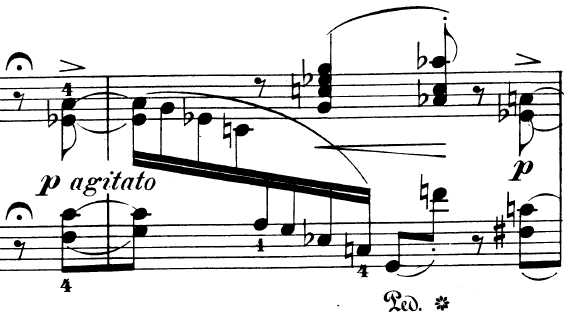
DSM: The exposition really takes the better part of the first 300 measures. There are the dead G’s in the first few bars, followed by dangerous and surprising leaping G’s (octaves) in m7-8. Then there is this cackling that begins in the LH in m15 and an agitato beginning in m18. We get the demented cackling again in m30-32, and the tonic B minor hits us with a vengeance.


b mi, m18

CMT: You really need to keep a cool head to play this piece effectively. The arpeggi in m40-44 are so easy to rush. And the sense of urgency inhibits the player from reducing the sound enough by m44. If it is too loud you fail to evoke the whispering of fallen angels.


b mi, m40

DSM: There is that hideous wailing in m18-22! The musical texture feels like a doomed Gustav Doré engraving. There are more deconstructions later on, notably in m113-119. Back and forth whispering and thundering, desperate pleading to be spared—from what we're not sure.


b mi, m113

CMT: Trying to un-do the deal with the Devil, I imagine, if we believe that the Faust-Mephistopheles legend was behind some explicit program Liszt had in mind here when he composed the B minor Sonata. Then in m197 the agitato dissipates—like waking from a nightmare. Look too at m239 and beyond—the weird swirling effects. The key is a paradoxical D major, but, like a tight-shot in a movie, you know something bad is about to happen. The sunniness you wouldn’t trust as far as you could throw it!


b mi, m197
b mi, m240

DSM: Oh, and look at the reprise of the original theme, beginning in m277. What chaos! The house is haunted! The humans are on their own, completely without protection. The passage in m286-300 sounds like the Devil himself is there, complete with flames.


b mi, m279

Then the recitative at m302: I like the mortified effect of putting the pedal down before the first note of the recitative begins.


b mi, m302

CMT: Yes, but guard against playing too softly there, or the effect will be a cheap, fakey, stagey gasping "Goodbye, cruel world"—a bad movie. What you want the pedal to do is emulate the persisting pulse of a person who is in a coma. While it may be true that they may be mortally injured, they are unconscious. They don't participate in the scene as agents who have plans or intentions. Instead, their cognition is gone—they're inert and don't respond. The heart and noisy breathing, the brainstem and some low-level reflexes—elemental and tenacious—are the source of what you see and hear. To keep from being stagey at m302, you just need to remember that you’re in a coma.

CMT: The ghostly-cold C minor in m311 is another feature that convinces me that this Sonata is one of the scariest pieces ever. And in m415-433 we are apparitions, floating out in some black void.


b mi, m312
b mi, m415

Here are a few representative recordings to guide you, as you revise your decisions on how to handle this piece (or your scary excerpt from it) for your friends' party:

And for a fine survey of the philosophy of horror, consistent with some of the musical ideas we’ve shared above, try Julia Kristeva’s excellent little book:

I take it you're going to go to the party dressed up as Liszt then?

Dore. Paradise Lost.