Showing posts with label fibonacci. Show all posts

Sunday, February 22, 2009

The Composer Vanishes: Solving the Diffusion Equation Shows that Adès’s ‘Arcadiana’ is Really a Quintet with a Fifth Un-voiced ‘Phantom’ Part

 DSM. Entropy-diffusion from composer Thos. Adès, in absentia, to and through string quartet artists performing ‘Arcadiana’, iii
B   oth form and content in Adès’s music depend upon the multivalent conjunctions that may be derived from relatively elemental forms of continuity… Analyses of ‘Arcadiana’ illustrate the paradoxical nature of postmodern musical time, in which a narrative linear interpretation may emerge from the higher-level perception of locally-concurrent periodicities and trends… Rhythmic analysis entails identifying projections of duration and pitch, as well as processes of timbre and dynamics… In some cases, these interactions are mutually reinforcing; in others, they may embody reorientation or conflict, not to mention ironic deception.”
  —  John Roeder, Music Analysis 2006; 25:121-54.
A    dès’s music merits special attention because of the consistency with which it employs elemental continuities, and because of the variety of temporalities that the composer derives from them... Continuity [is] defined as an association between two percepts, formed when the second realises a mental projection that was made as part of the first. Generally, continuity manifests itself in sequences of successive pitches, or in series of pitch percepts that are not literally successive... It may also subsist in more abstract projections and realisations of duration...”
  —  John Roeder, p. 122.
T he Jupiter String Quartet delivered a wonderful account of Thomas Adès’s String Quartet Op. 12, ‘Arcadiana’ (Venezia notturna; Das klinget so herrlich, das klinget so schön; Auf dem Wasser zu singen; Et... (tango mortale); L’embarquenment; O, Albion; Lethe) [1994] in Kansas City on Friday night in the Friends of Chamber Music 2008-2009 series—this in a program that also included Mendelssohn’s String Quartet in A minor, Op. 13, and Beethoven’s String Quartet in E minor, Op. 59, No. 2.

  • Nelson Lee and Meg Freivogel, violins
  • Liz Freivogel, viola
  • Daniel McDonough, cello
I n 2008, the Jupiter String Quartet received the prestigious Avery Fisher Career Grant, and in 2007 the Quartet won the Cleveland Quartet Award from Chamber Music America. This year is the final year in the Jupiters’ three-year residency with Lincoln Center’s ‘Chamber Music Society Two’. From 2004 to 2006, the Quartet was enrolled in the Professional String Quartet Training Program at New England Conservatory, earning Master of Music degrees in Chamber Music.

A dès wrote his first and, to date, only string quartet in 1994, under commission from Endellion Quartet in the U.K. The work is highly regarded by both performers and by theorists, and has been the subject of several important published analyses. The first several bars of the third movement (‘Auf dem Wasser zu singen’ [To be sung on the water]) are especially amenable to a kind of analysis that I think can shed light on the theme of the whole work—‘vanishing’ and mortality. That is what this post is about...

F ranz Schubert’s ‘Auf dem Wasser zu singen’ D. 774 (1823) is a setting of Friedrich Leopold Graf zu Stolberg-Stolberg’s poem, written in 1782—which Adès took as an inspiration/calibration for this third movement.

M    itten im Schimmer der spiegelnden Wellen
Gleitet, wie Schwäne, der wankende Kahn:
Ach, auf der Freude sanftschimmernden Wellen
Gleitet die Seele dahin wie der Kahn;
Denn von dem Himmel herab auf die Wellen
Tanzet das Abendrot rund um den Kahn.

Über den Wipfeln des westlichen Haines
Winket uns freundlich der rötliche Schein;
Unter den Zweigen des östlichen Haines
Säuselt der Kalmus im rötlichen Schein;
Freude des Himmels und Ruhe des Haines
Atmet die Seel im errötenden Schein.

Ach, es entschwindet mit tauigem Flügel
Mir auf den wiegenden Wellen die Zeit;
Morgen entschwinde mit schimmerndem Flügel—
Wieder wie gestern und heute die Zeit—
Bis ich auf höherem strahlendem Flügel
Selber entschwinde der wechselnden Zeit.

[Amid the glimmer of sparkling waves,
The bobbing boat glides like a swan:
Ah, the soul glides onward like the boat,
On shimmering, gleaming waves of joy;
For the sunset glow, shining down from heaven
Upon the waves, dances all ‘round the boat.

The rosy light winks at us
From above the treetops of the western wood;
Beneath the branches of the eastern wood,
The reeds whisper in the light—
In the reddening glow, the soul breathes
The joy of heaven, the peace of the grove.

Ah, alas, Time itself vanishes on dewy wings and I with It,
Into the weighty cradle of the waves.
Tomorrow, Time will fly away on glistening wings—
As it did today and yesterday and the day before—
Until I myself fly away from Time’s inconstancy
On yet loftier, more radiant wings.] ”
  —  Friedrich Leopold Graf zu Stolberg-Stolberg, ‘Auf dem Wasser zu singen’ [To be sung on the Water], 1782.
H ow does this piece work? What makes ‘Arcadiana’ ‘tick’? I look first at my rhythm metrics... These are not Fibonacci series... Ah, this quartet feels like a diffusion problem! Analytical solutions to heat- and mass-transfer problems reduce to solving partial differential equations (PDEs)—in this case, the so-called ‘heat equation’, treating the medium as a homogeneous solid under appropriate initial and boundary conditions. Hypothetically, the IC and BC can include convective and radiative interactions with the environment, but in the present example of Adès’s ‘Arcadiana’ I ignore convection and radiation possibilities.

M any analytical solutions of the heat equation refer just to the simple one-dimensional situation, with a ‘heat capacity’ c, a ‘diffusion coefficient’ k, and a ‘loss term’, φ, to account for dissipation of energy as diffusion proceeds.

 DSM. Diffusion equation with dissipation term φ
T he Endellion Quartet recording of ‘Arcadiana’ is the only one currently available. But, obviously, it is not possible to separate the four parts in the stereo channels. So I transcribed each part into Finale®, played each track individually, ripped myself MP3s from those, converted to WAV files, and began examining entropy as a function of time using FAWAV® and MATLAB®’s signal-processing toolbox.

 DSM. Wavelet-transform entropy analysis of viola part, mm. 1-4, ‘Arcadiana’, iii
T he results surprise even me. Using Crank-Nicholson finite-difference math to solve the 1-dimensional diffusion equation for propagation of entropy S(t), I find that the entropy pulse in the viola part diffuses to the cello, which appears to be sitting a “virtual 1,600 msec” away. Then the same entropy pulse appears, diffusing to the vn2 part with a smaller peak amplitude and more spread-out, consistent with a non-zero ‘dissipation’ within the expressive ‘medium’ constituted by the music. The vn2 appears to be located, according to the Crank-Nicholson solution of the diffusion equation, at a distance of about 2,100 msec from the cello. Further downstream, vn1 experiences the diffusing entropy pulse, at a virtual distance 1,200 msec away from vn2.

 Example 11a from John Roeder, ‘Co-operating continuities in the music of Thos. Adès’, Music Anal 2006; 25:121-54
A   dès often combines such elemental durational and pitch continuities within a single stream so that their realised projections are made to reinforce one another ... a series of regularly increasing and descending pitch-intervals unfolds [in ‘Arcadiana’, iii] within a sequence of regularly decreasing durations.”
  —  John Roeder, p. 126.
T   he effects of harmonic confluence may lead to a blurring of streams, and thus to a clear sense of temporal interaction, not merely co-operation. Example 11a renotates and simplifies the first eight bars of the third movement of ‘Arcadiana’ in order to foreground the two streams of activity which characterise this passage. In the pizzicato stream, the instruments alternate transpositions of the accelerating expanding-interval motive... The registral and transformational termination of the motive’s accelerating free-fall imparts a frustrated potential energy to its final interval that finds only tentative release in the contrasting tremolos of hexatonically stacked perfect fifths...”
  —  John Roeder, p. 141.

T hese results by themselves were fascinating to me. But then I got to thinking. Who is the ‘source’? The patterns account for the palpable, organically-sensible relative locations of four performers experiencing an entropy wave. But where is the entity who emitted this entropy wave? Can we use the PDE solution to impute where that ‘phantom’ source is ‘located’ with respect to the 1-D positions of the other players? (Click on the jpeg below to download the Excel spreadsheet with the C-N results in it.)

 DSM, Crank-Nicholson solution for entropy-diffusion in mm.1-4 of Thos. Adès’s ‘Arcadiana’, iii
A nd the answer is, ‘Yes’! If we take the ‘source’ of the entropy wave to be the composer in-absentia, then the diffusion equation says that that invisible, inaudible phantom is located about 3,200 msec upstream of the viola (jpeg at top of this CMT post). This piece is a quasi-quintet where the fifth player is absent!

A ctually, encouraged by the preliminary findings above today I’ve begun to do more calculations from other sections of this movement. And it appears that not only do the four string parts move around with respect to each other, as evidenced by the diffusion of entropy pulses propagating between and amongst them, so too does the phantom of Adès move, hovering at times very nearby one part and at other times watching the quartet at what is apparently a great distance.

 John Roeder, Mus Analysis 2006; 25:121-54, Example 1c, Arcadiana, iii, mm. 1-2
 John Roeder, Mus Analysis 2006; 25:121-54, Table 1
J ohn Roeder’s wonderful 2006 article in the journal Music Analysis—on coordinated continuities in Adès—is a great contribution to our understanding, illuminating a number of the features and mechanics of what Adès is doing. But I think what we have here (in entropy-diffusion evidence) is far deeper and far more symbolic (of Adès’s theme of mortality and vanishing) than Roeder and others have thus far recognized. What Adès has constructed here is nothing less than a statistical physics ‘diffusion chamber’ in which the four living performers together create an acoustic entropy field that strongly implies the existence/presence of the music’s creator. We are each familiar with the diffusion of a solute like sugar as it dissolves in a cup of tea; we are each familiar with the diffusion of heat by conduction through the cup from the hot inside to the surface that we hold in our hand. And the diffusive/dissipative effects that Adès has crafted here also strike the performer/listener as intuitively, empirically, palpably familiar. The fact that we can quantitatively model them and analyze them with pretty fancy math tools does not in any way diminish the fact that the underlying cognitive physics that Adès is using is utterly elemental, utterly organic.

A rcadiana’ is very difficult to play, yes. But when played well, the quartet evokes a physical reality that belies the technical difficulty. The very memory and spirit of the person who is absent are reanimated by the performers. We sense Adès’s presence through the implied [silent] fifth voice that is the source of the entropy waves that percolate throughout the other four parts. I find this deeply beautiful, as I hope you do as well. Thank you, Thomas! Thank you, Jupiters!

W   e are particularly fond of the ‘Arcadiana’ quartet. We wish Thomas would get busy and write more quartets.”
  — Daniel McDonough, Jupiter String Quartet, 20-FEB-2009, remark over supper.

 Jupiter String Quartet


Sunday, February 1, 2009

Spiccato Perfection: Formosa Quartet, Shih-Hui Chen’s Quartet No. 5

 Formosa Quartet
S hih-Hui Chen’s String Quartet No. 5 (‘Mei-Hua’, ‘plum blossom’) [commissioned by Formosa Quartet in 2007] was performed last night by Formosa Quartet at University of Missouri Kansas City’s White Recital Hall.

[Jasmine Lin (violin), Ayano Ninomiya (violin), Che-Yen Chen (viola), and Jacob Braun (cello) formed the quartet in 2003. Formosa Quartet members trained at Juilliard, the New England Conservatory, the Cleveland Institute, Curtis, Harvard, and Yale. They have held title positions in the San Diego and Cincinnati Symphonies and have been on the chamber music faculty at Interlochen, University of California San Diego, Taos School of Music, and Northwestern University and have appeared regularly at the Marlboro, Caramoor, and Ravinia festivals, and at the Chamber Music Society of Lincoln Center. They have taken first place in the Primrose, Paganini, and Naumburg competitions as well as first Prize and the Amadeus Prize at the Tenth London International String Quartet Competition in 2006. Besides the Shih-Hui Chen work on last night’s program, Formosa Quartet also performs other new music, including pieces by Bright Sheng and Richard Wilson.]

 Shih-Hui Chen
B orn in Taipei, Shih-Hui Chen emigrated to the U.S. in 1982 and received her doctoral degree from Boston University. Her works have been performed by the Cleveland Chamber Symphony, among others. Also frequently appearing in programs abroad, her music has been featured in China, Taiwan, Korea, Japan, Germany, Italy, and Amsterdam. A recipient of several fellowships including the Guggenheim, Ms. Chen has received grants from the Fromm Foundation, the National Endowment for the Arts, Meet the Composer Foundation, the Tanglewood Music Center, the Mary Ingraham Bunting Institute of Harvard University, the Koussevitzky Music Foundation Commission, and the Bellagio Rockefeller Foundation.

H   ard to be unaddressed,
Empty to reflection—
Take the road east—
Be where it is.”
  —  Robert Creeley, ‘There’, from ‘Gnomic Verses’, 1991.
S hih-Hui Chen frequently collaborates on inter-disciplinary and multi-media projects. She composed a film score for the documentary ‘Once Removed’ by film maker Julie Mallozzi, premiered several years ago at the Museum of Fine Arts in Boston. She also composed ‘There’, a song cycle composed with poet Robert Creeley prior to his dying in 2005. Shih-Hui Chen is currently an Assistant Professor of Music Composition at the Shepherd School of Music at Rice University and has served as Composer in Residence at the Tanglewood Institute and at the Boston Modern Orchestra Project (BMOP). She is a music advisor for Formosa Chamber Music Society, an active member of Musiqa (a composers’ collective based in Houston), and the Asian Composers’ League.

    Some Chamber Music Compositions by Shih-Hui Chen
  • Six Songs (‘Sweet Rice Pie’) for voice and mixed ensemble
  • Shui (‘Water’) for cello and piano
  • Fu I for solo pipa
  • Fu II for pipa and 5 western instruments
  • Four Little Pieces of Wood for piano
  • 66 Times (‘Voice of Pines & Cedars’) for soprano and chamber ensemble
Guettler & Askenfelt 1997
S hih-Hui Chen’s Quartet No. 5 is comprised of three movements: Fantasia; Scherzo; and the eponymous Mei-Hua (Plum Blossoms). It is edgy, energetic throughout—athletic, even, in the demands it makes of the artists. Part of its edginess derives from the extensive use of spiccato gestures in each of the instruments’ parts. The bows rarely stop dancing and bouncing.

T he bowing styles called spiccato (sautillé) and ricochét, in which the bow bounces off the string between notes, have a predominant mode between 13 and 15 bounces/sec for a bow tensioned at 50 to 60 Newtons force. The kinematics of the bouncing involves a ‘ripple’ that is dominated by bending moments in the distal part of the bow, out toward the tip.

T he percussive ricochet bouncing—with the dissipation of energy over the series of successive bow impacts with the string—can evoke a variety of suspenseful musical effects. It conveys an emphatic, forward-looking ‘consequentialism’, for example—like a reminder that gravity is inescapable, like death and taxes: a Creeley-esque ‘be where it is’ inevitability. The kinesthetics of the bouncing is trampolinesque, fascinating as our minds anticipate the diminishing intervals of milliseconds between the successive bounces.

 Ricochet bowing
I  calculate that, with a constant bow force, the inter-bounce time intervals approximately follow a hyperbolic Fibonacci series. I do not see that Askenfelt or anybody else has published on this. But, to me, it is a beautiful little mathematical result—writing spiccato as a compositional gesture amounts to invoking Nature and Mathematics and situating human society and its concerns in the large context of the universe and history. Spiccato kinesthetically alludes to the intersection of music and cosmology.

    1/1, 1/1, 1/2, 1/3, 1/5, 1/8, 1/13, 1/21, 1/34, 1/55, 1/89, ...

 Hyperbolic Fibonacci series B ut you need exceedingly skilled artists to pull the gesture off in performance! You need a light bow-hold, yet a bow-hold that stays under control despite the vigorous bouncing. The bow more or less pivots around an axis through the ‘U’ in the frog with the thumb and middle/index finger (depending on your bow-hold technic) daintily opposing each other. You want the force of the bow on the string to stay essentially constant during the successive bounces in order to avoid ‘multiple-slipping’.

A  squarish, Gibraltar-shaped force curve with a sharp rise and sharp drop, slipping during contact, has been shown to be optimal for a crisp spiccato. This was the result of physics experiments performed about 15 years ago by Anders Askenfelt and his colleagues at KTH in Stockholm. They found that the ‘ripple’ bending mode in the bow serves to reduce the build-up time for the force between the bowhair and the string with each successive bounce, enabling the sharp, box-shaped force as a function of time—and the crisp attack and release. However, more is not necessarily better, with regard to the sharpness imparted by the ripple. The risk of multiple-slipping is increased if the ripple mode is too great. Askenfelt found that spiccato playing properties of different bows varied widely and that the reproducibility of spiccato effects within-player and between-players also varied widely.

O ne of the [many] remarkable qualities that characterized the Formosa Quartet performance last night was the astonishing cohesiveness and elegance of their spiccato bowing. A cohesiveness of style and technic—all four of them—not just Ayano’s violin ricochet cohering with Jasmine’s violin ricochet. In fact, the extensive spiccato in each of the parts in the Shih-Hui Chen quartet provided ample empirical opportunity to confirm Askenfelt’s experiments: the ‘ripple’ in the bow dominates the effects, and the predominant 13 to 15 Hz mode is the same in violin, viola, cello, double bass. The effects are quite insensitive to the size and register of the ‘anvil’ (instrument) and have mostly to do with the physics of the bouncing ‘hammer’ (bow). The fact that this is so lends itself toward a ‘sectional’ unity that the composer can take advantage of. That spiccato physics plays no ‘favorites’ imparts a sense of the pervasiveness of ‘cause-and-effect’ natural law, of (eventual) justice and karma catching up with each and every one, of our embeddedness—every last mortal one of us—in Time.

T here are so many wonderful things in the Formosa Quartet performance and in this Shih-Hui Chen composition that I really must apologize for my ‘over the top’ delight in this one bowing-style/technical feature | compositional device. But, after all, this is a blog, not a ‘review’.

T he Formosa Quartet was joined by guest violist Scott Lee, Assistant Professor of viola at UMKC for Dvorǎk’s Op. 97, String Quintet in E-flat Major (1893). Scott won First Prize in both violin and viola in the Taiwan National Instrumental Competition, and was a top prize winner in the Lionel Tertis International Viola Competition and the William Primrose Viola Competition. He has performed at the the Newport Chamber Music Festival, La Jolla Chamber Music Festival, The Chamber Music Society of Lincoln Center, Music from Marlboro, and, in addition to collaboration with the Formosa Quartet, has been a guest artist with the Miro, Guarneri, Juilliard, Orion, and Miami String Quartets, and with the Beaux Arts and Mannes Piano Trios. Scott Lee has been a featured soloist at the International Hindemith Viola Festival and at the 22nd and 24th International Viola Congresses. Born in Taipei, Taiwan, 29 year-old Scott trained beginning at age 14 in the U.S. with violist Donald McInnes and violinist Todor Pelev and later with Michael Tree at Curtis Institute of Music and Paul Neubauer at Juilliard.

 Scott Lee, violist
B edřich Smetana’s String Quartet No. 1 in E Minor (1876) was also performed. Both the Dvorǎk and the Smetana were superb—highly narrative, dramatic expressions that cohered with the Shih-Hui Chen piece, in terms of their grounding in the composers’ respective (auto-)biographical, nationalistic and folk-music traditions. Without question, last night’s performance was an adventure and a high-point of my concert-going thus far in the 2008-2009 season. Bravo!

O    ne of my reservations about trendy new music that is heavily based on folk music—some pieces by Osvaldo Golijov and Tan Dun, everything by Mark O’Connor—is that it is too transparently a recycling of those sounds. With [Shih-Hui] Chen’s work, by contrast, the Taiwanese melody is heard only furtively, as if it were lurking around the corner or hovering spectrally above the music. Indeed, an imagined pentatonic melody rattled through my head at intermission, even though it was never really quoted fully in ‘Mei Hua’. The folk original was evoked in fragments, with microtonal bends and other effects, obscured by dissonance in the first movement and treated with viscerally exciting rhythms and a repeated-note pulse in the second movement. The instruments were called on to make sounds more specific to Chinese music in the third movement, reminiscent of the pipa and erhu mostly.”
  —  Jens Laurson, IonArts, 17-DEC-2007.

 A thrilling Ground Hog Day, 02-FEB-2009
                     [Happy Groundhog Day!]


Wednesday, November 5, 2008

Change We Can Believe In: Sofia Gubaidulina’s Mathematics of Physical and Religious Time

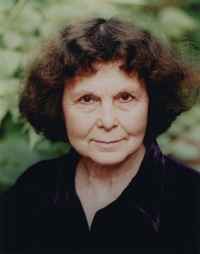
Sofia Gubaidulina
Co•na•tiv•i•ty (kō-nā-tiv'-ə-tee)
n. The aspect of mental processes or behavior directed toward change, including impulse, desire, volition, and striving.”
To-date, the analytical attention that’s been paid to Fibonacci series and other mathematical constructs in the compositions of Sofia Gubaidulina (София Асгатовна Губайдулина) has mainly concerned the role of mathematics in devising her melodies and harmonies and in guiding her voice-leading. Actually, it’s unclear whether Sofia actually uses the words ‘numerology’ or ‘gematria’ in discussing her own compositional methods. Her methods are in any case deeply associated with her Russian Orthodox religious beliefs and spiritual practices.

But besides the mathematical origins of her choices of pitches, she also creates ‘ambient’ fields of multi-rate polyrhythms that are based on the recursive Fibonacci and other mathematically derived series. Becomingness. ‘Change we can believe in,’ to borrow a phrase from the just-completed political election process in the U.S. I’ve recently been exploring recordings of Gubaidulina’s compositions, to discover Fibonacci-accelerando and Fibonacci-ritardando patterns—rhythmic counterparts to her number-theory-based polyphony. This CMT post is meant to tell you a little about what I am finding so far.

Winfree, Fig. 5.1
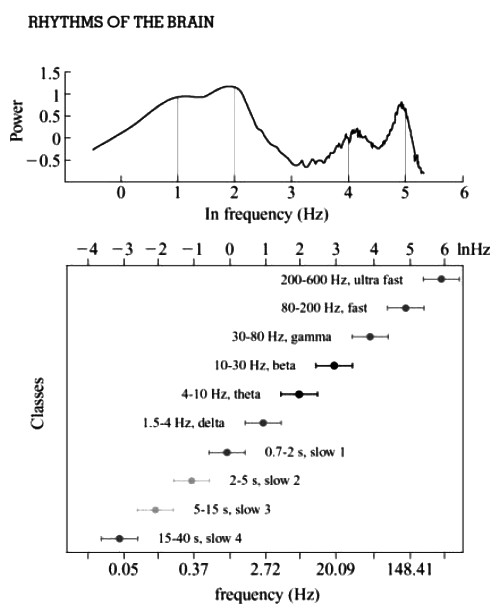
T   hree hippocampal rhythms: theta rhythms (4-10 Hz), gamma rhythms (30-80 Hz), and a fast oscillation (140-200 Hz). These rhythms are independently generated; we have observed that gamma oscillations persist without theta and compete with fast oscillation... There is a definable relationship among all brain oscillators: a geometric progression from band to band with a roughly constant ratio of e— the natural (Naperian) logarithm. Since e is an irrational number, the phases of coupled oscillators of the various frequency bands will vary on each cycle forever, resulting in nonrepeating, quasi-periodic, or weakly chaotic pattern: this is the main characteristic of the EEG. [But] why are there so many oscillators [in the brain]? Why can the brain not use a single, fixed-frequency clock for all of its computing functions? There are multiple answers to these questions... Once a slow oscillator appeared in simple animals, faster ones could be added as needed in subsequent evolutionary stages [for controlling functions on faster timescales]. We observe the continued coexistence of all of those independent clocks in the neurophysiology and neuroanatomy of brains today. The brain is not like a single, precise, fast clock and time-division [to produce a series of slower clock rates from the fast master clock] as is seen in digital computers. [‘Intelligent Design’ zealots notwithstanding,] the human brain did not appear de novo. The myriad independent clocks are the residue of evolution of the brain over many millennia. There is extra resilience and survival fitness that comes from the multiplicity of biological clocks, from the N-fold redundancy”
  —  Gyorgy Buzsaki, Rhythms of the Brain, p. 113.
O nce the hippocampus has been primed by stimuli that come down the perforant pathway, its own subsequent responses are greatly enhanced. Three seconds after granule cells in the hippocampus receive their first priming burst from above, they open up the ‘gates’. They transmit impulses much more efficiently across their synapses. This enhancing effect rises to its peak 15 to 20 seconds later. What is the most effective rate at which to deliver these brief trains of potentiating stimuli? Stimulating at the natural theta frequency: 5-7 Hz. Why is the result called ‘long-term potentiation’? Because transmission remains increased for as long as three weeks after the stimulation. Where does the theta rhythm come from? Chiefly from the medial septal region. Medial septal cells are ‘pacemaker’ cells. Their temporal pattern of acetylcholine release drives theta rhythms throughout the hippocampal formation.”
  —  James Austin, Zen and the Brain, p. 181.
Since the 1980s Gubaidulina’s work has been deeply informed by her Orthodox faith and her ‘zahlenmystik’, or the use of gematria, numerology, mystical mathematical formulae such as the Fibonacci series and the Golden Ratio. Sofia began to use the Fibonacci sequence as a way of structuring the form of the work. The sequence was especially appealing because it provides a basis for composition while still allowing the form to ‘breathe’—the naturalism referred to above. It plays a prominent role in such pieces as ‘Perception’, ‘Im Anfang war der Rhythmus’, ‘Quasi hoketus’ and the symphony ‘Stimmen... Verstummen...’ ). Later the Lucas series and Evangelist series, sequences derived from that of Fibonacci, were added to her repertoire. These compositional devices and effects are easiest to study in Gubaidulina’s chamber works.

Sethares, Fig. 2.14, p. 37
There’s a naturalness ... an innate and almost inevitable quality to Gubaidulina’s rhythmic structures. The proportions of the durations and the statistical distributions of the durations of notes feel like ratios and distributions that we are deeply familiar with from phenomena that occur in Nature. When things ‘wind-up’ toward a climax in a Gubaidulina composition, they wind-up in the manner that we see when gravity accelerates a falling object. When things ‘wind-down’, they wind-down in a progressively diminishing pace that we see in dissipative processes in Nature. The music of Sofia Gubaidulina imparts a distinct impression that it complies with the Laws of Thermodynamics and other physical principles. Mass and Energy are conserved, neither created nor destroyed in the course of performing the music. Entropy increases slightly from the beginning to the end of each piece. It can be measured, if you are inclined to do so. But even if you don’t measure it, you feel it. The Universe is proceeding as it should.

Sethares, Fig. 3.15, p. 74
Apart from the Orthodox spirituality that Gubaidulina intended to confer on her compositions, all listeners can at least apprehend the ‘organic’ cosmology that her compositional designs embody—the internal consistency and balanced energy and entropy budgets.

 Mats Bergström
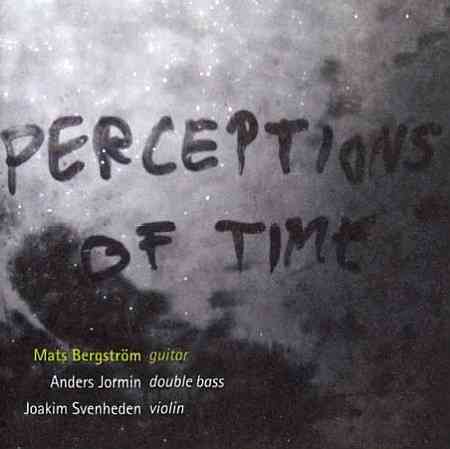
Okay. Measure it? Sure. Take one of her simpler pieces, like ‘Serenade’—the Swedish guitarist Mats Bergström (jpeg above) has a nice recording of this piece. It’s clear and the polyphony and rhythmic complexity are not too daunting. The Gibbs-Shannon entropy of a random variable that takes on values i with probability pi is defined as:

Entropy
If the rhythmic lines’ clock-rates are arranged so as to be Poisson-distributed, then the entropy of the Poisson distribution is given in terms of an infinite sum:

Entropy
where λ is the time-constant of the distribution. For long values of λ, the asymptotic form of this expression is:

Entropy
Or, in a slightly different formulation, the Renyi entropy of order α where α varies between 0 and 1 is defined as:

Renyl entropy
Obviously, if a composer sticks scrupulously to a mathematical construct in devising rhythms and orchestration, the result may be too complex to be playable. So there are compromises and simplifying decisions to make—collapsing the complexity into something that retains the feel of the programmatically-generated structure but omits things that inject too much variability or impose cognitive demands that are excessive. There’s a need to write forms that support ‘mutual entrainment’ of the disparate rhythms, re-syncing them on some regular basis. I try computing statistical copulas, to do multivariate measurement of synchronization/association between clocks...

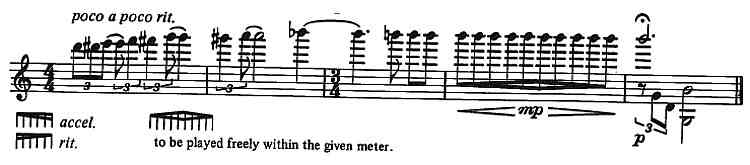
Sofia Gubaidulina, Serenade, Fibonacci-beamed 10:3, 11:3, 12:3
C ommunities of Clocks... ‘Mutual entrainment’ is a theme that recurs again and again throughout the physiology of coupled rhythmic systems... [The systems’] ‘phase-scatter’ is altered in proportion to the derivatives of new clock-phase with the old phase and the magnitude of the perturbing stimulus, as characterized by the following differential equation:
  —  Arthur Winfree, The Geometry of Biological Time, p. 119.
Winfree, Clock-phase ‘mutual entrainment’ of two coupled biological clocksBased on my measurements thus far, it looks like Gubaidulina’s ‘Fibonacci N-tuplets’ (? Fib-tuplets) and other rhythmic figures are hard for humans to play in a perfectly Fibonacci-timed way. With the note-durations normalized to the duration in milliseconds of each N-tuplet, the 10:3, 11:3, and 12:3 Fib-tuplets in ‘Serenade’ have as-written theoretical Shannon entropies of -2.06, -1.78, and -1.58, respectively.

As performed by Bergström, we get average values of -2.11, -1.85, and -1.72——entropy values slightly lower (more ‘ordered’) than the theoretical as-written values, owing to the [neurophysiology of entrainment that gives the--] plateauing of durations in the middle. (N-tuplets comprised of notes of perfectly identical durations would have Shannon entropies of -2.30, -2.18, and -2.07, for the 10:3, 11:3, and 12:3, respectively.) Interesting...

The ‘clocks’ in our brain that control our muscle function evidently tend to rush the accelerando beginning and ritardando ending just a little, and have a rate ‘plateau’ in the middle where the durations of the notes do not change as much from note-to-note as they should if they were strict, perfect Fibonacci.

It’s just how we're ‘built’, part of our innate physiology—beyond our interpretive control, really. What Gubaidulina reveals in these Fib-tuplets is a boundary between our humanity and our animality; between our conscious, sapient nature and our unconscious, instinctual nature; between things under our control and things that are beyond the possibility of human mastery. It is a fine and beautiful thing she does, reminding us performers and listeners of these things—we are stewards, not owners, of our mortal, animal bodies; we should be mindful of other animals with whom we share the planet; and so on. The Fib-tuplets induce a rhythmic meditation on humility, a spiritual posture that is receptive to grace... Have a listen to the MP3 clip below and you will see what I mean.

MetanoiaMind.com ‘EEG rhythms and states of consciousness’
And the spiritual effect of these naturalistic, physiologically propelled rhythmic structures is what I would say is this: ‘instantaneous epiphanies’ during neural pulse-entrainment. Maybe not on the first performance or the first casual listening. But if you do these pieces with intensely focused repetition, as part of a meditative practice? Wow! How long does an epiphany take to reach? And, once arrived, how long does the moment last? Try it and see!

Perceptions
So Gubaidulina’s music can induce dramatically altered perceptions of time, and transport the listener or performer to ecstatic, mystical, sufi-like states. Try it when you’re alone with your ‘significant other’. Maybe you will get to some exotic tantric, transfigurational, mutual-entrainment place you’ve never been to before. Change you can believe in! The tantric, ecstatic quality of Gubaidulina’s writing is maybe related to ‘theosis’ or the ‘Doctrine of Deification’ and ‘participatory union’ with God in the orthodox patristic tradition (see Russell, Tatakis, and Zizioulas links below).

Mats Bergström
Mats Bergström is a graduate of the Royal University College of Music (RCM) in Stockholm and Juilliard in New York. He made his recital debut at the Wigmore Hall in London in 1983 and has since pursued a career as soloist, accompanist and ensemble player in various genres. In 2006, he was elected member of the Royal Swedish Academy of Music. He performs solo recitals as well as the standard works for guitar and orchestra, and collaborates with artists such as singers Malena Ernman, Annika Skoglund, Olle Persson and Mikael Samuelson, flautist Anders Johnhäll and violinist Joakim Svenheden. He stretches the concept of chamber music in much of his work. Beautiful, fascinating. Mats currently lives with his wife and 3 kids in an old schoolhouse 30 km northeast of Uppsala.

Sofia Gubaidulina, Serenade, mm. 1-35

    [50-sec clip, Mats Bergström; Sofia Gubaidulina, ‘Serenade’, mm. 22-35 1.2MB MP3]

Here is a little spreadsheet I put together, which shows the Fibonacci-prescribed accelerando and ritardando timings for Gubaidulina Fib-tuplets that appear in ‘Serenade’ and other of her compositions. You can click on the screenshot to explore or download a copy to play with. Enjoy!

Gubaidulina Fibonacci N-tuplets timing
Altieri book

Seow book
A student doing a practicum in a nursing home reported to me an incident. She was walking with a resident along the hall where there were pictures of various bucolic, relaxing, unobtrusive scenes. One was a painting of a blacksmith shoeing a horse while a small boy looked on. The patient stopped at this picture and told the student, ‘This is a picture of me and Dad.’ The student asked me if, in fact, the picture was of the resident and his father. I told her that the patient's father had indeed been a farrier and that when he was young the son had often helped his father, but this was merely coincidental. The mid-19th Century Currier & Ives ‘Village Blacksmith’ picture was certainly not a depiction of this particular man and his father in 1925.”
  —  Allen Edwards, A Psychology of Orientation: Time Awareness Across the Life Stages and in Dementia, p. 208.

[This moment was for the elderly man ‘epiphanic’. And his fugue-like behaviors and experiences were these days continuously filled with small epiphanies. How brutal it would be to dispute his statement. How utterly awful to try forcibly to ‘correct’ the patient’s ‘mistake’ by compelling him to acknowledge it is Currier & Ives’s picture of some generic blacksmith, as a part of a cruel regime of medicalizing and treating the patient’s ‘confusion’ or ‘disorientation’. The old man’s variant, epiphanic reality must be permitted to stand——must be allowed anyhow if one cares a jot about his psychological condition and spiritual future.
—— dsm.]