Showing posts with label amateur. Show all posts

Saturday, November 13, 2010

Britten’s ‘St. Nicolas’ Cantata Op. 42 in Aldeburgh: The Importance of ‘Place’

 Boy Nicolas: ‘God be glorified!’
I    believe in roots, in associations, in backgrounds, in personal relationships. I want my music to be of use to people, to please them, to enhance their lives. My music has its roots in where I live and work.”
  —  Benjamin Britten, 1964, remarks upon receiving the Aspen Award.
I    want to write for people... There is something very fresh and unrestrained in the quality of the music produced by amateurs. What annoys me more is the ineptitude of some professionals who don’t know their stuff. I have no patience with that.”
  —  Benjamin Britten.
B etween the two World Wars, composers like Ralph Vaughan Williams, Gustav Holst, and others fostered a kind of pre-WWII musical Renaissance. But in the 1940s, a new generation of artists began to differentiate themselves from the previous generation.

I   t is encouraging that you too sense that something in the air that heralds a ‘renaissance’. I feel terrifically conscious of it—so do Peter [Pears], & Clifford [Curzon], & Michael Tippett & so many that I love & admire it—[and it] is good to add you to the list! Whether we are the voices crying in the wilderness or the thing itself, it isn’t for us to know, but anyhow it is so very exciting. It is of course in all of the arts, but in music, particularly, it’s this acceptance of freedom without any arbitrary restrictions, this simplicity, this contact with the audiences of our own time, & of people like ourselves, this seriousness, & above all this professionalism. One mustn’t and can’t deny the many heavenly genius[es] of the last century, but it is also a greater sympathy with the earlier centuries that marks this thing perhaps the most clearly.”
  —  Benjamin Britten, letter to Imogen Holst, OCT-1943.
T here is little doubt that Britten and his generation were ‘the thing itself’. Their sounds were not only ‘new’ but were emblematic of their nation and their generation. Britten’s Op. 42, the ‘St. Nicolas’ Cantata, represents one important embodiment of that.

O ne might think that a nationally and generationally emblematic sound would require in each performer a fully developed timbre and musical maturity to pull it off. But that is not so.

I  heard a rehearsal yesterday (Saturday, 13-NOV) afternoon in Aldeburgh, and the choirs and the boy singing the part of young Nicolas are mightily motivated from their pure love of music. They simply and obviously love making music happen. Their upcoming performance of ‘St. Nicolas’ next Saturday will not only be really special in regard to the historic setting and all that; it will also be most consonant with Britten’s original intentions and ethos for this piece. This semi-staged production celebrates the 100th anniversary of the birth of Sir Peter Pears, who sang the part of Saint Nicolas in the work’s première in Aldeburgh Parish Church in 1948, as part of the very first Aldeburgh Festival.

T he Solstice String Quartet will lead the other performers from the front desks (a string quartet at the front, leading the rest, is a feature that Britten himself suggested). Andrew Staples (tenor) will perform the part of the adult Nicolas. The Jubilee Opera Chorus and the Britten-Pears Chamber Choir, along with members of local boys’ and girls’ choirs complete the ensemble, antiphonally positioned in the church sanctuary. The conductor will be Steuart Bedford.

S teuart’s conducting during the rehearsal last evening indicated that, apart from his great renown as a Britten scholar, he has a special talent for teaching youngsters. He communicates every bit of the excitement and humor in this score to the youngest of choristers in a very engaging manner.

T    he conductor should be cool-headed...”
  — Benjamin Britten, conductor’s notes for Op. 42.
  • Introduction
  • The Birth of Nicolas
  • Nicolas Devotes Himself to God
  • He Journeys to Palestine
  • Nicolas Comes to Myra and Is Chosen Bishop
  • Nicolas from Prison
  • Nicolas and the Pickled Boys
  • His Piety and Marvellous Works
  • The Death of Nicolas
W    ithin the second movement are mischievous musical inventions, as when Nicolas swims in the bath, percussion imitating the water’s bubbling and splashing. During ‘He Journeys to Palestine’ all the musical components swirl into the tempest that threatens the voyager, and the melodic line becomes more dissonant as a storm approaches, silencing the male chorus. The children’s chorus, singing from the back gallery, rises like the flickering of lightning: ‘Winds and tempests howl their cry of battle through the raging sky! Ah!’ and the men plead for safety. As the storm subsides, the soloist emerges; his prayer is musically direct: ‘Pity Our Simplicity’ underlined by the hum of the tympani. The stars now visible in the clear sky twinkle in the light fingering of the pianist in the instrument’s upper octaves.”
  —  Jaime Robles, review of Chora Nova performance, November, 2007.
T he second movement (The Birth of Nicolas) initiates the account of Nicolas’ life, recounting the story of his miraculous birth, when “...from his mother’s womb he sprang and cried, ‘God be glorified!’” The tone of the boy treble singing the part of young Nicolas in this production—tender, flutey, and high, a clarion-call on high-E (E4) without vibrato or other world-wise colorings—is superb. The boy wanders through the sanctuary taking up various stations—from a back pew, to up front by a column, to the pulpit, to the chancel—emitting this high-pitched proclamation.

A ndrew Staples’ tenor voice has substance and a jaunty worldliness but is sweet as well—conveying that this is who the child grew up to become. When well-sung, these two parts are credibly the same person, heard across time. After six ‘stations’ or strophic episodes, the transformation of boy into the man is complete. When at the end of these the boy becomes a man, the movement closes with the full-voiced adult tenor singing the refrain. At the moment that Nicolas becomes a man, the supporting harmonies become dissonant, creating a sizzling semitone frisson symbolically marking the end of childhood.

I n the third movement, which features the tenor soloist exclusively, Nicolas sings of his experiences after his parents’ deaths. In “the wider world of man” he finds hopelessness, faithlessness, and poverty, which made him angry and heartsick.

N icolas is ordained as bishop in the fifth movement, at the conclusion of which the audience joins in singing a familiar hymn, the Old 100th [Psalm]. Using the audience to sing the familiar Nunc dimittis in the ninth movement is likewise very atmospheric and powerfully evokes memories of remote childhood church experiences for adults. Scary engagement of primal, limbic emotions—in the face of which our ‘adult’ reason is quite helpless.

A    new and important element in Saint Nicolas was the inclusion of the congregation in the musical action. These hymn tunes were familiar to a generation educated in English public schools, where chapel and hymn singing were daily events. It drew them back to their own childhood, at the same time demanded a level of participation beyond passive listening. This remarkable layering of musical elements . . . provides no small part of the pleasure we have in listening to this work. And the humility of a great composer writing serious music within the capabilities of ordinary people explains the continuing favor this music finds half a century after its composition. Britten was always a very practical composer who was equally at home whether writing for modest amateur performances or for international occasions with virtuoso professional soloists… Saint Nicolas was Britten’s first large-scale work written with mainly amateur performers in mind, and is a wonderful example of his outstanding ability to capture the essence of his subject-matter with a series of dramatic yet essentially simple ideas to which performers and audiences can immediately relate.”
  —  John Bawden, Musical Director (1994 - 2006), Fareham Philharmonic Choir.
T he seventh movement has tremendous drama and pathos. Here we have Nicolas as patron saint of children in the story of an innkeeper/butcher who robs and murders three young students, preserving and hiding their remains in a pickling tub. ‘Pickled Boys’: what a perfect gnarly image for all 9 year-old boys! Nicolas miraculously resuscitates the pickled kids, who then proceed to sing an enthusiastic Alleluia!

N   o question: there’s something unmistakably ‘fresh and unrestrained’ about Britten’s score, something that comes directly from the pleasure he took in writing for these performers. From the dizzy waltz that underscores ‘The Birth of Nicolas’, through the powerfully dramatic tenor numbers to the resounding final chorus, Saint Nicolas unerringly hits its mark. Understandably enough, Crozier’s libretto glosses quickly over Nicolas’s role as protector of prostitutes and pawnbrokers – but the extended, deliciously macabre episode of ‘Nicolas and the Pickled Boys’ (added at Britten’s own suggestion) shows a gleefully Roald Dahl-like understanding of the less-than-wholesome tastes of the young ‘little blighters’.”
  —  Richard Bratby, program notes, Barbican 2008.
T he eighth movement is sung by the choirs alone, as they recall the kindness of Nicolas, keeping “his memory alive in legends that our children and their children’s children treasure still.”

T he ending, including the audience, singing “God moves in a mysterious way his wonders to perform” is staggeringly moving, even for non-Christians, whipping up a transgenerational cosmic universality of the human condition and commending the moral necessity of our behaving civilly and charitably toward each other—toward our children and grandchildren, and toward our parents and grandparents. Heard in its original setting here in Aldeburgh Parish Church, the piece evokes a powerful sense of the importance of ‘place’—of how important our local culture and situatedness are, to the project of creating and conserving deep meaning in our lives.

I n all, it is ‘so very exciting’, just as Britten once wrote! Consider yourself very lucky to be able to attend next Saturday afternoon’s performance of ‘St. Nicolas’ in its ur-venue, the ancient and atmospheric church in Aldeburgh, and performed by local artists with audience participation. Tickets are nearly sold-out and, judging from the rehearsal, this performance will be fully up to the historic, ‘jubilee’ anniversary billing.

 Bridcut book
N   icolas was born in answer to prayer,
in answer to prayer, in answer to prayer,
And leaping from his mother's womb he cried-
GOD BE GLORIFIED!

Swaddling bands and crib awaited him there,
awaited him there, awaited him there,
But Nicolas clapped both his hands and cried-
GOD BE GLORIFIED!

Innocent and joyful, naked and fair,
naked and fair, naked and fair,
He came in pride on earth to abide-
GOD BE GLORIFIED!

Water rippled Welcome! in the bathtub by his side,
bathtub by his side, bathtub by his side.
He dived in open-eyed, he swam, he cried-
GOD BE GLORIFIED!

When he went to Church at Christmastide,
at Christmastide, at Christmastide,
He climbed up to the font to be baptized.
GOD BE GLORIFIED!

Pilgrims came to kneel and pray by his side,
to pray by his side, to pray by his side.
He grew in grace, his name was sanctified.
GOD BE GLORIFIED!

Nicolas grew in innocence and pride,
in innocence and pride, in innocence and pride, in pride....
His glory spread a rainbow round the countryside, round the countryside.
‘Nicolas will be a Saint! Nicolas will be a Saint! Nicolas will be a Saint!’ the neighbors cried.
GOD BE GLORIFIED!”
  — Op. 42, ii.


Tuesday, August 14, 2007

Celebration of Successes in Dealing with Failures: Bender, Joachim, and the Joy and Suffering of Amateurs

Wayne Booth: For the Love of It
I t was in 1961, at the summer session of CAMMAC (Canadian Amateur Musicians - Musiciens Amateurs du Canada), upon the occasion of butchering Beethoven’s first Razumovsky String Quartet, Op. 59, when Joachim said, ‘Fritz, you are really an awful violinist.’ Fritz, without missing a beat, replied coolly ‘Yes, Otto, but I am a much better violinist than you will ever be a chemist.’ ”
  —  Robert Bender, reminiscence regarding his father, Fritz Bender (1906-2005), inorganic and medicinal chemist, inventor of process for fabricating aircraft-grade plywood (initially for Mosquito bomber planes), fled Germany, interned in New Brunswick in 1941, served in Canadian government in various capacities thereafter; accomplished amateur violinist and acquaintance of Otto Joachim.

CMT: Otto’s implication was that Fritz ought to quit trying? He was implying that, because Fritz’s playing would never be virtuosic, he should simply stop?

DSM: No, not that. It was simply a genuine expression of frustration—the burden of being bound by the limitations of the other players, including Fritz, was, in that moment, too much for Otto. He lost his patience. It was regrettable, in that the four played together regularly.

Otto Joachim
CMT: Joachim had his symphony chair, and he had his McGill professorship, and he had The Montreal String Quartet (1955-63) - Le Quatuor à cordes de Montréal (1955-63). He had the Canadian government commissions. And yet he routinely played in amateur ensembles as well. That is really remarkable. The Montreal String Quartet was composed of illustrious musicians—Hyman Bress and Mildred Goodman, violins, Otto Joachim, viola, and Walter Joachim, cello. Its early performances were mainly devoted to works of Canadian composers: Vallerand, Papineau-Couture, Betts, Morel, Archer, Freedman, and Turner. It premiered Glenn Gould’s Quartet (1956), Otto Joachim’s Quartet (1957), and Clermont Pépin’s Quartet No. 2 (1956) and Quartet No. 4 (1960). When it disbanded in 1963, the quartet was considered one of the finest in Canada.

Fritz Bender at 99
DSM: Fritz was a little older than Otto. The picture above was taken when Fritz was almost 99 years old. Both of them had fled Nazi Germany in the 30s. Otto Joachim was born in Düsseldorf in 1910 and became a naturalized Canadian in 1957. He studied the violin 1916-28 at the Buths-Neitzel Conservatory. In 1934, a year after Hitler came to power, Joachim left Germany for the Far East, where he remained for 15 years, performing and teaching first in Singapore and later in Shanghai. He eventually decided to settle in Montreal, where he became principal viola of the Montreal Symphony Orchestra and of the McGill Chamber Orchestra. At the Conservatoire de musique du Québec à Montréal Joachim was in charge of chamber music, violin, and viola classes until 1977. He had a paradoxical interest in old instruments and modernist avant-garde electroacoustic music. As a modernist, Joachim wrote music in its various idioms: serial, aleatoric, and electroacoustic. In 1985, during a concert in Windsor, Ontario, to commemorate his 75th birthday, the Essex Winds premiered his Mobile für Johann Sebastian Bach, commissioned by the Windsor Symphony Orchestra, which he conducted. In 1990, his 80th birthday was marked by a concert of his works presented at the Chapelle historique du Bon-Pasteur in Montreal.

T  he terms ‘amateur’ and ‘professional’ are by no means opposites. Indeed, the distinction between them offers difficulties. E.T. Hiller (Social Relations & Structures, Harper, 1947) speaks of five variable attributes of professions:
  • long, systematic preparation;
  • the presence of norms of conduct;
  • an occupational conscience, that is, an emphasis on standards and services rather than material rewards;
  • recognition by the public of professional authority based on knowledge rather than mere credentials or powers delegated by the state; and
  • a kind of personal ‘bearing’ consistent with the value served by the vocation.
... The amateur, on the other hand, is ... free to choose, and can enter into his activity with the greatest of enthusiasm. He can be expected to contribute new ideas [but is not under a professional compulsion to do so]. In this sense, the problem of every professional musician is how to find a balance between freedom from his circle as an amateur in spirit, at the same time that he is supported by it as a professional in occupation.”
  — Max Kaplan, The social role of the amateur. Music Educators’ Journal 1954; 40:26-8.

CMT: Musicologist Robin Elliott has remarked that Joachim’s L’Éclosion and Concertante No. 1 and other pieces ‘exude a spirit of compromise. … [a trait that] has been one of the hallmarks of the Canadian psyche.’

M y deep-felt response to minor-third and minor-second dying falls ... Deryck Cooke rightly insists that our emotional responses to particular intervals and harmonies are partly cultural inventions and partly natural. Consider the half-dying falls Mendelssohn exploits so wonderfully in the quartet Op. 44 No. 2 (E minor) ... We were amateurs without—I suspect—even knowing the word.”
  —  Wayne Booth, For the Love of it: Amateuring & Its Rivals, p. 24.

DSM: According to Udo Kasemets, ‘Joachim’s treatment of the tone-row is at once quite conventional and undogmatic ... his rows are easily recognizable and tuneful.’

T he accidental blessing of the sense of total leisure—that precious freedom to go until ‘worn out,’ utterly drained, totally possessed: that freedom to be an amateur without qualification. How rarely in life do we stumble into anything like that!”
  —  Wayne Booth, For the Love of it: Amateuring & Its Rivals, p. 33.

CMT: Amazing to ears unprepared to believe that 12-tone music can be lyrical, he used tone-rows to achieve phenomenal lyrical and tragic effects. Joachim’s way of creating unusual sounds from traditional instruments also shows the influence of Varèse—the intersection of old instruments and new music.

A ll of this presupposes that you have available other players who are better than you are. It also assumes that you have no insatiable need to shine. Many professional cellists and violists don’t enjoy playing pieces that give them little to do beyond do-sol, sol-do. We don't need any testimony from them—the absence of compositions like that from professionals’ programs tells it all. When was the last time you heard a first-class group doing the early Haydn piano trio? The cellists have just backed off.”
  —  Wayne Booth, For the Love of it: Amateuring & Its Rivals, p. 45.

DSM: Joachim’s String Quartet presents an intricate and cleverly worked out balance between twelve-tone techniques and tonal procedures. Sensible, listenable textures—with ‘Webernesque frailties’ according to Kasemets.

CMT: Each of the instruments has important solo passages—you see, he was concerned with the balance of personalities and voices in ensemble playing. These are not compositions of a pianist but instead the creations of an inspired and knowledgeable string player.

I  s a [music] teacher teaching for the love of music and the teaching of it? It’s always hard to tell. A few of my teachers have taught, like my present one, as if even winning a fortune would not stop their teaching; more of them made it painfully clear that they were simply eking out a living. When Signora X spent several minutes complaining because I’d bought my cello without using her as a paid go-between, I felt that music had long since left the room. But when Kim Scholes moved over to the piano, began to play the piano part of the cello sonata I had just dragged out, and shouted, ‘Come on—dance it with me!’ he was a passionately engaged teacher.”
  —  Wayne Booth, For the Love of it: Amateuring & Its Rivals, p. 91.

DSM: Joachim’s String Quartet’s mixing of non-serial and serial techniques achieves a convincing synthesis of twelve-tone techniques and compositional techniques from earlier periods.

W e are scheduled, according to Phyllis’s calendar, to play the Schubert cello quintet this coming Sunday—a favorite—and perhaps one of the Boccherinis—with Mary and Zeke and two of their friends. So Phyllis and I practice our parts together on the wonderful Schubert—me on cello, as usual—and even run through the famous Boccherini, with me for the first time ever doing pretty well on the colorful solo of the fourth movement. But since the Boccherini is really a bit boring I decide to go to our university library and see if there are other two-cello quintets—I’ve been told that there is at least a Glazunov. Lo and behold, there’s a foot-high stack of them! I check them out and carry them home on my bicycle. She and I try out bits of each of them, and find that they’re either boring (the Borodin) or too difficult (the Milhaud). Then, late Saturday, we phone the Jacksons about time of arrival, but Mary begins by saying, ‘We’re looking forward to those sextets.’ ‘Sextets?’ So it’s the Brahms sextets; but we’ve spent hours working up the quintets!”
  —  Wayne Booth, For the Love of it: Amateuring & Its Rivals, p. 101.

S ince my musical life provides no coherent progression from Mozart to Bach to Bartok to Haydn, to follow mere chronological journal tracings won’t make sense. What will? Some sort of plot line is required. What can it be? The plot line of playing, of laboring at thumb position in your eighth decade, is unavoidably double. Considered as a struggle to get better all the time, it would inevitably trace, twenty years from now, a trajectory from rising to falling, from hope to failure—even if we leave death aside. The moment will finally arrive when I have not only failed to become a really good cellist but am getting worse and worse all the time. ... On the worst days the plot turns into something even more pathetic than the cello tragedy. Yet sometimes, writing after a blissful quartet session the night before, the undrawable plot line rises beyond tragicomedy to become almost a divine comedy: rising, falling, rising—though ever more slowly—to peaks never foreseen but at last coming into view. The always-poor cellist experiences unimaginable ecstasies, and, though he knows that no prosaic account can capture them, he also knows that the aspiration is quite different. It must become a celebration of success in dealing with failure, an account of why failure in climbing one mountain, whether in music or prose, may be success in climbing an unforeseen neighboring peak.”
  —  Wayne Booth, For the Love of it: Amateuring & Its Rivals, p. 119.

F ay ce que vouldras!” (Do what you like!)
  — Rabelais.

T radition of a different nature is the backbone of Otto Joachim’s work. Strict dodecaphony—that is, straightforward serial writing—underlies his String Quartet ... The extraordinary talent of this composer shows already in the basic tone rows. Compiled of a succession of intervals which enable the creation of sensitive melodic curves and intense harmonies, they establish an element of thematic power which never relaxes during the various manipulations of the total form ... Often he employs two-part counterpoint between outer voices while the inner parts articulate rhythmic pedal points or ostinati. Canons over fragmentary rhythmic punctuation in the Quartet ... are not mere mechanical constructions, but inspired formal complexities with enormous inner power. Webernesque frailties appear in contrast to multiple-stop rhythmic orgies ... A performing artist himself, Joachim makes no errors in scoring. Every detail is worked out with meticulous care and consideration for clarity and balance.”
  —  Udo Kasemets, New Music: Canadian Study Scores I, Canadian Music Journal 1960; 1: 65-7.

CMT: Kasemets’ analysis is a good starting point for looking at Joachim’s quartet. The label ‘strict dodecaphony’ is, I think, a misnomer—that’s not really what Joachim’s quartet is. The opening of the work establishes a tonal centre on D, and much of the harmonic and melodic center of mass of the quartet is without a doubt D. And the dramatic tension in the quartet is created by the contrast between the unfolding permutations of the row and the repetitions of the note D. D is also used in a pedal point in the second movement. But Joachim’s String Quartet isn’t truly ‘in D’ or even ‘on D,’ but this pitch is used to articulate several important structural moments. The choice of the pitch D as a stable reference point seems to result as much from considerations of string quartet scoring—the note resonates richly on string instruments, whether played as a stopped note or open string—as from any pre-compositional decisions about tonalaty and twelve-tone techniques. More melodic than strict, Joachim’s row is made up exclusively of minor and major seconds and thirds:

Joachim, String Quartet, 1956 “Row”
DSM: The structure of the row gives a homogeneous character to the melodic material of Joachim’s String Quartet—fourths and fifths are never used melodically except in a few places where the row is used vertically instead of horizontally. The oddity in Joachim’s String Quartet and Paean and other pieces is that he forces old and new together in uncomfortable arrangements. We get the impression that past and present have not been reconciled but are in constant tension and confrontation. This is what I feel when listening to this piece.

A lthough it seems beyond belief, there does not exist a single piece of music composed within the last forty years that is regarded by the learned as worth hearing.”
  —  Johannes Tinctoris, Liber de arte contrapuncti, 1477.

CMT: Like the tensions in the string quartets of Elliot Carter or Brian Ferneyhough … for as long as there has been an avant-garde in music, there has been a vociferous and at times vehement critical opinion in staunch opposition to it. I suppose Monteverdi was judged as harshly in his day by Artusi or other contemporaries, or as harshly as Boulez was judged by Ligeti.

DSM: Joachim’s chamber works include:

  • Music for Violin and Viola, 1953.
  • Sonata for cello and piano. 1954.
  • String Quartet. 1956.
  • Interlude ‘Quartet for Four Saxophones,’ 1960.
  • Nonet, 1960. (wind quartet, string quartet, piano)
  • Divertimento, 1962. (wind quintet)
  • Expansion, 1962. (flute, piano)
  • Dialogue. 1964. (viola, piano)
  • Illumination I, 1965. (speaker, chamber ensemble, projectors)
  • Kinderspiel, Aleatoric Music for Children, 1969. (narrators, violin, violoncello, piano)
  • Twelve 12-Tone Pieces for the Young, 1970. (violin, piano)
  • Six Pieces for Guitar, 1971.
  • Requiem, 1977. (violin, viola or cello)
  • Four Intermezzi, 1978. (flute, guitar)
  • Night Music, 1978. (flute, guitar)
  • Tribute to Saint Romanus, 1981. (organ, 4 horns, 4 percussion)
  • Paean, 1989. (violin, cello)
  • Stacheldraht. 1994. (speaker, solo flute, and chamber orchestra)
  • Trio, 1996. (guitar)
  • String Quartet, 1997.

M y recollection of my father, Fritz, as a violinist was that what he lacked in skill he made up for in both enthusiasm and knowledge: whenever he missed a passage or a page was dropped in turning, he was always able to ‘get back in’ and could in fact play most of the chamber repertoire from memory. As a chemist, he was well regarded by a fairly impressive group, as I came to appreciate late in my youth; even in his late 70s he attracted post-doctoral fellows from a number of international sources.”
  — Robert Bender, personal communication.


Saturday, December 16, 2006

SpotDJ plus iTunes: Webradio for and by the Chamber Music Community

SpotDJ client app
DSM: I looked on iTunes the other day and there are more than 6,000 string quartet tracks there.

CMT: Did you know there’s a new service called SpotDJ that works with iTunes and plays short MP3 clips (‘spots’) about the track and artist you just listened to in iTunes? At the end of a track, if the SpotDJ database has a spot associated with that track or artist, then the SpotDJ server pushes the spot to your PC, the SpotDJ client app on your PC plays it, and then your iTunes moves on to the next track in your playlist as usual. If SpotDJ doesn't find a spot to play (or if you have more info about an already-spotted track), you can record your own commentary about the track and share it with everyone else who has SpotDJ. It basically makes your private iTunes emulate webradio. The spots that you hear in between tracks are generally interesting—diverting or intellectually engaging—as they should be to have value. The remarks are expansive, encouraging the listener to reflect or stimulating the listener’s thoughts to head off in whatever direction the listener pleases. The spots are not heavy-handed or gavel-slamming. The result is that, instead of your solitary listening to your iTunes playlist, you get a ‘radio-like’ experience of hearing other human beings telling you things, telling you little micro-stories. This imparts a sense of community, a connection with other thoughtful people. It’s virtual radio. True story!

DSM: Is there any curation of the spots by SpotDJ’s webmaster? Are you ever subjected to idiotic or profane spots? Can you skip or kill a spot that you don’t like without having to listen to the whole thing? Does the SpotDJ webmaster do surveillance to make sure that the amateur SpotDJs submitting spots aren’t inserting bootlegged copyrighted material through their PCs, spoofing as ‘spots’? Is there any checking to make sure that somebody reciting something into their mic isn’t reciting some other author’s copyrighted text, misrepresenting the copy of the spot as the SpotDJ user’s own work?

CMT: Not so far as I can tell, to any of the above. But the identity of the submitting SpotDJ user is traceable. So I imagine it’s caveat orator —if a copyright-holder claims violation of copyright then the submitting SpotDJ user would be liable, and Spot DJ would have to remove the offending item.

DSM: Who or what is SpotDJ? Or should I say what is a SpotDJ?

CMT: Any person able to talk into a microphone can be a SpotDJ user/announcer. But besides human SpotDJ users/announcers, SpotDJ is a service that adds commentary to your music listening experience. It detects what track you’re listening to on your PC, communicates with the SpotDJ server so that the server can search its spotlibrary to find previously recorded spots that pertain to that track and select and queue up a spot that you haven’t heard before, and push that spot to the SpotDJ client app on your PC. You listen to your music in iTunes just like normal, but periodically, with a frequency that you specify in your SpotDJ client app preferences, SpotDJ plays a spot between your iTunes tracks. It’s an improvement over the spots you hear on the classical channels on XMradio or Sirius or Last.fm. A spot is simply a few seconds of recorded speech about the track you were listening to. It typically consists of information about the track, a story about the artist, a criticism, news, gossip, or recommendations about recordings or performances—other recordings of the artist just heard, or recordings by other artists who have ‘covered’ the same piece! All of the spots on SpotDJ are created by amateur SpotDJ user-members. So if you’re listening to a track and have something to say about it, just launch SpotDJ, click the “Spot this Song” button and record your spot. Other SpotDJs who later listen to that track in their iTunes environment will hear the spot you recorded.

DSM: What is a Spot, exactly?

CMT: A spot is a short audio clip that you hear between tracks you listen to in iTunes. While you’re listening to your music, SpotDJ checks to see if there are spots that are relevant to the track you’re listening to. When the track is over, you hear one of these 20-second to 1-minute spots! A spot can be just about anything. A spot might tell you something interesting that you didn’t know about one of your favorite tracks. Other spots contain artist updates, concert announcements, trivia, interpretations of tracks, etc.

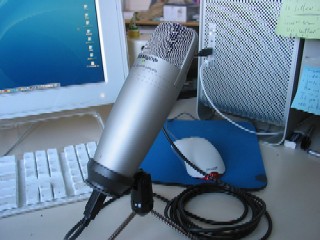
DSM: You know, I do some podcasting already. I’ve got my podcasting microphone and preamp and mixer connected to my PC. I assume SpotDJ works with the equipment I’ve already got, right? How do I record a spot?

CMT: Here’s how to record a SpotDJ spot:
  • Launch SpotDJ, by double-clicking the SpotDJ icon:
  • In iTunes, start playing the track you’d like to spot.
  • When SpotDJ shows the correct track info, click the “Spot this Song!” button:
  • Click the “Record” button:
  • Start talking!
  • Click the “Stop” button to finish:
  • Click the “Play” button to listen to your spot. If you don’t like it, you can record it again:
  • Click “Upload” to send your spot to SpotDJ. It’ll take a few seconds, and then iTunes will go on to the next playlist track.
DSM: How does SpotDJ decide which spots to play when I’m in iTunes and playing the tracks in one of my playlists?

CMT: The spots you hear are determined based on a number of factors. SpotDJ’s server has scripts that construct a list of potential spots to queue up for you based on the title and artist of the track you’re listening to and the log of spots that the SpotDJ has previously served up to your userid. They refine the list based on what you’ve already heard, your list of Faves, the ratings of the spots, and other of the preferences that you’ve set up in your SpotDJ profile.

DSM: Can I record a spot for a track that’s already been ‘spotted’ by somebody else? How about a track that I’ve previously spotted myself?

CMT: Even if a spot already exists for your track, you can go ahead and add your own new spot. Or if you hear a spot that you disagree with, or you want to expand on, add a new spot. You can record multiple spots yourself for the same track.

DSM: What are these ‘Fans and Faves’ things that are showing up in my SpotDJ client app GUI here?

CMT: A Fave is a SpotDJ user who’s recorded a spot, and you have favorably regarded that spot and marked its author as a Fave. Besides when you’re listening to a spot, when your just browsing a DJ’s page you can add that DJ as one of your Faves without necessarily having listened to their spots—if you see from that DJ’s profile that the genres that they do spots on coincide with things that interest you. So Faves are a way to connect with other people while using SpotDJ. Your list of Faves shows up on your DJ page (when other users look at your profile), and the SpotDJ server factors your list of Faves into account when deciding which spots to push to your PC (you’ll tend to get more spots from your Fave DJs). If you record spots yourself and then someone adds you as a Fave, they become one of your Fans. The more Fans you have, the more people tend to hear your spots, and the more popular you look when people view your profile. When you invite a friend to join SpotDJ, they automatically become one of your Fans. This is pretty much like friending in LinkedIn, MySpace, Facebook, and other social networking services.

DSM: Are the principles of doing a good ‘spot’ the same as those that make for a good podcast?

CMT: Well, the short ‘spot’ format—less than 1 minute or so—does make for some differences. Some of the best SpotDJs do seem to be following these practices:
  • Keep it Short! The length of your spot shouldn’t be more than about 20% of the length of the track itself, or people might start to tune out and they’ll just skip the spot. The best spots are less than 30 seconds long. That’s about 100 to 150 words at most. A good spot begins by announcing the track (composer, performer, date recorded, venue, other descriptive information) that you just heard and then gives the listener a brief nugget of info or a micro-vignette about the performer or composition or composer.
  • Emulate a Professional Announcer. Forget that you’re in front of a computer and pretend you’re in a studio sound booth—same as you do with your podcasts. You’ve got a mic in front of you and you just played a track. There are people out there listening, depending on you for interesting commentary and context.
  • Make it Personal. It’s most interesting to hear a DJ talk about their personal experience with an artist or composition.
Most of the spots I’ve heard in SpotDJ so far do tend to be journalistic or reportorial. Wouldn’t necessarily have to be that way, though. I imagine that some classical music SpotDJs in the future might start doing short clips about music theory or performance pedagogy—as long as they’re short and punchy and interesting and don’t go off the deep end with fancy technical language. That might be useful as part of music education classes. But for regular listeners probably the journalistic DJ style/format is what’d attract the most ‘listens’ and lead to other SpotDJ users’ Faving you.

DSM: Why don’t I hear the spot I just recorded here?

CMT: As soon as you uploaded your new spot, the SpotDJ server starts distributing it to people listening to the track you spotted. If you yourself listen to the track after you record your spot, SpotDJ (generally) plays your new spot so you get to hear it first. But I’ve noticed that there are still a few bugs in the current version. If you’re not hearing your own spot, here are some things to keep in mind: In general, SpotDJ’s queueing and dispatching algorithm to plays you spots recorded by other DJ’s because you probably know what you sound like. So after they’ve played your new spot once, you probably won’t get it again from the normal queueing and dispatching algorithm. Also, Spots take some time to download. It depends on the size of the spot you recorded, the bandwidth of your internet connection, how much of that bandwidth is being consumed by other stuff going on on your PC, the amount of traffic that the SpotDJ server is handling at that time, and so on. So if you’re near the end of the track and you recorded a longish spot, SpotDJ might not have enough time to retrieve it and push it to your PC before the track has finished playing on your PC.

DSM: So SpotDJ’s spot-matching algorithm logs the spots that’ve been pushed to each SpotDJ user and won’t play the same spot twice in a row. And if you heard your spot once and then you bring me over to hear it, I probably won’t hear it until at least one other spot has played first—or more typically three or more intervening spots? I see here that spots only play at the end of a track, so if you’re trying to replay it a few times to get the spot to play right away, you can skip to 5-10 seconds before the end to make sure SpotDJ has enough time to download the spot and detect that the track has changed. And you can always view/edit/listen to all your spots from your SpotDJ page, which you can access at your SpotDJ login page.

iTunes track pushing to SpotDJ
DSM: This is cool! I’m listening to spots recorded by other people—the spots that get pushed to my PC when I’m listening to the tracks on my iTunes playlists—and the effect is very much like listening to Karl Haas or other thoughtful classical music commentators. To me, the impression is very much like listening to late-night radio programs. No longer do I feel so solitary listening to my iTunes playlists! Here are these other like-minded human beings talking to me, volunteers telling me things about the tracks that, evidently, we both care about! Suddenly, a new virtual community! I feel connected, not isolated. This is a great new type of social media!

CMT: Yes, the late-night radio effect is something I noticed right away, too. It fosters an intimate, one-on-one relationship between a listener and a voice on the radio—or, in this case, on the SpotDJ-iTunes lash-up emulation of a radio experience. More details are left to the listener’s imagination. Oh, there’s a potential for these kinds of shows to become heavy-handed—or for a dog’s breakfast effect (that is, of various different DJs with very divergent perspectives and attitudes and ‘spot’ production values) to be excessively ‘uneven’ in spot mood or content. And if you don’t have someone on who knows what they’re talking about, or if the DJ is florid or romanticizes the issues, then they’ll do a real disservice to the listening public. The more sensational the spots try to be, or the more egotistical or full of himself/herself a SpotDJ user is, the worse they’ll be. But, thankfully, most of the spots that have been uploaded to SpotDJ so far are pretty good—certainly on a par with professional radio commentators.

DSM: You know, radio and memory are, for many people, very closely linked—a stitching together musical cultures with personal psychologies. The speech of an announcer who we listen to regularly—a Fave now in SpotDJ—becomes like a dear friend over time. The listener develops an internal notion of what the announcer looks like, what sort of a person the announcer is. And that announcer’s voice is coupled very tightly to our memory of the music that that announcer’s voice was associated with, and to our memory of what we were doing or experiencing in our lives around the time when we heard that music and that announcer. The dynamic of sound, ephemeral but powerful, finds a parallel in the dynamic of memory—fluid, complex, deeply ingrained. To grab hold of the certainty of our experience, knowledge, or sensation is often difficult when confronting both sound and memory. Both inscribe us deeply, but each is diffuse and malleable.

CMT: As Steven Connor says, ‘the self that is defined in terms of hearing rather than sight is a self that is imaged not as a point, but as a membrane; not as a picture, but as a channel through which voices and music travels’ (Connor2004, p. 57). Connor says that sound and memory are associated by being always already present, while at the same time oscillating between the ephemeral and the concrete, the diffuse and the certain. Because of this binding and cognitive flux, we get the evolving construction of the self, our identity as persons.

DSM: Radio has ever and always insinuated itself into the human imagination. Radio is a medium of the disembodied voice, and it therefore compels a ‘re-conceptualizing’ of the human body, of the self—broadcast audio media inherently leaves the speaker’s body behind while at the same time powerfully rendering the body in the listener’s mind.

CMT: Whereas ‘live’ performances bind us to the materiality of the immediate and local—the person(s) in front of us—broadcast technology offers the body its own escape, propelling flights of fantasy through the listeners’ imagination. Imaginary flights of fancy!

DSM: By adopting listening as a general attitudinal relation to philosophical inquiry, Fiumara seeks to move beyond the predominance of logo-centric models, which for her situates a particular form of ‘arrogance’ onto the field of knowledge. ‘An aversion towards listening to the rich multiplicity of “reality” seems to be linked with a background of profound fears and to the resulting defensive postures that express themselves in a tendency to reduce knowledge in general to a set of principles from which nothing can escape’. Listening thus provides a link or passage toward a renewed sense of inquiry by allowing us to remain susceptible and receptive, and impassioned less by our own thinking than by what it may converse with.

CMT: The ‘discourse of listening’ continually drives us into a productive ambiguity. This causes us to create new symbols. The thinking radio-listening body—a body that remains bound to listening—is engaged in memory-generating processes, increasing our understanding and feeling and expanding our knowledge. I think this is what makes a radio experience—like what we’re getting from this SpotDJ-iTunes lash-up—so seductive. We crave this otherness, this connectedness with other human beings, this expansive ambiguity, this boundness-to-generate-new-memories and new thoughts and new feelings.

DSM: Beyond that, I think this late-night radio effect is something where the self finds points of reference and security. It’s a ‘bath of community,’ more or less. And with radio memory, replaying is a prominent and typical feature. It’s part of the user’s behavioral paradigm, part of the psychology. Idiomatically, I wait for the DJ to play a track that I like again—or, in iTunes, I cause it to replay whenever I want, simply because I can. And I crave these SpotDJ spots’ evoking new ideas, extending my imaginary flights.

CMT: ‘Radio memory’—and the ways in which this kind of memory fixes itself onto the field of auditory constitution—can be understood as part of the allied musical partnership. For if music is understood as a means for ‘world-making activities’ and for realizing ‘subjectivity and self’, then ‘radio memory’ is a special type of musical understanding—relevant to all genres, not just classical or chamber music. And speech clips or ‘spots’ rendering descriptions of these memories is a powerful instantiation of that. In contrast to an ordinary iPod user, the radiophonic SpotDJ user does not predetermine or control the experience beyond selecting the playlist. Rather, there is a tremendous amount of runtime indirection. The SpotDJ radiophonic listener abdicates control to the SpotDJ server and its inventory of recorded spots. The user’s Faveslist and profile-preferences only moderately influence what will be served up in any given radiophonic SpotDJ-iTunes session. The playlist and accompanying spots are always only heard at the moment of memory-making. They’re served up by the medium of the event itself.

DSM: What radio memory also reveals are how noise contributes—and how indirection and surprise (surprise at the unpredictable spots served up) contribute—on an emotional and psychological level. A communication link through which negotiation and sharing takes place; how ‘location’ gets defined and remembered. Hidden just under the surface, these memories are a tapestry of individual experience; it’s a tapestry that tells the story of my individual negotiation with outside influences—the other SpotDJ DJs and the SpotDJ algorithms—as ‘locational conditions’.

CMT: More than anything, radio is a form of stylized sociality through which ‘location’ is rife with the unexpected. Inevitably, it brings with it new encounters. Think about the ontology of radio itself, interrupting our social reality with stimuli of ‘others’, impressing upon me that I am not an island unto myself despite the fact that I may be alone as I listen—it’s virtual life!

DSM: You’re emphasizing what happens when you do this when you’re alone. But what I want to emphasize is how your individual experience is related to communal sharing and how this ‘synthetic’ SpotDJ-iTunes-based form of amateur webradio provides an unexpected kind of community and sociality.

CMT: That viral, communitarian ‘swarm’ idea runs counter to sociological and musicological viewpoints that posit music as either inherently relational among social groups, or territorialized by the techniques of compositional method and the evolutionary jumps marked out from composer to composer, artist to artist. In any case, it’s very cool!


PodCasting and SpotDJ set-up