Showing posts with label radio. Show all posts

Tuesday, December 19, 2006

Connections/Syllogisms—Haas : O’Riley :: Beethoven Sonata No. 8, Op. 13, Adagio : Scriabin Prelude, Op. 11, No.12

Karl Haas, 1991
CMT: I just noticed that the 2006 Karl Haas Prize for Music Education was awarded to Christopher O’Riley, host of ‘From the Top’. This is the Public Radio International show that’s been carried by NPR radio stations in the U.S. since its inception in 2000. The award’s namesake, Karl Haas (who died in early February last year), received the first Fine Arts Radio International Awards Lifetime Achievement honor in 2000. And you’d mentioned Karl in our conversation on 16-DEC.

DSM: O’Riley’s ‘From the Top’ is a popular classical music program, aimed specifically at promoting classical music education of people under 20 years old?

CMT: Yes, that’s O’Riley. O’Riley’s a charming host who’s consistently able to relate to younger performers and audiences while still remaining engaging and relevant to adult listeners. In that respect, he is the capable heir to the style that characterized Karl Haas at his best. There’s nothing else like ‘From the Top’ in the U.S. market right now—the show promotes the joy of musicianship and informs and inspires musicians of all ages.

DSM: Our conversation the other day caused me to reflect on the Adagio movement of Beethoven’s Sonata No. 8, op. 13 ‘Pathétique’, which was Karl Haas’ theme music for the many years his program ran. The Adagio opens with the famous cantabile melody. The theme is played three times, intercalated with two modulating passages—one from F minor to E-flat major, the second from A-flat minor to E major. When the main theme in A-flat major resumes, the accompaniment becomes richer and takes on the triplet rhythm of the second section. The coda’s stylistic diversity is arresting—four bars of romanticism followed by a strikingly conventional 18th century close.

CMT: Another interesting feature of the ‘Pathétique’ Adagio is its wide textural range. After a dense four-voice texture in the principal theme, Beethoven temporarily reduces the texture to one voice near the end of the B section. The same kind of textural reduction takes place in the opening and last bars of the coda.

DSM: You know, I also happened to listen to O’Riley’s Scriabin CD the other night—specifically, the Scriabin Prelude in G-sharp Minor, Op. 11, No.12. And there, right in bar 11, is a phrase that’s very much like the theme in the Pathétique Adagio. How odd, I thought—to find thematic correspondences in Beethoven and Scriabin! The compositional distance between them seems so large! Look. There’s this:

Scriabin Prelude Op.11, No.12, m8-15
and there’s this:

Beethoven Sonata No.8 Op.13 Adagio, m1-4
And then I go over to ThemeFinder.
It has very uneven coverage [reflecting the specific time-periods and research projects at CCARH, with emphasis on Albinoni, Bach, Banchieri, Beethoven, Caldara, Carpenter, Cavalli, Puccini, Shostakovich, Spontini, Sullivan, Vivaldi, etc.]. But when I enter this:

Entering an incipit in ThemeFinder.org
it does successfully come back with several matches:
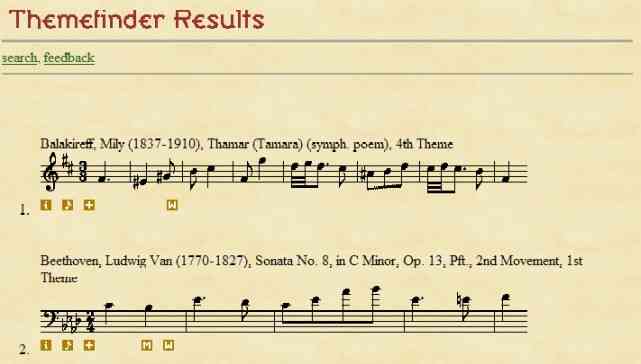
ThemeFinder results for the Pathetique Adagio incipit
So you see ThemeFinder’s search algorithm successfully retrieves Beethoven’s ‘Pathétique’ and a number of other accurate hits in the CCARH digital music repository.

CMT: And what’s really surprising is how short your search-string can be and still return a fairly noise-free, small list. For that matter, it’s astonishing how our brains can recognize a musical motif and accurately remember which compositions match it—one bar or less, just a handful of notes are often sufficient.

DSM: You’re right. But get this! I next go over to Nayio’s HummingSearch and hum the ‘Pathétique’ melody into it. It turns out that there are no classical pieces in the Nayio HummingSearch at the present time, but it’s interesting just the same—to see how accurate vs. how false-hit-riddled the search algorithm’s performance is. It’s surprisingly accurate. Nayio’s HummingSearch records 15 seconds of you humming a song, then searches for a match. This kind of humming search has been used in university musicology research settings for more than 10 years. But this service by Nayio is the only general-availability web-based humming search I’ve seen, and it’s free. As I said, there isn’t yet any classical music in Navio’s database, but that’ll change. And, yes, there’s the usual pattern-matching algorithm accuracy performance issue—the Nayio search does produce some false-positives, ‘hits’ where the search thinks it’s found a match for what you hummed but the search algorithm was wrong. For example, in my attempts to get a positive match on a tune, I started with a phrase, then tried the top result each time Humming search gave me a false-positive—and produced this trail: The Weight (miss!) -> Friday I’m in Love (miss!) -> A Day in the Life (miss!) -> Dream a Little Dream (hit!). This, despite the fact that I can carry a tune tolerably well! The search requires you to install Nayio’s ActiveX plugin, so Internet Explorer is the only browser it works on currently. Just the same, it’s interesting to play around with it. But from my playing around with it so far, I find it’s surprisingly accurate. And it’s fast—which is a dramatic difference from previous algorithms having similar accuracy and similar-size databases to search against. From a computer science perspective, the problem of searching for musical patterns or incipits is computationally hard—especially if you try to take meter and rhythm into account. I wonder if there’s any information on what algorithmic techniques Nayio is using…

Nayio HummingSearch
CMT: The Vers la Flamme CD was the result of the 1999 O’Riley collaboration with choreographer and director Martha Clarke, wasn’t it? They staged several stories of Anton Chekhov set to piano pieces of Scriabin. The production, “Vers la Flamme,” toured Europe and the United States, and was presented by Lincoln Center and the Kennedy Center, among others.

DSM: But what about the notion that there’s a considerable distance between Scriabin and Beethoven, in terms of compositional techniques and themes? What about the peculiarity of being reminded of the Pathétique Adagio theme when listening to that Scriabin Prelude?

CMT: In that connection, Scriabin (1872-1915) is generally regarded as continuing the traditions of Chopin, Schumann, and Liszt while simultaneously advancing avant-garde and mystical thematic material. His interest in philosophy and theosophy influenced his later compositions—I suppose especially his orchestral works more than his piano music. And he ventured beyond Romantic idioms to create pieces that’re simultaneously reflective/delicate yet rich/expository—and in that respect I imagine we ought to acknowledge a correspondence with Beethoven’s expressive ‘simultaneity’. Scriabin had also a unique expressive range, extending from sublime to intense “sensations.” This was Scriabin’s favorite expression for conveying the perceptual effect he was intending.

DSM: Look—there is an impassioned rhetoric here, an arpeggiated texture that you see also in Beethoven, a strong melodic profile, and interlocking octave and chordal passages…

CMT: Scriabin was afflicted (or should we say blessed?) with synasthaesia—a condition that merges sound and color (or other senses) in the brain so that the person actually “sees” music as color. There have been several composers with this condition besides Scriabin—Arthur Bliss, Nicolai Rimsky-Korsakov, others. But, more than others’ work, I think of Scriabin’s music as painterly—sensationalism of the ‘palette’. This impression also accompanies many Beethoven piano pieces, wouldn’t you say?

DSM: Clifton Callender at the University of Chicago developed about ten years ago an analysis of voice-leading parsimony to describe situations in which every voice in a motion between two simultaneities is either retained as a common tone or moves incrementally, a half-step in chromatic space (look back at our snippets from Scriabin’s Prelude and Beethoven’s Sonata Adagio above). The Pn-relation is parsimonious voice-leading between chords for which there exists a one to one mapping, where n denotes the number of voices moving by half-step. Callender looks at P2-relations, a common chord sequence in Scriabin’s music. Split voice-leading which holds between a single pc and a dyad consisting of that pc’s upper and lower neighbors, for example between {F} and {E,F#), is formalized as a split-relation. This relation employs a grouping based on register proximity, and this provides an alternative to the assumptions of one-to-one mapping of most theories of voice-leading. I think I can find some examples of this voice-leading in some Beethoven piano works…

CMT: We need a card-carrying music theory geek here, I think. But I have to say—O’Riley’s rendering of the Scriabin pieces shows a high degree of stylistic awareness and deep personal convictions about these colorful pieces. These O’Riley tracks—they’re not just thoughtful and competent—they’re animated: Réanimation-Urgences, n’est-ce pas?

DSM: Yes, O’Riley’s entry into this music is as mystical or supernatural as Scriabin himself. The playing is self-effacing, transcendent—almost entirely devoid of any gesture that could be considered self-referential. He enters into a priestly communion with Scriabin, capturing Scriabin's intent in a manner that makes me question previous interpretations by others. It’s voluptuous—beatific. The sound and production values on this CD are also natural and sympathetic. Very nice performance, and very nice recording.

CMT: Let’s see what we see for O’Riley and Scriabin over on last.fm, shall we? Well, sorry to say, not much. When an artist, album, or track is streamable, it can be played on last.fm. Streamable music is indicated by the presence of preview buttons on a last.fm music page. All last.fm radio stations—such as personal, neighbor, similar artist, and tag radio—are comprised of licensed, streamable music. In other words, you can’t add tracks that aren’t licensed and streamable to a last.fm station. If tracks (like Christopher O’Riley’s Scriabin: Vers la Flamme tracks ) aren’t streamable yet in last.fm, you might wonder how such non-streamable music can have ‘listeners’ in last.fm. Listeners who can’t listen. Well, last.fm compiles ‘charts’ and other statistical information for non-streamable music by using the information users submit through the audioscrobbler plug-in. And, thanks to the data about the individually-licensed tracks that people are playing on their own computers—the data that last.fm logs in its database—other users can explore it, search and discover things in it, tag it, and recommend it on the last.fm website even if it isn’t streamable yet. Which has some value, admittedly. It’s a dimension of social media and networking about the tracks, even though those tracks aren’t served up by last.fm. But what we really want is for O’Riley’s record company to license some of those tracks to last.fm. After all, you can get streaming feeds of O’Riley’s Vers la Flamme over on Rhapsody.

Christopher O’Riley


Saturday, December 16, 2006

SpotDJ plus iTunes: Webradio for and by the Chamber Music Community

SpotDJ client app
DSM: I looked on iTunes the other day and there are more than 6,000 string quartet tracks there.

CMT: Did you know there’s a new service called SpotDJ that works with iTunes and plays short MP3 clips (‘spots’) about the track and artist you just listened to in iTunes? At the end of a track, if the SpotDJ database has a spot associated with that track or artist, then the SpotDJ server pushes the spot to your PC, the SpotDJ client app on your PC plays it, and then your iTunes moves on to the next track in your playlist as usual. If SpotDJ doesn't find a spot to play (or if you have more info about an already-spotted track), you can record your own commentary about the track and share it with everyone else who has SpotDJ. It basically makes your private iTunes emulate webradio. The spots that you hear in between tracks are generally interesting—diverting or intellectually engaging—as they should be to have value. The remarks are expansive, encouraging the listener to reflect or stimulating the listener’s thoughts to head off in whatever direction the listener pleases. The spots are not heavy-handed or gavel-slamming. The result is that, instead of your solitary listening to your iTunes playlist, you get a ‘radio-like’ experience of hearing other human beings telling you things, telling you little micro-stories. This imparts a sense of community, a connection with other thoughtful people. It’s virtual radio. True story!

DSM: Is there any curation of the spots by SpotDJ’s webmaster? Are you ever subjected to idiotic or profane spots? Can you skip or kill a spot that you don’t like without having to listen to the whole thing? Does the SpotDJ webmaster do surveillance to make sure that the amateur SpotDJs submitting spots aren’t inserting bootlegged copyrighted material through their PCs, spoofing as ‘spots’? Is there any checking to make sure that somebody reciting something into their mic isn’t reciting some other author’s copyrighted text, misrepresenting the copy of the spot as the SpotDJ user’s own work?

CMT: Not so far as I can tell, to any of the above. But the identity of the submitting SpotDJ user is traceable. So I imagine it’s caveat orator —if a copyright-holder claims violation of copyright then the submitting SpotDJ user would be liable, and Spot DJ would have to remove the offending item.

DSM: Who or what is SpotDJ? Or should I say what is a SpotDJ?

CMT: Any person able to talk into a microphone can be a SpotDJ user/announcer. But besides human SpotDJ users/announcers, SpotDJ is a service that adds commentary to your music listening experience. It detects what track you’re listening to on your PC, communicates with the SpotDJ server so that the server can search its spotlibrary to find previously recorded spots that pertain to that track and select and queue up a spot that you haven’t heard before, and push that spot to the SpotDJ client app on your PC. You listen to your music in iTunes just like normal, but periodically, with a frequency that you specify in your SpotDJ client app preferences, SpotDJ plays a spot between your iTunes tracks. It’s an improvement over the spots you hear on the classical channels on XMradio or Sirius or Last.fm. A spot is simply a few seconds of recorded speech about the track you were listening to. It typically consists of information about the track, a story about the artist, a criticism, news, gossip, or recommendations about recordings or performances—other recordings of the artist just heard, or recordings by other artists who have ‘covered’ the same piece! All of the spots on SpotDJ are created by amateur SpotDJ user-members. So if you’re listening to a track and have something to say about it, just launch SpotDJ, click the “Spot this Song” button and record your spot. Other SpotDJs who later listen to that track in their iTunes environment will hear the spot you recorded.

DSM: What is a Spot, exactly?

CMT: A spot is a short audio clip that you hear between tracks you listen to in iTunes. While you’re listening to your music, SpotDJ checks to see if there are spots that are relevant to the track you’re listening to. When the track is over, you hear one of these 20-second to 1-minute spots! A spot can be just about anything. A spot might tell you something interesting that you didn’t know about one of your favorite tracks. Other spots contain artist updates, concert announcements, trivia, interpretations of tracks, etc.

DSM: You know, I do some podcasting already. I’ve got my podcasting microphone and preamp and mixer connected to my PC. I assume SpotDJ works with the equipment I’ve already got, right? How do I record a spot?

CMT: Here’s how to record a SpotDJ spot:
  • Launch SpotDJ, by double-clicking the SpotDJ icon:
  • In iTunes, start playing the track you’d like to spot.
  • When SpotDJ shows the correct track info, click the “Spot this Song!” button:
  • Click the “Record” button:
  • Start talking!
  • Click the “Stop” button to finish:
  • Click the “Play” button to listen to your spot. If you don’t like it, you can record it again:
  • Click “Upload” to send your spot to SpotDJ. It’ll take a few seconds, and then iTunes will go on to the next playlist track.
DSM: How does SpotDJ decide which spots to play when I’m in iTunes and playing the tracks in one of my playlists?

CMT: The spots you hear are determined based on a number of factors. SpotDJ’s server has scripts that construct a list of potential spots to queue up for you based on the title and artist of the track you’re listening to and the log of spots that the SpotDJ has previously served up to your userid. They refine the list based on what you’ve already heard, your list of Faves, the ratings of the spots, and other of the preferences that you’ve set up in your SpotDJ profile.

DSM: Can I record a spot for a track that’s already been ‘spotted’ by somebody else? How about a track that I’ve previously spotted myself?

CMT: Even if a spot already exists for your track, you can go ahead and add your own new spot. Or if you hear a spot that you disagree with, or you want to expand on, add a new spot. You can record multiple spots yourself for the same track.

DSM: What are these ‘Fans and Faves’ things that are showing up in my SpotDJ client app GUI here?

CMT: A Fave is a SpotDJ user who’s recorded a spot, and you have favorably regarded that spot and marked its author as a Fave. Besides when you’re listening to a spot, when your just browsing a DJ’s page you can add that DJ as one of your Faves without necessarily having listened to their spots—if you see from that DJ’s profile that the genres that they do spots on coincide with things that interest you. So Faves are a way to connect with other people while using SpotDJ. Your list of Faves shows up on your DJ page (when other users look at your profile), and the SpotDJ server factors your list of Faves into account when deciding which spots to push to your PC (you’ll tend to get more spots from your Fave DJs). If you record spots yourself and then someone adds you as a Fave, they become one of your Fans. The more Fans you have, the more people tend to hear your spots, and the more popular you look when people view your profile. When you invite a friend to join SpotDJ, they automatically become one of your Fans. This is pretty much like friending in LinkedIn, MySpace, Facebook, and other social networking services.

DSM: Are the principles of doing a good ‘spot’ the same as those that make for a good podcast?

CMT: Well, the short ‘spot’ format—less than 1 minute or so—does make for some differences. Some of the best SpotDJs do seem to be following these practices:
  • Keep it Short! The length of your spot shouldn’t be more than about 20% of the length of the track itself, or people might start to tune out and they’ll just skip the spot. The best spots are less than 30 seconds long. That’s about 100 to 150 words at most. A good spot begins by announcing the track (composer, performer, date recorded, venue, other descriptive information) that you just heard and then gives the listener a brief nugget of info or a micro-vignette about the performer or composition or composer.
  • Emulate a Professional Announcer. Forget that you’re in front of a computer and pretend you’re in a studio sound booth—same as you do with your podcasts. You’ve got a mic in front of you and you just played a track. There are people out there listening, depending on you for interesting commentary and context.
  • Make it Personal. It’s most interesting to hear a DJ talk about their personal experience with an artist or composition.
Most of the spots I’ve heard in SpotDJ so far do tend to be journalistic or reportorial. Wouldn’t necessarily have to be that way, though. I imagine that some classical music SpotDJs in the future might start doing short clips about music theory or performance pedagogy—as long as they’re short and punchy and interesting and don’t go off the deep end with fancy technical language. That might be useful as part of music education classes. But for regular listeners probably the journalistic DJ style/format is what’d attract the most ‘listens’ and lead to other SpotDJ users’ Faving you.

DSM: Why don’t I hear the spot I just recorded here?

CMT: As soon as you uploaded your new spot, the SpotDJ server starts distributing it to people listening to the track you spotted. If you yourself listen to the track after you record your spot, SpotDJ (generally) plays your new spot so you get to hear it first. But I’ve noticed that there are still a few bugs in the current version. If you’re not hearing your own spot, here are some things to keep in mind: In general, SpotDJ’s queueing and dispatching algorithm to plays you spots recorded by other DJ’s because you probably know what you sound like. So after they’ve played your new spot once, you probably won’t get it again from the normal queueing and dispatching algorithm. Also, Spots take some time to download. It depends on the size of the spot you recorded, the bandwidth of your internet connection, how much of that bandwidth is being consumed by other stuff going on on your PC, the amount of traffic that the SpotDJ server is handling at that time, and so on. So if you’re near the end of the track and you recorded a longish spot, SpotDJ might not have enough time to retrieve it and push it to your PC before the track has finished playing on your PC.

DSM: So SpotDJ’s spot-matching algorithm logs the spots that’ve been pushed to each SpotDJ user and won’t play the same spot twice in a row. And if you heard your spot once and then you bring me over to hear it, I probably won’t hear it until at least one other spot has played first—or more typically three or more intervening spots? I see here that spots only play at the end of a track, so if you’re trying to replay it a few times to get the spot to play right away, you can skip to 5-10 seconds before the end to make sure SpotDJ has enough time to download the spot and detect that the track has changed. And you can always view/edit/listen to all your spots from your SpotDJ page, which you can access at your SpotDJ login page.

iTunes track pushing to SpotDJ
DSM: This is cool! I’m listening to spots recorded by other people—the spots that get pushed to my PC when I’m listening to the tracks on my iTunes playlists—and the effect is very much like listening to Karl Haas or other thoughtful classical music commentators. To me, the impression is very much like listening to late-night radio programs. No longer do I feel so solitary listening to my iTunes playlists! Here are these other like-minded human beings talking to me, volunteers telling me things about the tracks that, evidently, we both care about! Suddenly, a new virtual community! I feel connected, not isolated. This is a great new type of social media!

CMT: Yes, the late-night radio effect is something I noticed right away, too. It fosters an intimate, one-on-one relationship between a listener and a voice on the radio—or, in this case, on the SpotDJ-iTunes lash-up emulation of a radio experience. More details are left to the listener’s imagination. Oh, there’s a potential for these kinds of shows to become heavy-handed—or for a dog’s breakfast effect (that is, of various different DJs with very divergent perspectives and attitudes and ‘spot’ production values) to be excessively ‘uneven’ in spot mood or content. And if you don’t have someone on who knows what they’re talking about, or if the DJ is florid or romanticizes the issues, then they’ll do a real disservice to the listening public. The more sensational the spots try to be, or the more egotistical or full of himself/herself a SpotDJ user is, the worse they’ll be. But, thankfully, most of the spots that have been uploaded to SpotDJ so far are pretty good—certainly on a par with professional radio commentators.

DSM: You know, radio and memory are, for many people, very closely linked—a stitching together musical cultures with personal psychologies. The speech of an announcer who we listen to regularly—a Fave now in SpotDJ—becomes like a dear friend over time. The listener develops an internal notion of what the announcer looks like, what sort of a person the announcer is. And that announcer’s voice is coupled very tightly to our memory of the music that that announcer’s voice was associated with, and to our memory of what we were doing or experiencing in our lives around the time when we heard that music and that announcer. The dynamic of sound, ephemeral but powerful, finds a parallel in the dynamic of memory—fluid, complex, deeply ingrained. To grab hold of the certainty of our experience, knowledge, or sensation is often difficult when confronting both sound and memory. Both inscribe us deeply, but each is diffuse and malleable.

CMT: As Steven Connor says, ‘the self that is defined in terms of hearing rather than sight is a self that is imaged not as a point, but as a membrane; not as a picture, but as a channel through which voices and music travels’ (Connor2004, p. 57). Connor says that sound and memory are associated by being always already present, while at the same time oscillating between the ephemeral and the concrete, the diffuse and the certain. Because of this binding and cognitive flux, we get the evolving construction of the self, our identity as persons.

DSM: Radio has ever and always insinuated itself into the human imagination. Radio is a medium of the disembodied voice, and it therefore compels a ‘re-conceptualizing’ of the human body, of the self—broadcast audio media inherently leaves the speaker’s body behind while at the same time powerfully rendering the body in the listener’s mind.

CMT: Whereas ‘live’ performances bind us to the materiality of the immediate and local—the person(s) in front of us—broadcast technology offers the body its own escape, propelling flights of fantasy through the listeners’ imagination. Imaginary flights of fancy!

DSM: By adopting listening as a general attitudinal relation to philosophical inquiry, Fiumara seeks to move beyond the predominance of logo-centric models, which for her situates a particular form of ‘arrogance’ onto the field of knowledge. ‘An aversion towards listening to the rich multiplicity of “reality” seems to be linked with a background of profound fears and to the resulting defensive postures that express themselves in a tendency to reduce knowledge in general to a set of principles from which nothing can escape’. Listening thus provides a link or passage toward a renewed sense of inquiry by allowing us to remain susceptible and receptive, and impassioned less by our own thinking than by what it may converse with.

CMT: The ‘discourse of listening’ continually drives us into a productive ambiguity. This causes us to create new symbols. The thinking radio-listening body—a body that remains bound to listening—is engaged in memory-generating processes, increasing our understanding and feeling and expanding our knowledge. I think this is what makes a radio experience—like what we’re getting from this SpotDJ-iTunes lash-up—so seductive. We crave this otherness, this connectedness with other human beings, this expansive ambiguity, this boundness-to-generate-new-memories and new thoughts and new feelings.

DSM: Beyond that, I think this late-night radio effect is something where the self finds points of reference and security. It’s a ‘bath of community,’ more or less. And with radio memory, replaying is a prominent and typical feature. It’s part of the user’s behavioral paradigm, part of the psychology. Idiomatically, I wait for the DJ to play a track that I like again—or, in iTunes, I cause it to replay whenever I want, simply because I can. And I crave these SpotDJ spots’ evoking new ideas, extending my imaginary flights.

CMT: ‘Radio memory’—and the ways in which this kind of memory fixes itself onto the field of auditory constitution—can be understood as part of the allied musical partnership. For if music is understood as a means for ‘world-making activities’ and for realizing ‘subjectivity and self’, then ‘radio memory’ is a special type of musical understanding—relevant to all genres, not just classical or chamber music. And speech clips or ‘spots’ rendering descriptions of these memories is a powerful instantiation of that. In contrast to an ordinary iPod user, the radiophonic SpotDJ user does not predetermine or control the experience beyond selecting the playlist. Rather, there is a tremendous amount of runtime indirection. The SpotDJ radiophonic listener abdicates control to the SpotDJ server and its inventory of recorded spots. The user’s Faveslist and profile-preferences only moderately influence what will be served up in any given radiophonic SpotDJ-iTunes session. The playlist and accompanying spots are always only heard at the moment of memory-making. They’re served up by the medium of the event itself.

DSM: What radio memory also reveals are how noise contributes—and how indirection and surprise (surprise at the unpredictable spots served up) contribute—on an emotional and psychological level. A communication link through which negotiation and sharing takes place; how ‘location’ gets defined and remembered. Hidden just under the surface, these memories are a tapestry of individual experience; it’s a tapestry that tells the story of my individual negotiation with outside influences—the other SpotDJ DJs and the SpotDJ algorithms—as ‘locational conditions’.

CMT: More than anything, radio is a form of stylized sociality through which ‘location’ is rife with the unexpected. Inevitably, it brings with it new encounters. Think about the ontology of radio itself, interrupting our social reality with stimuli of ‘others’, impressing upon me that I am not an island unto myself despite the fact that I may be alone as I listen—it’s virtual life!

DSM: You’re emphasizing what happens when you do this when you’re alone. But what I want to emphasize is how your individual experience is related to communal sharing and how this ‘synthetic’ SpotDJ-iTunes-based form of amateur webradio provides an unexpected kind of community and sociality.

CMT: That viral, communitarian ‘swarm’ idea runs counter to sociological and musicological viewpoints that posit music as either inherently relational among social groups, or territorialized by the techniques of compositional method and the evolutionary jumps marked out from composer to composer, artist to artist. In any case, it’s very cool!


PodCasting and SpotDJ set-up