CMT:
CMT: I just noticed that the 2006 Karl Haas Prize for Music Education was awarded to Christopher O’Riley, host of ‘From the Top’. This is the Public Radio International show that’s been carried by NPR radio stations in the U.S. since its inception in 2000. The award’s namesake, Karl Haas (who died in early February last year), received the first Fine Arts Radio International Awards Lifetime Achievement honor in 2000. And you’d mentioned Karl in our conversation on 16-DEC.
DSM: O’Riley’s ‘From the Top’ is a popular classical music program, aimed specifically at promoting classical music education of people under 20 years old?
CMT: Yes, that’s O’Riley. O’Riley’s a charming host who’s consistently able to relate to younger performers and audiences while still remaining engaging and relevant to adult listeners. In that respect, he is the capable heir to the style that characterized Karl Haas at his best. There’s nothing else like ‘From the Top’ in the U.S. market right now—the show promotes the joy of musicianship and informs and inspires musicians of all ages.
DSM: Our conversation the other day caused me to reflect on the Adagio movement of Beethoven’s Sonata No. 8, op. 13 ‘Pathétique’, which was Karl Haas’ theme music for the many years his program ran. The Adagio opens with the famous cantabile melody. The theme is played three times, intercalated with two modulating passages—one from F minor to E-flat major, the second from A-flat minor to E major. When the main theme in A-flat major resumes, the accompaniment becomes richer and takes on the triplet rhythm of the second section. The coda’s stylistic diversity is arresting—four bars of romanticism followed by a strikingly conventional 18th century close.
CMT: Another interesting feature of the ‘Pathétique’ Adagio is its wide textural range. After a dense four-voice texture in the principal theme, Beethoven temporarily reduces the texture to one voice near the end of the B section. The same kind of textural reduction takes place in the opening and last bars of the coda.
DSM: You know, I also happened to listen to O’Riley’s Scriabin CD the other night—specifically, the Scriabin Prelude in G-sharp Minor, Op. 11, No.12. And there, right in bar 11, is a phrase that’s very much like the theme in the Pathétique Adagio. How odd, I thought—to find thematic correspondences in Beethoven and Scriabin! The compositional distance between them seems so large! Look. There’s this:

and there’s this:

And then I go over to
ThemeFinder.
It has very uneven coverage [reflecting the specific time-periods and research projects at CCARH, with emphasis on Albinoni, Bach, Banchieri, Beethoven, Caldara, Carpenter, Cavalli, Puccini, Shostakovich, Spontini, Sullivan, Vivaldi, etc.]. But when I enter this:

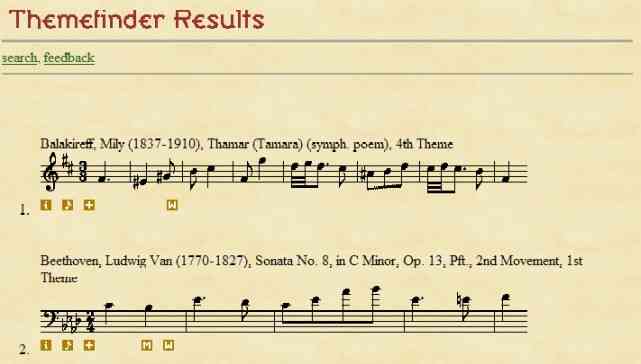
it does successfully come back with several matches:

So you see ThemeFinder’s search algorithm successfully retrieves Beethoven’s ‘Pathétique’ and a number of other accurate hits in the CCARH digital music repository.
CMT: And what’s really surprising is how short your search-string can be and still return a fairly noise-free, small list. For that matter, it’s astonishing how our brains can recognize a musical motif and accurately remember which compositions match it—one bar or less, just a handful of notes are often sufficient.
DSM: You’re right. But get this! I next go over to
Nayio’s HummingSearch and hum the ‘Pathétique’ melody into it. It turns out that there are no classical pieces in the Nayio HummingSearch at the present time, but it’s interesting just the same—to see how accurate vs. how false-hit-riddled the search algorithm’s performance is. It’s surprisingly accurate. Nayio’s HummingSearch records 15 seconds of you humming a song, then searches for a match. This kind of humming search has been used in university musicology research settings for more than 10 years. But this service by Nayio is the only general-availability web-based humming search I’ve seen, and it’s free. As I said, there isn’t yet any classical music in Navio’s database, but that’ll change. And, yes, there’s the usual pattern-matching algorithm accuracy performance issue—the Nayio search does produce some false-positives, ‘hits’ where the search thinks it’s found a match for what you hummed but the search algorithm was wrong. For example, in my attempts to get a positive match on a tune, I started with a phrase, then tried the top result each time Humming search gave me a false-positive—and produced this trail: The Weight (miss!) -> Friday I’m in Love (miss!) -> A Day in the Life (miss!) -> Dream a Little Dream (hit!). This, despite the fact that I can carry a tune tolerably well! The search requires you to install Nayio’s ActiveX plugin, so Internet Explorer is the only browser it works on currently. Just the same, it’s interesting to play around with it. But from my playing around with it so far, I find it’s surprisingly accurate. And it’s fast—which is a dramatic difference from previous algorithms having similar accuracy and similar-size databases to search against. From a computer science perspective, the problem of searching for musical patterns or incipits is computationally hard—especially if you try to take meter and rhythm into account. I wonder if there’s any information on what algorithmic techniques Nayio is using…
 CMT:
CMT: The Vers la Flamme CD was the result of the 1999 O’Riley collaboration with choreographer and director Martha Clarke, wasn’t it? They staged several stories of Anton Chekhov set to piano pieces of Scriabin. The production, “Vers la Flamme,” toured Europe and the United States, and was presented by Lincoln Center and the Kennedy Center, among others.
DSM: But what about the notion that there’s a considerable distance between Scriabin and Beethoven, in terms of compositional techniques and themes? What about the peculiarity of being reminded of the Pathétique Adagio theme when listening to that Scriabin Prelude?
CMT: In that connection, Scriabin (1872-1915) is generally regarded as continuing the traditions of Chopin, Schumann, and Liszt while simultaneously advancing avant-garde and mystical thematic material. His interest in philosophy and theosophy influenced his later compositions—I suppose especially his orchestral works more than his piano music. And he ventured beyond Romantic idioms to create pieces that’re simultaneously reflective/delicate yet rich/expository—and in that respect I imagine we ought to acknowledge a correspondence with Beethoven’s expressive ‘simultaneity’. Scriabin had also a unique expressive range, extending from sublime to intense “sensations.” This was Scriabin’s favorite expression for conveying the perceptual effect he was intending.
DSM: Look—there is an impassioned rhetoric here, an arpeggiated texture that you see also in Beethoven, a strong melodic profile, and interlocking octave and chordal passages…
CMT: Scriabin was afflicted (or should we say blessed?) with synasthaesia—a condition that merges sound and color (or other senses) in the brain so that the person actually “sees” music as color. There have been several composers with this condition besides Scriabin—Arthur Bliss, Nicolai Rimsky-Korsakov, others. But, more than others’ work, I think of Scriabin’s music as painterly—sensationalism of the ‘palette’. This impression also accompanies many Beethoven piano pieces, wouldn’t you say?
DSM: Clifton Callender at the University of Chicago developed about ten years ago an analysis of voice-leading parsimony to describe situations in which every voice in a motion between two simultaneities is either retained as a common tone or moves incrementally, a half-step in chromatic space (look back at our snippets from Scriabin’s Prelude and Beethoven’s Sonata Adagio above). The P
n-relation is parsimonious voice-leading between chords for which there exists a one to one mapping, where
n denotes the number of voices moving by half-step. Callender looks at P2-relations, a common chord sequence in Scriabin’s music. Split voice-leading which holds between a single pc and a dyad consisting of that pc’s upper and lower neighbors, for example between {F} and {E,F#), is formalized as a split-relation. This relation employs a grouping based on register proximity, and this provides an alternative to the assumptions of one-to-one mapping of most theories of voice-leading. I think I can find some examples of this voice-leading in some Beethoven piano works…
CMT: We need a card-carrying music theory geek here, I think. But I have to say—O’Riley’s rendering of the Scriabin pieces shows a high degree of stylistic awareness and deep personal convictions about these colorful pieces. These O’Riley tracks—they’re not just thoughtful and competent—they’re animated:
Réanimation-Urgences, n’est-ce pas?
DSM: Yes, O’Riley’s entry into this music is as mystical or supernatural as Scriabin himself. The playing is self-effacing, transcendent—almost entirely devoid of any gesture that could be considered self-referential. He enters into a priestly communion with Scriabin, capturing Scriabin's intent in a manner that makes me question previous interpretations by others. It’s voluptuous—beatific. The sound and production values on this CD are also natural and sympathetic. Very nice performance, and very nice recording.
CMT: Let’s see what we see for O’Riley and Scriabin over on
last.fm, shall we? Well, sorry to say, not much. When an artist, album, or track is streamable, it can be played on last.fm. Streamable music is indicated by the presence of preview buttons on a last.fm music page. All last.fm radio stations—such as personal, neighbor, similar artist, and tag radio—are comprised of licensed, streamable music. In other words, you can’t add tracks that aren’t licensed and streamable to a last.fm station. If tracks (like Christopher O’Riley’s
Scriabin: Vers la Flamme tracks ) aren’t streamable yet in
last.fm, you might wonder how such non-streamable music can have ‘listeners’ in
last.fm. Listeners who can’t listen. Well,
last.fm compiles ‘charts’ and other statistical information for non-streamable music by using the information users submit through the audioscrobbler plug-in. And, thanks to the data about the individually-licensed tracks that people are playing on their own computers—the data that
last.fm logs in its database—other users can explore it, search and discover things in it, tag it, and recommend it on the
last.fm website even if it isn’t streamable yet. Which has some value, admittedly. It’s a dimension of social media and networking about the tracks, even though those tracks aren’t served up by
last.fm. But what we really want is for O’Riley’s record company to license some of those tracks to
last.fm. After all, you can get streaming feeds of O’Riley’s Vers la Flamme over on
Rhapsody.
- de Schloezer B. Scriabin: Artist and Mystic. Univ California, 1987.

- Drake K. Sonatas of Beethoven as He Played and Taught Them. Indiana Univ, 1981.
- Gourari A. Scriabin Preludes. (Koch Schwann, 1999.)
- Haas K. Inside Music. Anchor, 1991.
- Harding H. Three Hundred & Fifty Questions on the Form and Tonality of Beethoven's Pianoforte Sonatas. Library Reprints, 2001.
- O’Riley C. Scriabin: Vers la Flamme. (Image, 2000.)
- Reti R, Cooke D, eds. Thematic Patterns in Sonatas of Beethoven. Da Capo, 1992.
- Rosen C. Beethoven's Piano Sonatas. Yale Univ, 2001.
- Sabbagh P. Development of Harmony in Scriabin’s Works. Universal, 2003.
- Szidon R. Scriabin Sonatas. (Deutsche Grammophon, 2004.)
- Taub R. Playing the Beethoven Piano Sonatas. Amadeus, 2003.
- Zarafiants E. Scriabin Preludes, Vol. 1. (Naxos, 2000.)
- Meeks J. Aspects of Stylistic Evolution in Scriabin's Piano Preludes. D.M.A., Performance, Peabody Conservatory of Music, 1975.
- Child F. NPR interview with Christopher O’Riley, May, 2002. Radiohead CD.
- Christopher O’Riley website
- Christopher O’Riley Scriabin tracks at last.fm
- Beethoven sonatas on eClassical
- Klein A. Beethoven sonata mp3s.
- Fishwick W. Beethoven sonata mp3s.
- O'Riley C. Scriabin mp3s.
- ‘From the Top’ NPR radio program
- Fine Arts Radio International, KXMS FM 88.7 MHz. (MSSU, Joplin MO)
- Pro Musica, Joplin, MO
- CreativeCommons Mixter
- Wikipedia entry on Beethoven Sonata No. 8 Op. 13 ‘Pathétique’
- Mutopia Beethoven entry
- Vernon P. The Personality of the Composer. Music & Letters. 1930;11(1):34-47.
- Arkiv Music listing of recordings of Beethoven Sonata No. 8, Op. 13, C minor, ‘Pathétique’
- ThemeFinder (CCARH, Stanford University), using Humdrum [thema] construct
- Nayio HummingSearch
- Naxos webradio