Showing posts with label technology. Show all posts

Wednesday, April 13, 2011

Memory of the Future: Joan Grossman’s Video and David McIntire’s Music

H   istory is marked by catastrophic events that defy meaning and understanding. The 20th century was a century of prosperity and progress; it was also history’s bloodiest. The death toll from war and genocide reached 140 million people. Trauma of this magnitude poses grave challenges to memory and thought. This work explores failures of memory and cognition—The Blackout—as a condition that plagues history, and is particularly problematic in an era of mass media, in which memory is increasingly disembodied and virtualized, undermined by [what might be called] a ‘Generalized Media Disorder’. Technologies of media and war are creating a condition in which the virtual world is displacing the ethical world. The Blackout is a space of memory and thinking that collapses with Catastrophe and falls into a stupor. Humanity has been nearly extinguished by the tremendous violence it has enacted, pushing philosophy, language and ethics to their limits.”
  — BLACKOUT, jacket blurb.
A nd music can be both a political act and powerful antidote to the collapse of social memory and the erosion of community... the withdrawal into passive, vegetative isolation, each at home, continually surfing Netflix, surfing the web.
  • McIntire – ‘Revenants’ (electroacoustic recording, live percussion, 20-min)
  • McIntire & Grossman – ‘Singing Bowl’ (video, electroacoustic, live percussion, 47-min)
T he combination of the video imagery and the live and the electroacoustic music was imaginative and highly listenable and watchable. Joan Grossman’s video was elegant... with a simple beauty that leveraged symmetries across the vertical and/or horizontal axes in the center of the 8 x 6-meter projection screen in Epperson Auditorium. The video involved replication and reflection of imagery in kaleidoscope fashion, at times with superimposed additional imagery blended into the central part of the visual field.

Joan Grossman
U nlike certain computer music / media compositions where the composer-artists ‘try too hard’ or succumb to temptation and use too many of the diverse array of techniques and patches available to them (resulting in sensory overload for the audience, hindering our grasping a memorable meaning or narrative arc), McIntire and Grossman achieved a satisfying, deliciously cohesive, coherent effect.

David McIntire
P ercussionists Jennifer Wagner and Christopher Howard performed at percussion tables on the right- and left-hand sides of the auditorium, while the recorded electroacoustic tracks were played through Mackie SRS 450® powered monitors and SRS 1500® subwoofer at the front of house. Seated as I was front-and-center, the antiphonal bells and gongs and cymbals, and glass wine goblets bowed across their rims with violin bows, and hammered and brushed brass bowls, and Equilibrium® tuned-box slit-drums, and Daisy® BBs rolling on the underside of a tom-tom drum head—all of this was wonderfully ‘immersive’ with the house lights dimmed. Great sibilance of the live percussion sounds, creating a rich contrast to the electronically-filtered and distorted sampled-voice and other sound content in the digital-recording tracks. [The ‘live’ elements might be better still if yet another pair of percussionists were added, positioning them toward the rear of the auditorium/performancespace so that the entire audience could experience the intense immersive effects that we did at the front.]

Memory of the Future
T he electroacoustic recording and reproduction/sound-reinforcement EQ was expertly done by McIntire. Both of the pieces have a low-pitch ‘red-spectrum’ rumble—almost boilerroom-like, or intrauterine—that imparts a subtle but pervasive ‘interiority’ to the music, very chesty, very warm.

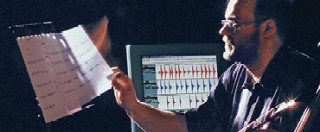
G etting the pre-recorded digital tracks to ‘sit’ well amongst live performers relies on the tracks having an even level, a congenial tonal and level balance, and the right reverberant ambience. McIntire does this superbly, gracefully executing minor adjustments at the workstation control-surface in response to moment-to-moment performance decisions made by Wagner and Howard. Compressor and gain automation settings were spot-on, so that the percussion sounds sat happily in-track, with none of the live percussion effects sounding too loud or too quiet or clashing with the pre-recorded sonic material and synthesizer tracks.

F or some of the voice content (e.g., DECtalk Hawking-esque recitations of NOAA National Weather Service Marine Forecasts; alpha-bravo-charlie...romeo-sierra-tango...zulu), McIntire adds density to the voice sample by upping the compression ratio to maybe around 6:1 or 8:1 and then adjusts the threshold to a couple of dB on average-level parts. This means quieter sections are left alone and anything louder is jumped-on hard, bringing it closer to the average level. The coherence or cohesiveness of these two compositions, each with its volume level and acoustic complexity ascending to a climax about two-thirds of the way through and then tapering to a quiet conclusion, is nicely enhanced by this approach.

M cIntire’s EQ and engineering are commendable as noted above, and he does not go overboard on special effects. His EQ cuts are made over quite narrow bands, and his boosting is gentle and wide. McIntire gently applies boosts in the 50-300Hz band to add warmth. He applies cuts in the 1 KHz band, to deemphasize nasal vocal sounds, and adds generous ‘presence’ with boosts between 4 KHz and 8 KHz. The magical sense of Nature and air and space involves a wide boost applied between 12 KHz and 20 KHz, and that was really beautiful up-front, seated in Row #1. With these two compositions that explore the interplay between Nature and Technology, between humankind and other species—between inanimate noisy things like water (sometimes seemingly talking to us, almost alive, almost human), and supposedly-sentient creatures (humans) who often act in hostile, destructive and uncaring ways as though they were inanimate—the musical and artistic success absolutely depends upon making these EQ choices right.

I n summary, a fantastic, powerful experience—beautifully composed, engineered, filmed, edited, and performed. Very happy!

T he ArtSounds series, of which the McIntire-Grossman ‘Memory of the Future’ program was a part, is co-sponsored by UMKC Conservatory and Kansas City Art Institute.

J oan Grossman is a Brooklyn, New York-based independent media artist and producer. Her work has been screened in more than 20 countries and won numerous awards. She is currently Visiting Professor in Film & Media Arts at UMKC. Grossman was formerly a producer for NPR and Voice of America on a variety of programs, including All Things Considered, Afropop Worldwide, Kids America, and The Territory of Art. She has worked in Africa, China, Russia, and throughout Europe, has produced media for public interest organizations and NGOs, and has also worked as producer on European documentaries and feature films. Joan has a Ph.D. in Media and Philosophy from the European Graduate School and has taught film production and theory. She has worked with leading theorists and filmmakers such as Agnes Varda, Claude Lanzmann, Chantal Akerman, Jean Baudrillard, and Jacques Derrida. Her book, ‘Blackout: On Memory & Catastrophe’, was published in 2009 (link below).

D avid McIntire is a Kansas City, Missouri-based composer who, with composer-musicologist Kyle Gann, co-directed the 2009 Second International Conference on Minimalist Music at UMKC Conservatory. In 2010, he launched Irritable Hedgehog Music, a record label focusing on minimalist and soundscape compositions. McIntire has performed with Colorblind James Experience. With pianist R. Andrew Lee he has produced a recording of Tom Johnson’s ‘Hour for Piano’ (link below).

Memory of the Future


Tuesday, May 6, 2008

National Performing Arts Convention: Electronic Voting Systems (EVS) to Set Priorities

 Reply EVS
L  et your voice be heard and your vote count, so that we will speak with one voice and together ensure a vital future for the performing arts.”
  —  NPAC 2008 brochure.
I  usually gag at this sort of trendy management books. (I still bear scars from the ‘Who Moved My Cheese?’ era.) But [Collins’s ‘Good to Great and the Social Sectors’] is smart, down-to-earth wisdom.”
  —  Michael Bento, reviewer on Amazon.com .
W  hen reproduction, distribution, and categorization were all difficult, as they were for the last five hundred years, we needed professionals to undertake those jobs, and we properly venerated those people for the service they performed. Now those tasks are simpler, and the earlier roles have in many cases become optional, and are sometimes obstacles to direct access, often putting the providers of the older service at odds with their erstwhile patrons.”
  —  Clay Shirky, Here Comes Everybody, p. 78.
W  e’re not being atomized. We’re molecularizing, forming groups that create local culture. What’s happening falls between the expertise of the authorities in the editorial boardroom and the ‘wisdom of crowds’.”
  —  David Weinberger, Everything Is Miscellaneous, p. 131.
Management guru, Jim Collins, will speak on Thursday 12-JUN about ‘From Good to Great and the Social Sectors’ at the 2008 National Performing Arts Convention in Denver. Among the topics are ‘Getting things done within a diffuse power structure’ and ‘Getting the right people “on the bus” within social sector constraints’.

The NPAC is portrayed as a technology-enabled event. Without doubt, it is that. An Advocacy Center will be available with computers for Convention delegates to send messages to the federal, state and local legislators about key issues. Software will be provided that gives comprehensive access to contact information, updates on the most important legislation, and supplies standard formats for letters. “Here's your chance to act on your commitment to take action!” exclaims the NPAC brochure. Delegates can set up 20-minute appointments to learn from experts in one-on-one consultations at the ‘SmART Bar’ at the Convention. NPAC will run from June 11 through June 14.

But technology-enabled is not the same as ‘egalitarian’ or ‘fair’. For example, professional doctors and lawyers determine the parameters and credentialling of their peers, the prerequisites for acceptance and licensing. And professional chamber music presenters and agents determine the parameters for performers and ensembles. But what happens to the word ‘professional’ when works of comparable quality and skill can be conceived, produced, and distributed without expensive or centralized means of production? Oftentimes, not much changes. Filtering by the traditional ‘gatekeepers’ continues. The usual suspects show up in force, and the conventional wisdoms are usually replicated. Little ‘outside-the-box’ thinking occurs. Few real revelations emerge.

Organized by discipline, the fields of dance, music, opera, theater and others have been supported by national service organizations that provide a range of leadership and support services as needed by the respective fields. The combined effort of local arts organizations and their partner national service organizations has resulted in an exponential growth in the number of producing and presenting organizations and audiences. Technology-enabled surveys tend merely to reveal the extent of the market fragmentation that has set in.

In fact, while the traditional discipline-centric structure has merit for new and growing genres, it works at cross-purposes against goals that are inter-disciplinary, that are beyond the remit of any one service organization, or that reveal contested turf between disciplines. In the 2008 convention, NPAC will offer delegates an opportunity to address interdisciplinary issues in ways that aim to harness the energy and expertise of the whole non-profit performing arts sector.

Taking Action Together is the theme of the 2008 National Performing Arts Convention (NPAC). NPAC aims to lay a foundation for future cross-disciplinary collaborations and effective advocacy in terms of funding and public policy.

Three ‘caucus sessions’ will be held, one each day (Wednesday, Thursday, and Friday) during the convention. The caucuses are designed to elicit ideas and set the agenda for consideration in Saturday’s summation ‘21st Century Town Meeting®’, which is aimed at driving future planning and priorities for the performing arts in the years to come. The caucuses will be broken into round tables of ten delegates each. Each table will engage in a facilitated conversation to identify goals and action items toward enhancing performing arts’ prospects in the U.S. Each caucus will address a specific question and target a specific outcome. The responses of all of the round tables will be compiled every day and shared with the full convention to form the basis of the following day’s work. Industrial survey methodology at its intensive best.

The National Performing Arts Convention has engaged AmericaSpeaks Inc. to lead the process of caucuses leading to the Town Meeting, using methods and technologies that they have refined in previous public opinion analysis projects. Facilitators are charged with insuring a level playing field for all ideas, opinions, and suggestions.

The ideas that surface at the three caucuses will be addressed at Saturday morning’s ‘21st Century Town Meeting®’. Using the realtime radiofrequency (RF) enabled keypad survey Electronic Voting System (EVS) technology, the topics will be consolidated, discussed and voted upon by the 5,000 thousand NPAC conferees. Results will be projected on large video screens in order to identify and hone an agenda to be ratified by the assembled performing arts community. The aim is to help set the agenda for the performing arts for the coming years: by U.S. communities; by national, state, and local governments; by performing arts organizations’ supporters; and by audiences.

To promote spontaneous interactivity, an audience response system (ARS) or participant response system (PRS) or EVS that equips attendees with radio frequency keypads at their seats to record their real-time responses to multiple-choice questionnaire items, will be used for the first time at NPAC. The EVS system enables the audience to provide immediate information and responses to questions posed by presenters. The responses from the RF handhelds are tabulated by software. Bar-charts of those tabulations are immediately displayed on large projection screens for all to see.

These systems have been in use in medical professional society meetings for more than 10 years, as well as in other industry marketing and market research meetings. The EVS respondents are traceable and identifiable (via the permanent database records that are created by the system when the votes are cast), although their identities are not revealed by the displays.

 Quizdom Q5 RF handset/keypad
One realtime effect of the anonymity is to remove respondents’ inhibitions—the opinions and votes tend to be more polarized than those collected by traditional survey methods and, if re-votes are taken, the respondents’ preferences tend to be more resistant to discussion and compromise than usual, because there is no accountability. This phenomenon makes sense in terms of psychology, but it runs ‘counter’ to what meeting organizers typically believe. Organizers typically see the real-time tabulations as wondrous and wholly factual representations of the prevailing opinions. The temptation is to ‘strike while the iron is hot’ and immediately act upon the wonderful statistical information that is so fresh and beautiful, without regarding it more carefully (and examining and tracing the votes to individual specific voters) and dispassionately later on. NPAC says it intends to “ratify” the results during the meeting. In my view, the RF keypad EVS survey technology is a “sword” that definitely has two edges—the capacity to help and the capacity to distort or harm. I hope that CMA and NPAC are mindful of this . . .

Besides special RF handheld EVS devices of the sort NPAC will use, cellphone SMS text-based EVS services have emerged as well, providing:
  • A short text number to dial (e.g., 41123) ;
  • Message content that each voter keys in (e.g., ‘CAST 82A SEND’);
  • Votes are caught, processed, and put on a dynamic web page that can be displayed to the conferees in real-time and embedded in Microsoft PowerPoint™.
  • Votes from SMS and web ASP/PHP HTML/XML apps can be combined. (Also can download spreadsheet form of the data.)
These might be considered for surveys at future classical music society meetings, including CMA. The cost is, in general, cheaper for cellphone SMS-based surveys than for surveys conducted using the older RF handhelds. A group need only arrange and pay for the service in advance and have a live internet (WWW) connection in the meeting hall. Audience members come with their regular mobile phones, and no other equipment or setup is necessary on the spot. PollEverywhere is one company offering SMS-based EVS services.

There are several issues, though, with SMS-based EVS. To cast each vote, each voter has to make about a dozen key presses, compared to one key press for conventional RF EVS keypads. This is a major issue in terms of ease-of-use and the time required for respondents to complete each survey question or an entire questionnaire.

Another factor is that mobile phone networks were not originally designed to handle hundreds of calls from a single room at once. This is not a fundamental technical barrier, but it rules out some off-the-shelf technologies that would otherwise be suitable. For example, Bluetooth™ is not currently able to handle 300+ respondents in a room. Even cell phone networks are not designed for EVS type loads with large groups of respondents all using their cell phones at once. For audiences of 300+ there is usually not enough cell capacity in any location. Each cell can handle 168 concurrent calls on digital cellular networks, 56 on analog. Concurrency will work differently for SMS texting, so those figures are context-agnostic, but for reliable EVS voting the phones may need to resend the message until they get a positive acknowledgment back from the server—which adds more latency time and causes problems with respondents in terms of ease-of-use (lack thereof), under-counts, and compliance.

In fact, a cell phone system could be deluged by a flood of SMS messages, which, if the EVS volume were big enough, would overwhelm the control channels, and prevent voice service as well as SMS from working in that area/cell. This means that it is likely the service provider will have defenses that would preclude large voting audiences.

Even if adequate coverage could be obtained, SMS messages (unlike voice calls, but like emails) are not guaranteed to be instantaneous or to be delivered within any specific time interval. Texts can be (and, in practice, often are—) delayed, and there are no prospects for an archictecture to allow text delivery for a vote within a guaranteed time (e.g., 2 minutes; vs. 2 seconds for the best regular RF EVS equipment). But not only is “prompt” delivery not guaranteed, it is frequently delayed beyond 2 minutes and drop-outs (uncounted votes) occur.

What’s more, the SMS service charging models are inappropriate. It’s probably impossible to arrange for the voting to be free to respondents/conference attendees, since they all use different providers. Local cells are expensive, and they will not be private but will fall under an existing licence and operator (AT&T, Sprint, T-Mobile, Vodafone, O2, etc.) who has paid for that part of the radio spectrum. Charging respondents to participate is not a good way to get this approach off the ground, even if it wouldn’t matter in a mature model.

EVS systems have a ‘ranking mode’ that is used to obtain first, second, etc., preferences from a list of options—for example, prioritizing the order in which possible activities should be done. These are tallied and displayed immediately, in barcharts and pie charts and other easy-to-understand formats.

Yes, formative, summative, and peer assessments can be made conveniently and quickly with EVS. And building a sense of community could get off to a quick start with EVS, especially in large groups that have factions that are mutually misapprehensive of each other.

But those results should best be considered a ‘beginning’, not an end. The results should not be considered “actionable” or “ratifiable” as-is, in the way that NPAC says it intends to do. Why? Because of the unique psychology of anonymous EVS, which encourages fait accompli ‘American Idol’-style relativism: “I like choice ‘A’ because I like ‘A’.” In other words, voting is the only responsibility of the anonymous EVS respondents, and, by contrast, discussion and explanation would require unmasking of identities and the additional duties of civility and discourse. Anonymity tends to bring out the worst in people, in terms of self-interested fractious behavior.

In fact, in some EVS surveys that I have personally designed and conducted, some respondents were recorded electronically voting for positions that they were known to oppose in reality, and did so expressly so as to be categorized into a particular focus group. Then they inserted themselves into the subsequent discussions as “wolves in sheeps’ clothing” and (a) passively ‘lurked’ in-caucus, to perform reconnaissance on those adversaries of interest to them, or (b) actively intimidated the members of the other camp.

In yet other instances of EVS surveys that I personally supervised in 1998 and 1999, some respondents had hidden motives such that they wished to surreptitiously undermine the legitimacy of the survey process itself. To accomplish their goal to sow seeds of doubt among the broader membership, they voted disingenuously, capriciously, seemingly irrationally—so that the displayed EVS survey results would, to the assembled conferees, appear to be scatological, unusable, unreliable. The broad group would then, they hoped, be thrown into disarray, and the decision-making and policy-setting process would be effectively derailed. Remember, these were EVS surveys of academic medicine faculty members. Don’t kid yourselves! This summer in Denver CMA and other NPAC-member organizations are likely to discover some of these idiosyncrasies of EVS survey psychology and sociology, about ten years after other professional societies learned these lessons.

If you are interested in these topics, please have a look at Aaron and colleagues’ recent book and look also at the whitepaper materials of some of the EVS vendors (links below). EVS is very useful technology, yes. But it can be co-opted, distorted, and manipulated by factions who want to interfere with the goals, privacy, and priorities of other factions——or who are determined to fabricate a “unified voice” when those [dominant; paternalistic] factions earnestly but mistakenly believe that only by so doing can they “ensure a vital future for the performing arts.” This is not a ‘hypothetical’; it is an unfortunate reality, especially when the stakes are high.

 Li-Bernoff book

 Weinberger book


Saturday, May 5, 2007

The Fabulous Invalid at Last? Virtual Instruments Undermining/Supporting Classical Music

Herb Tucmandl, Vienna Symphonic Library
A human professional musician is of course faster than our sounds. We have 1.5 million samples, but real musicians have more. I don’t think we’ll ever get them all. I don’t think orchestras are threatened. In the TV industry, for example, they don’t have the budgets for orchestras anyway. And there are still live performances. Nobody goes to a concert to listen to a computer.”
  —  Herb Tucmandl, Vienna Symphonic Library, 2006.

DSM: Working for Vienna Symphonic Library would have to be the ultimate conflict of interest for a musician—helping to build a digital sound library that can reduce the need to have a full complement of live musicians. Live performing gigs are plentiful in Europe, but aren’t so abundant in North America.

CMT: Classical musicians have long opposed replacing live artists with computers in concert performances. This has gotta be one of the most compelling reasons why. The VSL sounds are that good! I never thought I would say so but, yes, the digitally sampled waveform libraries, like VSL, and all of the articulation and technic options are finally that good!

DSM: Today’s Wall Street Journal has an article describing the plan of conductor Paul Henry Smith to produce three Beethoven symphonies back-to-back in a concert with an "orchestra" having no live musicians—just sequenced waveforms from the Vienna Symphonic Library.

CMT: The conventional stance has musicians opposing the substitution of digital virtual instruments and sequencers for live musicians in orchestras, ballets and opera houses.

DSM: But yet some composers, conductors, musicians and engineers actually feel that embracing the use of virtual instruments holds promise for keeping classical music alive.

CMT: And of course touring musicals and acts like Cirque du Soleil have used virtual instruments for a number of years. Those incursions are harmful enough, but the impact is modest—simply because the number of shows and engagements per year is relatively small. And the musicians’ unions’ efforts do keep virtual orchestras out of Broadway orchestra pits so far. But in London a virtual orchestra has been used in Cameron Mackintosh’s revival of ‘Les Misérables.’ We seem now to finally be on the slippery slope. It’s not hypothetical anymore. The worry has a basis in reality. Even a paranoid has real enemies!

Keith Lockhart in Digital Conductors’ Jacket, bristling with sensors and telemetry gear
DSM: It’s true that composers of new music who couldn't otherwise afford to have their compositions performed by a live orchestra can now commission a high-quality software-generated recording for a few thousand dollars.

CMT: But what about communities that stand to lose their orchestra due to negative cashflow? A digital waveform library and sequencer-based virtual orchestra stands in for half the players? It’s a drink, but it’s not the martini I wanted!

DSM: I’ve got a copy of GIGA Virtual Instrument and a copy of VSL. I use both with Finale, as a way to hear what I’ve written and revise it or change my voice-leading to make sure I’ve got the texture right. The quality of the libraries is definitely good enough for that purpose. And good enough to record a demo, so that I can get string quartets interested in playing what I’ve written. But—I agree—playing a sequencer in front of a paying audience seems like a travesty. It’s not the martini they wanted.

CMT: There’s a big difference between theatre where the musicians are hidden and theatergoers are mainly buying an experience with live actors, and concerts where concertgoers are mainly buying an experience with live musicians. Would theatergoers be satisfied with holographic, sequenced digital imagery of a play onstage? I doubt it! There’s no intimacy in it. There’s no risk or uncertainty. So why should a concertgoer be any different, with regard to virtual instruments? Where is the intimacy? Where’s the authenticity? Where’s the real-time interaction with an audience?

DSM: Herb Tucmandl, founder of the Vienna Symphonic Library, acknowledges that virtual instruments do change the competitive landscape. Nothing is value-neutral. In an era obsessed with driving out cost and optimizing efficiency the virtual instruments aid and abet the buyer and undermine the musician-seller. But classical musicians should take control and become fluent in this technology instead of complaining about it or ignoring it. It’s not possible to turn back the clock. In that way, the new virtual instrument trend is just an extension of the MIDI and synthesizer boom that began in the 1980s. Many keyboardists adapted to that and became proficient in using synths. But many older ones did not. So the ‘digital divide’ is not just about internet access or web-enabled social networking. It’s the more general process of technology disenfranchising human beings and eroding the number and the value of the opportunities still available to human beings.

Music Value Chain
CMT: You have to admit, though, that the virtual instruments are pretty good these days as far as the sound qualities are concerned—the attacks and decays and timbre and other parameters. Virtual instruments should provide satisfying control over sound—comparable to the control that an expert musician has over a fine acoustic instrument. These elements are necessary for virtual instruments: low latency of only a few milliseconds; virtually no jitter; realistic representation of all of the technic and artifacts of actual performance on the instrument in each of its registers; precise and accurate sensing; reproducibility; and reliability. Current-generation virtual instruments and sequencers have got all that. But what about silence? It’s not yet possible for virtual instruments and sequencers to deliver fully realistic and many-timbred silences as powerful as we normally get in live performances. This is the kind of musicmaking one expects in concert.

DSM: It’s difficult to produce a variable delay for an audio signal without pitch shifting or complex granular techniques, if you think in terms of an event representation such as MIDI output by a keyboard. Synthesized sounds with sharp attacks illustrate what I mean. The question is: how large of a range of latency can the sequencer-driven system impose without adversely affecting the rhythm that the remaining human performers play? Builders of sensor-based instruments should experiment for themselves with the tolerability of different amounts of jitter. The musically acceptable amount of jitter depends on the kinds of sounds you’re producing. At one extreme are examples such as dense textures and timbral changes in sustaining sounds, where latency and jitter up to even 200ms may have very little impact in the musical result. In the middle is the common case of each gesture causing an individual note to be played. For a skilled performer, jitter of around 10 ms makes the difference between feeling that she does or does not have complete control of rhythms played on the instrument. The other extreme is illustrated by strings of notes played in very rapid succession on the same instrument. Unevenness of just one millisecond of jitter in that situation is audible.

CMT: In this age of email and instant messaging and video games, it’s a treat to savor the wit and eloquence of live artists in an intimate and revealing dialogue. That’s the main beauty and appeal of chamber music. And while the issue discussed in the WSJ article seems mainly one that concerns symphonic or large orchestral productions right now, you can’t help but feel that slippery slope underfoot. What’s next? In the future, will we be confronted with smaller chamber ensembles, with some members substituted with virtual instruments controlled by sequencer applications?

DSM: Did the unions have objections to Music Concrète and electroacoustic music? Years ago, were there lawsuits about the incorporation of tape-loop or other machine sound effects?

CMT: I don’t believe the issue was a prominent one in past decades, mainly because the nature of those effects was outside the realm of traditional performance—a human musician could not make those sounds on a conventional instrument. The other aspect was that the performance required a human operator to man the console—and as long as that person was union, then it was regarded as just another ‘instrument’ among many. Not like it is now, with virtual instruments and a sequencer able to replace an entire orchestra.

DSM: While there are beneficial uses for the virtual instruments (like some we’ve mentioned above), it’s hard to think of their intrusion into concerts or other live performance contexts as anything other than a commodifying influence, depressing wages for musicians and reducing the overall number of gigs per year. The AFM and MU positions on this trend are therefore readily understandable. Think about it. If lawyering is a performance art, then would lawyers sit still for software and artificial intelligence application software preparing virtual briefs and arguing before the court, eliminating many human lawyer engagements per year? I doubt it!

CMT: Right. Their years of preparation as lawyers are aimed at delivering live human legal acumen and insight. Our years of preparation as musicians are aimed at knowing and loving the music so well that we inhabit it as we play. To offer it in performance to an audience opens the possibility of their being drawn into its orbit and understanding it and loving it. A virtual instrument forecloses on that interpersonal offering, to about the same degree—no more, no less—that a recording does.

DSM: For string players, it’s astonishing that any novice has the perseverance to persist past the out-of-tune, scratchy-tone stage. No frets to mark the notes, so the left-hand fingers must learn their spacing to the accuracy of a millimeter in order to create decent pitches. It usually takes many years before reliable accuracy is developed, and it requires constant vigilance to retain it. Precise spatial memory must be coupled with strength, suppleness, speed and stamina—the athleticism of that is partly what the audience sees in live performance. Meanwhile the right arm and hand must learn the movements required, too, a butter-smooth fluidity to set the strings vibrating evenly. The bow not only coaxes the sound from the instrument, but also conjures the colors and emotions in the sound and traces the contours of the phrases—you give voice to the music itself. The right hand must know the action of the bow on the strings, constantly adjusting its speed and weight. And of course, both hands must be perfectly coordinated. Where is that in a performance involving virtual instruments of sampled waveforms of anonymous performers in a studio?

CMT: Even when your technic is under control, each piece of music demands technical and expressive understanding, the hands learning to negotiate the notes and then committing them to kinesthetic memory. With virtual instruments, all of that’s bypassed. The audience knows it. That’s part of why I think a virtual performance lacks authenticity.

DSM: Your kinesthetic memory point is true enough, but there’s an obverse side as well. To be emotionally open as a live performer means avoiding reflexive playing. The reflexes are there: they’re what your kinesthetic conditioning establishes. But the muscle-memory is what frees you in performance to switch your autopilot off. We’re living at a time when intensity in performance is considered obligatory. But great art doesn’t shout all the time. It knows that there is enormous power in gentleness and understatement. Some pieces even require a dry, cold detachment to accurately convey their meaning. The problem with many of the excellent virtual instrument libraries available these days is that the sounds are too wet, too intense. They shout ‘virtuoso’! It’s doubtful that the myriad options available to you when you lay down your GVI tracks adequately cover the dry-and-detached end of the spectrum.

CMT: And music isn’t always earnest and serious. A mature work of art often reflects an integrated view of life and contains humor and wit and irony. I can’t readily find humorous or witty bowings in the Vienna Symphonic Library.

DSM: No matter how many times the music is played, we need to be able to capture the spontaneity of the moment. The virtual performance will never come alive the way that a live performance will, no matter how much you improve the digital “jacket” sensors and artificial-intelligence algorithms for modulating the dynamics and articulations based on the remaining humans’ motions.

CMT: Our duty as musicians is to breathe life into the music, to re-create it with all the excitement and commitment of the composer, or to reinterpret it in valid ways that the composer may not have thought of. It’s an act that renders us both humble and powerful. The paradox is that it is only by being intensely alive as ourselves that we can be entirely at the service of the music and the audience.

DSM: I agree. And your point illustrates another aspect of what seems to me inauthentic about virtual instruments: the absence of community. A sequencing of virtual instruments is typically arranged by a single musician, and the track(s) that result reflect the aesthetic and technical judgments of just that one person. By contrast, the beauty of chamber ensembles derives from the real-time conversational interactions and freedom of several distinct personalities and intellects. With virtual instruments, what we get is one person’s account of the meanings that the music contains. We miss the tension and disputes and surprises.

CMT: Ultimately, with virtual instruments, it’s hard for me to see how either the performer or the listener could be lifted into an enchanted space where diverse shades of emotion are brought into play. ‘Authenticity’ to me means reconnecting to our innermost being. That’s the drink that I ordered! Virtual instruments are a boon for composers, but not for many others.


T o obtain an exception to the minimum musician requirement, a League member must demonstrate that there are legitimate artistic reasons why the production should be permitted to use fewer than the required number of musicians. An application for an exception is first reviewed by a Special Situations Committee (“Committee”), comprised of experts in the field of theatrical production, who are chosen in advance by the Parties. (Pet. ¶ 10, Ex. A at 11.) FN3 Both Parties may present documentary evidence and call witnesses when they appear before the Committee. (Pet.¶ 10.) The Committee is required under the Agreement to “decide the issue primarily on artistic considerations.” (Pet. Ex. A at 12.) Specifically, the Committee is to consider four factors:
  • the musical concepts expressed by the composer and/or orchestrator;
  • whether the production is of a definable musical genre different from a traditional Broadway musical;
  • the production concept expressed by the director and/or choreographer; and/or
  • whether the production recreates a pre-existing size band or band’s sound (on or offstage). (Pet. Ex. A at 12.)
After considering the Parties’ presentations, the Committee must render a written decision explaining in detail the basis for its conclusions within forty-eight hours after the Parties have submitted their positions. (Pet. ¶ 10, Ex. A at 12.).”

  —  United States District Court, S.D. New York, ASSOCIATED MUSICIANS OF GREATER NEW YORK, LOCAL 802, AFM, Petitioner v. The LEAGUE OF AMERICAN THEATRES AND PRODUCERS, INC., Respondent. Slip Copy, 2006 WL 3039995, No. 05-CV-2769 (KMK), Oct. 25, 2006.