Thursday, June 5, 2008

Stalking: An Occupational Hazard for Chamber Musicians?

 Pathé book
I  am not absolutely certain that I’m being stalked. But I’m pretty sure somebody was following me after our quartet’s last performance. What should I be doing about this? I don’t know who to talk to or call about this.”
  —  Anonymous.
This is outside the scope of things I have any personal expertise in. The links below may be helpful to you, though.

Current U.S. statistics on stalking are here. More than one million women and almost 400,000 men are stalked annually in the United States. Eight percent of women and two percent of men in the United States have been stalked in their lifetime. Although stalking is a gender-neutral crime, most victims (78 percent) are female and most perpetrators (87 percent) are male. In the course of managing a stalking episode, 28 percent of female stalking victims and 10 percent of male victims obtained a court protective order. Sixty-nine percent of female victims and 81 percent of male victims had the protection order violated. Eighty-one percent of women who were stalked by a current or former husband or cohabiting partner were also physically assaulted, and 31 percent were also sexually assaulted by that partner.

The average duration of stalking is 1.3 years. Most stalking, however, lasts about one month. Statistically, the median (31 days) is way lower than the mean (470 days in the U.S.). The statistical distribution has a long tail toward the right (longer durations). Two-thirds of stalkers pursue their victims at least once per week. Seventy-eight percent of stalkers use more than one means of pursuing, contacting or interfering with the victim. Have a look at this article by Mullen’s group in Australia for more information. (The stats are qualitatively similar in other countries, although duration distributions by stalking type, comparative prevalence by stalking type, and other details differ quantitatively from country to country, or even by region within each country.)

Stalking, Table.1 from Mullen et al., 1999
There are no statistics maintained on epidemiology of classical musicians as targets of stalking or as stalker perpetrators, although undergraduate musicians or conservatory students probably experience stalking rates comparable to other university students (about 20%). Possibly members of small chamber music ensembles might be more vulnerable on account of the small number of members in the group, and the absence of budget such as a large orchestra may have for security and other services.

Stalking behavior is not motivated by any one thing, and therefore no one strategy is effective protection against all the various types of stalking and types of stalkers. Effective strategies are ones that take into account the particular circumstances and identity, if these are known (that is, the history of any prior relationship with the pursuer; the chronology of events; the methods the pursuer is using).

R  isk assessment in stalking situations is currently limited by a lack of prospective studies of representative samples. Clinicians and the legal decision-makers do not, however, have the luxury of deferring action until such evidence emerges. They must, for the present, depend on integrating knowledge from stalking research, borrowing from the systematic studies of risk in other areas, and drawing on clinical experience... The longer stalking has lasted, the longer it is likely to persist. Nearly 50 percent of stalking situations amount to a short burst of intrusive behavior lasting only a few days and not extending beyond two weeks. This form of harassment is typically perpetrated by a stranger. In contrast, stalkers who persist for longer than two weeks usually continue for many months.”
  —  Paul Mullen et al., 2006.
Even if no physical violence has occurred, the anxiety and fear and implied threats are a form of harm. You do not know what the stalker might do next.

B  eing stalked can induce depression, anxiety, and chronic stress. Post-traumatic stress disorder (PTSD) describes the psychological sequelae of stalking... To our knowledge, however, the utility of [PTSD] treatments in the management of stalking victims has yet to receive empirical support.”
  —  Paul Mullen, Michele Pathé, and Rosemary Purcell, Stalkers, p. 221.
Don’t assume that there is just one pursuer. Some celebrities attract multiple pursuers, either serially or concurrently. Classical musicians may not have as great a likelihood of this as other celebrities, but the risk of it is surely not zero.

Do inform others about what is happening and what you are concerned about. Neighbors, co-workers, friends, and other ‘proxies’ who are not aware of the victim’s situation and who think they are being helpful can unwittingly disclose the information that a stalker wants to know.

If you have children who could be potential secondary targets for the pursuer, do have a calm, serious discussion with the children about the subject and instruct them how to be safe. In the U.S., you can contact VictimServices.org’s 7x24 hotline at 1-866-689-HELP (4357) for advice.

The Mullen-Pathé-Purcell book is especially good. It covers strategies to defend against and manage stalking behaviors; protecting personal information; declining and terminating contact; classifying different types of stalking and stalkers and risks associated with each; false stalking and delusions of being stalked; stalking-by-proxy, such as ordering/cancelling goods and services. Proxies utilized by stalkers may include your current or past employers, doctors, lawyers, pharmacists, hairdressers/cosmetologists, gyms/fitness clubs, banks, schools, churches/synagogues, and other intermediaries.

The book provides comprehensive discussion of morbid infatuations and other psychopathologies; incompetent suitors and intimacy seekers; acquaintances and friends. It counsels us to avoid any further discussions or correspondence with the pursuer—do not indulge them in argument or negotiation; do not deliver your termination message incrementally, in ‘let them down slowly’ instalments. The imperative is to be decisive, be firm.

The 12-page 2006 paper by Mullen and co-workers is excellent. The pdf is downloadable free here.

Recognizing possessiveness, hypersensitivity, dependence, jealousy, and mood swings in friends or business acquaintances can help to identify the potential for stalking and may be instrumental in your decision to terminate contact with the person, as a means of preventing stalking by someone who is known to you. According to Mullen and Pathé, ex-intimates are the stalking victims most likely to be threatened and assaulted. A history of domestic violence and/or jealousy before separation have been reported to increase the risk of violence in this group. Statistically speaking, and despite some famous examples to the contrary, stranger stalkers present the lowest risk of assaulting their victims.

Do be selective about disclosing personal details, including home address or phone numbers or email addresses. A post-office box provides security to prevent theft of confidential materials from a private letterbox at your home.

Do get an electric shredder for your home and be careful to shred all of your mail before placing it in the recycling or rubbish bins. Don’t take the same route to work or concert hall or other destinations; don’t do anything that’s readily monitored, in which your routine daily patterns can become known in a manner that may make it easier for a pursuer to harrass or attack you.

Do get a whistle. Get a small mace or pepper spray if legal in your area.

Do avail yourself of some musician-specific guidance for your use of MySpace, FaceBook, and other social networking sites, available on pages 206-208 of Frances Vincent’s book. Her blog is here.

Do consider hiring under-cover security services, such as Bo Dietl & Associates, for at least a few days or for covering your next several performances. They can discreetly monitor the performance venues and monitor your comings and goings, to ascertain whether there is or is not suspicious stalking-type activity. On a short-term or intermittent engagement basis such services are not tremendously expensive, and the reassurance that can come from their expert observations (esp. if they find no evidence of stalking) is huge. And, if in fact there is someone stalking you, they are expert in engaging law enforcement, the courts, forensic healthcare, and other appropriate authorities to deal with it in an expeditious, definitive way. With far more flexibility than the authorities can muster, an under-cover security service can devise counter-measures to stop the person, or to precipitate circumstances and evidence that will make the pursuer chargeable under the anti-stalking laws. Tremendously good value. Here are some more suggestions:

  • If you are arriving or departing from a performance in separate vehicles, make sure each person is accompanied/escorted between the performance venue and the transportation.
  • If you are not accompanied while en route, be sure and phone someone to let them know when you are departing and when you expect to arrive.
  • Leave your mobile phone turned on. If it has a GPS feature, leave that turned on as well.
  • If no one will be home when you get there, arrange to go to someone else’s house/apartment and stay with them, instead of going directly home to an empty house.
  • Let doctors, lawyers, hairdressers, dentists, etc., know the importance of maintaining your security. They may be able to arrange off-street parking so that you are less visible. Ask them to instruct the receptionist not to allow any information about you to be leaked out.
  • Check to be sure the library, gym, video shop, etc., will not give out information about you.
  • Sell your car and buy a different one if feasible, so that the stalker will not recognize you (for awhile).
  • Make sure you check the car before you get in, to make sure no one is in it.
  • If you are being followed drive directly to the nearest police station.
  • Don’t always drive the same way home. Don’t always take the same subway or bus home.
  • Put the car away immediately when you arrive home, out of sight if possible.
  • If you believe someone is stalking you, call the police.
  • Arrange for your mail to be redirected to a post office box. You will need to fill in a Mail Redirection form from the Post Office.
  • Call ‘fire’ instead of ‘rape’ or ‘help’.
  • Put 911 into your mobile phone directory so that it can be speed-dialed. Note that, when contacting 911 from a cellular phone, you must identify where you are (i.e., tell the dispatcher your exact address or location). From a hardwired landline phone, the address pops up on the dispatcher’s computer automatically. But with cell phones, the computer doesn’t know where the phone is. 911 calls placed from cell phones are routed to the closest 911 operations center based on cell tower site location that’s closest to where you are calling from. And although technology has made advances in getting cellular phone calls to the appropriate police/fire agency, the process is not 100-percent accurate. If you call 911 on a cell phone, it will be associated with the nearest mobile phone repeater cell antenna tower, which may be miles away from where you are. The software will not route to the correct 911 center closest to you but instead will route to the 911 center that is closest to that cell tower. Then, if you are not able to speak freely or if you hang up or an attacker damages your phone, the dispatcher will not have your address information available, and it may take many minutes to locate the approximate address where your cell phone transmissions came from to send you help. Help would be dispatched from a 911 center needlessly further away from you, possibly some miles beyond that cell tower, to a destination that is so vague as to offer minimal chance of locating and assisting you in a timely way. Uggh.
  • For the reasons noted in the previous point, put other emergency numbers into your mobile phone, for each of the cities where you perform.
Please be safe. Don’t ignore or discount what’s going on or pretend that it’s not happening or that it will go away. Contact one of the social services agencies in your area who have responsibility for sexual harassment prevention and management, or one of the national services whose URLs appear in the list below. Bo Dietl & Asociates provide a number of security and investigative services to performing musicians. Thank you for your CMT comments and questions!

Categorizing Stalking, Fig.1 from Mullen et al., 2006

 Glass book


Wednesday, June 4, 2008

04 Jun 08

Mum and Dad’s Ruby Wedding Anniversary

Charging into our house six hours before the party was scheduled to begin, Aunty Lily seized control of the kitchen and set about hustling up a buffet. Beef pies. Cheese-and-onion pies. Butter-potato-and-onion pies. White and brown salmon and egg rolls. Chicken-and-stuffing sandwiches. Mushroom pasta. Mini pizzas. Chicken goujons. Savoury rice. Prawn rice. Mini tartlets. Coconut macaroon cakes.

Some of the first people to arrive were Mum’s teacher friend, Kath, who brought her son, Kieran, and his new bride, Yoko, who if let loose on a catwalk would easily put Anne Watanabe to shame.
“You’re invited to our wedding party in Manchester on the twenty-eighth,” Kieran said.
“I am looking forward to it,” I said.
“Yoko’s bringing ten single Japanese women just like her,” Kieran said. They may be looking for husbands.”
“What?” I said. “Ten more of her!”
“Not ten. I think about nine,” Yoko said. “One is engaged. They’re all about my age, twenty-nine.”
“Are you going to introduce me to all nine?”
“Of course. There are many many opportunities with them for you. But they’re only here for a few days, so you’ll have to be quick-quick-quick,” Yoko said, snapping her fingers. “They’re staying at the Midland hotel. You should stay at the hotel with us.”
“It sounds like paradise,” I said.
“Just wait till you meet her father,” Kieran said. “He looks like Odd Job and he has a voice like Lee Marvin – the furniture rattles when he speaks. You should see him do karaoke in the Lee Marvin voice.”
“Kieran’s terrified of him,” Kath said.
“He’s a judo master who crushes walnuts in his bare hands,” Kieran said. “He showed me the swords in his samurai room.”
“Is he a member of the yakuza?” I asked.
“No, but he owns his own construction company, so when the yakuza gangsters come and ask him for money, he throws them around with Japanese techniques,” Yoko said, demonstrating by throwing an air person. “Then they say, ‘I’m sorry.’ One guy he threw had to have an operation.”

Among the neighbours to attend were Posh Bird and her parents, John and Julie.

Arriving with an envelope, my aunt Sue said, "You must open it now."
Dad opened it, and said, "My God. Look at this. It's tickets for Queen with Paul Rogers at the Manchester Evening News' stadium."

In a packed house, Dad commenced his speech:
“Thanks everybody for coming along and helping Barbara and I to celebrate this special day. Thank you for the cards and gifts, and a big thank you to Lily for the marvellous buffet. It’s also very special to have Shaun joining in the celebrations with us.
We’re a bit jetlagged at the moment as yesterday we came back from a week in New York. Barbara managed to drag me to Tiffany’s on 5th Ave, but as luck would have it they were stocktaking on that day.
1968 seems such a long time ago now. Beer was six pence a pint. Petrol was five bob a gallon. And you could buy a house for two-thousand quid or less.
Louis Armstrong had the best selling single of the year. Can anyone guess the song?”
“‘What a Wonderful World!”
“That’s right,” Dad said. “Lots of momentous things happened that year. Riots and revolution in France. President Johnson signed the civil rights bill. The first astronauts orbited the moon. And Barbara and I got married at St Bede’s church on the first of June.
At the time, many people said it wouldn’t last – we were barely out of our teens and basically still kids. But here we are forty years on and still very much together.
Couples are often asked when they’ve been married for a long time, ‘What’s the secret? How come you have managed it?’ and so on. Replies are often along the lines of, ‘Give and take,’ ‘Working it through,’ ‘Ups and downs.’ Well that’s all true, but my answer would be is that we still love each other very much. Barbara is still the same big-eyed beautiful girl that I married that hot June day back in 1968."
Mum started to cry.
"Please raise your glasses to my wife Barbara.”
The champagne flutes took to the air.
“I was going to make a speech, but I’m too emotional,” Mum said, drying her eyes with a napkin. She then did the rounds showing off her new one-carat-diamond white-gold ring.
“It’s gorgeous,” Posh Bird said.
“Don’t do any house work with that on,” Julie said.

Posh Bird and I chatted. I managed to spill champagne on her mum, Julie’s, leg. Later on, Julie reciprocated by spilling beer on mine. Julie was so charming – she proposed I should be her ballroom-dancing partner, and invited me over for Christmas dinner.
“We don’t cater for vegetarians,” Posh Bird yelled.
“Bugger her. I’m inviting you,” Julie said.

As my chances of dating Julie now seem to be considerably higher than my chances of dating her daughter, when Posh Bird’s dad takes his next work trip to Norway, I am going to see if her mum will elope with me.

Email comments to writeinside@hotmail.com or post them below

Copyright © 2007-2008 Shaun P. Attwood

Tuesday, June 3, 2008

Mannes College Beethoven Institute: Amity via Cello-Piano Sonatas

 Colin Carr, Thomas Sauer
T  hese sonatas are] a representation of one of Beethoven’s deepest yearnings: to fashion order and harmony from the chaos of life.”
  —  Thomas Sauer, Program Notes, Mannes Beethoven Institute, New York, 02-JUN-2008.
Colin Carr (cello) and Thomas Sauer (piano) take on super-human powers when they make music together. Their recital last night—a two-and-a-half-hour program consisting of all five Beethoven cello-piano sonatas (Op. 5 [Nos. 1 & 2], Op. 69, Op. 102 [Nos. 1 & 2]; in chronological order)—one of the events in this week’s Beethoven Institute at Mannes College of Music The New School in New York—was a tour de force.

These sonatas hail from each of the three major ‘periods’ in Beethoven’s career: Op. 5 (1796), Op. 69 (1807), Op. 102 (1815). Their textures and compositional styles are dramatically different from each other, reflecting Beethoven’s stages of development and changing motivations: early demos and self-promotion, to Friedrich Wilhelm II, and others; mid-career self-reinvention and discovery; late-career envelope-pushing iconoclasm. As Thomas Sauer says in the program notes, these cello-piano sonatas offer a quicker tour of Beethoven’s compositional styles and major creative periods than do works of his in any other genre: “An evening suffices.”

And what an evening it was!

The two-movement Op. 5 sonatas have 18-min first movements, followed by 7- to 9-min second movements. The long first movements are expansive—emblematic of symphonic writing; unusual for chamber works. The second movements are discursive—the No. 1 carrying on in a light-hearted rondo-like manner, in F major; the No. 2 evoking 18th-Century literary notions of tragedy, in G minor.

The Op. 69 admixes minor-key motifs in predominantly major-key settings. The recurrent uncertainty and eventual triumph of major over minor are routinely regarded as characteristic of Beethoven. Anxiety and sorrow displaced by fortissimo joy and affirmation: yes, that’s there. But Carr and Sauer find far more depth and complexity in Op. 69 than that. The plot-line, according Carr and Sauer, to has more to do with temporality as a feature of the human condition: an essay on how patience and the interplay between personal ‘will’ and opportunity and cooperation [between the characters represented by the cello and the piano] can lead to the affirmative result.

The Op. 102 sonatas, especially the No. 2: these are my favorites. The sheer energy that propels them; the emotional range that they cover, from deep despair, to euphoria, and back again; the improvisatory quality of the dissonances and transitions; the drama of the fugal finale—there is so much to love in here. And Carr and Sauer do animate these sonatas as a labor of love. Breathtaking exuberance! From warm-and-tender, to fierce and defiant. The expressive range is quite a ride.

One of the remarkable things about the collaboration between Carr and Sauer, each of whom is a superb soloist, is an extraordinary ‘filial’, ‘fraternal’, brotherly quality that they impart to their playing together. These cello-piano sonatas present ample temptations for each voice—to display soloist-style ‘ego’, rubescent embellishments, flamboyant figurations, fioritura. But Carr and Sauer do not indulge in any such thing.

It is not as though either of them renounces his ego totally; far from it. The acoustic image they each project is simply a strong, genuine ‘brotherliness’. The allegiance between the two is evidenced by the extraordinary balance and responsiveness, one to the other, in a thorough-going, egalitarian way. (Much as with rock climbing/mountaineering, each one, Carr or Sauer, when it is his turn to take the lead, places an ‘anchor’ or ‘protection’ as he goes—to protect the other, enabling him to ascend/descend with expressive assurance, agility, and safety. The trading of ‘call-and-answer’ figures between the cello and piano parts throughout these sonatas is like a ‘running-belay’, to use the moutaineering term. No heroics; just continual looking-out-for-the-other-guy. The pleasures in doing this in climbing are a similar species of pleasure as we see in the beaming faces of Sauer and Carr: these are the pleasures, not of mere collegiality, but of true brotherhood.)

In other words, their conceptions of ‘self’ and of ‘other’ and of ‘family’ are not formal or rule-based; the realizations of the concepts are extemporized, improvisational. Both voices—cello and piano—are continually active, never passive or subordinate; the piano is never ‘accompaniment’. The net effect of this is to impress us listeners with a vision of collaboration and solidarity and mindfulness to which each of us can and should aspire. If they can do it, we should too!

We thank Colin and Thomas for the wonderful evening—for their gift of vitality and warmth. Nominally a faculty recital with a musicological rationale and didactic, pedagogical program notes, the performance showed its true colors as a compelling concept of aesthetic and filial unity: a shining Beethovenian example for all of us, a noble thing to emulate, not just in music but in everything we do.

Colin Carr is the winner of many international awards, including First Prize in the Naumburg Competition, the Gregor Piatigorsky Memorial Award, and Second Prize in the Rostropovich International Cello Competition. Carr was on the faculty of the New England Conservatory in Boston for 16 years. He became professor at the Royal Academy of Music in 1998. Also in 1998 St. John’s College, Oxford, created the post of ‘Musician in Residence’ for him. Since 2002 he has been professor at Stony Brook University in New York. Mr. Carr plays on a Matteo Gofriller cello made in Venice in 1730.

Pianist Thomas Sauer, founder and director of the Beethoven Institute at Mannes College, received his Bachelors of Music from The Curtis Institute, his Masters of Music from Mannes College of Music, and his DMA from the City University of New York. Among others, he studied with Jorge Bolet, Edward Aldwell, and Carl Schachter. He has performed regularly at Carnegie Hall and with the Chamber Music Society of Lincoln Center and the Philadelphia Chamber Music Society. His CD of five Haydn piano sonatas is available on MSR Classics. His recording of music of Britten and Schnittke with cellist Wilhelmina Smith is available on Arabesque.

 Colin Carr, Thomas Sauer

 mountaineering / rock-climbing, as behavioral/psychological analogue of musicianship in ensemble


Monday, June 2, 2008

2 Jun 08

Women in Prison: From Lifer Renee (Letter 1)

As a teenager, Renee received a sixty-year sentence from a judge in Pima County. Fourteen years into her sentence, she is writing from Perryville prison in Goodyear, Arizona.
The voices of women prisoners are seldom heard, and I am unaware of any blog posts by females inside. I’m hoping Renee will continue to provide insight into her own life and the lives of women prisoners by becoming a regular contributor to Jon’s Jail Journal.


Dear Shaun,

Hello. How are you doing? I hope all is well for you. I have thought about writing for your blog for a while. I was/am shocked and a little scared. I have attempted several letters to you, but I felt I didn’t know what to say. It felt planned. Not natural. So instead of trying I am just writing. With time, maybe I will feel a little more comfortable.

Yes, the woman prisoners are in orange. I’ve been down a while. 14 years. I’ve seen and experienced a lot. I feel as though I have been prison raised. I was 18 when I hit the yard.

You want to know what it’s like in a women’s prison? A dog eat dog world and you’re wearing milk bone underwear, and either going to eat or get eaten. The women are different from the men. The men are more physically violent, whereas the women are more mentally, emotionally and verbally vicious. While there are the few who will duke it out, the majority will just talk badly about you and try to turn the masses against you. I know because I live this on a daily basis. Even the officers get caught up in the ebb and flow of the never-ending drama.

When I speak of individuals that are legends in their own minds, I speak of individuals who believe they are “the ones,” the leaders of the people, the ones you should bow down to, run or fetch for, do this, do that. The ones that proclaim everyone fear them. They run the weak by playing on weakness, claiming to bring them up, but when their ass is in a sling you’re the first person to get thrown under the bus. The ones that will not fight their own battles when called out, but will slither around filling people’s minds, recruiting others to fight their battles, all the while claiming deeds they never really did. All just to feel like they are someone. When in reality no one can stand them. They are only legends in their own minds.
Most of the women suffer from something I call “princess syndrome.” They feel they should be catered to and everything is all about them.

The medical here is a joke. A couple of days ago I was at work (I have worked maintenance for 8 or 9 years now) and we were trying to repair the showers on 26 Yard (that is the close custody yard). We were replacing the moldy/mildewy shower tiles with stainless steel. We had three showers to do. Things were running fairly smoothly. We completed one shower and I was getting ready to cut the steel for the second shower.
Our boss came around the corner of the control room, yelling, “Wrap it up. Someone broke something on 30 Yard.” 30 Yard is supermaximum custody.
So we were rushing to put everything up. We loaded up my ten-foot sheet of steel. I saw the copper pipe lying under the truck, so I bent down to retrieve it. I came up and I ran right into the corner of the sheet of steel. My hand went to my forehead. The blood was running down my face. I called for Cletis my friend and coworker. I removed my hand. She saw the blood running down my face and started screaming.
“Oh my God! Oh my God! Somebody help her!”
My boss led me to the shower bleeding all over the place.
Somebody gave me some rags and paper towels for the gaping wound on my forehead.
My boss said, “Let me see how bad it is.”
So I removed the rag.
“Oh, you need stitches. Let’s go,” he said. He got on the radio, notified the sergeant and medical.
I went to medical with paper towels pressed to my forehead. The nurses cleaned the blood off, slapped a big piece of gauze on my head and taped it on. They asked me if my head hurt and sent me on my way. No instructions on how to take care of it. No tetanus shot. They did not even butterfly it with a bandaid. Mind you, I still hadn’t seen it.
I got back to my room and removed the gauze from my head. My stomach turned. I almost threw up. The gash was about two inches long and about a quarter of an inch wide.
I showed the yard officer.
“You need at least butterfly bandaids,” he said, and called his LT.
The LT called medical.
Medical’s response was they had done all they were going to do for me.
I was traumatized – this is my face.
A friend came over and taped my forehead together and told me the best way to take care of it.
It is healing now but without the help of someone off the yard I would not have known what to do.
Everyone was freaking out, but medical didn’t care.
I picked a piece of aloe vera from the U-gate to apply to it to help it heal.
All I could think of was, I have so many scars that run so deep. Now I have one that people can see.

Thank you for the pictures and the biography. It is so tempting and easy to get caught up in the drug world but the price that is paid at the end is not worth it – but we never see that tollbooth coming.
I am really glad you are not a perv looking for a hottie. That is so old and worn out. I can tell you after 14 years, I am tired, drained, beat. Yet I get up every day and try and start a new day. I continue to educate myself. I want to learn as much as possible. I try to grow from my mistakes. I try to be a better person. I lost my life but not my will to live. Although I feel beaten and battered I am not quite broken yet. The sad part is the fact I may never get to prove I have changed and have learned from my mistakes. I never really had a chance.

I love yoga. When I first came down I still did drugs to numb the pain. Then I started corresponding with the Siddha Yoga Foundation. I quit drugs and realized I really needed to take a good look at myself. I did not know who I was, who I wanted to be or what I was about. I couldn’t figure it out. I meditated on it for a while. I couldn’t figure out what it was I wanted, but I knew for sure what I did not want and that’s what I started with. The pose I am trying to master right now is the peacock. I love yoga. It feels as though it saved my soul. With yoga I am humble, centred and aware. I am thoughtful in my words and actions.

I hope to hear from you soon. Take care.

Always,

Renee


As this is Renee’s first contribution to Jon's Jail Journal, your comments and feedback would be greatly appreciated and shall be forwarded to her. If you would like to write to Renee email me your name, address, and a few sentences about who you are.


Email comments to writeinside@hotmail.com or post them below

Copyright © 2007-2008 Shaun P. Attwood

Terry Eder: Lawyer, Romantic

 Terry Eder
T  he traditional configuration of the keyboard—its arrangement of black and white keys—has had a largely unrecognized influence on the history of harmony, because of most composers’ dependence on the piano for inspiration, an influence that may perhaps not be considered entirely benign... Playing a melody in C major feels very different under the hand from playing it in [all black keys— ] F-sharp major. We are physically in a different realm.”
  —  Charles Rosen, Piano Notes, p. 229.
D  ebussy’s music is different from any other. It was a leap into a new region of art. It is like the music of another planet.”
  —  Claudio Arrau, in Dubal, p. 14.
A  t the heart of Romanticism lies transformation, a magic act conferring promethean powers on the artist.”
  —  Benita Eisler, Chopin’s Funeral, p. 120.
Terry Eder delivered a wonderful, inspired-and-inspiring recital last night at Zankel Hall. The thoughtful program was comprised of innovative romantic works. Each one in its day precipitated innovations in piano technic.

  • Chopin—Barcarolle in F-sharp, Op. 60
  • Messiaen—Prelude: Chant d’extase dans un paysage triste
  • Beethoven—Sonata No. 32 in c minor, Op. 111
  • Bartók—Mikrokosmos 6, Nos. 148-153 (Six Dances in Bulgarian Rhythm); Sonatina; Three Folksongs from the Csík District
  • Debussy—Estampes; l’Isle joyeuse
Eder went straight to the heart of Chopin’s world-view, and gave insight not only into the artist himself—the interiority of an exile—but solid commentary on his technique and interpretation as well. Eder renders the Barcarolle’s natural rhythm as one more of ‘breathing’ than of ‘water flowing’—a legal theory for which there is reliable precedent.

In a moderate 6/8 or 12/8 meter (lilting; waltz-like triplets), the title ‘barcarolle’ (boating song) was used for many character pieces, by various Romantic composers. The ephemeral, liminal effects evoked in Op. 60 are informed by the hopes and dreams of the tubercular Chopin, who was within 3 years of his death at 39 and in the midst of ongoing difficulties with his lover, George Sand, at the time this piece was composed. One of Chopin’s last works, Barcarolle in Eder’s hands is laden with the passion that the piece demands. Eder’s light, dry pedal technique kept the gunwales well above the waterline.

The right-hand enjoys considerable independence from the left-hand, which Eder manages with ease. The pulse in the left-hand cannot be resisted by the right forever, though—the effect is evocative of small ‘eddies’ in the margins of a serene river. Particles caught up in an eddy may circulate for awhile but are eventually compelled to continue the course downstream, captured by current/hypermeter with a longer timescale than the activity in the eddy. With Eder as the boatman at the helm, this piece ‘pushes off’ not for a round-trip boatride in the present but instead a transformative one-way adventure into the future. River of no return, such is Life. Last night’s performance by Eder is the first time I have imagined that this is what Chopin may really have intended to say in this piece—in effect a much ‘darker’, ‘realist’ breed of Romanticism than Barcarolle is normally given credit for.

The Debussy l’Isle joyeuse, composed in 1903, was superb. One of its inspirations was Antoine Watteau’s (1684-1721) painting, L’embarquement pour Cythère. But Debussy eloped with his mistress, Emma Bardac, to Jersey in 1904, and he revised this piece after that visit—so it’s likely that this is more autobiographical essay than arms-length character piece. The piece’s close correspondence to D’un cahier d’esquisses has also been pointed out. The two pieces are sometimes performed as a single lyrical work, without a break (or even lifting the pedal) between them—much as Chopin’s Barcarolle is often played back-to-back with Berceuse.

Eder’s account of the Bartók was admirable for its coloristic depth, pensiveness—phlegmatic, festinating bagpipers and all. Her treatment of Messiaen yielded a fatalism that was fascinating for its existential qualities—despondency that still has energy to speak with friends and friends still gathered around with whom to speak; youthful ‘tristesse’ that gives way to a growing-up and taking measure of what one has learned; newly-attained worldliness that is not endangered or ‘damaged goods’. Eder’s topicality is genuine and persuasive.

Terry Eder made her Lincoln Center recital debut in April, 2006. She was a Recipient of Artists International’s Outstanding Alumni-Winners Award in Piano. She received her Bachelor of Music degree from Oberlin Conservatory and her Master of Music degree from Indiana University at Bloomington. She served one year residencies at the Franz Liszt Academy in Budapest (under the guidance of acclaimed pianist and conductor, Zoltán Kocsis, where she also learned to speak Hungarian) and at the Banff Centre in Alberta. Ms. Eder is a practicing lawyer with special interests in international human rights practice. She received her J.D. from Fordham Law School in 1999. (As a musician-lawyer, she follows in the footsteps of such other musicians as Telemann, Tartini, Marcello, Schumann, Tchaikovsky, and Stravinsky, each of whom studied law.)

Eder’s wonderful piano performance makes one yearn for lawyering so skillful and committed and storied as this. Eder lives with her architect-husband and their daughter in an 1861 brownstone in New York City.

 Terry Eder, Zankel Hall, 01-JUN-2008

 Dubal book


Sunday, June 1, 2008

01 Jun 08

From Frankie (Letter 5)

Frankie - A Mexican Mafia hitman and leader of prison "booty bandits" who has been proposing our gay marriage ever since he saw me applying antifungal ointment to the bedsores on my buttocks at the Madison Street jail, where he was held on murder charges he subsequently beat. He’s now locked-down in a supermaximum prison.


5-18-08

What’s up my friend?

I received your letter in which it’s always nice to hear from you.

The pod I live in has six Mexicans, one cheeto and one white dude. I also have a partner here serving 35 to life for killing 3 people and he’s only 27 years old. We call him Negro cuz he’s a dark Mexican.
Yes, we all disrespect the guards almost every day to pass the time. The guards talk stuff too, so it’s a two way thing.
The food really sucks. They changed the menu on us. No lunch on the weekends and sack lunch Monday through Friday.
Yes, I do have access to talking dirty to the cheeto in the cell next to me. I do it in the vent all day long with her. I tell her if we were on an open yard I would be having her suck me off. I tell her to finger her ass while I jack off and talk dirty to her. She moans and tells me she wishes it was my dick inside her. I do this until I get off.

You must be doing something wrong with those women. You need to know how to use your hands. Foreplay is good for a woman. You’re probably just sticking it in and getting off.
Next time before they dump you at least take some naked pictures for me. You need to take care of business with your friend Frankie cuz the women may leave you but I’ll still be here for you.
I’ve been wondering why them girls keep cutting you off, maybe they are sensing the gayness in you. Deep down in your heart you know that you’re gay but you’re in deep
denial. Get over it and come out now.

My friend do not use Mexican Mafia in your letters. I can get in a lot of trouble by the system. When you refer to that use 26 cuz the thirteenth letter in the alphabet is M and 13 plus 13 is 26. Remember these things cuz I don’t need the heat. I’m in enough trouble as it is.
Yes, there’s a lot of number 26 around this place. It’s full of them.

Also, if you can’t handle them women turn queer and I’ll bone you down.

Englandman, you need to get a job so you can help me out.

Next time you write to Two Tonys tell him I send him my love and hopefully I’ll see him soon.

Englandman, today is May 18 2008. By May 25 2008 you should get this letter. By June 1st I should hear from you. Don’t keep me waiting.

I’m going to close for now. Take care and forget me not.

Much love,

Mr Frankie

ps) send me pictures of naked women from your home town


Email comments to writeinside@hotmail.com or post them below

Copyright © 2007-2008 Shaun P. Attwood

Assistive Technologies 3: Music Is the Prosthesis

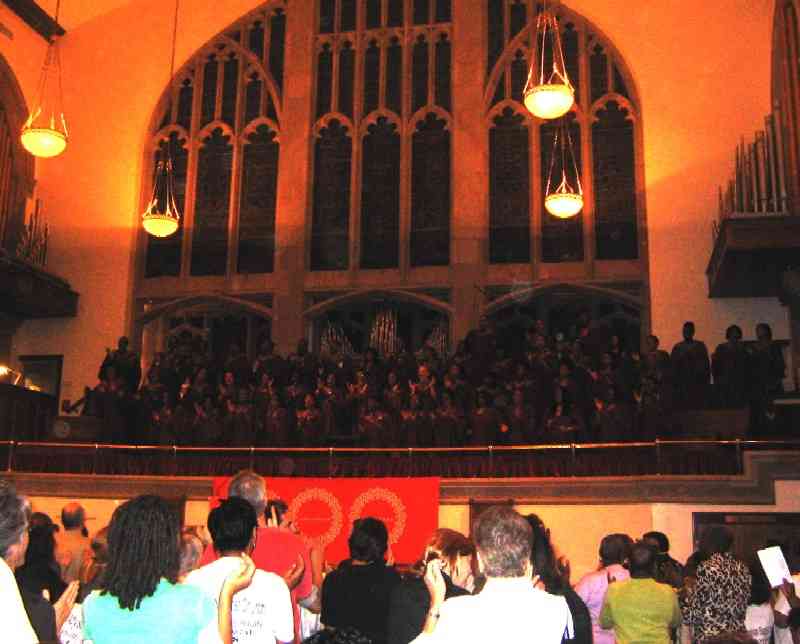
 Gospel Choir, Abyssinian Baptist Church, World Science Festival, New York, 31-MAY-2008
M  usic has a unique ability to animate us, to initiate activity for people who are stuck for one reason or another. And it has a unique ability to help us to feel community with others, to bind us together and to reveal and restore bonds that were broken. These are true for all people. But they are true also for people who have diseases, whose bodies prevent them from starting on their own. Stutterers who cannot speak can, amazingly, sing perfectly. People with viral encephalitis lethargica, about whom I wrote in my book ‘Awakenings’, are helped greatly by music. The power of drugs to help—this waxes and wanes. But the power of music never diminishes. With Parkinson’s, the music must only have a beat, a clear-cut rhythm, to get the person un-stuck. With Alzheimer’s, the music must also be familiar music, music from a time in the person’s life before the dementia. Even with advanced dementia, when powers of memory and language are lost, people will respond to music. With a song, it is possible to discover that words are still in there. Finding that out can be very reassuring, say, to a person who has been unable, for 2 years or more, to call forth words to speak. Then, once we know that the words are still there, it is our task to see whether we can elicit them at other times [when music is not there] and make them available for general use [once again]. It is the basal ganglia, the brainstem, the cerebellum, and some parts of the motor cortex; it is the mammalian old hindbrain. That is where these music-related connections are, and why the ability for music to liberate a person is impervious to diseases that destroy other parts of the brain, the intellect. Actually, I say ‘mammalian’, but every time I do someone tells me about ... cockatoos. Perhaps it is not just mammals...”
  —  Oliver Sacks, Abyssinian Baptist Church, New York, 31-MAY-2008.
There is a tendency to place too much emphasis on thought—on higher brain functions and deliberation and intellect—when we think of how we understand and respond to music. To counterbalance that tendency, neurologist-author Oliver Sacks spoke yesterday at the Abyssinian Baptist Church in Harlem, New York, in one of the events that comprise the World Science Festival. The two-hour program featured a performance of many selections of gospel music by the church's 53-member Abyssinian Baptist Choir. There was a standing-room-only sold-out crowd of more than 1,000 in attendance for the event. The World Science Festival was conceived by Columbia University physicist Brian Greene and his wife, Tracy Day, who is a broadcast journalist.

  • Over My Head (Arr., R. Jennings)
  • Woke Up This Morning (Arr., J. Bolding)
  • We’ve Come This Far by Faith (Arr., J. Bolding)
  • Lift Every Voice and Sing (Arr., R. Carter)
  • Order My Steps (G. Burleigh)
  • Total Praise (R. Smallwood)
  • That’s How the Lord Works (Arr., J. Bolding)
  • Didn’t My Lord Deliver Daniel! (Arr., J. Bolding)
  • For Every Mountain (Arr., J. Bolding)
  • This Little Light of Mine (African American Spiritual)
 Sacks book
Two CMT posts last month concerned assistive technogies, to help disabled people regain and maintain abilities to perform music, particularly in a chamber music setting. But the Abyssinian Baptist Choir concert last night and Dr. Oliver Sacks’s and Rev. Dr. Calvin Butts’s talks (and this CMT post) are reminders that music itself is an assistive technology that promotes the health of the individual and the well-being of the community/society.

Consider, too, that a dimension of the ‘intimacy’ that is definitional of chamber music idioms is that chamber music is assistive in connecting each of us with our true selves—it induces an intimacy of self-awareness, self-discovery, self-actualization. In other words, the intimacy of chamber music is not purely discursive, interpersonal intimacy. It is intra-personal as well; it is about intimate identity. Those who, through the ravages of Alzheimer’s or stroke or other conditions, have lost their memory of their own personal history or identity know this more acutely than the rest of us. The amount of the processing of musical stimuli (and the amount of the synaptic storage and processing associated with personhood and identity) that is located in lateral prefrontal regions, in motor cortex, and in the amygdala, hippocampus, and other limbic structures (ones that are only tangentially connected with intellect or volition) in the brain is suprising, as Grahn and others have recently observed in their fMRI imaging studies. The heart of the emotional brain responds innately to psychophysiological stimuli associated with realistic musical scenes and animalistic rhythms—even the mere suggestion of rhythms or songs, as Sacks says. Our true selves are (partly; substantially) down in those non-intellectual structures, too.

 Snyder book
Those who, through Parkinson’s or other diseases, have lost their ability to initiate actions that manifest their will and their personhood also know that music can assist or restore these—a major point of Oliver Sacks’s remarks. There is a physiologic immanence that is fundamental to music—the rhythm of music is the vehicle for it, more than melody or harmony. The latter are ‘added bonuses’, as Sacks put it. Gospel singing is, apart from its other notable features, inherently physical, intensely rhythmic, radically anticipative, contagious.

 Huron book
The ‘intimacy’ of gospel singing as a species of chamber music is also inherently communitarian—the solidarity and support and intimate belonging and acoustically-mediated enclosedness of the congregation; the musical rhythm-enforced inclusiveness that accepts divergence and difference ( ‘alterity’ ). At one point during last night’s performance, one of the women Abyssinian Baptist Church congregants leapt into the aisle and began shaking and shouting ecstatically. Two of the ushers stood by, but the woman did not collapse. So moved by the music, she continued her rhythmic ‘speaking-in-tongues’ shouting and shaking, at a decibel level often exceeding that of the large choir. The chamber culture and the chamber singers welcome this and recognize and assimilate it as part of the intimacy of worship in community. Sacks recommended that musical training in the schools should be a major curriculum priority, given the large social and health benefits that are known to be associated with engagement with music. In enthusiastic agreement with this remark, the crowd cheered and gave Sacks a standing ovation.

S  teven Mithen has written about this … his experience of discovering his own musicality. He was humiliated when attempting to sing as a child, and stayed away from singing for more than 30 years. Now in his forties, he decided he would take singing lessons for one year. Before he began, he got an fMRI scan of his brain. And, after singing for a year, he arranged to get another fMRI. The corpus callosum and other parts of his brain had dramatically changed in size. The changes were obvious. And it has been found in other musicians, too. We could look at fMRI scans of Albert Einstein’s brain or Brian Greene’s brain, and you could not tell the difference between the brains of mathematical physicists or cosmologists and the brains of ordinary people. But I dare say if you got an fMRI of any of the people behind me [gestures toward Abyssinian Choir members in loft] and you would say ‘This must be the brain of a musician’. It is that dramatic. Of course, it is not yet clear how much of this difference is due to genetics—music-induced structural differences in those who have already musical potential—and how much is from the musical training. But the effect is real. Engaging in music changes your brain.”
  —  Oliver Sacks, Abyssinian Baptist Church, New York, 31-MAY-2008.
The World Science Festival programs continue today with a performance by jazz singer Marilyn Maye (born in Wichita in 1930) at the Kimmel Center, with lectures by Robert Butler, David Sinclair, and Richard Weindruch entitled ‘90 Is the New 50: The Science of Longevity’ at the Eisner & Lubin Auditorium at NYU—how music may help us to live longer, in addition to helping keep our wits and our initiative and our community.

W  hat we have been studying ... is that when you pray, there’s actually a physiological change in the body. Music is very much a part of this. There are certain notes that generate in the human body a kind of peacefulness.”
  —  Rev. Dr. Calvin Butts III, pastor, Abyssinian Baptist Church, New York, 31-MAY-2008.
 Yang painting

 fMRI image of brain