Wednesday, December 5, 2007

Bronfman and Everest: Balakirev’s and Ravel’s Virtuosic Fantasies

Yefim BronfmanIn the U.S. the new season of DiscoveryChannel’s documentary, ‘Everest: Beyond the Limit’, is currently being broadcast as an ongoing series of television programs. Each episode shows climbers—young and old ones, highly-skilled ones and relative novices—risking their lives trying to reach the summit of Everest. Not surprisingly, the drama revolves around the steepest, riskiest, most hostile parts of the climb. We viewers feel a [morbid?] fascination with the ever-present possibility of catastrophe—a fascination equal to the admiration we feel for the climbers’ endurance and achievements and successes. The spectacle of the natural beauty that’s connected with the pursuit captivates us, too, as does the diversity of humankind when (self-) driven to these extremes——when (self-) driven to accept such suffering and risk, in pursuit of an extreme, world-class goal.

Everest
‘Summits’ of a different kind—musical comparables to Everest—are in store when pianist Yefim Bronfman performs on Friday evening in the Kansas City Friends of Chamber Music Master Pianists Series. The program includes Balakirev’s ‘Islamey’ and Ravel’s ‘Gaspard de la nuit’, among other works. The program requires a capacity to play these technically demanding works—prodigious athleticism—but never decoupled from the capacity to play with interpretive skill. In other words (and to paraphrase Stephen Pettitt, music critic of The Times in London), true virtuosity requires as much poetry as athleticism—or so Bronfman implies, in devising a program like this.

A  virtuoso is a musician who can play with panache a score of seemingly impossible technical difficulty... The north face of the Eiger has been conquered. The musician has, once again, triumphed over impossible adversity... A significant part of the musician’s craft has to do with the acquisition—through many hours, many years, of arduous, repetitive practice—of a very particular athleticism, one that enables the accurate playing of a large number of notes within a small amount of time while still making a pleasing sound. Virtuoso playing is a high-wire act, and the sensation it delivers to the audience similar. Surely he’s going to fall off at that speed, we think. When he gets to the other side intact we still think it a miracle. … Surely some dark magical force must be at work to enable such superhuman miracles of execution. … Indeed, is what seems like virtuoso playing necessarily that? Don’t misunderstand me. Even if its purpose is simply to thrill its audience, much as a particularly adroit footballer thrills with a piece of consummate skill, there’s nothing wrong with this showy variety of virtuosity. It’s fun to hear — and see — a violinist skate across a Paganini Caprice now and again. Yet it’s hardly a test of the most insightful musicianship. The player isn’t required to see between the notes, because between the notes there lies precisely nothing. There’s no insight into the human condition. No miracle of contrapuntal logic. Just a musician showing off his or her amazing skills. But maybe we should recognise more generously than we do the exercise of the inconspicuous brand of virtuosity... Virtuosity need not be a matter of playing lots of notes brilliantly at all. The truth is that all serious music worth the playing and singing, no matter how physically simple it might seem, requires a certain virtuosity of the mind. … Although the notes in Mozart might come relatively easily, the contextualising of them, the weighing of them, the nuancing of them, does not. Mozart demands such precision of touch, colour and phrase that an interpretation can fail on the slightest contextual faux pas. Moreover, it’s the performer who must find a personal context, since playing Mozart is no more a matter of choosing one correct way than is playing anything else. Control and freedom need to co-exist in perfect balance, so that the mysterious eloquence of the music is allowed to emerge, the player opening a window on to the soul of a miraculously gifted person. That is true virtuosity.”
  —  Stephen Pettitt.
In 1928, Ravel wrote, “ ‘Gaspard de la nuit’, piano pieces after Aloysius Bertrand, are three romantic poems of transcendental virtuosity.” Well, Mozart can be technically demanding, too—the two-part cadenza of the opening allegro of K 466, for example. But we usually think of the virtuosity required for Mozart as predominantly interpretive virtuosity. Similarly tough: revealing the emotion in Chopin without falling into cliché, or articulating the voices within Bach without being stilted and suppressing the emotion or creating a fugue-pastiche. Ravel’s ‘Gaspard de la nuit’ imposes demands that are simultaneously interpretive and technical/athletic——hideously, dauntingly so. Aloysius Bertrand’s prose-poems, ‘Gaspard de la nuit: Fantaisies à la manière de Rembrandt et de Callot’, were published posthumously in 1842 and re-issued in 1895, when Ravel’s friend Ricardo Viñes discovered them and introduced them to Ravel. Later Ravel returned to the poems and was captivated by their grotesque, hallucinatory imagery as an evocative subject for a piano composition.

And what about ‘Islamey’—composed in 1869 by Mily Balakirev, then 32 years old? The first theme is a folk dance from the Caucasus. The prevalent augmented seconds lend a south Asian ‘islamic’ aspect. The central section is lyrical and derives from an Armenian folk song. The slow, exotic middle section contrasts with the energetic outer parts. In the third section, Balakirev reprises the thematic material of the opening, culminating in a pyrotechnical coda. ‘Islamey’ is comprised of variations with increasingly, insanely, demonically complex elaborations. (Maybe we should note that Balakirev had a nervous breakdown in 1872, three years after composing this piece?) So our definition of ‘virtuosity’ gets worse: virtuosity is defiant and risky; it tempts fate; it scoffs at danger. It wouldn’t be virtuosic if catastrophe were impossible. You have to work without a safety net! (Balakirev punched out—became a railway clerk for awhile; worked as a school inspector until 1883; then returned to music as Director of the Imperial Chapel and conductor of the Imperial Musical Society, where he remained until retiring in 1895.)


I n music, no less than in athletics, audiences thrill at witnessing exceptional feats of physiological accomplishment, and they fête and reward those who
afford them such thrills.”
  —  Jane O’Dea, p. 40.
Everest
H e did not appeal to the emotions, except those of wonder—for his playing was statuesque, cold, beautiful, and so masterly that it was said of him, with reason, that he would play with the same care and finish if roused out of the deepest sleep in the middle of the night.”
  —  Sir Charles Halle, review of Thalberg, quoted in O’Dea, p.39.
In ‘Performance as an Extreme Occasion’, Edward Said writes that the contemporary concert is an extraordinary event, highly specialized and totally alienated from ordinary life. Before the mid-20th century performers were often also composers, and listeners were also often amateur musicians. Today the audience is marginalized. The specialized artist so ‘owns’ the work today! The recital has come to be an occasion for the display of extreme ability—on a level that’s totally alien to the listeners, most of whom are neither familiar with the scores nor play any instrument or sing. Their ‘regression of hearing’ (Adorno’s phrase) is manifested in “the listener’s poignant speechlessness as he/she faces an onslaught of such refinement, articulation and technique as almost to constitute a sado-masochistic experience.”

The audience has become more passive and concurrently we get this spectatorly cult of virtuosity. But why has social power recently captivated the imagination of popular culture—and academic anthropologists as well? Surely it’s not just a consequence of fewer practicing amateurs! Is it instead a society-wide reaction to our diminishing power as individuals? Is it a reaction to the decimation of social cohesiveness by the recent emergence of long-tailed, fragmented, web-based culture? Is it a backhanded way to oppose the ‘colonization’ of our selves—that is, an endorsement of and vicarious participation in demonstrations that individual victory over mass culture is still possible—more than gazing at an athlete/artist’s literal victory over physical difficulty?

Stanley Barrett asserts that the answer can be found in the effect of the past 100 years’ warfare throughout the world; the end of old colonialism and emergence of new forms of colonialism under the guise of multinational corporate globalization; the information and technology revolution, mass culture and cultural fragmentation. “The notion of a homogeneous, cohesive, geographically-bounded local culture consisting of people who share a putative common ancestry is obsolete,” he says. The diversity of distinctive cultures and identities “has become constricted, and ‘culture’ has become the new equivalent of ‘race’: difference-as-inferiority; new structures of exploitation and domination; new relations of power saturated with new possibility of inequality and disparities.”

I hope that hearing Bronfman perform on Friday may shed additional light on these issues. Me, I’ll be listening from a moderate elevation, at ‘Base Camp #3’!

T he question of the relationship of the individual person or subject to domination carries ‘resistance’ to the level of consciousness, subjectivity, intentionality, and identity.”
  —  Sherry Ortner, Anthropology and Social Theory: Culture, Power, and the Acting Subject.
Everest: Cairns (memorials to those who have died on the mountain)
[Mr. Bronfman was born in Tashkent, in the Soviet Union, on April 10, 1958. Bronfman immigrated to Israel with his family in 1973, and made his international debut two years later with Zubin Mehta and the Montreal Symphony. In Israel, he studied with pianist Arie Vardi, at the Samuel Rubin Academy of Music at Tel Aviv University. In the United States he studied at Juilliard and the Curtis Institute—with Rudolf Firkusny, Leon Fleisher, and Rudolf Serkin. He made his New York Philharmonic debut in May l978 and his New York recital debut in January 1982 at the 92nd Street Y. Bronfman became a U.S. citizen in 1989. In 2006, Bronfman partnered with Emanuel Ax in Mozart's ‘Concerto for Two Pianos’ conducted by Lorin Maazel. Early in 2007 he premiered Esa-Pekka Salonen’s Piano Concerto, written for him and commissioned by the New York Philharmonic. In addition to solo recital appearances, he recently served as the Pianist in Residence with the Berlin Philharmonic and completed recordings of all the Beethoven piano concerti and the Triple Concerto with violinist Gil Shaham and cellist Truls Mork with the Tönhalle Orchestra Zürich under David Zinman for the Arte Nova/BMG label. Bronfman is a “Perspectives” artist at Carnegie Hall during this 2007-08 season.]

Everest: Prayer Flags, Rocks, Fog


14 Nov 07

Release (3) letters to parents

I do appreciate all of your blog slog, and that you've tempered some of my excesses and perversions with your editing skills. My mind is such that my prose is prone to going beyond left field, not as much as it used to, but still it manages to go there somehow and I don't even notice it at the time. You've given so much of your time, typing it up, editing and dealing with my emails, what will you do when I'm in charge? I understand your qualms about handing it over. It's safe with me. Honest! Ha! Ha!

Copyright © 2006-2007 Shaun P. Attwood

Tuesday, December 4, 2007

13 Nov 07

Release (2) letters to parents

Today has been a day of conflicting emotions. Thanks for putting in the calls necessary to get the wheels of bureaucracy turning. I am insanely happy that my release was finally confirmed this afternoon, and I have been scheduled to be picked up by Immigration this Friday. This morning C03 H. told me, “Your release is confirmed,” at which point my heart leaped, and he then added, “but you’re not actually down as being scheduled for release,” at which point my heart sank again. Getting released isn’t easy.

The prisoners who knew I wasn’t scheduled for release (because word came back from the prisoner clerks privy to these things) have been placing bets on whether or not my release would go through and what day they expected me to get out or whether I’d be stuck here until my next release date. Some still doubt I’ll get out on Friday. Others have been shaking my hand offering congratulations and asking for my mailing address in England. A few people who have barely ever talked to me before, have come to my cell, struck up a conversation, and then at the end of it have asked me something like, “By the way, have you decided who you are going to give your sunglasses to when you leave?”
Departing prisoners shower their friends and neighbours with gifts in the form of personal property before they leave. Everything from my orange sportswear down to my pencil sharpener must go. People started asking me months ago. The first was
Too Tall after my tumbler and lid, an item that has served me well for smuggling meals out of the chow hall (when I’ve had to postpone eating due to my work-outs with Iron Man). Then came Red after my chess set, and numerous people after my dictionaries.
Part of me, although my soul is full of joy, still doesn’t believe I am about to leave this prison. That part of me will not be satisfied until the guards in the control room tell me to roll up. Upon hearing those winged words and having that last bit of doubt dismissed, I’m sure my excitement will ratchet up several levels above how I’m feeling right now.

I’m going to miss my friends on Yard 1.
Weird Al’s sarcasm. Working out with Iron Man – a truly strong man who’s added some new dimensions to my life. I’ll miss Xena, who is in the hole and out of reach of the parting kiss some of the blog readers were hoping for. Kat came by yesterday and while shaving my back suggested we go one further than what had been proposed with Xena. Don’t worry, I didn’t, as Xena likes to say, "pitch a trouser tent." Almost six years in now and I’ve not (like Frankie predicted I would at the five year mark) gone with any cheetos.

Weird Al just came in and said CO3 H wants to see me.
“I’ve got good news and bad news, which do you want first?” CO3 H said.
“The bad,” I said, my heart sinking again.
“You are not getting out on the 16th.”
“What?” Panic setting in now.
“The good news is that you’re getting out on the 20th. Immigration needed seven days notice, the 16th only allowed for four.”
“Well, at least I am getting out. I guess I can hang out for another four days.”

Do you see how things change by the minute around here? It’s madness. Anyway, it’ll give me a little longer with my friends here, and the 20th will arrive in no time at all. It’ll also give me a chance to finish the book I just started: Mario Puzo’s
The Godfather Returns.

Email comments to writeinside@hotmail.com or post them below

Copyright © 2006-2007 Shaun P. Attwood

Sunday, December 2, 2007

Trio Mediæval: Dark Winters, Mythical Thinking, and the Duty to Invent

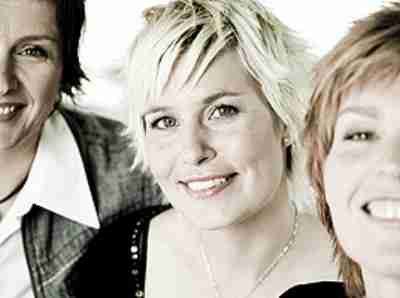
Trio Mediæval, photo by Mikkelsen
A  principle that is characteristic of both mythical and musical thought is that which is referred to as ‘calculus of combinations’. According to this principle, myth consists of distinct elements or ‘mythemes’, which the narrator of a myth—like any speaker of a language—may combine by obeying certain rules, thus creating mythical stories and utterances. The same principle can be found in folk music as well. ...Folk-melodies reshape and transform themselves everywhere. ...[Only fragments] have survived in the memory of the people. It is due to this fact that the melody includes numerous tonal irregularities.”
  —  Eero Tarasti, p.45.
Trio Mediæval’s performance yesterday (02 December) at Cathedral of the Immaculate Conception in Kansas City was exceptionally good. The weather outside the filled-to-capacity cathedral was freezing, and the audience deeply appreciated the Trio’s warmth and charm.

It isn’t often that we think of medieval singing and jazz improvisation at the same time. But, in fact, much of the charm derives from improvisational qualities of the Trio’s performance. The ‘tralling’ (mouth-singing, of rhythmic nonsense syllables); the ornamentations and microtonal shadings they applied to various figures, especially in solo passages; the antiphonal and aleatoric effects they used in several songs as they sang, dispersed in different locations within the cathedral sanctuary and, walking, converged on the central altar platform; the atmospheric effects by guest percussionist Birger Mistereggen, who simulated blustery gales, drifting snow, sea blown against a rocky shore, wind clacking icy branches together, cows in a mountain meadow, animals in the stable, etc.—all of these were delivered in an engaging, extemporaneous, dramatic manner. The improvisational effect is more evident because the Trio does not rely on sheet music during performances: the entire recital is done from memory.

If as a child you were ever thrilled by a parent or grandparent who told you bedtime stories from memory, confabulating new and exotic features on the fly, that is the spell-binding effect that you can expect from Trio Mediæval’s singing. It is a spell of clan and family, longing and belonging. Etymologically, ‘tralling’ → ‘thralling’ → ‘enthralling’ → ‘enthralled’ : the listeners who were these songs’ original target audience were induced to be ‘in thrall’ to the clan elders/chieftains/society whose songs these are. No mere artifacts, these folk songs were ancient normative generators, anchors, and enforcers of cultural identity, family identity, individual identity—the songs were a means for the continual inculcation and (re-)invention of identity, desire for community, and belonging. Ethnomusic-archy!

In fact, that inventive quality is a fundamental aspect of traditional Scandinavian skaldic poesy. The nominal sketch, characters, sequence of events, and so forth are there. The framework of the story must be respected, but the storyteller who recreates the story is obliged, aesthetically, to personalize and revivify it in the retelling. Each time the story is retold, the storyteller must extemporize and breathe fresh life into the story. Considerable dramatic license is granted for the performers to embellish and resequence, to repeat or return to subplots or vamp and emphasize some feature of a character or location, some interaction between characters that bears some special relevance to members of this audience on this night’s retelling. Trio Mediæval’s improvisations are just like that: faithful, conspiratorial, storytellerly improvisations.

Trio, Bergen 2007
After all, this historically-informed performance (HIP) practice is serious ethnomusicology, but it is not museum conservation of static texts. The music is continually evolving. The Trio focuses on individual performers and the insights gained from them about learning how to arrange and sing this traditional material, and performing such folksongs in public. The Trio’s website notes some of those who have preserved this oral tradition, from whom the Trio has derived some of their arrangements of these tunes. Although a first-rate singer or Hardanger fiddler may take up tunes (‘slattar’) from other performers past or present, it’s incumbent upon a new performer to add something of her/his own whether it be different ornamentation or varied rhythms or new ‘mouth sounds’. It would be banal to slavishly reproduce what has been done before. It would be ‘bad form’ and aesthetically false. Conservation is not sufficient for authenticity. It’s essential that skalds/singers contribute something new and diverting each time. True also of the folkmusic and stories of Finland, Iceland, and Sweden. Think of Eddas and sagas; think of Kalevala.

In this concert we were reminded that myth and music are two forms of discourse that are interrelated, as Eero Tarasti and others have written. Trio Mediæval reveals to us precisely and vividly how they are related. Bravo!

Aubert book
I  f music has its own place in all reflections on culture, it [holds this position of power] by the stakes it represents. Music is indeed never insignificant. It is simultaneously a strong and unifying means of communication and a revealer of identity within the abundance of models that characterise a society.”
  —  Laurent Aubert, Music of The Other.


8 Nov 07

Release (1) letters to parents

It's hard not being able to phone you just when I need to keep you up to date with my release. Luckily I can phone Barry or Sue-O to email you messages. I've applied to get the 520 phone number back on the list, but I'm hoping to be out of Santa Rita before they process my request, in which case I'll be calling you on the 520 number from Immigration.

I saw the counselor yesterday and the day before, and he said that my release has not been processed at this unit yet according to his computer screen. Apparently, Time Comp does its thing, then sends the release package here, and these people have to process it. Other prisoners are telling me to have someone call down here, so it gets done. I’m going to e-mail you the info via Sue-O.

Email comments to writeinside@hotmail.com or post them below

Copyright © 2006-2007 Shaun P. Attwood


07 Nov 07

Dear Mum & Dad

In a letter from Jon:

T-Bone’s parting advice moved me greatly, especially when he emphasised how I need to talk to you two when I get home and to get to know more about you as human beings. I agree with him wholeheartedly. Some talks are in order. He also pointed out that Mum’s stress over me adjusting to freedom is grounded in love. I know this, but I don’t want you, Mum, to wear yourself out with worry. I’ve caused you enough heartbreak, and couldn’t be more ashamed of the hurt I’ve caused you. I want to do whatever I can to lessen your burden.

I'm concerned about Mum’s dreams of me with drugged-up eyes. The partying I did produced a disaster for all of us. It did not produce the endless fun I’d imagined. It produced imprisonment and a chain reaction of emotional damage to the people who love me the most. There’s no way I can allow the set of circumstances that led to that disaster to ever happen again. I did drugs because I felt inadequate. I was unhappy with my sober self and drugs brought out an alter ego that attracted people like crazy. This persona took over because I lacked the strength of character to be myself. That’s not the case anymore. My character has strengthened, and I’ve become who I am. I no longer feel the need to impress people by acting like a loon. I am happy with who I’ve become. And this transformation is probably the biggest benefit I’ve received from incarceration, and the reason I no longer feel that I need to take drugs to compensate for something I lack in a natural state.

It’s my hope that your feelings of worry will be assuaged if you try focussing not on my past, but on the person I have become, the real me, the me that’s entering the world confident he will not repeat the past disaster, or let anything prevent him from pursuing a positive, healthy, and happy lifestyle.

With love, Jon


Email comments to writeinside@hotmail.com or post them below

Copyright © 2006-2007 Shaun P. Attwood

Saturday, December 1, 2007

Trio Mediæval: A Cappella Anagnorisis

Trio Mediæval, photo by Wesenberg
H  e was the solitary and lucid spectator of a multiform, instantaneous and almost intolerably precise world.”
  —  Jorge Luis Borges, Funes the Memorious.

Trio Mediæval was recently broadcast on NPR St. Paul Sunday [18-NOV-2007]. The a cappella performances of the Trio are a consummately precise blending, with perfectly tuned and controlled pitch and exquisitely matched vibrato. Trio Mediæval’s next live performances will be tomorrow (02 December) at Cathedral of the Immaculate Conception in Kansas City, on 04 December at Weill Recital Hall at Carnegie Hall in New York City, and on 14 December at Bijloke Concertzaal in Gent.

T  he voices of three women, each one distinct and yet all three closely melded. Nothing else... dark silence all around them. I think the group is breathtaking: arresting, vivid, calm but never peaceful, with every moment ready to bring a surprise.”
  —  Greg Sandow, The Wall Street Journal.

Y  ou can’t sing a footnote.”
  —  Susan Hellauer [of Anonymous 4], on performing medieval music.

A  harmony-led view of the music hears a sequence of vertical sonorities made up of rhythmicised pitches proceeding in a linear fashion, while a counterpoint-led view hears lines of rhythmicised pitches that proceed through changing vertical relationships. Put like that, it is not easy to see the difference. But it is in fact a dichotomy that has been perceived between these two views-or, if you prefer, an insistence on perceiving a difference between them-that lies at the heart of the century-long debate about the hearing of medieval music.”
  —  Daniel Leech-Wilkinson, The Modern Invention of Medieval Music, p. 158.
The first note of a phrase doesn’t get as much attention as cadential notes. But trills, morulae, tremulae, appogiaturas, and microtonal variations—especially on penultimate notes of phrases, and especially when the note is a ‘longa’ and when the interval between it and the following note is an ascending half-step—these increase the already-heightened dramatic tension. When such ornaments are performed slowly and with obvious deliberation, the tension is further increased. Rhetorically, the impact is similar to that of organum purum sung by the upper voice, with a lot of latitude with regard to timing/tempo.

I know only a tiny bit of Norwegian, and this lack of fluency substantially frees me from the literal textuality of the songs. The sounds seem timeless, in part because my linguistic deficiency decouples my comprehending process from the lyric. The sounds also seem ‘permanent’. Compared to the age of these sounds, how minuscule is the time we have to live! The songs remind us of our own mortality, and of the continuation of the world without us. How exactly do these songs ‘work’? And why do the songs’ solitariness and mesmerizing effect remind me of the fiction of Jorge Luis Borges? How medieval/post-modern is that?

Folk Songs
  • Anna Maria Friman, soprano
  • Linn Andrea Fuglseth, soprano
  • Torunn Østrem Ossum, soprano
  • Birger Mistereggen, guest percussion and mouth harp

  • Det lisle bånet (The little child)
  • So ro, godt barn (Rest now, sweet child)
  • Villemann og Magnhild (Villemann and Magnhild)
  • Tjovane (The thieves)
  • Nu solen går ned (The sun is setting)
  • I mine kåte ungdomsdagar (In my reckless, youthful days)
  • Gjendines bådnlåt (Gjendine’s lullaby)
  • Rolandskvadet (The song of Roland)
  • Solbønn (Sun-prayer)
  • Eg veit i himmerik ei borg (I know a stronghold in heaven)
  • Nu vilar hela jorden (All the earth now rests in peace)
  • Springdans fra Vestfold (Dance from Vestfold)
  • Eg aktar inkje (I don’t think much of those boys)
  • Den elskte Jerusalem (Beloved Jerusalem)
  • Till, Till, Tove (mountain pasture song)
  • Lova Line
  • Danse, ikke gråte nå (Dance, do not cry now)
  • Den signede dag (Day of joy)

The nonsense-syllables (‘tralling’) add to the hypnotic, atemporal quality of the songs. This idiom involves a sequence of improvised syllables, instrumental-sounding passages, and uneven accents—and in this respect ‘tralling’ is similar to Scottish and Irish gaelic ‘mouth music’. Trio Mediæval also does a type of mountain pasture singing known as ‘laling’—an example is the cattle song ‘Till, Till, Tove’.

These contrasts in sonic texture emphasize the transitoriness and shallowness of much of our daily lives and conversations. The contrasts in texture are like Rilke’s cathedral Rose Window; are like Blake’s Tiger’s Eye with its deep fearsome symmetry. The contrasts are like blue-water sailing—water so deep it may as well be bottomless. The Trio’s textural contrasts set up a kind of ‘force-field’: the voices’ effacement of the self induces in us an alienating desire to live an imaginary life in the medieval ‘amour-propre’ sonic space that they create.

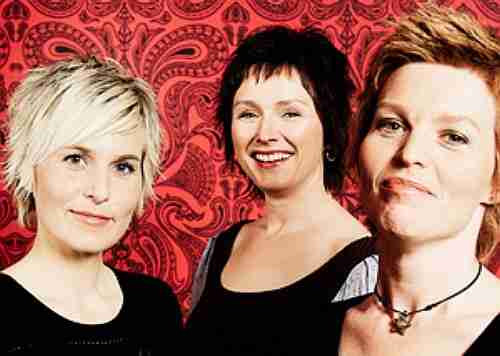
Trio Mediæval, photo by Mikkelsen
W  hy mightn’t there be, somehow, a new science for each object? A Mathesis Singularis and no longer Universalis?”
  —  Roland Barthes, Camera Lucida.
Through these folk songs there emerges a dialectic of signs and symbols, a precursor to the modern, Wittgensteinian notion that the self is a by-product of language, the conflict between particularity and generality, the conflict between the individual and her/his expression: the concept that language and public and private narrative are what enables us to be ourselves. (Self-) consciousness is inhabited by linguistic otherness!

The fact that language is so important in our experience of ‘self’ might lead us to expect that the narrative tension between our private selves and public others must eventually resolve. In fact and paradoxically, with these songs our conventional language-based concept of identity produces the opposite effect. These songs make us seek sources of authentic individual identity beyond language.

The song ‘Gjendines bådnlåt’, for instance, betrays the extent to which the individual is shaped by society and by public discourse. The mother’s lullaby portrays the self as a collage of experiences and begs the philosophical question as to whether there is anything more to us, anything immortal. Introspection in the company of a baby too young to speak; a solitariness-together: the drive toward authenticity leads the song to seek alternatives in unisons and silence—a silence more ‘telling’ than words—in the hope of finding a form of expression for a mystical self, one that will not grow old and die.

T  he songs are on fire: the Trio quests for more, ever more immediacy—until one wonders whether the escalations can possibly continue. The Trio’s quest for this supremely authentic self is manifested by a relentless search for sonic truth and timbral purity, even if that search involves, paradoxically, severing the sound/truth from the self (the three singers’ selves), from the sound’s/truth’s substrate. This is an aspect of the ur-scandinavian temperament: a violent, unremitting quest for truth and transcendence through beauty, which inadvertently ends in solipsism, often in desolate wildernesses and darkened churches. This skaldic view is my birthright. I recognize it when I hear it. I am myself Norwegian.”
  — DSM.

T  he voices blend and fuse in clouded silence: silence that is the infinite of space: and swiftly, silently the soul is wafted over regions of cycles of cycles of generations that have lived.”
  —  James Joyce, Ulysses.
From the sonorities—the interplay among the notes and the silences reverberating in the cathedral as the Trio sings—one forms new understandings. The listener’s imagination is propelled to new vistas, much in the way that James Joyce’s run-on prosody can move us. The counterpoint between the parts’ colors and rhythms and the sculpted diminuendos that collapse sounds into silences all contribute toward shaping the music into something we can understand, even without our comprehending the Norwegian words. This mental process is like reading Finnegan’s Wake without aiming to decode the English words, understanding it instead by osmosis. Joyce’s writing is not ordinary narrative prose: it is performance art, sculpted poetry, hell on wheels.

When we listen to these folk songs, silence and space play primary, essential roles enabling/compelling us to understand, dividing the cathedral into gestures and sounds, using the gestures to discover a path through sonic ambiguity. Silences provide textural contrast that confers meaning upon the text, and qualifies or reinforces the surface meanings that are present in the text.

Trio Mediæval, photo by Mikkelsen
T  he silent images in the soul bring their silence to the words that are the life of the mind. They work silence into the texture of language: they keep it
supplied with silence, with the original power of silence.”
  —  Max Picard, Die Welt des Schweigens.

I  n the realm of Western art music, silence is generally perceived not as the original power at the centre of the texture, but at the opposite extreme: its acknowledged function is to provide the conventional matting, frame, and structural delimiters to ease and define listeners’ reception of a performance... the dimming of lights, cessation of audience noise, and quiet ambience between movements. [In Mozart,] the silence lacks sound but not motion, the moment of no-sound carrying forward and raising urgent expectations of what is to come. [e.g., piano concerto in G major, K. 453, m.224].”
  —  Jenny Doctor, Silence, Music, Silent Music.
The first movement of Haydn’s String Quartet Op. 71 No.3, mm. 1-14 has a bar of rest with a fermata, right before the Vivace begins-and unison eighth-note rests subsequently. The silence of the four parts is a way of manipulating the listeners’ expectations of tension and release, of stasis and action. It’s a valuable compositional tool, an effective motivic device—one that arises frequently in the Trio’s arrangements.

S  he told me that Ireneo was in the back room and that I should not be disturbed to find him in the dark, for he knew how to pass the dead hours without lighting the candle. I crossed the cobblestone patio, the small corridor; I came to the second patio. A great vine covered everything, so that the darkness seemed complete. Of a sudden I heard the high-pitched, mocking voice of Ireneo. The voice spoke in Latin; the voice (which came out of the obscurity) was reading, with obvious delight, a treatise or prayer or incantation. The Roman syllables resounded in the earthen patio; my suspicion made them seem undecipherable, interminable; afterwards, in the enormous dialogue of that night, I learned that they made up the first paragraph of the twenty-fourth chapter of the seventh book of the Historia Naturalis. The subject of this chapter is memory; the last words are ‘ujt nihil non iisdem verbis redderetur auditum’. Without the least change in his voice, Ireneo bade me come in. He was lying on the cot, smoking. It seems to me that I did not see his face until dawn; I seem to recall the momentary glow of the cigarette. The room smelled vaguely of dampness. I sat down, and repeated the story of the telegram and my father’s illness. I come now to the most difficult point in my narrative. For the entire story has no other point (the reader might as well know it by now) than this dialogue of almost a half-century ago. I shall not attempt to reproduce his words, now irrecoverable. I prefer truthfully to make a résumé of the many things Ireneo told me. The indirect style is remote and weak; I know that I sacrifice the effectiveness of my narrative; but let my readers imagine the nebulous sentences which filled that night. Ireneo began by enumerating, in Latin and Spanish, the cases of prodigious memory cited in the Historia Naturalis: Cyrus, king of the Persians, who could call every soldier in his armies by name; Mithridates Eupator, who administered justice in the twenty-two languages of his empire; Simonides, inventory of mnemotechny; Metrodorus, who practised the art of repeating faithfully what he heard once. With evident good faith Funes marvelled that such things should be considered marvellous. He told me that previous to the rainy afternoon when the blue-tinted horse threw him, he had been—like any Christian—blind, deaf-mute, somnambulistic, memoryless. (I tried to remind him of his precise perception of time, his memory for proper names; he paid no attention to me.) For nineteen years, he said, he had lived like a person in a dream: he looked without seeing, heard without hearing, forgot everything—almost everything. On falling from the horse, he lost consciousness; when he recovered it, the present was almost intolerable it was so rich and bright; the same was true of the most ancient and most trivial memories. A little later he realized that he was crippled. This fact scarcely interested him. He reasoned (or felt) that immobility was a minimum price to pay. And now, his perception and his memory were infallible... A circumference on a blackboard, a rectangular triangle, a rhomb—are forms which we can fully intuit; the same held true with Ireneo for the tempestuous mane of a stallion, a herd of cattle in a pass, the ever-changing flame or the innumerable ash, the many faces of a dead man during the course of a protracted wake. He could perceive I do not know how many stars in the sky. These things he told me; neither then nor at any time later did they seem doubtful. In those days neither the cinema nor the phonograph yet existed; nevertheless, it seems strange, almost incredible, that no one should have experimented on Funes. The truth is that we all live by leaving behind; no doubt we all profoundly know that we are immortal and that sooner or later every human being will do all things and know everything.”
  —  Jorge Luis Borges, Fune the Memorious.
Borges’ Funes the Memorious character is a person who is constitutionally unable to enter into a story. He can remember and retell anything and everything, but he cannot himself play a part in a story, even the story of his own self. In a story we are prepared to accept an updating of our understanding. And most stories are about people who resist the transformation of their perceptions or of themselves, with comic, tragic, or tragic-comic results. But Funes is unable to do this because his mental condition prevents him from engaging in the mutual fiction of singling from the Real, the core Symbolic fiction of singular reference which rides on our trust in each other—author and reader; singers and listeners—a trust which is prepared to have its granting in the mutual ‘taking-for-granted’ meet with disappointment, discouragement, repudiation.

This is very much the Fune-like ‘spell’ that Trio Mediæval casts. The central feature of our listening consists in temporarily imagining that we have a co-reference with the singers, with the songs. But none of our percepts turns out to be mutual—they could never be updated by anyone else; we recognize them as if déjà vu, and we suffer a sort of aspirational disappointment, a leaving-behind. Similarly, Funes suffers in his withdrawal from the world. In principle, Funes shouldn’t be able to speak at all—and, technically, neither can we (while the Trio’s singing persists). The relation of Borges’ narrator to Funes reveals that the mutual trust of language can and does break down. People talk [sing] past each other, and their mutual trust must acknowledge the finite risk of breakdown. It’s not only Funes who is unable to perfect a reliable, unambiguous understanding in dialogue with a fellow human being: the narrator is revealed as trapped within the same dilemma. And we’re trapped in it, too—we are exposed to unexpected sacrifices and losses, for [and of-] those we love and with whom we imagine ourselves to be fully in harmony. So before we can congratulate ourselves on the luxury of being able to forget so much (whereas Funes was condemned to remember so much), we’re reminded that what we remember may not be what our friends or family have remembered and valued: they may be like Funes, recalling something that we had vaguely sensed but didn’t actively notice, something that at that earlier time had been noticed and remembered by them. The poignant ‘anagnorisis’ in these plot-free stories [songs] turns out to be our own!

So, too, in these songs we marvel at the Fune-like precision of the Trio’s members’ memory. These songs—enchanted and enchanting—give us a glimpse of the existence of an enduring, transcendent self. And then we achieve a sudden, anagnoristic realization that we are, and can only be, something less than that self. We may be less memoriously burdened than the Fune-like Trio. But we are, oh, so much more mortal.

G  ode ord skal du hogge i berg; de dårligere i snø. (Praise, write in stone; criticism, in snow.)
Av skade blir man klok—brent barn lukter vondt. (Pain wisens you young; if not wisened, burnt kids smell bad.)
Et lite, men utsøkt selskap, sa mannen—han drakk alene. (Good but small party, said s/he, drinking alone.)”
  —  Norwegian folksayings.

[Linn Andrea Fuglseth founded Trio Mediæval in 1997. Linn Andrea is from Sandefjord and studied at the Norwegian Academy of Music, specializing in baroque interpretation, and the Guildhall School of Music & Drama in London. She has also trained with Marit Isene, Barbro Marklund, Emma Kirkby and Mary Nichols. Linn Andrea has been soloist with the Stavanger Symphony Orchestra, The Norwegian Baroque Orchestra and Det Norske Solistkor. In addition to singing, she conducts a children’s choir in Oslo and writes arrangements of Norwegian folksongs for the Trio.

Anna Maria Friman is a PhD candidate at the University of York, where she is researching modern performance of medieval music by women. She has presented her research at international musicology conferences—including a paper entitled ‘Early Music Singing: Fact vs. Fiction’ in 2002 and another paper at the ‘Voice, Sound and Subjectivity’ conference in 2005. Anna has performed with the Gavin Bryars Ensemble, Red Byrd, Last Century Ensemble, Ciconia Ensemble, Peter Hill, NYYD Ensemble (Estonia), Latvian Radio Choir, Stuttgart Bach Choir, Det Norske Solistkor, Collegium Vocale Gent, and Ricercar Consort directed by Philippe Pierlot. Her work in the U.S. has included recording with the Girl Choristers of Washington National Cathedral. She grew up in Gothenburg, Sweden.

Torunn Østrem Ossum was originally from Namsos, Norway. She studied singing with Svein Bjørkøy at Rønningen County College in Oslo. She has wide experience as an ensemble singer and has performed with groups such as Det Norske Solistkor, Nordic Voices, Con Spirito and Grex Vocalis conducted by Carl Høgset, where she also sings as a soloist. ]

Smith book

Losseff book