Sunday, November 18, 2007

Opposing Throw-away Culture: Future of Program Notes

Fawcett-Tang, Experimental Formats
I wish program notes could be more like:
  • the ‘extras’ that we get on DVD videos, with panel discussions and out-takes, trailers, rehearsal miscellany, biographical and historical documentary collateral;
  • liner notes in CD and MP3 albums—less expository than conventional program notes and more expansive;
  • art exhibit catalogues—nice coffee-table books, objets d’art in their own right and iconic souvenirs that we treasure and display in our houses/apartments.
Program notes form the core of many classical music presenters’ marketing materials. But most printed literature today is disposable: today’s hot communication document is tomorrow’s landfill. Presenters and their donors and the authors of program notes devote huge amounts of time and money to make their material as informative and attractive as it can be. But many audience members treat it as though it were a cheap gew-gaw to divert them from their abject boredom while waiting for the performance to begin. They discard it after the performance, pitch it out without a second thought. This is really, really unfortunate.

The best programs should have a permanence and organic completeness that counters the ephemeral, and increasingly electronic, world of instant communications. A presenter’s program book should embody the best of contemporary printed literature or multimedia design. And I think it should drive the same kinds of revenue and cross-merchandising opportunities that, say, exhibit catalogues provide to museums and art galleries. It shouldn’t be a ‘throw-away’. It shouldn’t be so chock-full of advertising that it can’t function as a coffee-table book or iconic catalogue.

What we need are new formats, new and changing formats and new media—multi-media program note formats that offer the content that we are used to receiving but that also offer critical surveys of current work by leading practitioners from the U.S., Europe and Asia. Arranged performer-by-performer, composer-by-composer and accompanied by interviews, the kinds of new media program notes formats I wish for would offer a more complete and informative picture of the presenter’s programs, artists, and subjects—a more extensive invitation to the readers’ own further thoughts and enjoyment.

What we need, too, are new styles of writing and new, unconventional tone. The tone should be generous. The essays should not try to score ‘points’ (in the way, for example, that Richard Taruskin’s and Bernard Holland’s writing sometimes tries to do). The style should be engaged and engaging, not pedantic.

One of the champions of such writing is composer Robert Kirzinger, who is publications associate and author of program notes for the Boston Symphony Orchestra. By concentrating on the overlooked, and by transforming and manipulating his texts-as-objects into works of art in their own right, Kirzinger both subverts their nominal function and challenges existing systems of classification and modes of discourse. Playful, often fantastic, his work reveals an acute intelligence alloyed to an irreverent and mischievous sense of humor. His are not ordinary program notes or liner notes, to be read and discarded. They are painterly essays filled with exciting imagery. They are adventure stories filled with the suspense of exploration. They are letter-like program notes that have an intimacy, and are written in a conversational style as if to a friend or a family member.

Handsomely illustrated, Kirzinger’s writing is straightforward, readable, and agreeably jargon-free. He can be didactic without being pedantic. Full, traditionally-placed footnotes and URL links make it easy for the reader to pursue particular topics. His critical judgments are often less ‘ends’ in themselves than jumping off points for explorations of particularly vexing problems in composing and performance practice. And, more to the point, general readers, who have perhaps had simplistic ideas of the scope of the music or the composers or the performers, will find themselves reconsidering and re-reading Kirzinger’s program notes. These are not Alex Ross or John Rockwell journalistic essays conglomerated into a book-of-days. These are art objects that have a certain timelessness. They read like Natural History.

Listening cannot be hurried: you have to allow enough time for it. You have to ask yourself how the piece is put together, how it is like other pieces you know and how it is different, and how it fits into the traditions you are familiar with, the works that you enjoy. Kirzinger writes in such a way that readers are not rushed or coerced. Instead, readers are tantalized as well as reassured of the legitimacy of their own independent ideas.

Good program note authors remember that the music itself is more important than all the talk about it, even what is said by esteemed experts. They try not to approach a piece through the fog of what others have said about it, for much of what’s said and written about music can be misleading until you experience the music itself. Good program note authors write without displaying their egos much. Cases in point are Kirzinger’s program notes for Wes Matthews’s ‘Terraces’ (Minnesota Orchestra Composer Institute, 20-27 OCT-2007) or his liner notes [1MB pdf] for Eric Chasalow’s ‘Left to His Own Devices’ CD, an homage to composer Milton Babbitt. Plenty of ‘light’ with no gratuitous ‘heat’ or ’tude.

T aruskin’s points are eminently worth making—but they’re drowned out by the irresistible lure of the lapidary put-down.”
  —  Matthew Guerrieri.

S  tarry-eyed critics of the 1930s and ’40s predicted that by 2007 we would be singing Schoenberg’s ‘Moses und Aron’ in the shower. Most of us still lean toward ‘Embraceable You.’ I hope it is not unreasonable to suggest that composers, not listeners, are the servants here, and that every new opera or orchestral piece they write should be brought in on a tray with hopes that it has something substantial to say that we can like. When Haydn worked for the Esterhazys, he wore a uniform. That’s not a bad idea for our premiere-givers too. They can also tend bar at intermission. How do I prepare for premieres? I read about the people and the circumstances, where the piece came from and what the composer eats for breakfast. If I have a score, I look at the orchestration. It’s nice to know how many crayons are in the composer’s coloring box. I don’t listen to anything [recordings of the composer’s or artist’s work, before attending the performance]. Surprise me.”
  —  Bernard Holland, New York Times, 04-NOV-2007.

A proper note should follow up on points made by the music, the performers, the composers, and their lives and times. Often, music is influenced by or connected with political events of the day, by music of other composers, or other artists (painters, poets, authors). A good note may touch on such aspects of the music. Notes or reviews may discuss your impressions of the music as you listened, but should not lapse into a running commentary on how the music made you feel as you listened or what you did as a result of your internal feelings, nor should they be a medium for public ventilation of some private beef.

J  ust as some chefs excel at seafood and struggle to make a good porterhouse, musicians have strengths and weaknesses, which are often related to temperament, intellect and taste. The all-Brahms first half of pianist Markus Groh’s recital Friday had refinement and clarity of texture but was so stuffy and colorless that I went out onto 12th Street at intermission gasping for air.”
  —  Paul Horsley, Kansas City Star, 20-OCT-2007.

This review may be of use to arts journalism students, as an illustration to prove that images and sentences do not automatically add up to a real review or a real program note. In short, I wish more people who write classical music program notes and reviews would write in good faith and good humor, like Arthur Danto writes about art. If they did, their work would not end up thrown into a rubbish bin.

L et us consider a painting once described by that cheerful Dane, Sören Kierkegaard. It was a painting of the Israelites crossing the Red Sea. Looking at it, one sees something very different from what a painting with that subject would have led one to expect, were one to imagine, for example. what an artist like Poussin or Altdoerfer would have painted: troops of people, in various postures of panic, bearing the burdens of their dislocated lives, and in the distance the horsèd might of the Egyptian forces bearing down. Here, instead, was a square of red paint, the artist explaining that ‘The Israelites had already crossed over, and the Egyptians were drowned.’ Kierkegaard comments that the result of his life is like that painting. All the spiritual turmoil, the father cursing God on the heath, the rupture with Regina Olsen, the inner search for meaning, the sustained polemics of an agonized soul, meld in the end, as in the echoes of the Marabar Caves, into a mood, a single color. So next to Kierkegaard’s described painting let us place another, exactly like it, this one, let us suppose, by a Danish portraitist who, with immense psychological penetration, has produced a work called ‘Kierkegaard's Mood.’ And let us, in this vein, imagine a whole set of red rectangles, one next to the other. Beside these two and resembling each as much as they resemble one another (exactly), we shall place ‘Red Square,’ a clever bit of Moscow landscape. Our next work is a minimalist exemplar of geometrical art which, as it happens has the same title, ‘Red Square.’ Now comes ‘Nirvana.’ It is a metaphysical painting based on the Artist’s knowledge that the Nirvanic and Samsara orders are identical, and that the Samsara world is fondly called the Red Dust by its deprecators. Now we must have a still-life executed by an embittered disciple of Matisse, called ‘Red Table Cloth.’ We may allow the paint to be somewhat more thinly applied in this case. Our next object is not really an artwork, merely a canvas grounded in red lead, upon which, had he lived to execute it, Giorgione would have painted his unrealized masterwork, ‘Conversazione Sacra.’ It is a red surface which, though hardly an artwork, is not without art-historical interest, since Giorgione himself laid the ground on it. Finally, I shall place a surface painted, though not grounded, in red lead: a mere artifact I exhibit as something whose philosophical interest consists solely in the fact that it is not a work of art, and that its only art-historical interest is the fact that we are considering it at all: it is just a thing, with paint upon it. This completes my exhibition. The catalogue for it, which is in full color, is monotonous, since everything illustrated looks the same as everything else, even though the reproductions are of paintings that belong to such diverse genres as historical painting, psychological portraiture, landscape, geometrical abstraction, religious art, and still-life. It also contains pictures of something from the workshop of Giorgione, as well as of something that is a mere thing, with no pretense whatsoever to the exalted status of art... Meanwhile, I can only observe that, though J has produced a (pretty minimal) artwork, not to be told by naked inspection from a bare red expanse of paint, he has not yet made an artwork out of that bare red expanse. It remains what it always was, a stranger to the community of artworks, even though that community contains so many members indiscernible from it. So it was a nice but pointless gesture on J’s part: he has augmented my little collection of artworks while leaving unbreached the boundaries between them and the world of just things. This puzzles J as it puzzles me. It cannot be simply because J is an artist, for not everything touched by an artist turns into art. This leaves then only the option, now realized by J, of declaring that contested red expanse a work of art. Why not? Duchamp declared a snowshovel to be one, and it was one; a bottlerack to be one, and it was. I allow that J has much the same right, whereupon he declares the red expanse a work of art, carrying it triumphantly across the boundary as if he had rescued something rare. Now everything in my collection is a work of art, but nothing has been clarified as to what has been achieved. The nature of the boundary is philosophically dark, despite the success of J’s raid.”
  — Arthur Danto, Transfiguration of the Commonplace.


4 Nov 07

The
Royo Romance (19)
Click here for 19B.

In the prison visitation room.
“I read some of the nasty comments people have made about me at your blog,” Royo Girl said.
“What nasty comments?” I asked.
“That I’m leading you on, and I’m not a good person.”

“But you’ve gone out of your way so many times to visit me and bring some happiness into my life.”
“There were some comments on my side.”
“Good.”
“I put my own comment on anonymously.”
“Nice one," I said, laughing. "I’m glad you stuck up for yourself.”
“How’s your release and deportation arrangements going?”
“I’m due to be picked up by immigration on the 16th of November. They’ll take me to a holding centre. Either Florence or Eloy. I hope it doesn't take them too long to put me on a plane for England.”
“So are you prepared for freedom?”
“Yes. But my mum’s worrying about how I’ll adjust"
"That's only natural. Your folks have been through a lot."
"Yes, But I’m not phased. I can’t wait to embrace the world. I feel the best I’ve ever felt in my life.”
“But are you prepared for both sides?”
“What do you mean?”
“The positive and the negative.”
“Like what?”
“Like how people are going to respond to you.”
“I’ve not tried to hide who I am. People can respond however they wish to respond.”
“People may be wary of you coming from prison.”
“That’s on them. Prison has made me who I am today. I am happy with who I’ve become.”
“I think prison has made you a better person.”
“Thanks,” I said, pausing to admire how she looked with her hair in a headband.

Suddenly, a guard summoned me to his desk.
“Did you know you have another visitor?” he said.
“No,” I said.
“Well,” he said, looking over at Royo Girl, “I can stop the person from coming in if you’d like?”
“Let’s not do that. Let’s find out who it is.”
“OK.” He made a call and ascertained it was Barry from Tonopah (the father of my ex fiancée, Claudia).
“Let him in,” I said.
Barry entered and we hugged. The ex-biker had lost a lot of weight due to medical problems, including seizures.
“Thanks for coming Barry. I didn’t expect this. I have a visitor right now, so come and join us.”
“You have a visitor?”
“Yes.”
“I just wanted to surprise you. Where’s the visitor at?”
I pointed to Royo Girl.
“Then maybe I shouldn’t stay.”
“Don’t be silly. It’s great to see you. But near the end of the visit I’d like to get some kissing in.”
“With me?”
“We’ll have to save that for another occasion.”
“In that case I’ll leave before the end.”

Visit continued/…


Email comments to
writeinside@hotmail.com or post them below

Copyright © 2006-2007 Shaun P. Attwood

Saturday, November 17, 2007

03 Nov 07

Interview with a Homey who found Jesus (3)

“What do homies get up to?”
“It’s just like everybody else – we ain’t aliens.”
“You go to bars?”
“Go clubbing, house parties, go party at your own house.”
“Doing drugs?”
“There’s a lotta cats getting high offa weed. Some cats sniff coke. Some cats do shrooms. Most times you’ll catch a cat smoking bud, getting budded.”
“How do homies support themselves financially?”
“Some get jobs. We normal people too – we gotta eat. You can hustle for yours, get out there and grind. Some slang. Some cats in the neighbourhood will move some stuff if they have to – you gotta do whattya gotta do.”
“What tunes do you listen to?”
“You got Damu Riders, Mack 10 is a Blood, but we listen to a little bit of everything. Some cats listen to the Blood-supported rap more than anything. Here’s some Damu Riders:

Whatchoo gonna do when you get out of jail?
I’m gonna kill some Crabs
What do you consider Crabs?
Fags with flue rags.

And here’s a saying that goes:

I gotta fluebird on my shoulder
Should I kill it?

I used to have a burned CD of some of the stuff.”
“Is there anything you’d like to say before we finish?”
“I want people to understand that I’m doing this blog witchoo right now to show people we ain’t all hardheads. Sometimes it’s just a way of life. For me, I made some bad mistakes, you know, and I’m not necessarily proud of them. When I get out, I’m not gonna continue that lifestyle. I’ve found better ways to live my life. It’s not all about going out there and tripping over a colour, or a block you don’t even know. And for cats trying to get into gangs I’d say it’s not worth it. It might be cool for a minute, but after a while you wanna look for a better way of life – but the way out of a gang can cost you your life or put you behind these walls for a long time. I’ve given my life to Christ, and that’s a major turnaround for me. It’s opened my eyes. I realise there’s homies out there I wuz kicking it with who aren’t alive today. I’m alive today and I realise Jesus Christ gave me a second chance at life 'cause when I entered prison I wuz looking at a lotta time.”
“Alrigh,t Fat Boy, thanks a lot.”

Flue is a derogatory term for blue, the colour worn by Crips
Crab is a derogatory term for Crips – used by Bloods
Bud is a marijuana cigarette


Email comments to writeinside@hotmail.com or post them below

Copyright © 2006-2007 Shaun P. Attwood

Friday, November 16, 2007

Better Eyeglasses for Chamber Musicians?


I  use glasses when playing. I can see the music in the central part of my visual field, but my peripheral vision is out of focus. My sense of where the keys are isn’t as good as it should be. Also, when I glance down the keyboard for jumps I can’t focus. And if there’s a D.C. or D.S. or a repeat that stretches back across a page-break, then I find myself having to move my head and neck to get focus on the part of the page that I’m headed to.

LASIK (keratomileusis) isn’t a good option for older, farsighted musicians like me. LASIK works best for myopia or nearsightedness and has little benefit for presbyopia (the fancy medical term that denotes the inability to focus on near objects due to hardening of the natural lens in the eye).

And graduated-focus glasses for all-purpose use don’t work for reading music, because the magnification for reading is at the bottom of the lens and because the variable-magnification in that area has a relatively narrow-angle field-of-view.

Some musicians seem to do pretty well with bi-focal contact lenses, provided the diopter correction you need is not too large and provided you don’t have too much astigmatism. Still, a single-vision pair of glasses is what I prefer.

But it’s hard to find an optometrist in the U.S.—even in large cities—who really comprehends what a musician needs. Possibly the only ones who truly do understand are the ones who are optometrist-musicians, a somewhat rare breed. So, typically, you visit your friendly conventional non-musician optometrist and tell him that your eye-to-music working distance is X centimeters, and you want ‘music glasses’. When you pick up the glasses you find that, despite the pleasant discussion, he’s given you a “generic” pair of book-reading glasses. Or maybe you tell him you want straight bi-focals with the top part of the lens optimized for an eye-to-music distance of X cm and the bottom part of the lens focused at eye-to-keyboard distance Y, and he looks at you like the request is a giant inconvenience or impossible to do. I doubt that these frustrating experiences are unusual.

What to do? First of all, you need to shop around and find an optometrist who will agree to make glasses for you that are designed for the typical working distance between your eyes and the music. Somebody, optometrist-musician or otherwise, who’ll talk with you and is interested in your special needs and is not trying to persuade you to immediately accept some generified mass-market compromise.

Actually, you can finagle a solution that re-purposes a mass-market eyeglass design. And some of these (see links below) may be quite inexpensive. But you may need to have some detailed and quantitative idea of what you need for your specific playing situation before you walk into the optometrist’s office. That’s what this blog post is about. This post is meant to enable you to have the information you need to have a successful dialogue with your optometrist and get a pair of eyeglasses that is matched to the geometry of your playing environment.

You see, where vision is compromised, the musician has to adapt her/his posture to minimize eye strain. If the musician is using reading glasses designed for a 40 cm normal book-reading distance, she must lean toward the music stand that may be 70 cm away or more, in order to clear the image. But if she leans in, then there is back and neck strain. And if she leans in, the field of vision in lenses designed for book-reading may be too narrow to encompass the entire page or scan easily from one page to the next. Extra head and neck movements are needed to compensate for the narrow field of vision. That’s wrong!

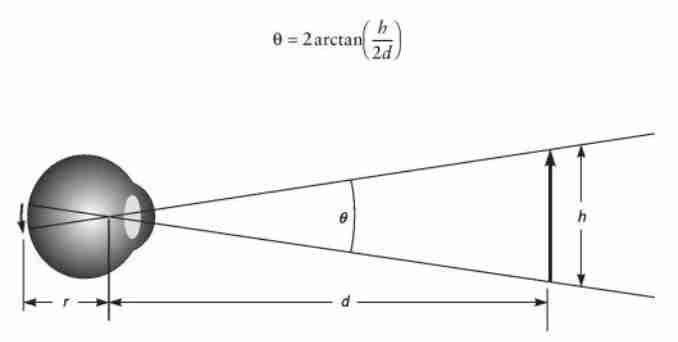
What size lenses would be ideal for your particular eye-to-music viewing distance and your eye-to-eyeglass-lens distance? Well, first you need to say how far away your music stand is from your eyes? How far down your nose do you wear your glasses when you’re playing? How strong is your prescription? All of these things figure into the equations that determine the minimum lens size you’ll need.

And there’s more. The eye’s rotatory movements occur around a center-of-rotation within the globe. Eyeglass optics design usually assumes that this center-of-rotation is in a constant or fixed location, but detailed physiologic studies show that this isn’t fixed or stationary at all, especially when the head is moving vigorously. The center-of-rotation moves medially and laterally inside the eye-socket. And the center-of-rotation of the eye has significant velocity when it does this—in fact, the center-of-rotation moves quickly in a semicircle in the plane of the eye’s rotation. So even simple eye movements are complex, and your eyeglass design should take these things into account—quantitatively, if possible—inasmuch as these movements augur for bigger lens widths. In straight-ahead viewing, the center-of-rotation is located about 13.5mm behind the apex of the cornea on the line of sight.

So how much does the center-of-rotation deviate from this, in its little elliptical path? Optometrists won’t know, but engineers who design aircraft cockpit displays do! Almost all of the conventional optometry and optical engineering literature regards the eye as a sphere whose degrees of freedom are only rotational. An aspect of eye movement that’s seldom considered is translation—linear motion of the globe. At near distances and when the two eyes’ convergence is 20 degrees or more, the eye muscles make the eyeballs translate temporally by up to 0.5 mm. This may seem like a small amount, but it actually is pretty large when you consider the angles involved at small eye-to-glasses (relief) distances of only a few millimeters.

Face Forming of Specs
Another stumbling block is that much of the conventional optometry literature neglects the dynamic nature of how a musician scans the music—far more important for sight-reading than for playing pieces that you know well. Mostly-involuntary movements of the eyes—in slow ‘drifts’ rather than ‘microsaccades’—are thought to be mostly responsible for accurate fixation and fine vision when you scan a page. But let’s say your two eyes need different corrections—different diopters. If the refractive difference for the two eyes along the optical axis between the eye and the part of the page you are scanning is big, then the eyes and brain may not maintain the drift movements necessary to achieve or sustain a clear, unambiguous view of that part of the page. In this situation, the experience you get is similar to a blind-spot—a scotoma—and this amounts to a surprisingly large percentage of the angle that’s bounded by the rims or edges of the eyeglass lenses. So the calculation of minimum lens width may have to take into account the refractive difference between your eyes, as well as the amount of time you spend scanning off-axis for the typical number of pages you have open, the typical eye-to-music distance you have, and so on.

The conventional optometry and optical engineering literature also fails to take into account that a musician moves or rolls her/his head in the natural course of playing their instrument (or singing, or conducting), up to about 25 degrees. The optometrists’ conventional lens design rules fail to recognize that there are torsional movements that the eye executes, to compensate for your head motions. The compensatory ocular torsion (ocular counter-roll) is opposite in direction to the head role, up to about 4 degrees. These dynamic motions interact with regard to the visual field you experience through the eyeglasses when you’re playing music. The optometrists’ design rules are expecting a stationary reader, not a mobile musician. Let’s calculate eyeglass lens width with provisions for movement! What we need is an eyeglass lens-sizing calculation that takes into account (a) the lens edge-related scotomata (what optometrists call the ‘jack-in-the-box effect’) that reduce the effective lens-width [i.e., that reduce the usable lens area in the periphery, near the eyeglass rims or lens edges] and (b) the range of head roll and ocular counter-roll that’s inherent in performing.

What we need, too, is some insight into lens materials. It’s all too likely that a musician will be ‘sold’ a pair of glasses by a salesperson who is persuasive about eyeglass features that affect appearance or weight but who is unaware of the properties that are the ones most relevant to the musician’s use of the glasses.
    Advantages of increased refractive index materials:
  • Thinner lenses give nice aesthetics and weight reduction.
  • In myopia, high index minimizes thickness at the outer edges of the lens. A thinner edge means less light entering into the edge of the lens, which in turn eliminates internal reflections and the visual distraction/confusion from reflections.
    Disadvantages of increased refractive index materials:
  • Worse dispersion (lower Abbé number) and chromatic aberration.
  • Inferior light transmission and reflection properties (Fresnel Reflection Equation), making an anti-reflective coating more important.
  • Greater sensitivity to grinding and polishing precision and manufacturing defects.

Of all of the properties of a lens material, the one that dominates overall optical performance is dispersion, measured by the Abbé number. It sounds like a geeky term, but don’t let that stop you. Ask the optometrist to show you the datasheets on the lens materials you’re considering. Easy!

Low Abbé number lenses have significant chromatic aberration—color fringes above/below or to the left/right of high-contrast objects, like black music note heads on a white page, especially in larger lens sizes and stronger prescriptions (±4 diopter or greater). Generally, lower Abbé numbers are a property of high refractive index lenses, regardless what the material is—glass or plastic. Also, note that the Abbé effect on chromatic aberration is not ‘linear’. That is, a change from 30 to 38 Abbé will not have a noticeable benefit, but a change from 40 to 48 Abbé could be beneficial for a musician who requires a strong correction, who moves her/his head a lot, and who looks ‘off-axis’ quite a bit of the time.

Some people don’t sense color-fringing directly but instead perceive ‘off-axis blurring’. Abbé values as high as 42 produce chromatic aberrations that are noticeable with lens widths bigger than 45mm, especially if the correction is stronger than ±4 diopter. At ±8 diopter, even glass with Abbé 58 gives enough chromatic aberration to interfere with your playing.

The human eye has its own Abbé number, of course. The eye’s Abbé number is independent of the eyeglass lenses’ Abbé number. Your eye:
  • Moves to keep the visual axis close to the achromatic axis (which is, by definition, free of dispersion);
  • Is pretty insensitive in the periphery (at retinal points distant from the fovea, where the cone cells responsible for color vision are concentrated).

Your eye moves to look through various parts of a corrective lens as it shifts its gaze. Some regions of the lens that your eye traverses can be two centimeters or more away from the optical center of the lens. So, despite the eye’s own Abbé properties, the eyeglass lenses’ Abbé value can’t be ignored. People who are sensitive to the effects of chromatic aberrations, who have stronger corrections, who often look off the lens’s optical center, or need larger lens widths to accommodate the geometry of their eye-to-music working distance and page-size will be more affected by chromatic aberration and will therefore be better suited to lens materials that have high Abbé numbers and lower refractive index.

To minimize chromatic aberration interference with the clarity of your seeing the music, you would want to:
  • Try to use the smallest lens height that’s comfortable and still covers the vertical extent of the music page at your typical working distance from the page. Usually, chromatic aberrations are more noticeable as the pupil moves vertically below the optical center of the lens (for example, when you look at the keyboard or down the nether regions of your cello’s fingerboard). Keep in mind, though, that a smaller lens height will make you move your head vertically more, especially while performing pieces that require short and intermediate distance viewing. This could lead to more neck strain.
  • Restrict your choice of lens material to the highest Abbé value at acceptable thickness and weight.

What else? As your gaze shifts from looking through the optical center of the eyeglass lens, the lens-induced astigmatism value increases. In a spherical lens, especially one with a strong correction whose base curve is not in the best spherical form, the lens-induced astigmatism can significantly impair the clarity of your vision in the periphery. In this regard, classical musicians work in stressful, high-glare environments that often require them to maintain asymmetric, off-axis postures for prolonged periods during performances and rehearsals. Maladaptations like astigmatism and anisometropia that are exacerbated by stress and by asymmetric head and body postures haven’t been researched much. Harris’s old paper (link below) discusses a study that shows that sight-readers in music use a different eye scan pattern to read music from the pattern that they use to read written language. To my knowledge, no subsequent publications on this have appeared to-date.

Temple Parallelism of Specs
Taking all of the above into account, I’ve prepared an Excel spreadsheet that lets you input your distances and your diopter correction (via scroll-bars) and calculates the minimum lens width that would enable you to visualize the page(s) on your music stand with a minimum of head and neck motion. This two-eyed calculation takes ocular and facial anatomy into account—for example, the fact that, when you gaze to the right, your left eye is only using a modest percentage of the left lens, and vice versa when you gaze to the left. The equations in the spreadsheet also incorporate the so-called ‘Prentice Rule’ estimate of edge scotoma minus the angle of the pupil subtense, to get the size of the ‘jack-in-the-box’ scotomata at the periphery. This adds significantly to the required lens width for corrections greater than +6 diopter and normal pupil diameters between 4mm and 7mm. Click on the screen shot below, and it will open a window where you can play with the spreadsheet or download it to your computer for off-line use.

I  hope this spreadsheet and the links below are useful for you. As always, if you have a criticism or suggestion, please post a comment below. Thanks!

Spreadsheet to Calculate Minimum Lens Width for Music Glasses

Jalie Optometry book


Thursday, November 15, 2007

1 Nov 07

My Plan

From a letter to my parents:

I have just finished reading a Solzhenitsyn bio that I started two days ago and couldn’t put down. It’s as if fate has stepped in just before my release and strengthened my commitment to making a go of writing.

My suffering can’t compare with what Solzhenitsyn had to endure, yet he rose from prison to spearhead the literary elite of Russia. Death called on him so many times: on the front fighting the Nazis, in Russian prisons, and then in the form of cancer. Reading about the odds he overcome has inspired me. From prison he was exiled to Kazakhstan where he knew no one, and he ended up lodging in a corner of a kitchen in an old couple’s house.

As for me, I have your loving home to go to. He set strict limits on his social life and gave writing his all. He funnelled his prison experiences into fiction in such an honest and compelling way that his book about Ivan Denisovich caused a revolution in Russian writing. This quote really touched me:

“
The writer’s tasks concern more general and eternal questions – the secrets of the human heart and conscience, the clash between life and death, and the overcoming of inner sorrow.”

These Russian literary geniuses (including Tolstoy and Chekhov) seem to have a knack for penetrating the human soul and portraying it in an uplifting way in their prose. Not that I could come anywhere near the genius of these great writers, but I’ve tried to go in that direction and as I continue my writing should mature.

Anyway, I learned a lot more from this bio than I can convey in this letter – especially how I need to have a disciplined work ethic, like I had when I began stockbroking. I’m used to a monastic life, so you locking me in the
garage and feeding me meagre meals won’t be a problem.

I don’t intend to succumb to the temptations of my former life. I need to be with people who will have a positive influence on my life. I would like to use the knowledge I’ve gained to help with prison reform, help young offenders or speak to youngsters about my involvement with drugs and how I ended up in prison.

I’ve certainly undergone the “impoverishment and devastation” that according to Thomas Mann, constitute the preliminary conditions to serious writing. And Solzhenitsyn claimed:
“Good literature arises out of pain.” I would like to expose injustice through my writing. I’m willing to make the necessary sacrifices. I’d be happy to accomplish a fraction of what Solzhenitsyn accomplished.

With your help, I just need to follow through on the opportunities that continue to come my way, and to keep myself emotionally stable.

Email comments to writeinside@hotmail.com or post them below

Copyright © 2006-2007 Shaun P. Attwood

Wednesday, November 14, 2007

Neuroprotective Approaches for Mitigating Hearing Injury in Chamber Musicians?

Inner Ear Hair Cells. SEM, © SPL / Photo Researchers, Inc.
What, if anything, can a chamber music performer do to restore or preserve hearing? You’re already taking care to avoid noisy environments as much as you can. You avoid playing mp3s at high volume. You wear noise-cancelling headphones when you fly or ride the train. You are careful about your nutrition. You avoid ED meds like Viagra. What else can you do?

Pharmaceuticals and nutraceuticals are no panacea. But there are a few things that have shown recent promise and may deserve consideration, either as neuroprotective preventives [before hearing loss has occurred] or as a component of a regimen aimed at helping the body to recover hearing [when a loss that has occurred is (partially) reversible].

Among anti-oxidants, ebselen [2-phenyl-1,2-benzisoselenazol-3(2H)-one] is not yet FDA-approved for any clinical indication. It’s being studied as a neuroprotective in Japan and elsewhere but not for hearing loss. Based on the interest in hearing loss management among CMT readers in past months, I plan to post again in the future on this topic as new information becomes available regarding this and other meds.

Besides the foregoing, you may want to consider getting audiometry testing done on an annual basis. You want serial measurements so that you will know, quantitatively and objectively, what changes are occurring and respond promptly to those trends. Audiometry should be carried out at 0.25, 0.5, 1.0, 2.0, 4.0, 6.0 and 8.0 kHz so that problems concerning lack of data at certain frequencies do not arise. Longitudinal monitoring by audiometry will enable you to assess whether the preventive or corrective measures you are taking are achieving worthwhile benefits or not.

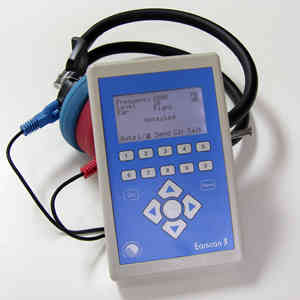
Such testing can be something you perform yourself, if you wish—at whatever time intervals suit you. Small software-driven audiometers that automatically conduct testing are readily available and can be ordered off the web. These can be purchased for $400 to $1,000 (see links below). For an ascending sequence, the automated audiometry self-test sequence begins with the lowest sound-intensity level selected and tests at each level, up to the highest level selected, or until you press the response button after a sound presentation. Once you respond to a sound presentation that the audiometer emits in the headphones, that presentation level is recorded as the screening result. Then it changes to one of the other frequencies and executes another software-controlled sequence of sound-intensity levels for that frequency, and so on, until the entire acoustic spectrum has been sampled. For a descending test sequence, the audiometer software begins at the highest sound-intensity level selected and tests at successive levels down to the lowest level selected. Once you do not press the response button after a signal presentation, the level of the previously presented signal is recorded as the audiometric screening result. It then proceeds automatically to the next frequency to test. When all of the frequencies have been tested, the audiometer then saves the testing results and optionally prints a report or saves the report as a Microsoft Word document or an Adobe Acrobat document. It takes less than 20 minutes to do this at home. Obviously, self-monitoring is no substitute for care by a qualified otolaryngologist / neurologist. But it is an additional option that is available to you with relatively inexpensive, simple, portable equipment today. (After all, you spend quite a bit on your iPod, on your laptop, on other technology ... Why wouldn't you spend several hundred on an audiometer, if you’re a musician?)

MicroAudiometrics ES3S
Okay. So much for what you can do as an individual. What about collective measures? It’s certainly impossible to ask your fellow ensemble members to play more quietly (the equivalent of reducing noise levels in industry). However, it is possible that careful planning of ensembles’ repertoires and the sequence in which pieces are rehearsed might be a general solution to reducing sound level exposures or reducing the ‘duty-cycle’ of high-volume, high sound-pressure intervals.

Apropos of those chamber musicians whose main job is in a symphony orchestra, you should know that some orchestras use screens placed around musicians who play ‘loud’ instruments (brass; percussion) to shield other players from the excessive sound intensity. Of course, the musician playing the high-volume instrument is still exposed. Rarely, the layout of orchestras has also been altered in some cases, by using raised sections in an attempt to reduce local sound levels. Maybe this could be done more often and more deliberately, for the good of all.

Individual use of hearing protection in the form of noise-cancelling headphones and studio audio feeds to all of the players is a possibility, especially now that noise-cancelling headphones are readily available which have good dynamic range and modest sound attenuation. However, in the case of clarinet players, the use of these is not an option, as bone conduction carries the vibrations from the reed, via the upper teeth to the inner ear. Noise-cancelling headphones would interfere with ordinary performance for clarinet and other wind instruments. Totally unworkable.

Chamber Orchestra of Philadelphia, Recording Session, members with headphones on.
M  ost musicians don’t have a clue about this. They start playing music in fourth or fifth grade and nobody mentions the damage they might be causing themselves. A musician who can’t hear is like a painter who can’t see or a sculptor who can’t feel. Not being able to hear the nuances in the music he/she plays – the upper harmonics, the colors. I just don’t have the same confidence I used to. I don’t have the same control. That’s the most frustrating part to me.”
  —  Kris Chesky, Trumpet, and Research Assistant Professor, University of North Texas Center for Music and Medicine

Inner Ear Hair Cells. SEM, © G. Brederg / Photo Researchers, Inc.
CMT should not be considered as medical advice, and the remarks in these blog posts are not a substitute for professional medical advice, diagnosis, or treatment. Never delay or disregard seeking professional medical advice from your physician, pharmacist, or other qualified healthcare provider because of something you have read on CMT. You should always speak with your doctor before you start, stop, or change any prescribed part of your care plan or treatment. CMT understands that reading individual, real-life experiences may be a helpful health information resource but they are never a substitute for professional medical advice from a qualified healthcare provider.


Tuesday, November 13, 2007

30 Oct 07

Interview with a Homey who found Jesus (2)

“With the Blood language I picked up, when you talk, you know, you drop the C on a lotta stuff. If it starts with a C you replace it with a B, for instance, a cigarette would be a bigarette, and a homey is bicking back not kicking back. When you see a Crip walking, sporting all blue, you’d say, ‘That cat’s all watered down. That fool’s all flued up.’”
“Would you attack him?”
“Sometimes, and sometimes not. If you’re driving by and you see a Crab [Crip], one of your homies sticks his head out of the window and says, ‘Whattup, Blood. Where you from?’ If he responds with his hood, he’s disrespecting, so you start disrespecting back till the fool gets hands put on him.”
“How badly do hands get put on him?”
“We usually beat them down and run off. Once he’s on the ground and can’t get back up, we spit on him and jump in the ride.”
“Can girls be homies?”
“She’s your homegirl.”
“How does she join?”
“A man is either born in the hood or jumped in. For a girl, she can be born in the hood or jumped in if there’s enough girls to jump her in, or she gets banged in.”
“Banged in?”
“Everybody has their turn with her.”
“And she knowingly enters into this?”
“If she wants to get into the gang she knows what she’s doing. I’m gonna keep it real though: I haven’t witnessed it.”
“What other slang do you have for girls?”
“You’ve got hoes, bitches, breezies.”
“Oh boy, sorry I asked.”
“These are girls you’re messing around with and don’t give a damn about, you know, you’ll bring you’re homies in and let your homies hit it.”
“Don’t you think words like bitch are a little harsh?”
“It’s like when you talk to a pimp, he’s gonna call his girls bitches, hoes, whatever.”
“Say you fall for a woman?”
“Then you don’t bring her around your homies, and if you do, it’s only homies you trust.”
“What do homegirls do?”
“If you call up your homegirl, she’ll bring homegirls. If she’s for the hood, you ain’t gonna disrespect her, you’re not gonna call her no ho. But don’t get me wrong, some girls in the neighbourhood are known as neighbourhood hoes.”

Email comments to writeinside@hotmail.com or post them below

Copyright © 2006-2007 Shaun P. Attwood