Friday, July 25, 2008

On Stylized Naturalism: Chamber Music of Elliott Carter

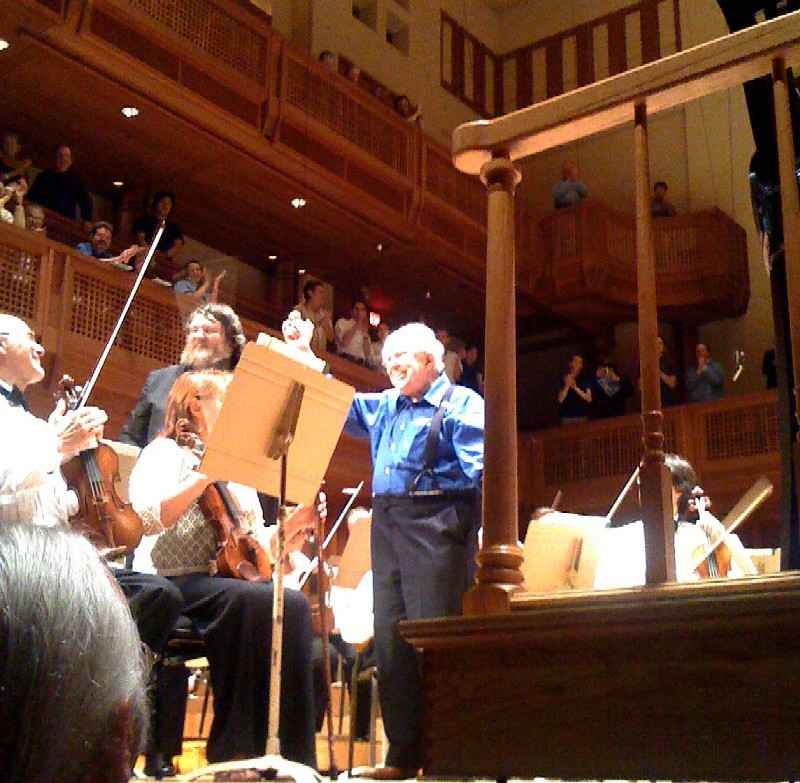
 Elliott Carter, Oliver Knussen, and TMC Orchestra, 24-JUL-2008, Tanglewood
F  inally, I began to understand what he [Carter] was doing. Then I said, ‘Well, it’s really not all that interesting: the same gestures over and over again.’ ”
  —  Robert Baska, comment on Allan Kozinn’s NY Times ArtsBeat blog post, 24-JUL-2008.
A  nd, to each his/her own. Is it true, then, that maybe you are not interested in patterns in nature: flocks of birds in flight; ripples on water; fresh breezes on your face? Those are the same gestures over and over again. Are those not interesting and beautiful? Do you turn away from those? No. Well, to me, Carter’s stylized naturalism—referred to by Oliver Knussen on Monday—is neither more nor less interesting than Nature itself. There is no law that says all music has to have a dramatic human-centric plot, no law that says all chamber music has to have explicit dialogue between the parts, no law that says you have to work yourself up to a big rhetorical finale.”
  —  DSM, 24-JUL-2008.
The BSO’s Festival of Contemporary Music at Tanglewood (Elliott Carter Centenary) on Thursday had a wonderful performance of several of Carter’s smaller instrumental pieces by Tanglewood Music Center Fellows, plus special guests Charles Rosen and Fred Sherry.

  • Saeta (1949) and Canaries (1949) [Steven Merrill (timpani)]
  • Four Lauds for Violin (1984-2001) [Martin Schultz: Remembering Aaron, and Remembering Roger; Stephanie Nussbaum: Riconoscenza per Goffredo Petrassi, and Rhapsodic Musings for Robert Mann]
  • Figment IV (2007) [Gareth Zehngut (viola)]
  • Figment III (2007) [Kevin Jablonski (double-bass)]
  • Steep Steps (2001) [Brent Besner (bass clarinet)]
  • Canto (1966) and March (1949) [Kyle Zerna (timpani)]
  • Elegy (1943) [Fred Sherry (cello), Charles Rosen (piano)]
  • 90+ (1994) [Charles Rosen (piano)]


    [30-sec clip, Charles Rosen, Elliott Carter, ‘90+ for Piano’, 1MB MP3]

Before the performance, we were treated to a captivating discussion, with former Boston Globe music critic Richard Dyer interviewing Elliott Carter. Elliott extemporizes his responses in a vivid, easy-going way—a way that enables us to see the genuineness of the man and his thinking. No mere reminiscences, his comments were up-to-the-minute ‘pearls’ reflecting his current assessment of how things are and why they are that way.

On matters where he feels he has no answer or where he thinks his views might be biased, he says so, simply and matter-of-factly. When one is 100, there is a premium on integrity.

But on most topics, Carter is expansive, each point leading to others in rapid succession. Those lucky enough to attend the Tanglewood Festival of Contemporary Music have much to be thankful for. Bravo!

I  have not thought about periods in my development as a composer. I do not think I have been striving to be more ‘transparent’, for example, in my recent compositions. In fact, I may return to my so-called ‘Second Period’ shortly. [Laughs.] Frankly, I have always simply written things that interest me … I am always just trying new things.”
  —  Elliott Carter, interview with Richard Dyer, Tanglewood, 24-JUL-2008.
T  he role of ‘intuition’ in the compositional process? Oh! That is a question! It’s a question I’d like to transpose into something else: What is the role of intuition in conversation, as you and I are talking to each other? Things come out automatically, without our having to think too much. … I get an idea that seems to be an interesting one, and I go from there.”
  —  Elliott Carter, interview with Richard Dyer, Tanglewood, 24-JUL-2008.
I  ntuition, yes. Composing, for me, is something like writing a letter. First you have a word, then it becomes a sentence. Pretty soon it’s a paragraph, and, eventually, what you have in front of you is what you would call a letter. Things just germinate. Composing is a process not unlike what each of us does every day—it’s like what we are living all the time.”
  —  Elliott Carter, interview with Richard Dyer, Tanglewood, 24-JUL-2008.
T  o answer your question [of where does the idea of putting a contrabassoon against the cello part come from] ... the very different timbres and registers—I’d say I’ve always been impressed with sounds. Sounds. I remember being very impressed by gardens in Japan, the sounds of water dropping and striking pieces of bamboo: very touching, very beautiful, like a soft pizzicato. And, you know, to make the cello part sound very high, you just need some low notes. Contrabassoon!”
  —  Elliott Carter, interview with Richard Dyer, Tanglewood, 24-JUL-2008.
M  ore than water dropping or leaves flickering—your allusion to the shimmering rubato of Liszt—I am instead trying to communicate something deeper than that [in my compositions]. It isn’t a literal naturalism exactly … but I can’t really explain it adequately. For the ‘Symphonia’, which you will hear performed tonight, I just thought about sad things and then I wrote it, that’s all. It is a vision—the sadness of Life, the joy of Life, and, in the end, a ‘balloon’: the piccolo going up. Not a big rhetorical ending. That would’ve been awful. ”
  —  Elliott Carter, interview with Richard Dyer, Tanglewood, 24-JUL-2008.
T  he musical ideas are not the problem. So many! Even now, I am trying to keep my mind off of them! [Laughs.]”
  —  Elliott Carter, interview with Richard Dyer, Tanglewood, 24-JUL-2008.
I  t’s not just I, I suppose, who should express gratitude for this extraordinary Festival. If the pieces of music spoke English instead of notes, they would say, ‘Thank you’. Their gratitude this week is immense.”
  —  Elliott Carter, interview with Richard Dyer, Tanglewood, 24-JUL-2008.

 Steven Nagy, Nikon SmallWorld 2007 Microscopy Photography Competition, 10th-place winner
 Convection regime of intersecting flows, semi-stable line on pool surface
 Convection regime of intersecting flows. Robert Baska would not think this flow-line is interesting or beautiful. But it reminds me of the processes in Carter's String Quartet No. 2
 Convection regime of intersecting flows, art in nature, nature in art
 Convection regime of intersecting flows, something in nature that interests me
 Convection regime of intersecting flows makes me think of the structure of Elliot Carter's music


Thursday, July 24, 2008

Pulse! : Motivic Wave Propagation in the Chamber Music of Elliott Carter

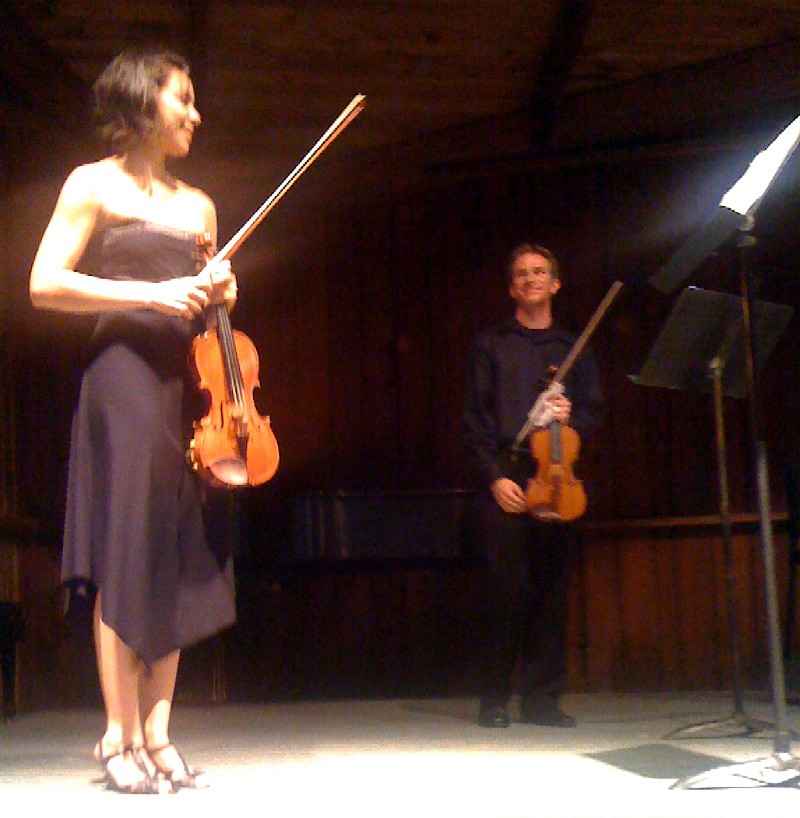
 New Fromm Ensemble members, Carter Quintet for Piano & Winds, Tanglewood, 23-JUL-2008
T  he Second Quartet signifies for Carter a leap forward in terms of control of harmony (and, by extension, melody), register, and rhythm, from the smallest rhythm to the largest form, and including the way in which time passes in the piece—in each part, and in the whole.”
  —  Robert Kirzinger, Program Notes, p. 67.
The BSO’s Festival of Contemporary Music at Tanglewood (Elliott Carter Centenary) on Wednesday had a wonderful performance by members of the New Fromm ensemble.

  • Quintet for Piano and Strings (1991) [Henry Ward (oboe), Raymond Santos (clarinet), Rose Vrbsky (bassoon), Lauren Moore (horn), Nolan Pearson (piano)]
  • String Quartet No. 2 (1959) [Stephanie Nussbaum (1st violin), Martin Schultz (2nd violin), Garth Zehngut (viola), Kathryn Bates (cello)]
The rich textures and rhythmic complexity thoroughly diverted the appreciative SRO audience filling the 200-seat Chamber Music Hall. (The Chamber Music Hall is a weather-worn barn with wood plank walls, 2-by-10 rafters, and simple folding-chair seating in the west side of the Tanglewood campus in Lenox, Massachusetts.)

From the tiny scale of microsounds and fragments and motives, to the large scale of whole movements of a piece, to the yet-larger scales of multiple works by a composer, a pattern normally only attains a level of significance if it occurs more than once, in more than one setting. In Carter’s chamber music works we experience a wide and innovative range of evocative patterns. For those of you who are interested in the theory of such things, the recurrence of patterns is treated from a post-modern intertextuality and other perspectives in Steven Jan’s nice book, ‘The Memetics of Music’.

But it’s more than that, more than sequences and recurrences. In Wednesday afternoon’s performance: we experienced the ‘vascular’ or ‘hemodynamic’ propagation of musical motives and phrases, as though they were blood. Within a Carter piece, it as though the expression in one instrument’s part is like a contraction of the heart, sending a pulse of blood outward into the circulatory system—of the composition, of the performance. Depending on the distance traveled and the stretchiness or ‘compliance’ of the blood vessels (the channels of acoustic and visual communication that prevail amongst the performers and the neurophysiology of their attention), the pressure ‘wave’ that is ejected in each pulse propagates with a finite speed and has its effects on the other body systems some milliseconds to seconds later. In other words, the patterns propagate, not so much as intimate ‘conversations’, but as though they were blood pressure waves from successive heartbeats among the various organs (instruments/parts) that comprise this living organism of performers.

 Thaut book
Furthermore, between and among compositions by a particular composer like Carter, I think the morphologically and dynamically similar expressions are like Richard Dawkins’s ‘selfish genes’, propagating down through generations of a species. The stylized Carterian naturalism to which conductor Oliver Knussen referred on Monday here arises in part through a kind of organic, self-replicating, mutually-reinforcing recursion. In the ‘refinements’ of Carter’s style, we see a cumulative evolutionary ‘selection’ among the best and most effective of these self-conserving compositional ‘genes’. (I suppose the idea can be over-done, pushed beyond the limits of its validity. All I am saying is that there is more to the human composer than intellect and ‘will’. There is an unconscious, organic element, too. And only by hearing several pieces in close succession—ones composed decades apart from each other—only by doing this is one likely to hear these possibilities and think these thoughts.)

Propagation of expressions in ‘waves’. The sensations of point, pulse (series of points), line (tone), and surface (texture) emerge as acoustic particle density increases. Sounds coalesce, evaporate, and mutate into other sounds—and they do so as though they had mass and viscosity. This Carter quintet and this Carter quartet feel as though they were made of living, flowing blood.

 Hemodynamics wavefronts and velocities in coarct of aorta
What do I deduce from this? Rather than looking at the performer as an ‘instrument’ of the analyst/composer—as an ‘executant’—we should remember that the performer’s interpretive choices are themselves inherently analytical. But (of course!) the performer’s ‘analysis’ is not 100% cerebral. The neurophysiology of pitch and rhythm kicks in, and—here, nicely illustrated by the Tanglewood New Fromm Players’ performance of these Carter pieces—we get these genuine, honest, primal, highly physical interpretive responses. Some of you Conservatory-based theorists may want to confer with your cardiologist and neurophysiologist colleagues over in the School of Medicine, to see whether the analytics that are used to study human circulatory and nervous systems can be brought to bear on better understanding some of this wonderful, exciting music by Elliott Carter. And have a look at some of the sources in the list of links below.

Thank you for this superb performance! Bravo, New Fromm artists!

 New Fromm Ensemble members, Carter Quartet No. 2, Tanglewood, 23-JUL-2008

 Elliott Carter, ©2008 Boston Globe
I  love Elliott, but I loved his music first. (I can’t do this in reverse; I can’t love the music just based on a rapport with the composer.)”
  —  Conductor James Levine.


Wednesday, July 23, 2008

Segmentation and the Limits of Representational Art: Elliott Carter Centenary at Tanglewood

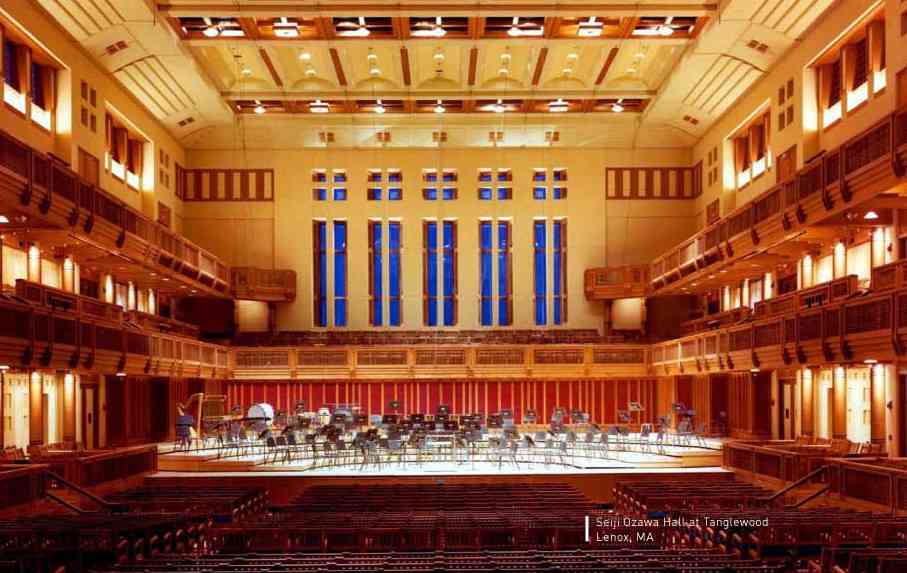
 Seiji Ozawa Hall, Tanglewood, Wm. Rawn Architects
H  ow are we to build emotional expression into music criticism? The new way is not to amplify criticism by adding interpretation to analysis but, rather, by amplifying analysis itself. For once one ceases to see expressive properties of music as semantic or representational properties, it becomes clear that they are simply musical properties ... and as such a proper subject of musical analysis.”
  —  Peter Kivy, Fine Art of Repetition, p. 316.
The BSO’s Festival of Contemporary Music at Tanglewood (Elliott Carter Centenary) on Tuesday had a diverse program of smaller pieces representing various phases of Carter’s career, performed by members of the New Fromm ensemble.

  • Enchanted Preludes
  • Figment I
  • Figment II
  • Esprit doux I & II
  • Au Quai [To the quay; quant ‘à [pour-]quoi’ c’est que nous allons ‘au quai’ je ne savons pas. Pour découvrir un mot français ironique?]
  • Trilogy
  • Two Thoughts about the Piano (Intermittences; Caténaires)
The thematic and compositional diversity in this program was delightful—warmly received by the audience filling the 1,200-seat Ozawa Hall. (A steady Berkshires rain beat down outside throughout the performance, but the acoustic baffling between the barrel-shaped roof and the ceiling of the hall prevented any acoustic interference. The sound engineering in the Ozawa Hall is really quite nice. The architects at Boston-based William Rawn Associates, Inc. who designed this performance hall are to be commended for their excellent design and engineering.)

Each of the pieces epitomizes the narrative and intimate dialogical idiom of chamber music. And each calls into question the conventional dictum that musical dialogue lacks specific semantic reference to the external world. Here, for example, ‘Caténaires’ has phrase-structure and lines between left-hand and right-hand that are clearly arcs—representational of curves draped in mid-air, in some parts with descender cables attached to the pylon-to-pylon catenaries, such as we see in bridge designs. You do not need to see the title of the piece to have the clear impression of the pendency, the evocation of gravity creating catenary curves in pendant strands.

 catenary curves Representational acoustic art! Pianist Sandra Gu performed this with intensity and grace. Likewise, ‘Intermittences’, performed with much feeling by pianist Jacob Rhodebeck, is an exposition of intermittent effects and an extended meditation on human expectations—the decay of notes once struck; the reverberation and decay in the Hall; the intermittency of rhythms, of textures, of harmonies that come, go, and reappear. We anticipate things as we do, for reasons we don’t fully understand. Carter’s ‘Two Thoughts about the Piano’ helps us not only to understand the instrument and the character of pianists who express themselves through it, but also helps us to understand ourselves—and our relations to those pianists, the composer, and the music.

The music on Tuesday’s program was full of internal references, linkages, and interactions among individual segments, lines, and parts. ‘Trilogy’ (Nick Stovall, oboe, and Megan Levin, harp), ‘Enchanted Preludes’ (Brook Ferguson, flute, and David Gerstein, cello), and ‘Esprit doux’ (Brook Ferguson, flute; Brent Besner, clarinet; Nick Tolle, marimba) are, essentially, reflection pieces on musical segmentation.

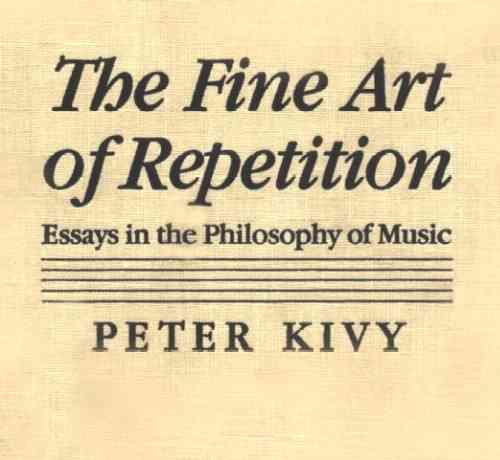
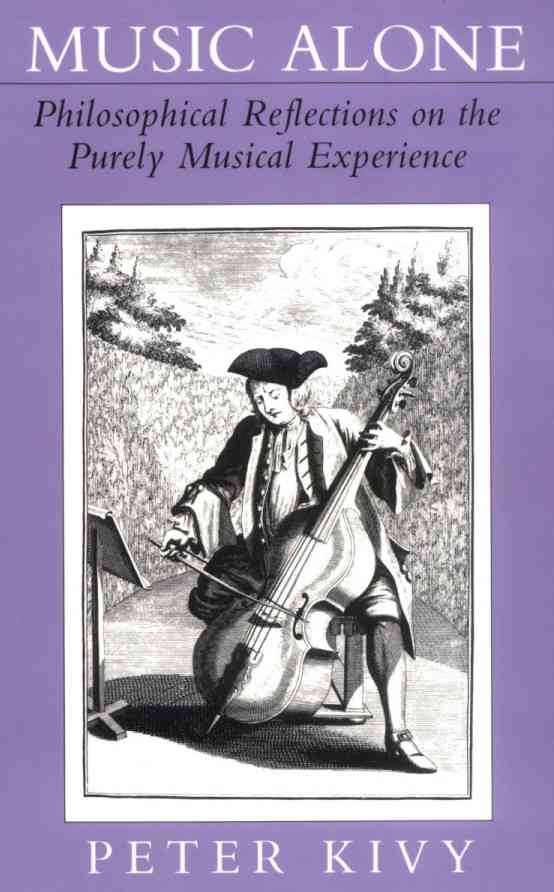
 Kivy book
We listen and answer these questions:
  1. Do individual segments form primarily within one part or across two or more?
  2. Do associations among segments develop within a part or between parts?
  3. How many distinct streams of association are active simultaneously?
  4. How do the segments, associations, and streams evolve over time?
In each piece a dialogue develops among the parts’ personae. At times, we have a collection of individuals, each with her/his own characteristic rhythms, articulations, and intervals; at other times, we have an ensemble in which the meaning-generating harmonic and motivic features emerge only as a group. Surprising how this can happen in an ensemble of only two people—a duet—or between the diverging-converging left-hand and right-hand of a single pianist.

In these Carter pieces there are diverse changes in the segmentation. These changes in segmentation are vehicles for changing modes of interaction among the parts. In ‘Esprit doux’, the dialogue between the clarinet and flute gives way to the trio section, in which the marimba is not so much a co-equal voice as it is an omniscient narrator—functioning much as the piano part often does in piano trios. The marimba ‘explains’ the context within which the segmentation and trill-swapping exchanges between the flute and clarinet parts makes ‘sense’.

We get what amounts to a series of shifts from individualism to ensemble collectivism, and from predominantly contrapuntal textures to predominantly harmonic textures. In the duets and trio, the interplay among individual personae is internal to the group. In the solo pieces (Figments I & II; Two Thoughts), the interplay references the soloist’s relation to the external world.

 Kivy book
Figment I, with its double-stopped figures, one note held constant and the other sliding up in pitch, evokes things suspected and feared true. It is the essence of anxiety, distilled. It conveys ‘anxiety-as-process’, not as ‘symptom’. Anxiety (and the troubling figments of imagination that accompany it) is, you see, not a ‘state’ or ‘condition’ but a succession of thoughts and events that, together, comprise the anxious self—alienated from comforts and reassurances, isolated existentially. Segmentation in the cello part, superbly played by Kathryn Bates, propels our understanding this existential discomfort. Beautiful, iconic, elegant, credible.

Have a look at Peter Kivy’s books, for detailed discussions of texuality and the limits of the representational in music—not in Elliott Carter’s music per se, although Carter’s music does illustrate or embody many of Peter’s arguments.

 Pople book

 Elliott Carter, ©2008 Boston Globe
I  love Elliott, but I loved his music first. (I can’t do this in reverse; I can’t love the music just based on a rapport with the composer.)”
  —  Conductor James Levine.


Tuesday, July 22, 2008

23 Jul 08

Two Tonys and Warrior at Rec (by Two Tonys Part 1)

Two Tonys - A whacker of men and Mafia associate serving multiple life sentences for murders and violent crimes. Left bodies from Tucson to Alaska, but claims all his victims "had it coming."


When I first got to this yard, I’d done 90 days in the hole in Tucson. They took me out of the hole and shipped me to Buckeye.
I’d never been to this unit before, but I know a lot of these guys from the old days and other yards. One guy I knew for 28 years, I and hadn’t seen him for 23. He was a half-ass shot-caller back in his younger days, and was very close to that dude, T, I had to snuff in Phoenix.
So I’m put in Building 2, but after 3-4 weeks they move me down to Building 1 where Shotcaller lives, and there are 4-5 friends of T I felt I should be careful around.

Now Shotcaller and I had seen each other through the rec field fence going and coming to chow.
In Building 1, Shotcaller’s cell is right above mine. He’s in my vent, so we can talk but there’s also 2 other cells in our vent, so it’s light talk. "How ya been? You seen so and so?" Yaddy yaddy ya bullshit.
We agree to talk at rec, take some laps around the track.

Now I’m old. 66. He’s 62. Gray headed. Great shape. Prison does that to a guy.
We meet. We hug. We start lapping. Just the 2 of us.
So I start it off. I tell him, “Look, I know T was your guy and you had love for him, and so did I at one time. But he got out. He got full of that fucking speed and he got real disrespectful and real ignorant. You know how he was. He was dangerous. I couldn’t wait for him to whack me. I did what I did. It’s a shame, but it’s over. It was a me or him thing. You would have acted as I acted.”
Shotcaller agreed with everything I had to say. I ain’t no fool. I’ve been to a few tea parties, but I got sense in certain situations.

I check out the yard. It’s not like the old days. This is a modern 21st Century prison. Gun towers. CO’s walking around. No cliques running things. This is a let-me-do-my-time-and-go-home yard. Or a let-me-do-what-I-can-of-my-life-sentence-and-die-in-peace yard.

Shotcaller assures me he understands. While he loved the guy T, he knew T was a whacko, and if he were in my shoes he would have probably done the same.
So I grill him a little bit about others on the yard.

One in particular had a nasty rep. He was big back in the day. Mean, crazy and tough. I knew him 25-26 years ago and stayed away from him. They called him Mekong Mike. He was a vet who had seen a lot of shit over there and did a lot of shit. He was for real, I knew that much. But he was also close to T and he was in my building. We had passed each other maybe 10 times. But no eye contact. No swagger. No good vibes. I felt the vibe Mekong Mike put on me so I asked Shotcaller about him.
He tells me, "Mekong Mike's a Jesus freak now. He's hung up all his spurs. He walks with God.
The T shit is over. No need to get paranoid. Relax. Enjoy the yard. It’s mellow. It’s our fucking retirement home.”
I tell him, “Right on. That sounds good to me.”

So we go on. He takes me over and introduces me to a few guys. Young guys. All buffed up. Tatted down. You know the type.
Now look, I don’t want to sound vain or nothing but I got a rep that precedes me also. So some of these kids heard of me and I’m picking up good vibes. A lot of respect. I’m old. Shotcaller’s old. But we got respect. We’re not rape-os. Or chomos. Or rats. We’re a couple of OG’s. Old Gangsters.

We earned our spurs back on Florence prison yard. Where white guys always had to go 2-3 deep to the showers. Always on full tilt in case the Mexicans or blacks jumped off. It was like that back then. Most of these kids were shitting yellow while guys such as me, Shotcaller, T, Mekong Mike were representing the white man.

The other races had theirs, we had ours. Respect ours, we’ll respect yours. Otherwise fuck it. Back in those days if a new arrival showed heart he was not alone. We’d stand with him. If he broke weak, then he did his time as a weakling. So that’s how it was.

The man let it go on, it made his job safer and easier. We all would do our best to keep the lid on. And most of the time we did. It would blow at times, but afterwards it would settle down.

So now here we are in the 21st Century prison. It’s the man’s system now. He’s got 30 prisons to break up gangs and tough guys. He’s got holes that are deep and dark and insane. You get scared just going to them.
I realize it’s an adapt or suffer world, so the smart ones adapt. Go to rec. Read. Watch TV. Enjoy this time drama free. You don’t have to check your balls at the warden’s office, but try to use your head.
But keep in mind there are still motherfuckers up in here whose brains are still locked into that old shit. And if you hit the button, you can get killed. But you stay away from those guys. Don’t borrow. Don’t lend. Just a “Hi!” or “Right on!” and keep your distance.
I’ve been in both time frames. This is better. Less stress. The old days were fun at times. But lots of stress.

So Shotcaller introduces me to this Warrior kid. He’s got the face of a choirboy. The build of a young Mike Tyson. And polite as hell. I pick up good vibes from him. He’s real respectful in his manner. We talk for a little while about Tucson.
Then this lame they call Skids comes up to me. “Hey, Two Tonys. You remember me back in ’84 South Unit.” Yaddy yaddy da. So he wants to lap a couple with me.
So I say, “Sure. Why not.”
Shotcaller hangs out kicking it with Warrior and some others.
So we start taking laps.

Now as we’re lapping we go by 4 young Mexican eses. I notice them. I don’t stare or make eye contact. They have an air about them that radiates, “We’re all that and a bag of M&M’s.” They got tats. Mexican war eagles. Aztec chieftain stuff. Real political stuff. They’re young. In shape. And think their shit has no odor to it.
I hear one of them call out my name.


Email comments to writeinside@hotmail.com or post them below

Copyright © 2007-2008 Shaun P. Attwood

Positive Turbulence: Elliott Carter Centenary at Tanglewood

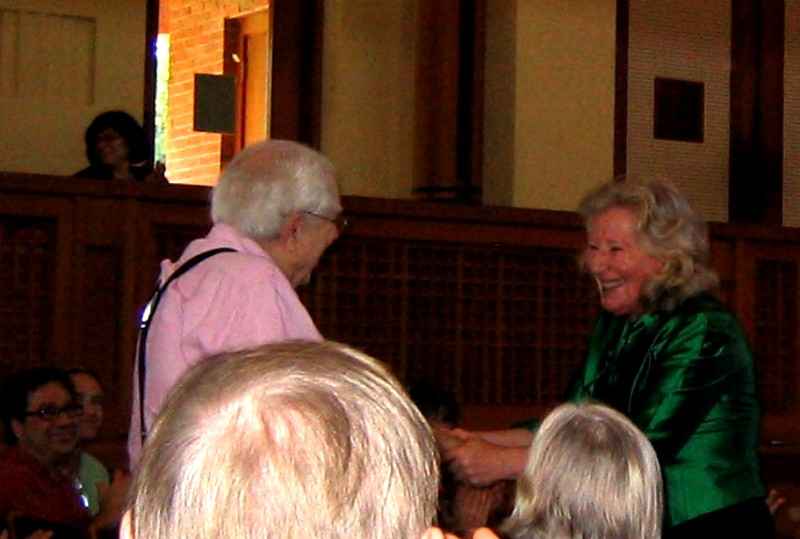
 After performing ‘Night Fantasies’, Ursula Oppens thanks Elliott Carter, 21-JUL-2008
The all-interval tetrachords, the mutating rhythms and meters: such facile pigeonholing by theorists/analysts!

But Elliott Carter’s compositions strongly resist analysts’ efforts to reduce them to mere products of any classifiable compositional ‘method’. There are evidences of careful method, of course, as there surely must be in any work that endures. But the ever-present spontaneity and novelty belie a method that is open to inspiration and chance. How has it been possible for Carter to sustain such creativity into his 90s and beyond? Amazing.

This year’s Tanglewood Festival marketing materials do extol the “100th birthday of Elliott Carter” aspect of the celebration. It is indeed unusual to reach 100 years, and distinctly uncommon to achieve that milestone with a reasonable measure of one’s health. And, of course, there were celebrations ten years ago of Elliott Carter’s 90th, and his 80th ten years before, and honors and celebrations before that. So this CMT post is not about the U.S. cult of sensationalism (“Only 25 in 10,000 born in the U.S. in 1908 will have lived to be 100 years old; only 18 will make it to 101!”; “Being 100 is big box-office!”) or the centenary hoopla that accompanies the actual celebration. Instead, I’m wondering what we can learn about how Carter has managed to stay so energetic and vivacious. What can we learn from him?

I  n cognitive pragmatics, which is primarily culture-based, there is evidence for stability and positive change in persons who reach old age without specific brain pathology, and who live in favorable life circumstances. Successful aging, selective optimization with compensation, illustrates how individuals and societies can effectively manage the age-related shift toward a less positive balance between gains and losses and the associated dynamics between culture-based growth and biology-based decline in level of functioning.”
  —  P.B. Baltes, Max Planck Institute for Human Development, Berlin, 1993.
It’s widely recognized that music for many older people is crucial in supporting a sense of well-being. But that recognition is with respect to the typical, aged non-musician. The role of music in the lives of musicians in their eighth, ninth, or tenth decades has not been systematically studied. Presumably, the importance of music as concerns musicians’ sense of well-being would be like average non-musicians, only more so.

But we really don’t know. Since music is, for musicians, such an important part of their identities, the role that music plays in later life may be very different from regular people. In particular, the progressive losses (of hearing acuity; of memory; of dexterity; and so on) would tend to more directly and dramatically reveal the musician’s progressive loss of the sources of selfhood and accomplishment. For the typical elderly non-musician, by contrast, the experience of music does not relentlessly reveal the important things that are slipping away. But there are exceptions to any generalization.

My maternal grandmother, for example, retained her ability to play piano until the very end. The centers in the brain that relate to musical creativity and appreciation are primitive, hindbrain, hypothalamic and other structures that have the good fortune to be spared in many cases. But continuing to play something (or compose something) every day may have had a lot to do with it. In other words, the continuing to play music was probably not an ‘effect’ of her daily habits so much as it was the ‘cause’ of her ability to continue other dimensions of her life, including her daily habits.

 Sternberg book
Gudmund Smith and Gunilla van der Meer demonstrated in their research at the Gerontology Research Center in Lund, Sweden, in the 1980s that creativity can be preserved in old age and serve as a health-promoting adaptation to aging. In fact, continuing creating things is not only an ‘adaptation’; it may be an aging ‘retardant’.

 Elliott Carter, seen here illustrating the beneficial effects of music as age-retardant, ©2008 Lutch, BSO
For us who attended the Carter panel discussion Monday afternoon with cellist Fred Sherry and conductor Oliver Knussen in Seiji Ozawa Hall at Tanglewood, it was hard to imagine that the person we were listening to is 100. Elliott stands up in the aisle, talking to friends during the intermission. Sharp as a tack, he discusses various points, laughing and gesturing animatedly as he goes. There is a characteristic twinkle in his eye, engaged and enthusiastic, that makes him seem decades younger than his years. The man looks and acts 70 if he is a day!

 Tanglewood, Seiji Ozawa Hall, Lenox, Massachusetts
Unlike other of his contemporaries, Carter’s brand of musical modernism always focuses on the human element. Carter’s music is essentially theatrical, emphasizing the interplay of characters or personalities in ways that are dramatically engaging. This is connected to that ‘twinkle’, I think.

C  arter’s piano concerto looked, to me, like the Forbidden City, in 1968—the metronomic markings in decimals, and so forth. I devoured this thing. What attracted me most was ... the mathematical beauty of it; very European; why certain chords happen when they do is crystal clear. Anything in that score, however abstruse it may seem, can be traced back to single, individual elements. There is a consistency, an internal coherence—this was very different from the European avant garde at the time: Carter’s music made far more sense; it was completely playable. There was nothing ‘conjectural’ about it.”
  —  Oliver Knussen, panel discussion, Tanglewood, 21-JUL-2008.
T  he form of the pieces is also completely traceable, completely comprehensible. All of it falls into place, very poetic, very natural. So it turns out that Carter is not so European after all. Everything in a Carter piece is made out of thinking about a simple, graspable thing.”
  —  Oliver Knussen, panel discussion, Tanglewood, 21-JUL-2008.
T  hese pieces were, you know, considered ‘late’ pieces at the time. And since then we have had what might be called the longest ‘Indian Summer’ on record. How many pieces does Carter have in him?!”
  —  Oliver Knussen, panel discussion, Tanglewood, 21-JUL-2008.
R  egarding his piece ‘Sound Fields’, I have no recollection of saying anything at all to Elliott that could’ve resulted in the piece that ‘Sound Fields’ is. And yet the other evening Elliott tells me that there is something about the way that we talk to each other that ‘triggers’ things for him, that results in his forming musical ideas and developing them. We are all ‘triggers’ for each other, I suppose.”
  —  Oliver Knussen, panel discussion, Tanglewood, 21-JUL-2008.
E  ven when things are worked out, polished, equidistant intervals, regularized rhythms, and so on—the piece may not work, as-written. It may turn out to be boring. And so Elliott adjusts it. He is no slave to rules.”
  —  Oliver Knussen, panel discussion, Tanglewood, 21-JUL-2008.
T  he Carter harpsichord sonata was the first piece I played, at 19 years old. It astounded me. He asked, ‘Is my music too difficult?’ And, of course, nobody would confess that it was. Later, when he was writing the cello concerto, Elliott called me up and said ‘Fred! Help! Can you learn this?’ I found many fingerings that were extremely awkward, nearly impossible. Actually, I never complained about any figure unless it was so difficult that I was confident that no living human being could play it. Then I would recommend a revision to Elliott. He would come back with the most wonderful changes—alternatives that I myself would not have thought of. Brilliant. Finally, Elliott said to me ‘Fred, don’t come back again. Your visits are too exhausting for me.’ [Laughs.] But then, several days later, he calls me up and says, ‘Fred! Can you come over here? I need you to try some things out! ’ ”
  —  Fred Sherry, panel discussion, Tanglewood, 21-JUL-2008.
C  arter’s music has what I would call a ‘stylized naturalism’. It all feels natural somehow, if you play it as it is written—the combined ensemble feels natural. It will have this staggering effect that the individual player will not have anticipated from his or her individual part—playing 29 16th notes against 30 16th notes, against 31 16th notes in another part, over the same interval of time, ending up on the same downbeat together.”
  —  Oliver Knussen, panel discussion, Tanglewood, 21-JUL-2008.
I  f you’re conducting a piece by Carter you’re deeply involved in the notation, laying down the beat, structuring the layers, and so on. But recently when I was listening to a recording, I realized that it is very different for a listener compared to my experience of this music as a conductor. I was astounded as a listener: the music just floats up, speeds up, slows down—it is a bubble. The shape of the piece seems very different for me as a listener than when I was conducting it. Form is very elusive—the partita is a good example. You can’t remember at all what’s coming on the next page—and it goes on for 116 pages. It’s like a chase scene.”
  —  Oliver Knussen, panel discussion, Tanglewood, 21-JUL-2008.
T  he recurrences—the recursion—in Carter’s music are like a rhyme.”
  —  Fred Sherry, panel discussion, Tanglewood, 21-JUL-2008.
Y  es, the dramaturgy, the rhyme-like patterns and cadences, are very attractive. In Carter’s music, it is really more impressive if you do not think about each thing too much. Then it hits you.”
  —  Oliver Knussen, panel discussion, Tanglewood, 21-JUL-2008.
L  ike a fresh peach. A canned peach will never taste like a fresh peach, and you cannot intellectualize or explain just why that is. It just hits you.”
  —  Fred Sherry, panel discussion, Tanglewood, 21-JUL-2008.
People tend to think of creativity as a static trait—something we’re endowed with at birth and that stays pretty much the same throughout life. Many people also think of creativity as something that only very gifted people possess. Wrong.

 Hopkins-Link-Carter book
Torrance in the 1970s developed tests of creativity, which included exposing the person to a picture of a scene and having the person write out all of the questions he or she could think of in regard to that scene. Carter would not only write prolifically; he would also set forth an algorithm to depict scenes that plausibly could've come before the one pictured, plus a trajectory of scenes that could come afterward, depending on the answers to the questions. Oh, and for extra credit, he would have the trajectory turn back on itself and culminate in arriving back at the starting scene.

The ‘algorithm’ would be like the first-pass of a two-pass computer-language compiler—essentially addressing syntax rules but leaving runtime indirection to be resolved by the linker and, later, the runtime operating system. The first-pass insures the coherence and conformity of the work, parsing it according to the governing metrical and harmonic rules of [Carter’s] compositional method and reporting any deviations for subsequent editing. The first-pass doesn’t generate the executable ‘binaries’, nor does it constrain the expressive and creative content of the work. In other words, listening to him and listening to his music, I think Carter’s mathematics has served a ‘normative’ desk-checking role, rather than a ‘generative’ compositional role. Just an impression…

F  rom the Cello Sonata onward Carter’s music sprang from a single idea: disconnection.”
  —  David Schiff, Reed College, Portland, Oregon.
For Carter, the relationship between music and ‘turf’ (territory) is, I think, a very strong one. Yet questions of how anybody’s music actually articulates a sense of place (or of who controls or owns particular musical territories and how) have only recently been posed by academic music theorists. Previously, such questions have been overlooked.

But questions of meaning and territorial ownership run through and through Carter’s compositions, which can be regarded as essays on music and ‘self-as-territory’ or ‘self-as-ballistic-object’ and the space that that self carves out as it hurtles through space. His music is fundamentally complex, even when it’s relatively simple, as David Schiff has said. The music, often highly multilayered like Carter’s Second String Quartet, or like the ‘Night Fantasies’ that Ursula Oppens performed so beautifully, or the brilliant account of the Carter piano sonata that Charles Rosen delivered at Ozawa Hall on Monday. The layering separates the players (or, in the piano pieces, the left hand and right hand) by individualizing their parts—they diverge and diverge from each other. But it doesn’t separate or disconnect them entirely, because each instrument’s (hand’s) part shares an interface with [at least one of—] the others. Carter’s originality and the long-lived twinkle in his eye seem to emanate from this constitutional curiosity—a fascination with interpersonal boundaries, integrity, self-hood, give-and-take, separation and convergence. There is a positive turbulence that he creates, and the trajectory that each part’s ‘flight envelope’ occupies responds to that turbulence and, in doing so, asserts itself. It is the same sort of identity—the same sort of ‘I am’—that we hear in Beethoven and in other classical composers. And that, I think, is the predominant reason why Carter’s music is so important, and why it is so loved.

Great to be here; great to be alive as an authentic self; great to be in dialogue with other people.

T  he music can be understood transformationally as a complete traversal of this [mathematical] structure by just a few, striking, characteristic gestures. A three-dimensional computer animation that can be viewed here makes vivid these transformational gestures, and the musical form of Figment II.”
  —  John Roeder, Univ British Columbia.

 Elliott Carter, ©2008 Boston Globe
I  love Elliott, but I loved his music first. (I can’t do this in reverse; I can’t love the music just based on a rapport with the composer.)”
  —  Conductor James Levine.


Monday, July 21, 2008

15 Sep 07

Flashback to Tucson Prison

Kat (Part 6)

Kat - A Navajo transsexual who crashed while drunk driving, killing two people. A talented artist specializing in Native American and southwestern designs.

“I take it you know Gina who cut her balls off?” I asked.
“Yeah. She’s down there on Yard 4,” Kat said. “Did Xena ever tell you about Pam?”
“No.”
“Pam set the trend for castration, for in-cell self surgery.”
“When?”
“Around 2000.”
“Was she hospitalised like Gina?”
“No. She did the perfect surgery. She said the doctor told her she’d done a good job on them.”
“What did she use?”
“Nail clippers.”
“Ouch!”
“She used a rubber band for a tourniquet.”
“How’s that work?”
“You know how the ballsack hangs down? She tied the sack with a rubber band, and then she used the nail clippers to cut the ball skin open.”
“Was there a lot of blood?”
“Yeah, but before she’d removed the balls, she tied the tubes that were holding them. Then she sowed the sack up and undid the rubber band. She said the pain didn’t start until thirty minutes later, and it was sooo like unbearable.”
“Did she flush her balls down the toilet?”
“Yeah. Bye-bye, boys!”
“Was she happy?”
“Besides having to deal with hot flushes, yeah. She said she’d do it again if she had to.”
“Does she want vaginoplasty?”
“No. She just wanted a good tuck.”
“How was her sex life after the orchidectomy?”
“A year later, I asked her if she was sexually gratified and she didn’t wanna comment on it. I’d assume sex is boring now.”
“Why?”
“’Cause there’s no sexual gratification, no release. The stimulating part of having sex – the ahh-ahh – is gone.”
“Perhaps she’s more prostate orientated.”
Kat burst into falsetto laughter, then said, “Sorry, Pam.”


Email comments to writeinside@hotmail.com or post them below

Copyright © 2007-2008 Shaun P. Attwood