Sunday, June 24, 2007

Airbags and Hegemony: Esoteric Classical Accordion, Novel Repertoire


DSM: Not everyone’s aware that such a thing as classical accordion music even exists. The repertoire consists largely of folk music and pieces adapted from organ music, as well as some contributions by modern composers. But all musical instruments carry lots of nuanced meaning. How they’re built, how we position our bodies to play them, what motions and gestures their design permits us to use in performance, what historical and current expectations have been established by artists who perform on each instrument, the particular qualities of the literature that’s been written for each instrument, and many other anthropological details—all of these contribute to each instrument’s social ‘standing’ and its going-forward expressive scope. Accordion’s no different!

CMT: I agree. Any instrument is itself a powerful ‘physical signifier’, apart from the music that the instrument’s used to perform. But there’s no reason why accordion should be so maligned or neglected as a vehicle for classical music and new music anymore. Through exceptional performances of classical and new music on accordion, we can hear and learn new aesthetic implications of the music itself, things that we would otherwise have missed with conventional orchestrations on ‘normal’ chamber music instruments. It may be interpretively radical or exotic in some cases—these accordion arrangements. And, in other cases, the instrument’s not a good match to the demands of the music. But I find there’s often tremendous new meaning to be discovered, not just novelty. Take the new Mikko Luoma disc, for example.

The works here, played by Mikko Luoma, are challenging to the ear and mind. The contrast between the complex, intricate writing and the clichéd polka and cafe sound so ingrained in our ears is fascinating. After some dedicated listening, one hears an organ, woodwinds, even violin harmonics.”
  —  Daniel Wakin, review of Mikko Luoma, Virtuoso Accordion (Bridge Records), NY Times, 24-JUN-2007.

DSM: Mikko Luoma’s a senior lecturer at Turku Music Academy in Finland, and has lectured and given master classes at the Juilliard School, Columbia University, the Hochschule für Musik in Lübeck and the Musik Akademie Franz Liszt in Weimar. Salvatore Sciarrino’s Vagabonde Blu is an atmospheric piece emphasizing the accordion’s ‘stradella-bass’—pre-set major, minor, seventh and diminished chords in the instrument’s left manual. And Vladimir Zubitsky’s Carpathian Suite is perhaps the most traditional music on this disc, embodying the sounds of Ukranian folklore and folk instruments.
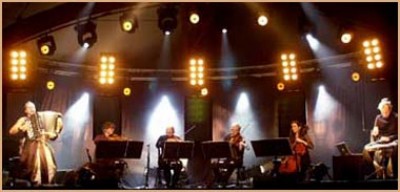
Kimmo Pohjonen, with Kronos Quartet
CMT: Teodoro Anzellotti, performing Luciano Berio’s Sequenza XIII, is as remarkable as Luoma, I think. And remember American accordionist Daniel Barski’s landmark Free-Reed Odyssey, which demonstrated a remarkable emotional honesty. And the amazing Norwegian, Frode Haltli! His repertoire includes Berio’s Sequenza XIII, Kalevi Aho (Sonate no. 2, Black Birds), Håkon Berge (Girlander), Adriana Höldzky (Miserere), Magnus Lindberg (Jeux d'anches), Per Nørgård (Toccata), Iannis Xenakis (Khoai), and transcriptions of Bach, Grieg, Scarlatti, Mozart, Satie, Shostakovich. He also has a new CD out with Mats Eilertsen on double bass and Torbjørn Dyrud on organ, Short Stories, released a month ago. This atmospheric album was recorded by Audun Strype at Kampen church and Eidsvoll church in Norway — it evokes a dark and contemplative mood. Fantastisk! Here is a 2004 photo of Frode with Joe Macerollo in Toronto at the Glenn Gould Studio. Frode performed Maja Ratkje’s ‘Concerto for Accordion’ and much more (photo courtesy of Linda Rogers, Univ Toronto). Frode’s musicianship is phenomenal . . .

Frode Haltli and Joe Macerollo, Toronto, 2004, performance of Maja Ratkje’s ‘Concerto for Accordion’ (photo courtesy of Linda Rogers, Univ Toronto)
DSM: Accordions, of course, come in many different styles—and the varieties of expressive truth that they’re capable of are really diverse. Most people are aware there are rock, classical, western, jazz and folk-style guitars but don’t realize there are at least as many types of accordions. Just like the guitar, there are accordions built for different styles of music, with and a variety of temperaments/tuning schemes. Three of the most popular sounds are musette, dry tuned, and chambered. ‘Musette’ is the over-the-top, cinematic or cheesy, continental sound that’s so familiar, achieved by de-tuning two or more sets of reeds at the same pitch. The amount of de-tuning affects the sweetness or aggressiveness of the timbre and the expressive meaning of ‘musette’-style sound. ‘Musette’ characterizes many styles of music, of course. Most often described as French cafe sound, it’s used today with various tunings by cajun/zydeco and polka ensembles and wild Yan Tiersen soundtrack music. ‘Dry-tuned’ is the bright sound of the accordion that’s achieved by the reed blocks being tuned in octaves. This style of sound is often heard with an accordion playing tango and other Latin music. ‘Chambered’ is that mellow sound of the accordion often preferred by jazz accordionists. This sound is achieved by engineering the reed blocks in chambers, which adds tonal warmth. This construction is more expensive and is often used by classical and jazz artists. ‘Dry tuning’ is also used in classical.

Löhner instrument, ca. 1816
CMT: I think many people are unaware that accordion as an instrument dates to the 18th century. The literature from the Classical era is scanty, but there’s no reason to think that accordion is an ‘aberration’ or an inherently inappropriate instrument for chamber music. You’re just needing to find an appropriate repertoire, and appropriate venues where the performance of it can be reasonably balanced with the other instruments’ parts. ‘Essentialism’ and doctrinaire ‘anti-essentialism’ both affect the non-canonical instruments in classical music—much as anti-essentialism in the academy has been noted in Art in general. Accordion isn’t the only ‘victim’ of this. The confusion of traditional aesthetics was imputed to the assumption that the Arts share a common essence, which, once discovered by the aesthetician or musicologist, could serve as an absolute standard for aesthetic judgment. Well, both are terribly confining—as Arthur Danto and others have written for a long time! These new performances and compositions/arrangements should make people reconsider their assumptions, about classical accordion. In fact, the experience may unhinge the listener sufficiently to unseat other prejudices at the same time!
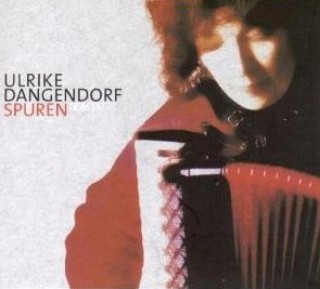
Ulrike Dangendorf
DSM: Accordion is a significant area of interest among women musicians: Ulrike Dangendorf, Lydie Auvray, Chava Alberstein, Cathrin Pfeifer, Joan Sommers at UMKC, and others. There is clearly a ‘radical’ quality to these women’s playing . . . Do you think accordion is symbolically congenial to ‘feminist’ interpretations?

Cathrin Pfeifer
CMT: The range of recordings and performances makes me begin to think so! Have you heard Finnish accordionist Maria Kalaniemi, who has explored many musical facets of the instrument, ranging from classical to folk to new music? Polish accordionist Lidia Kaminska’s chamber music, concerto and solo performances have also dramatically expanded the expressive range of the accordion as an instrument of classical music. So, with the quality of chambered free-reed instrument construction today, the quality of new compositions/arrangements for solo accordion or accordion as a voice in chamber ensembles, and the quality of classical musicianship on the instrument these days—it’s clear how ureasonable it is to harbor prejudices against the instrument any longer!

T he exceptionally large dynamic and tonal spectrum of the accordion, its virtuoso potential arising from the way the manuals are constructed, its harmonic and polyphonic scope and characteristics of bellows handling, compared to the bowing of a string instrument, make this now an utterly fascinating instrument for me.”
  —  Magnus Lindberg, composer.
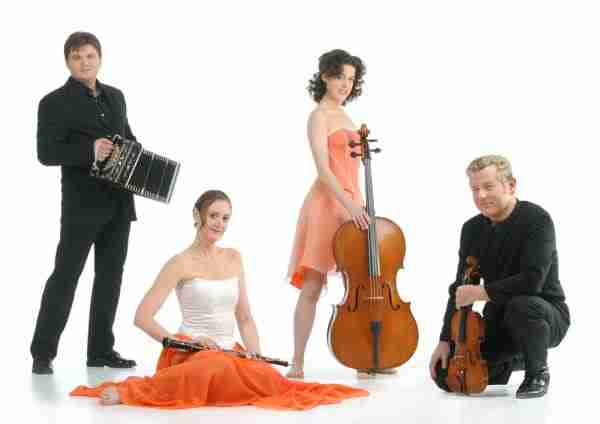
Quartetto Gelato


GoldStarEvents: Successfully Vying for Thinly-Spread Attentions of Young Market Segments

Jim McCarthy, CEO GoldStar Events
W  e have to have a [reduced] price that is behavior-changing.”
  —  Jim McCarthy, CEO, GoldStar Events.

CMT: More diverse classical music marketing matters more than ever in a crowded market filled with competing leisure activities and ever more cultural product. Because classical music doesn’t fit the demands of the construction of the culture of youth and fashion, it’s inevitably marginalized in a culture that’s obsessed with youth and fashion. So what’s a presenter to do, to sustain or improve revenue? GoldStar is clearly one good, rational answer. It’s been reasonably successful for presenters in 8 U.S. metropolitan markets for about 3 years now . . .

The feeling of danger is a fact to be reckoned with. The problem is perhaps less economic or demographic than it is cultural, less a question of the music’s survival than of its role. The days when listening to classical music could feel like an integral part of cultural life are long gone. One reason why is the loss of a credible way to maintain that people ought to listen to this music, that the music is something that should not be missed. Our growing reluctance or inability to impose prescriptive ‘shoulds’ has obscured the power of the ‘should’ that says, ‘Don’t deprive yourself of this pleasure.’ . . . There is nothing anymore that one just has to hear.”
  —  Lawrence Kramer, 2007.

DSM: Yes. I like your point about youth and fashion, by the way. I don’t believe anybody’s chamber music programming is overtly elitist. But, in general, it’s not fashion-generating or fashion-responsive. Most chamber music performers don’t have the financial wherewithal to be fashionistas! But, more than clothing or other surface elements, chamber music is, with the exception of Kronos and a handful of others, not transgressive enough to capture the imagination of the under-40’s. The idea of transgression, of breaking rules, is as important in classical music as it is in popular music. But in classical music, it’s essentially an inward, musical matter, while in popular music it is mostly an outward, performative, public display. Classical music infrequently shows outwardly transgressive moments. But inwardly, within the discourse of a string quartet, say, it’s frequently based on the idea of transgressing its own formal boundaries, of breaking prior conventions, of radically recasting its materials and methods. It just isn’t packaged with physical transgressions on the surface, which would be essential for pop cross-over—the daring costumes of Sophie Mütter notwithstanding.

If you [classical music presenters] want to keep your doors open in the 21st century, you’d better scrap the cultural entitlement mentality that has long dominated the marketing of the Arts in America and start trying out new business models that make sense to postmodern audiences. When it comes to the fine arts, young people want what they want when they want it—and if they can’t get it, they’ll go see a movie instead.”
  —  Terry Teachout, 2007.

CMT: Remember, too, that classical music is generally made as art but serves the function of entertainment. And, for many people, the discretionary spending is limited and is already committed to other activities. So classical music on the whole tries to market itself as art, but, by doing so, it becomes progressively more and more expensive and more and more elitist—inadvertently elitist; backhandedly elitist. GoldStar Events reverses this. Goldstar Events puts classical music and chamber music events back into the realm of ‘entertainment’ and prices the events at 50% or less of the full-price ticket. Transgressive or not, it suddenly becomes more affordable. And the internet-based social-networking and push-marketing enables GoldStar members to be notified of just those events that they have interest in. It’s not a panacea, but GoldStar’s “rush” tickets are one way for chamber music presenters to build audiences and market diversity. Ticket-drop and ‘buzz’! More butts in seats!

C   lassical music ... is no less concerned with individuality, radical difference, and expansive energy [than popular music], but it does not restrict these qualities to the image of a merely physical youthfulness.”
  —  Julian Johnson, p. 45.


Lawrence Kramer, Matters


Saturday, June 23, 2007

Hargis: Music to Live For, Aided and Abetted by Gestures

Ellen
CMT: Ellen Hargis is a member of the Newberry Consort and The King’s Noyse. As a soprano, she’s one of America’s preeminent early music artists, specializing in repertoire ranging from ballads to opera. She’s performed at many of the world’s leading festivals including the Adelaide Festival (Australia), Utrecht Festival (Holland), Resonanzen Festival (Vienna), Tanglewood, the New Music America Festival, Festival Vancouver, the Berkeley Festival (California), and is a frequent guest at the Boston Early Music Festival, where she’s sung title roles in Baroque operas and recently served as assistant director and Vocal and Gesture Coach for the production of the Lully opera, Psyché.


DSM: Her discography includes repertoire ranging from medieval to contemporary music. She’s recently recorded the leading role of Aeglé in Lully’s Thésée for CPO Records, released this month. Recent releases also include the premier recording of Conradi’s opera Ariadne. She’s featured on a number of Harmonia Mundi recordings including a critically acclaimed solo recital disc of music by Jacopo Peri, and in Arvo Pärt’s Berlin Mass. Ellen’s on the vocal faculty of Case Western Reserve University in Cleveland, and teaches numerous summer courses in early music, including the Longy International Baroque Institute in Cambridge, The Lute Society of America Seminars and the Vancouver Baroque Vocal Programme.

CMT: Ellen’s sense of operatic gesture is superb. Every dramatic action requires a justification, a rationale that can be apprehended by the audience, and Ellen’s Psyché direction ensured that the connection between action and justification—through appropriate visual scale of the gestures, and the reinforcement and repetition of gestures consistently by the various actors—was clear and convincing and natural.

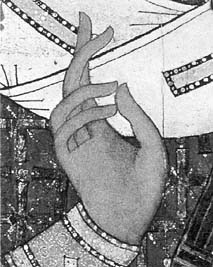
Hand Gesture, Russian Blessing
DSM: But ‘clear and natural’ doesn’t have to mean ‘tame’. The gestures of Venus, performed by Karina Gauvin, called to mind Martha Rosler’s “system of harnessed subjectivity” in her short film, Semiotics of the Kitchen (1975)—in which the artist blithely traverses a seemingly benign range of various kitchen utensils, punctuated by sudden violent actions, followed in each case by calm returns to composure.

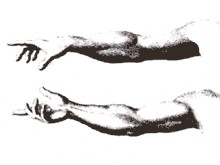
Hand Gesture
CMT: Repeat the gesture at least several times, pausing at the end of each repetition to allow the gesture's ‘radiations’ to flow through you. Walk around the stage. See yourself doing the gesture inwardly. You generate a kind of “pull” through repetition and radiation of the gesture, and awaken a sense of urgency in the character—which can be amusing or heartbreaking or other things, depending on what the gesture is and what it signifies.

DSM: Allowing your breath to release with each “pull” helps, too—it adds to the power and complexity and emotional richness/truth. The “pull” reinforces the emotional truth, makes it more vivid. Nicole Potter has a lot to say about this in her book on acting.

B  y distilling characters or scenic moments to their core gestures, you can achieve performances that are so psychologically complex that it would take reams of paper to describe them.”
  —  Nicole Potter, Movement for Actors, p. 22

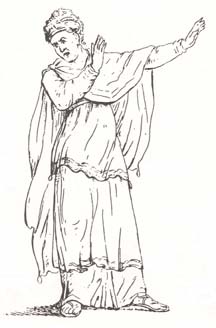
Hand Gesture
CMT: When multiple players are on stage, as is usually the case in opera, special considerations arise. There are often multiple activities going on at once, which is confusing since a viewer can only really focus on one activity at a time. It’s important for actors to coordinate their activities to make the overall action on stage understandable and coherent. One way to lend coherence to multi-player action is to give it focus. If one player has the primary role in the current action, then the other characters should direct their attention to that character.

DSM: This helps the audience to see where to direct their attention, and avoids extraneous action on stage that can distract the viewer.

CMT: Giving focus doesn’t simply involve staring at other cast members, though. Each player must have an intention at all times, and display that intention. So if a player is focusing on another player and listening to what that player is saying, the first player should react to what the other player is saying or singing, and display that reaction. Action on stage involves a continual give-and-take among the players, where action leads to reaction, which entrains further action. When done right, these actions and reactions combine into a continuous flow, and that propels the drama forward—as we saw done so well in the BEMF production of Psyché!

DSM: In Psyché, I saw human beings, fully-dimensional characters. I saw suffering and joy in their eyes; I saw their lips tremble; I saw Venus’s face darkened by rage, jealousy and pain; I saw Psyché’s face brightened by love and relief. Obviously, it’s a big difference to see the opera live, at BEMF. I saw completely human people, fighting, suffering, loving and expressing all shades of human feeling, from the brightest to the darkest. Light and shadow is the leitmotiv that comes to mind.

CMT: I could hardly separate the singing from the orchestra, so harmonious was the fusion between all the elements of this production: voices, instruments, gestures, lighting … like a broad stream that just carried us away.

DSM: Ellen Hargis’ stage presence is simply phenomenal. In the various BEMF performances in which she appeared last week, what struck me most about her stage skill was the simplicity of her body language. She didn’t have to gesticulate and pace around on the stage to be expressive. She projects an aura of mobility which gives her individual gestures weight and emotional power. In her workshop at BEMF, Ellen explained the agile placement and orientation of the body—the torso, hips, arms, legs—so as to be readily and fluidly able to move to the next location on the stage, and the next.

CMT: The word ‘impressive’ is insufficient to describe Ellen’s physical presence on stage—as we saw in her performances at last week’s Boston Early Music Festival. Her beauty and smile are so striking that you can feel the audience focus on her and, at that moment, I wouldn’t have been surprised if the musicians lowered their bows and the whole audience got to their feet.

Hand Gesture
DSM: Interestingly, she isn’t the kind of singer who appeals to everyone instantly. When I first saw her I was surprised by the low tone of her soprano voice—but I soon found her singing superb and profoundly moving.

CMT: When music moves you to the extent of rendering you speechless, you utter platitudes like “This is music to die for.” In the case of Ellen Hargis, I would invert it: this is music to live for!

Hand Gesture, Sioux Malediction
DSM: Dr. Elena Nicoladis and her research colleagues have studied the hand gestures of bilingual children as they told the same story twice, first in one language and then the other. The researchers were surprised by what they saw. The children used gestures a lot more when telling the story in what they considered to be their stronger language. These results seem counter-intuitive. You’d imagine the children would be more inclined to use gestures to help them communicate in their weaker language. Based on these results and the results of earlier studies, Nicoladis believes there is a connection between language and memory access and gesturing.

CMT: What they believe is going on is that the very fact of moving your hands around helps you recall parts of the story—the gestures help you access memory and language so that you can tell more of the story. In other words, it’s not that the gestures are all outwardly directed, for the purpose of emphasis or persuasion or clarity of communicating what is already queued-up to be told; instead, it’s that the performative process, including gesturing, serves to “lubricate” the speaker’s memory and verbal expression centers in the brain—enabling “more” to be told, than what would otherwise have been queued-up. Benjamin Bagby says something that amounts to the same thing in the round-table discussion that’s included on his Beowulf DVD.

Initially, we thought gestures were related to meaning—that they mean things on their own. But now we believe they are more deeply related to language.”
  —  Elena Nicolaidis, Univ Alberta, 2005.

DSM: Even with a libretto to follow, there’s no question that well-devised gestures can have this same “lubricating” expressive effect in opera! This BEMF production of Psyché is ample evidence of that!

G  esture has therefore this Advantage above mere Speaking, that by this we're only understood by those of our own Language, but by Action and Gesture (I mean just and regular Action) we make our Thoughts and Passions intelligible to all Nations and Tongues.”
  — Thomas Betterton, 1710

CMT: In Russian theatre we have Otkaz (Refusal/Reversal). The ‘otkaz’ is the preparation for the action, the wind-up before the pitch. The inhale before the speech, the bent knees before the jump. Basically preparing and storing up energy needed for the intended imminent action. And we have Posyl (Sending Out, To or Away). The ‘posyl’ is the execution of the main action. It’s the path from C to B passing through the point of origin, A. Just like a ball thrown by a pitcher, the energy held in the body during the ‘otkaz’ is released and sent in the direction of the action. Because it passes through the point of origin, A, the posyl is seen by the audience as the path from A to B—containing the energy collected from the otkaz. Without such energy, the posyl has no momentum. If it’s difficult to understand an actor—if her/his lines seem unconvincing—it’s usually because she/he hasn’t prepared and gathered the energy necessary for the line. Hasn’t used the otkaz.

M  ovement is the most powerful means of expression in the creation of a theatrical production. Deprived of words, costumes, footlights, wings, auditorium, and left with only the actor and his mastery of movement, the theatre would still be theatre.”
  — Vsevolod Meyerhold, 1914

DSM: Ellen’s workshop stressed that we must always bear in mind the ‘when’ and ‘why’ of gestures, or else the ornaments will merely be ornaments—of little consequence to the energy and meaning of the performance. Indiscriminate use of gestures is a kind of incontinence—it belies a lack of understanding of when less is more. She alluded to “that landscape painter who knew how to paint cypress trees well, and who then [stupidly] painted them into every landscape everywhere.”

CMT: She also noted that the ‘accessibility’ of stage gestures does depend upon a certain amount of cultural literacy among members of the audience—a general literacy of physical/kinesthetic “grammar” that these days is faltering. So companies producing baroque operas today have the additional burden of gently informing or illustrating for audience members the 17th century gestures that are essential for their understanding and enjoyment of the performance.

DSM: There’s also the matter of timing. As Ellen emphasized in the BEMF workshop, the gesture usually precedes the action or line that it references. The gesture’s typically an ‘otkaz’-like “set up.” It may even be paradoxical or silly if it’s synchronous with the action or line.

CMT: The gesture isn’t only a “set up” for a positive verbal disclosure or declamation. Ellen points out that a gesture can also anticipate an impending ‘withholding’ of information—a secret, an emptiness, a negative whitespace. Gestures span the full range of rhetorical devices—something that was ably illustrated by the Psyché cast—aided and abetted by Ellen’s expert coaching and direction. I was glad to see that Heidi Wilson, the Wall Street Journal music critic, noted this in her review. I was glad also to see that Heidi was enthused about the notion of getting investors interested in producing this Psyché in Paris and/or New York . . .
S  eek not to know what must not be reveal’d,
Joys only flow when hate is most conceal’d ...
Let me no more with powerful charms be press’d —
I am forbid by fate to tell the rest..”
  — Indian Queen, Act III
    (opera by John Dryden and Robert Howard,
     music by Henry Purcell)


Hand Gesture


Friday, June 22, 2007

1st June 07

Kat (Part 3)

With long dark hair not lacking a Pantene shine, Kat sashayed into my cell and sat down.
“If you don’t mind me asking,” I said. “What are you in prison for?”
“An accident,” Kat said. “Two people had stalled at 7th Avenue and Dunlap. Instead of pushing their car off the road, they opened the hood and stood in front of the car. I came up right behind them and pushed the car over them. One died and one was seriously injured.”
“Wow! That’s awful. Was alcohol involved?”
“Yes. People had been buying me drinks at the bar. The bar was sued for serving me over the limit.”
“How much time did you get?”
“I signed a plea bargain for twelve years for vehicular manslaughter.”
“How much time do you have left to serve?”
“I get out in twenty-one months. This was never a part of my life plan. Who knew?”
“Taking someone’s life must have devastated you?”
“Yes. What happened will haunt me forever. It’s completely changed my life and the way I see the world. How a life can change overnight.”
Seeing the inner pain in Kat's eyes, I changed the subject.
“How come your skin looks so good? Do you have an exfoliation routine? Or use Jergens?”
“I put vitamin E on my face at night, and wash it off with Camay an hour later.”
“And your hair.”
“I just cut my hair. It’s dark auburn, two-tone.”
“Do you mind if I ask you some questions about prison sex?”
“No. Go ahead.”

Email comments to writeinside@hotmail.com or post them below

Copyright © 2006-2007 Shaun P. Attwood