Friday, February 8, 2008

Carried Away: Bezaly, Hahn, Déjà vu et l’Heure exquise

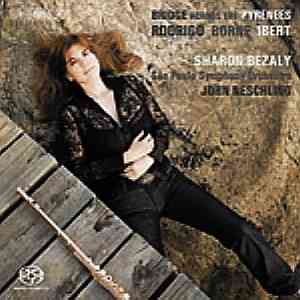
 Sharon Bezaly
T  he official conception of the classic was still linked to a holistic, conservative French community... Reynaldo Hahn’s A nos morts ignorés is typical in its economy of means and its search for an expressive style that incorporates learnèd archaisms, such as modal allusions and ars antiqua organum.”
  —  Jane Fulcher, p. 91.
H  is mind is attracted by a vision, by an image; his heart suffers a feeling; his refined sensuality thrills under the contact of an impression; immediately the emotion is translated into a musical formula, fixed in an instant; but soon reverie gains the upper hand, the image becomes general, the overtones of feeling reverberate, hum, and the inconstant dreamer, seduced by their echo, allows himself to be distracted and carried away.”
  —  Reynaldo Hahn, speculating on Fauré’s creative process (but really projecting his own process and imagining it as belonging to Fauré), Journal de l’Université des Annales, July 1914, 8:115-8.
 Sharon Bezaly

    [50-sec clip, Reynaldo Hahn, Romanesque, Bezaly-Brautigam-Imai, 1.5MB MP3]

Sharon Bezaly is best known for her performances of the traditional flute repertoire. But she is deeply committed to new music, too. Sofia Gubaidulina, Kalevi Aho, Sally Beamish, Daniel Börtz, Fulvio Caldini, Brett Dean, Carl-Axel Dominique, George Flynn, Hans-Ola Ericsson, Anders Hillborg, Christian Lindberg, Uljas Pulkkis, Ge Gan-ru, Mari Takano, Haukur Tómasson, and Zhou Long have written compositions for her.

Sharon Bezaly
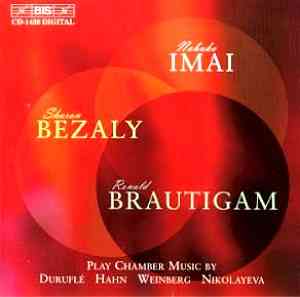
She has also this penchant for time-warping and spell-casting, especially with solo and small-ensemble works. Some of it appears on her CD with pianist Ronald Brautigam and violist Nobuko Imai.

Bezaly’s vibrato and phrasing tell us much about the culture and the expressionistic intent, just as Edith Piaf’s voice belongs to mid-Century French culture and Souzay’s performance of Reynaldo Hahn’s song l’Heure exquise illustrates an overtly erotic vocal intent.

The phrases overlap for a moment, as the viola begins to sing over the piano’s dissolving phrase and the flute’s virtual ascent into heaven, carried away. Over the course of the Romanesque the elements gradually converge toward a subtle synthesis that depends on a progressive ‘dematerialization’ of the flute. The strophic construction of the piece enables us to watch this progression in slow motion.


    [50-sec clip, Reynaldo Hahn, Romanesque, Bezaly-Brautigam-Imai, 1.4MB MP3]

The etherealization of the flute goes hand in hand with the musical processes of sequence, inversion, and motivic fusion. This yields a kind of musical ‘interiority’, exquisitely deliberate on Hahn’s part and elegantly rendered by Bezaly, Brautigam, and Imai. It refutes the exteriority of mere ‘mimesis of Italian 16th and 17th Century dance’—which is where Horst Scholz’s liner notes for the CD leave it.

 Bone Flute, 43,000 years old
 Bone Flute, overlay on Boehm flute
What else is on the Bezaly-Brautigam-Imai CD?
    Bezaly—Chamber Music
  • Maurice Duruflé: Prelude, Recitatif et Variations, Op. 3
  • Reynaldo Hahn: Romanesque; L’Enchanteur; Portraits de peintres; Danse pour une déesse
  • Meiczysław Weinberg: Trio, Op. 127
  • Tatiana Nikolayeva: Trio, Op. 18
Some highlights of Bezaly’s upcoming performance schedule include:
  • 14-15 Feb 2008: Bergen: Mozart: Concerto in D Major; Bernstein: Khalil
  • 23-24 Feb 2008: Den Haag: Rodrigo: Concerto; Borne: Carmen Suite
  • 28 Feb 2008: Norrlands: Rodrigo: Concerto
  • 21 Apr 2008: Amsterdam: Recital with Ronald Brautigam
  • 23-26 May 2008: Zagorje: Slovenian Flute Festival
  • 01-04 Feb 2009: Spain: Tour with London Baroque
 Sharon Bezaly


Thursday, February 7, 2008

07 Feb 08

Zucchini (Part 1)

Because many of you asked for more details of what prisoners get up to sexually, I spent a long time with Max documenting his sexual awakening in the prison system. Fearing repercussions, Max asked that I wait until we were both out of prison before I posted this series. It’s a long series, and Max just gets in deeper and deeper. I’d like to thank Max for being so candid.

“I was deliverin’ chow,” Max said, “to lay-ins on Yard 3, and I see my buddy, Log, peekin’ outta Cindy’s door.”
“What do Log and Cindy look like?”
“Log’s a big dude, and Cindy’s a tiny white dude, maybe one-hundred-and-five pounds, with long light-brown hair.”
“With a pretty face?”
“No. With a dude’s face.”
“What happened?”
“I leave my cart with all the trays on the motherfucker – I know they’re gonna get stolen – and I go into Cindy’s cell. Cindy’s on the top bunk. I’ve seen him around, but I’ve never spoken to him before. Log’s standin’ next to the door, and he says, ‘Look at this.’ I said, ‘Wassup, man?’ He says, ‘Cindy, lift up the sheet.’ Cindy was layin’ on his side. He lifts the sheet, and I see a shampoo bottle about as round as a tennis ball but with serious length. The motherfucker had to be at least eleven inches, dude. Log comes over and lifts up one of Cindy’s buttcheeks, so that his starfish is in full view. Log says, ‘Hey, do that thing again.’ Cindy commences to get the bottle and slowly work it into his tiny little pucker – and you can’t just shove somethin’ that size in there, dude, you’ve gotta work it in. Well, he finally gets it in a coupla inches – picture somethin’ tiny with somethin tennis-ball wide inside it. I mean, it was sheer amazin’, dude, that it so stretched to capacity. I mean, how does one blow their O-ring like that? Does it take years of practice? Do they have sphincter control when they take a shit or do they just squat and it goes plop-plop?
So me and Log are just standin’ there lookin’, and Cindy is workin’ the shampoo bottle in further. It’s startin’ to get a little natural lube thing goin’ on. It’s so wide I’m thinkin’, If he takes an inch, he might as well get the whole eleven in there. I could’ve stuck my fist in there – and I’m a big dude with big hands – but not that I would.”
“Was Cindy making noises?”
“Of course. He’s moanin’ and tryin’ to make it seem all seductive and shit. Like that’s a turn on. Fuckin’ that would be like droppin’ a pencil down a mineshaft.”
“Are you sure you weren’t thinking about giving it a go?”
“Hell no! He’s nasty, dude. I woulda caught all kinds of stuff.”
“So what was the joy of watching this?”
Blushing and stuttering, Max said, “There was no joy. If you ever come across a situation like that, you’ll be stupefied.”
“How did you feel?”
“I don’t know, man. I’m not a voyeur.”
“Repulsed?”
“Yes, in some small way.”
“Mesmerized?”
“Yes. Four or five minutes went by, and it was like I was a deer caught in the headlights. I was stuck. What broke me outta the situation was when Log said, ‘Imagine what you could keyster in there.’ And then they called me back to the kitchen over the loudspeaker. I say, ‘I’ve gotta go, dude.’ I’m chucklin’. I just don’t know what to say ’cause I’ve never been in a situation like that before. Do you say, ‘Right on, dude. Thanks for the show’?
I leave and my face is all red, and people are yellin’, ‘Max, what happened?’ I get my cart – which is seven trays light – and go back to the kitchen thinkin’, He didn’t even use grease or anythin'. He literally pushed it in there.”
“So you couldn’t stop thinking about it?”
“I have to admit, I was fascinated by it. I’ve seen broads in porno mags gettin’ fist fucked, but the poon is made to stretch like that. So I get back to the kitchen, and guess what they tell me?”
“I dunno.”
“That I’ve got to go back to Yard 3 to give a CO a tray. And the CO is right by Cindy’s cell.”
“Which, naturally, you happened to return to?”
“Yes.”
“And then what happened?”
“Oh, dude, do you really wanna know?”
“Absolutely.”


If you were in Max’s position would you stay away from or return to the scene of the shampoo-bottle show? And if you would return, why?


Email comments to writeinside@hotmail.com or post them below

Copyright © 2007-2008 Shaun P. Attwood
Wednesday, February 6, 2008

Writing Home: Reflection Papers and Journaling to Deepen Your Music

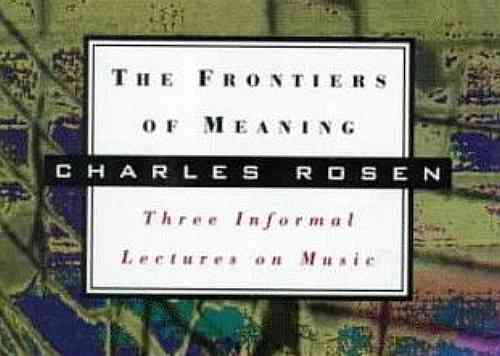
Charles Rosen, Frontiers of Meaning
N ow I’m supposed to write a paper reflecting on my playing and my learning process, which in turn are reflections of my literacy and adherence [or not] to the assignments. If I have to write this reflection paper of my reflecting on my reflections, I will ... do badness to something or someone. I have no idea what to write.”
  —  Anonymous.
If you’re in school, then chances are your assignments include writing one or more ‘reflection papers’ this semester. The task of writing an essay on your own experiences and applications and first-hand gleanings forces you to collect and distill and categorize: you critically evaluate your experiences and place them into context; the narrative form forces you to write about your own impressions and explain the context into which they fit. Quelle horreur!

Reflection papers aren’t a pedagogical punishment. Throughout your career, you can and should invest in improving your musicianship through regular journaling. This is in addition to whatever other activities you engage in for performance, composing, producing, engineering, arts marketing, artist management, presenting, teaching, listening—whatever you do musically. Writing ‘reflection papers’ is just one way for you to harvest and preserve the experiential learning that you do in those other activities. It’s a way to connect the work with the learning.

Why journal? (Why blog?) Mostly to keep yourself learning and growing, and to force yourself to clarify your thinking and revisit and retest your convictions—especially ones that may never’ve been fully thought-through in the first place. Consider it as a dimension of your training, just like practicing on your instrument(s)—it keeps your mind from getting old or rusty or atrophied. Use it or lose it!

W    hen I don’t practice for one day, my fingers know it; for two days, my friends know it; for three days, and the whole world knows it.”
  —  Ignacy Paderewski.
Journaling is about the shape and meaning we assign to our experiences. Our stories are about who we are, where we’ve come from, and where we think we’re headed and why. What you want to do is get ideas and explore ideas. You want to assemble evidence and counter-evidence, and critique the quality and strength of both.

How to go about it? I think it helps to have at least one or two examples as ‘benchmarks’ to serve as guides and reminders of the writing qualities you admire. For me, the epitome of writing that is at once erudite, elegant, and entertaining is pianist Charles Rosen. His little 1994 book ‘Frontiers of Meaning’ is, for me, iconic. Kyle Gann’s ‘Music Downtown’, emblematic of journalistic bravery. Alex Ross’s ‘The Rest Is Noise’ has a different tenor but serves to remind me of how wide our palette can be. Arnold Steinhardt’s ‘Indivisible by Four’, reminds me of grandfatherly patience and generosity in the life lived and the life written-about. You don’t have to write books as they have done. But our own writing will be better if we look frequently at how our favorite authors write.

The best book I know that specifically covers journaling and reflection papers as a practice for working artists is Buck’s. If you’re looking for practical guidance on how to go about writing a reflection paper (whether for your class assignment, or independently for your own professional growth), I recommend you pick up a copy. Check out the other books below, too.

Ultimately, critical analysis and interpretation aren’t detached acts; not value-neutral reportage. No, as a kind of psychological counterpart to Heisenberg’s Uncertainty Principle in physics, the acts of observing and journaling change the things you are observing and their relationships to each other. The personal change is the source of the value in writing reflection papers: the change enables further growth in your playing or composing or listening. Paradoxically, the infinite regress that Anonymous complained about above is actually the whole point of the exercise. Rather than ending in confusion, the process makes you figure things out; makes you figure out how you figured them out; makes you figure out how ‘figuring out’ works. A different dimension of professional practice. A different kind of rehearsal. Quelle horreur!

O  ur doubts are traitors, and make us lose the good we oft might win by fearing to attempt.”
  —  William Shakespeare.


Tuesday, February 5, 2008

02 Feb 08

Hammy

Feeling ill, Hammy didn’t want to go to the Ring O’ Bells. He wanted to stay in and recouperate from recent benders. He invited me to his flat where he explained that recouperation involved not going out to drink, but instead, drinking at home. As he made a vodka and orange, I admired his wall-mounted bottle rack with optics.

“My mum thinks you’re killing yourself with all of this drinking,” I said. “I go out with you on a Saturday night, and you drink right through until Sunday night.”
“That goes without saying,” Hammy said. “Sometimes it’s from a Friday night straight through until Sunday. And on a Sunday I don’t even touch beer, I’m straight on the spirits. I used to drink every night and love it, and carry on till I could take no more. It was like lifeblood – the lifeblood of the universe.”
“Are you looking to quit?”
“No, it’s like quitting breathing. I’ve calmed it down a lot. I’m bored of hangovers at work, and going in looking like Mr. Cadbury’s Parrot – looking at myself in the mirror in the morning, and seeing one of my eyes looking at me and the other looking for me.”
“What do you prefer to drink?”
“Anything with a vowel in it. If you can’t pronounce it and it’s Welsh, I won’t drink it. I like getting fucking hammered – power drinking. Sometimes I step it up a gear and drink with a load of hooligans.”
“When I left for America you were more interested in women than drinking, has that reversed?”
“When I’m on day one or two, women are still high on the list. On day three or four they slip down the pecking order.”
“Aza told me you’ve slept with half the women in this town.”
“I’ve had strangers come up to me in the street, ask me my name and say, ‘You don’t know who I am do you?’ I look at them bewildered, and they say, ‘You’re me dad.’ One time I was fucking wankered – I had a full week’s growth and I’m looking like Grizzly Adams – and this girl comes up to me and says, ‘This is him. I’ve found him,’ to these young lads. I’m looking at her. I’ve got a crate in each arm and a bottle under my chin – I’m fully laden with spirits. And there’s beer and slobber running down my T-shirt. Anyway, she says, ‘You’d better start putting your hand in your pocket for pocket money for me.’ I don’t say anything. Then she says, ‘But I’ll start off with one of them beers.’ That’s when I knew it had to be my daughter. She was about fifteen. That’s going back some years. I probably didn’t remember the mum the next day.”
“What do you think of the women in Liverpool?”
“We’ll go to Liverpool. There’s so many women there we’ll get raped. You’ll end up having knee tremblers against a wall.”
“Knee tremblers?”
Thrusting his pelvis, Hammy said, “Yeah, doing it up against a wall.”
“How is your sex life going?”
“I like to have sex when I’m on drink. They come hand in hand.You missed the Hulk last night. She calls every few months for a fuck. She broke my bed riding me like a cowgirl. That’s why the microwave oven is under my bed.”
“When I've been in a happy relationship with a good woman, I've managed to get my excesses under control. Maybe a strong woman would put you in check. What qualities are you looking for in a woman?”
“It depends on what stage of the night it’s at. And in the end I always have my beer goggles on. I go to bed with Claudia Schiffer and I wake up with Margaret Thatcher.”
“Perhaps the influence of a good woman will help get you off the drink. If you meet the right one will you get married?”
“Possibly. Later. I don’t know. I’m only thirty-seven.”
“I’ve noticed that when we go out, as the night progresses, your voice slowly turns into what your friends describe as the pirate voice. You never had that when I left. How did it come about?”
“The more I drink, the more the pirate voice comes out. I can’t help it. When I’m completely off my barnet, I sound like I’ve just come back from an expedition on the Spanish Main loaded with booty from the Caribbean.”


I’m worried about Hammy’s health. I’ve asked him to go jogging, and to try to go easier on the drinking. What else can I do to help him?

Email comments to writeinside@hotmail.com or post them below

Copyright © 2007-2008 Shaun P. Attwood

Monday, February 4, 2008

04 Feb 08

From Two Tonys (Letter 1)

Jan 26, 2008

Hey Pal,

I received your most welcome letters. I was so happy to read that you are back in sunny ol’ England surrounded by those that have got love in their hearts and minds for one of the best blokes I’ve run across in my prison years (from the heart).

Now I don’t have to tell you (but I will), stay the fuck away from all the silly shit that life will throw in your path. In simple talk, “Do the right thing.” Enough said.

It’s 6:30 AM Sat morning here. I’m going out to clean my showers soon. I’m a shower porter. Then to breakfast. I’m going to be on my radio at 1 PM to listen to you and then I’ll give you my critique. I’m looking forward to it.

So I’ll give you a quick news update. Long Island was on the TV last night. He’s in jail. He ran over a cop during a robbery. It’s over for him. Poor guy. He loved that dope and now he’s a dope for life along with yours truly. Also my old nemesis Bill Bonanno died. I’ve enclosed a clipping for you to file. He was full of shit to the end. Fuck ’im. Let the worms eat his ass. I don’t mean to be disrespectful to the dead. It’s just how I feel. Why be a phony?

I’m going to break for now. Duty calls and these showers have to be cleaned, so these geeks can wash their cruddy arses and balls. Woe is me. Crime doesn’t pay, but I sure enjoyed some of it along the way. Fuck it. (It is what it is.) I’m not complaining. These fucks treat me better than I would them.

2 PM

I listened to your radio interview. I’m so proud to know ya Shaunny me boy. You’re for real. On a 1 to 10, you were a strong 9. You get them mate. Dennis Welch seemed cool and so did Todd. All the callers concurred. You stay with this. The one about inhaling the roach was the best. I’m a sicko, but I can’t help it. The rat story was good also. Like I said, you go boy.

I’m here in Buckeye. It’s not as bad. In fact it’s better than Santa Rita. Specially now that they moved them into dorms. Imagine living next to Slinglade. There’s 50 guys per dorm, 3 shitters, 3 showers. Yea. You get up in the morning, grab your toothbrush, go to put a nice brush on the pearlies and there’s Slingblade sitting there taking a big noisy shit, and there’s a line of people waiting to dump. No thanks. I’ll pass. This place is OK as far as yards go.The COs are not as picky as those C.O.D.A. COs at Santa Rita. They let a man do his time. Oh, they do their job, but a man has to expect that. But it’s nothing like Joe Arpaio bullshit.

Repo caught a murder case. Something about some dead Indian swinging in the wind. Who knows and who gives a shit. My biggest concern is what time chow is and what’s on the tube, or if I got a good book to read. Hey! I’m reading The Constant Gardener by Le Carre. It’s slow but I’m staying with it. I read Looming Towers about Osama bin Laden. It was good. Check it out if you can take time from your pubbing you bloody bloke.

I’ve enrolled in horticulture school. Yea, I’ve decided to devote my life to planting plants instead of blokes who cross me. In fact I’m seriously thinking of opening a horticulture store when I get out in 2082. But if I don’t make my release date then, oh well, it’s still a good class to get out of my single cell and keep my mind busy. That along with my shower porter job and rec 5 times a week. I keep active.

Oh yea, Jim Hogg came back and was in the cell right next to me till last week then they took him back to Tucson. (He won’t last.) He didn’t want to go. He was sad. The big dummy. He gets out in Jan ’09, “shitter time,” he could do that on the shitter.

You asked about Ogre. He’s here. We don’t speak. He’s a fraud and a pooty butt. But he’s not in my building. That’s good.

Hey, I was glad to read that you’re safe and had a good home coming with Mum and Pops. I’ll bet baby sis is happy to have her wild and raving bro back. Hey, bro, it was a real pleasure to have known ya and spend the time I did with ya. You were a bright light on a dark shore and you helped me several times when I was headed for the rocks and shoals, just by being around and helping me calm down. I miss ya.

Send a picture or two of you and the folks if you can. Stay strong, my Limey friend. Let me hear back from you. I’m excited about your future. Give the folks my L ’n’ R and tell them to let up on your leash a bit at a time.

Get back with me mate,

Two Tonys

PS

Oh yea, you saw where Norman Mailer passed, well fuck ’im. He talked shit about our boy Tom Wolfe, plus he never put a penny on Two Tonys books. So let the worms eat his ass. Maybe he’ll be my celly in hell. I’ll give him the blues and assign him shitter cleaning duty 24/7. The fraud. And that goes for his pal Jimmy Breslin.

Hey, this Bill Bonanno was as full of shit as a Xmas turkey. He tried to write. Furgedaboutit. He sucked. His only claim to fame was his daddy, who became senile and got run out of New York. I was present when some big shots talked shit about Bill. Plus he had me put in his work. He was balless. He’s better of dead. At least the worms will appreciate his fat ass. Him and his daddy like to throw the word honor around. They didn’t have any. The scuds. Man of Honor. Bound by Honor. Honor thy Father. All titles of books. The only one with any substance was Honor thy Father and Guy Talese wrote that. Hey, I hope I don’t sound bitter, but to be honest I’m just glad I outlived the bastards. Fuck ’em.

Hey bro, I don’t want to get on a roll. I hope I haven’t already. Believe me, life is good. I’m as happy and content as can be expected. Humor helps a lot. I like to laugh, and I do everyday. I’m 67 and healthy. This ain’t a Russian gulag or Joe Arpaio’s jail. So let the good times roll. Let’s do this thing!

PPS

Hone your skills. You got good skills.


Here's the article Two Tonys enclosed. Two Tonys was an associate of the Bonanno crime family.


Ex-crime boss Bill Bonanno dies at 75

Son of notorious mafia don has coronary at Tucson home
By Enric Volante
The Arizona Daily Star
Tucson, Arizona Published: 01.02.2008


Salvatore "Bill" Bonanno, the former acting head of one of New York's Mafia families and son of Prohibition-era crime boss Joseph Bonanno, died Tuesday at 75.
Bill Bonanno, who survived a mob shootout in Brooklyn before he retired from organized crime, had a heart attack at his Tucson home and died at Tucson Medical Center around 9 a.m., said his daughter-in-law, Kathleen Bonanno.
Bonanno, a tall, sometimes charming man who liked to talk about the history of Sicily, moved to Tucson from New York as a young boy when his father began dividing his time between the East Coast crime family and a home in Tucson, where Bill attended the University of Arizona.
FBI officials said Bill Bonanno served as consiglieri of the Bonanno crime family and then as acting head when his father went missing in the 1960s.
Bonanno served federal prison terms in the 1970s and 1980s following two convictions, including one for a stolen credit card.
Bonanno said he retired from organized crime in 1968. The FBI said that was when his father lost control of the Brooklyn-based criminal organization he had ruled for decades. The organization that bore their name was infiltrated in the 1980s by FBI Agent Joe Pistone and was portrayed in the film "Donnie Brasco."
In 1980, the elder Bonanno, who died in 2002 at 97, was convicted of obstructing a federal grand jury's investigation of an alleged money-laundering scheme involving his sons Bill and Joseph Jr.
A crime novel that Bill Bonanno co-authored with retired agent Pistone and another writer came out last year.
Bill Bonanno was the focus of the best-selling book "Honor Thy Father," by Gay Talese, in 1971.
In 1999 Bill Bonanno co-produced a nearly five-hour-long Showtime series on the life of his father. A former U.S. attorney who had prosecuted organized crime when the elder Bonanno was a powerful don said the Bonannos "had a lot of nerve" exploiting their notoriety.
Soon after, Bill Bonanno published his own book, "Bound By Honor: A Mafioso's Story."
In his book, Bonanno made the unsubstantiated claim that mobster Johnny Roselli confided he shot President John F. Kennedy from a hiding place in a storm drain in Dallas' Dealey Plaza. He also recalled that he ran an illegal betting parlor with his mafia crew in the early 1960s in a building on East Broadway in Tucson.
He also took credit for arranging G. Gordon Liddy to be released from segregated lockup when they were in prison together.
"Liddy wasn't a rat like (Watergate witness) John Dean. He was a loyal soldier. I was told he would be perfectly safe."
Daughter-in-law Kathleen said Tuesday, "The mystique of the Bonanno family we did not know about because to us he was a wonderful, kind and giving father, grandfather and great-grandfather."
"He stopped at nothing to come to the aid of his children," she said. He often spoke to them of their family heritage in Italy and Sicily and took his grandchildren there.
Bonanno was celebrating the holidays with his relatives and recently wrote to them: "Nothing can exceed the joy of Christmas when a father and a mother and their children and their children's children come together in a conscious awareness of Christmas' true meaning."
Survivors include his wife of 51 years, Rosalie; sister Catherine Bonanno Genovese of Pleasant Hills, Calif.; sons Charles and Joseph of Phoenix, and Salvatore of Scottsdale; daughter Felippa "Gigi" Pettinato of Grass Valley, Calif; 18 grandchildren; and two great-grandchildren.
Funeral arrangements were pending with Bring's funeral home on Broadway.

● Contact reporter Enric Volante at rvolante@azstarnet.com. The Associated Press contributed to this story.


Email comments to writeinside@hotmail.com or post them below

Copyright © 2007-2008 Shaun P. Attwood

Trio Con Brio: Individualism-Collectivism in Ensemble

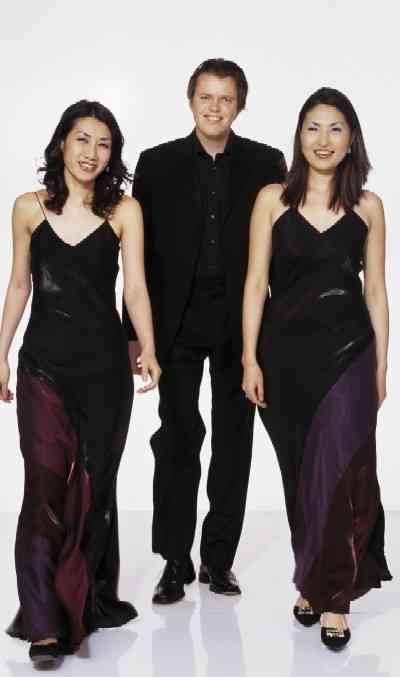
 Trio Con Brio
The performance by Trio Con Brio in Kansas City on Saturday, 02-FEB-2008, thrilled the appreciative audience. The program consisted of Beethoven’s Op. 1 No. 1, Shostakovich’s Op. 67, and the Ravel Trio, capped by an encore of the 5th movement of Dvorák’s ‘Dumky’.

    Trio Con Brio Copenhagen
  • Soo-Jin Hong, violin
  • Soo-Kyung Hong, cello
  • Jens Elvekjaer, piano
The Trio Con Brio’s integration and cohesiveness were superb—such a unity of anticipation of each other’s next steps, each other’s needs. Close your eyes. Is this the playing of three distinct musicians, or is it the happy subordination by each, to the needs of the organism that, together, they comprise? Schools of fish, flocks of birds, herds of synchronized gazelles are not so beautifully coordinated as this! Fascinating!


    [50-sec clip, Dmitri Shostakovich, Piano Trio No. 2, Op. 67, Andante, Trio Con Brio, 1.5MB MP3]

    [50-sec clip, Dmitri Shostakovich, Piano Trio No. 2, Op. 67, Andante, Trio Con Brio, 1.5MB MP3]

    [50-sec clip, Dmitri Shostakovich, Piano Trio No. 2, Op. 67, Largo, Trio Con Brio, 1.5MB MP3]

    [50-sec clip, Dmitri Shostakovich, Piano Trio No. 2, Op. 67, Largo, Trio Con Brio, 1.5MB MP3]

Throughout the performance on Saturday evening, Trio Con Brio’s dynamics and phrasing were ‘alive’. Breathing, sighing—collectively, a unified and ‘pneumatic’ interpretation that was inspired and inspiring.

This was all the more remarkable to me as I thought about what the nature of their rehearsals might be like—involving the two Hong sisters, and Jens married to Soo-Kyung Hong; involving the mixing of Danish attitudes and culture and Korean attitudes and culture. The ensemble has been together now for more than 8 years, but still—there must be moments when opinions among them diverge and disagreements between them as individuals bring friction!

And yet, apparently, such moments are amazingly few. Jens is, by nature and upbringing, a charming and modest person, despite his impressive skill as a pianist. The same is also true for Soo-Jin and Soo-Kyung, even though their charm and modesty hail from Korea, half a world away from Denmark. Each of the three is warm, optimistic, exuberant—in the playing, and in conversation after the performance. The ways that each of the three of them has for achieving this wonderful balance of collectivism and individualism may differ, but the musical result is a beautiful and deeply meaningful one. Bravo!

 Trio Con Brio
T  he Korean self is profoundly collectivist while deeply committed to individual self-assertion... I do not assume there is a code—a key value that resolves the conflict. All selves are built up from incompatible elements, and they stay that way... [The Korean self] is not so much a ‘modal’ self as an ‘ideal’ one, reflecting the ideals of Korean culture... kibun—the state of the self-in-society... Koreans are not separate individuals—at least they do not see themselves as such in the same way as Westerners—so the individualistic competition you see Koreans engage in is not really competition among individuals at all [in their view], but among families, the individual always representing more than himself or herself... an ‘amoral familism’.”
  —  C. Fred Alford, The Self Is a Conflict, Not a Continuum, p. 31.
L ee Soo-Won uses the word ‘chong’ to characterize the collective self and ‘exchange’ to characterize the individual self. ‘It is chong that enables us to overcome our own point of view in relationships and fit into the group.’ Lee does not distinguish between good (‘koun) and bad (‘miun’) chong, or between affection and attachment, including those attachments that may be destructive. Does it make any sense to say that Eunyoung has a porous ego, that she is less autonomous than one who gives up everything for love? Does it not make more sense to say that she knows her values, what she cares about, and that one cannot have all of everything one wants, and she is aware of how she would choose? Are these not the attributes of a strong self who knows that reality means choices among values? That hers is a strong group self makes no difference in this regard! Hers is still a strong self—highly individuated without being separated. Koreans are actually more self-aware than Americans because Koreans are more aware of their relationships. Self-awareness is not awareness of a ‘pristine’ self. There is no such thing. Self-awareness is awareness of the self-in-interaction with others, including others who exist only in our memories. Koreans do not have ‘Emersonian Moments’. There are other forms of self-awareness, forms that actually come much closer to what it means to be a real self in the world.”
  —  C. Fred Alford, Why Do Koreans Say ‘We’ and Instead Do ‘I’ ?, p. 55.