Thursday, January 10, 2008

Dr. Atomic: John Adams’s Photographer’s Gaze

Dr. Atomic
It is useful to think of chamber music as ] a narrow deep area between the novel and film.”
  —  Lewis Baltz.
There was a time when we thought it was enough just to photograph objects at eye level, standing with both feet on the ground. But then we began to move around, to climb mountains, to fly in space, to go to the bottom of the sea—and to document what was there and our responses to what was there. John Adams’s compositional ‘concision’ is tremendous—he is able to imply so much with so few notes, with so few compositional gestures! He is not satisfied with things apprehended at eye level.

 Still Life with Fish, Kleinschmidt
Adams’s opera, Dr. Atomic, is nominally about the history of J. Robert Oppenheimer and others who participated in the Manhattan Project in the 1940s, to create the atomic bomb. But the text fragments that were incorporated into the opera or adapted to become part of its libretto offer close-ups so extreme as to become abstract—studies of textures, microscopic studies of the ethos of the period. In places, it’s as though we have waveform-sampled, electroacoustic still-lives of Oppenheimer and colleagues. The opera is painterly—or, more accurately I think, photographerly.

 Still Life with Fish, Claesz
The images affect us on the physical level, the depictive level, the mythic level. The setting of a John Donne sonnet is made to sound archaic by Adams’s choice of a slow, solemn D minor chaconne. All the typical 17th-century ingredients of a breakfast still-life painting are here. On the left is a large römer, a green wine glass with prunts on the stem. Next to it is a salt cellar with a Chinese porcelain dish on top. It contains capers, which go well with fish. The still-life is subdued in color—only the yellow of the lemon grabs the eye. Delightful details, such as the curling lemon peel and pewter plates jutting out from the table, divert our attention. Dr. Atomic has still-life compositional qualities like these.

R eality has started to be understood as a type of writing—one that can be decoded [through photographs]… Photographs are not so much an instrument of memory as an invention of it, a replacement for it.”
  —  Susan Sontag, On Photography.
This type of still-life is sometimes called a ‘vanitas painting’, in which arrangements of fruit and flowers, or lavish banquet tables with fine silver and crystal, are accompanied by symbolic reminders of mortality. A skull, an hourglass or pocket watch, a candle burning down, a book with pages turning, serve as a moralizing message on how short life is. Look! The fruits and flowers themselves are starting to spoil and droop. Look! The boy comes to get a glass of milk from the nanny! Look! The bomb!

D r. Atomic came out very fluidly, and largely without my analyzing it [in the process of composing it]. [Don’t] make the mistake of walking through the kitchen to get to the restroom—and come back having lost your appetite. [Don’t] look in my kitchen here, but for the moment just enjoy what’s on the plate.”
  —  John Adams, in interview with Thomas May, FEB-2005, p. 233.

Still Life with Skull, Claesz
Interplay among the levels of experience that Adams devises for us is what creates tension and meaning in this opera. The collapsing of depth, foreshortening of events, telescoping of time by way of the festinating micro-marches that Oppy and Groves make together across the stage—these create new relationships; they don’t just reveal and characterize existing historical ones.

Some of the moral or ethical implication of Dr. Atomic is diminished by the libretto’s obsessing over trivial and self-absorbed dialogue of the scientists and military characters. But this, too, is a choice on Adams’s and Sellars’s part. Possibly their intent is to portray the Americans’ inhumanity and hubris even more brutally, by downplaying the characters’ attention to the destructive implications and casualties that the bomb will have. But the effect of this choice—minimizing the characters’ attention—also tends to reduce our own.

Dr. Atomic, ‘Batter My Heart, Three-Personed God
General Groves’s candy-bar eating and weight management issues—his recitative about the 200-calorie brownies and three pieces of chocolate cake—are maybe genuine historical artifacts, but their inclusion here is conspicuous for the vacuousness and/or sociopathy they imply.

John Adams, photo O’Grady
Kitty Oppenheimer spends the majority of the second half of the opera on center stage, passed out in her chair from consuming too much scotch whiskey. This, too, may be historically accurate. But the choice to have one character inert and stationary—whether due to psychological strain or moral incontinence or some other cause—is a curious one for the composer and librettist to make.

Dr. Atomic
T he photographer can identify with the circumstances. Choosing is the final, essential act of creativity. If, as Poincaré suggests, the subconscious brings up ideas in pairs or in crowds, then it is up to us to choose what makes sense to us. If, as he suggests, this bringing into consciousness is directed by an aesthetic force, the best one can do is not undo it but take it as it is... What I call imagination is simply that active link between intuition and rationality.”
  —  David Travis, p.77.

 Still Life with Fish, Peeters
Dr. Atomic is a work that can hold special significance to people of a certain age, say, those who are today 55 years and older and who have a clear personal recollection of the milieu of the 1950s or of the 1940s. Adams and Sellars take imagery and texts from that period and make them more complex and multi-layered by injecting them into this latter-day composition. Although in many ways the historicism of the quoted texts and images makes them ‘stay the same’, the farther we go in this process the more different they become and the more intriguing the results are—and the more those results play to our imagination and compound the complexity. There’s a ‘fractal’ quality of memory that Adams evokes in us—and we’re led to recognize a mathematically recursive quality of our memory—led to recognize the inherently, unavoidably ‘revisionist’ nature of our human cognitive process. Our minds continually re-contextualize everything! We cannot help it!

V ertov is right. The task of cinema and of the camera is not to imitate the human eye, but to see and record what the human eye normally does not see. The cinema and photo-eye can show us things from unexpected viewpoints and in unusual configurations, and we should exploit this possibility.”
  —  Ossip Brik, in Wells, p. 90.

 Still Life with Fish
This opera is chock-full of implication—open-ended imagery that empowers the audience to enter into constructing individualized meanings. Adams is aiding and abetting curiosity and conjecture. This is not mere ‘optical’ fidelity—a claim to correctly transcribe visual appearances (‘It happened, and it looked this way.’). It’s emotional fidelity—accurate, in part, because we’re engaged by Adams in actively generating its truth. That said, this is not an opera for anyone incurious—anyone who’s unprepared to be engaged and unwilling to be actively implicated.

The sparseness of the set, its raising and lowering mountains-scrim and bomb and gantry/scaffolds, and the repetitiousness of the choreographed movements all present challenges to audience members who are expecting activity on-stage to have a purpose, advance the story, or make a point. In many ways, the point seems to be the utter lack of a point—the absurdity of the process of making the bomb, the impersonal and unstoppable momentum that the process has when it is underway, the existential horror that that zombie-like activity has.

Cumberland, photo Pieter Ombregt
Unexpectedly, the imagery in the Dr. Atomic production was reminiscent of the Pieter Ombregt XYZ photographs I had seen earlier in the day, at the Columbia College Chicago exhibit at the Water Tower on Michigan Ave.

Harelbeke II, photo Pieter Ombregt
Angular, inhuman geometry and architecture. Harsh, inhuman light bathing depersonalized human figures as morally impoverished objects, not subjects. Entering and exiting doors and apertures, to fulfill purposes unknown or no purpose at all.

Still Life with Glasses
Found Art’ can be the epitome of a consumptive, exploitative capitalistic political economy. But this opera is not ‘Found Art’. It’s not shameless appropriation and naked, direct presentation of historical texts set to music. Instead, it creates new connections, creates an aura—empowers us to find these connections, discover our own aura. The aura may be ugly and disheartening, though. The quiet recorded Japanese voices that percolate down on us from the balconies as we wait for the bomb test detonation in the final 5 minutes of Dr. Atomic are terrible reminders of how needless, how cruel, and how avoidable the deployment of these weapons was. There is no catharsis here. And it is difficult to applaud afterward. Dr. Atomic might be best done with instructions to the audience to exit the theater silently, to go home and meditate on how to make amends and how to be better human beings.

I  have never attempted to squelch the kind of energies inherent in my music in order to avoid a catharsis or ‘crisis’ or climax. I don’t view my expressive world as teleological. Rather, I try to allow what’s latent in the material to flower naturally. I think a lot of being a good composer is like being a good gardener. You have to know when to wter something, to cultivate it, and also when something needs judicious pruning.”
  —  John Adams, in interview with Thomas May, FEB-2005, p. 28.

Still Life with Sharkfin, Isaacs
Adams is—in this opera and in other of his work—a specialist in creating quasi-historical scenic wonderment for the audience. It’s as though, say, he (re-)introduces the mid-Century concept of phosphorescence, as it was before the era of television and fluorescent lights—before the wide public experience of phosphors and phosphorescence had expunged the cultural remembrance of what ‘phosphorescence’ had been in the literary age that went before.

T he concept of revelation—one hears, one does not seek; one accepts, one does not ask who gives... Everything happens involuntarily but, as in a gale of a feeling of freedom... The involuntariness of image and metaphor is strangest of all: one no longer has any notion of what is an image or a metaphor... It actually seems as if the things themselves approached and offered themselves as metaphors.”
  —  Friedrich Nietzsche, Ecce Homo.

Mushroom Cloud
Adams’s detached, clinical observation—leads him to compose still-lives of these carefully selected and edited ‘found’ objects. His material and inspiration lead him to construct views through barn doors and beyond relay-racks filled with arrays of meters and glowing pilot-lights, to mountains and prairie grass and historical people outside. It is very much in the aesthetic realm between the novel and the film, as photographer Lewis Baltz once said. Very much like the objectification that happens in the Ombregt photographs.

Porch Shadows, Strand, 1916
Adams’s wife, Deborah O’Grady, is a photographer. I wonder whether she sees photographerly influences in his work, with regard to John’s compositions and compositional techniques. I wonder if harmonious ways of seeing are part of what brought them together.

Truth in photography may involve some degree of verisimilitude to the objects seen, but the primary reference shifts from object to subject. Truth now refers not to accurate representation of the objects but rather to accurate representation of the artist’s response or interpretation of the object. Truth now means fidelity to the subjective experience, of the artist and the viewer.”
  —  Jerry Thompson, p.22.

Music Hall, Madison Ave, Szarkowski, 1943

Still Life with Fish, Bazille


Wednesday, January 9, 2008

09 Jan 08

New Clothes

When I first lived in America in 1991 I went to a gym wearing clothes from England and people looked at me as if I’d committed the crime of the century. The unwanted attention, explained a friend, was due to my black socks. So, I got rid of the black socks and for sixteen-and-a-half years wore white. Upon returning to England last month, I met various friends who were horrified to see my white socks.
“In England, we wear black socks,” Hammy said.
“Even with sneakers?” I asked.
“Yes, even with white trainers. Don’t worry we’ll soon cure you of that habit.”
Now I’m back to black again.

My aunt Sue took one look at my clothes – prison blues and sportswear fashionable in America over half a decade ago – and said, “We’re going shopping for clothes. We’ll take my son Mike. He knows all the latest fashions.”
Mike guided me through three stores: Barometer, Blueprint, and Burton. The shoes in Blueprint were narrow and curled up at the toes.
Mike recommended a pair, and said, “They’re dead trendy them.”
Trying them on, I felt like one of Santa’s elves. I opted for two pairs not so heavy on the curl.
As far as tops go, stripes are popular here. I chose three striped tops including a Lacoste shirt. Lacoste was popular when I was a teenager and according to Mike it is back in fashion.
I replaced my prison blues with a pair of VOI jeans, and Sue picked out some dress pants. I traded in my Alien Workshop beanie for a reversible beanie from Burton that is black on one side and striped on the other.

Thanks, Sue, for decking me out, and Mike for the sound advice. I feel swanky in the pointy shoes. Thanks also to Barry in Tonopah for the jacket filled with white down feathers - it is like wearing a sleeping bag in this cold weather.

Email comments to writeinside@hotmail.com or post them below

Copyright © 2006-2007 Shaun P. Attwood

Monday, January 7, 2008

07 Jan 08

On Shanks (Part 2)

“To make a shank using paper, you soak the paper in glue, roll it up real tight, and make a long thin pointed stabbing implement. Some will put a needle at the point of it, or some kind of pushpin, so it has a sharp metal point. Once the metal point breaks the skin it goes right in.”
“With one hit?” I asked.
“It’s a one-hit deal.”
“Aiming for the heart?”
“They aim just below the breast bone, and the shank goes in and up. Once it’s in they move it from side to side, and either break it off or pull it out. The thing is, ’cause going in it makes such a small-diameter wound, if you pull it out there’s not a lot of blood. With a small diameter the skin will close in, but because they wiggle it, it’s done damage to the heart or aorta, and you bleed internally.”
“And die?”
“Yeah. You die a long time before the prison can get you to a hospital.”
“You mentioned stabbing shanks and slicing shanks, what’s the deal with slicing shanks?”
“With a slicing shank they’ll go for the neck if they’re intending to kill you. If they can slice either the jugular or the carotid, odds are you’re gonna bleed out and die. They may go for the inner thigh. If the femoral artery is cut with a slicing blade, it’ll cause you to bleed out. Anyone shanked there should put pressure on it and get to the hospital.”
“If you’ve been shanked in the neck, what are the chances of the prison getting you to a hospital in time to save your life?”
“Slim – but it can happen.”
“Slicing shanks are made out of what?”
“Any kind of flat metal or round metal.”
“I’ve heard about people making shanks from fence.”
“Yeah, just straighten it out and sharpen the end of it – make it into an ice pick.”
“Can we talk for a little bit about how to reduce your chances of getting shanked?”
“OK.”


Email comments to writeinside@hotmail.com or post them below

Copyright © 2006-2007 Shaun P. Attwood

Saturday, January 5, 2008

Irish New Music: Back to the Future—‘Folk music’ Elements in ‘Art music’

M  usic—the natural words in the natural order. Through that formula we go back to the people.
  Music will keep out temporary ideas, for music is the nations’ clothing of what is ancient and deathless.”
  —  W.B. Yeats, Letter to Lady Gregory, 08-FEB-1937.
New music in Ireland is neither an attempt to move away from traditional music nor a deliberate construction upon previous works. The ‘Irishness’ of recent chamber music compositions is as idiosyncratic as the Irish counties and their distinct cultures and histories. I recently had an opportunity to explore the Contemporary Music Centre in Dublin, in preparation for travel to Ireland later this year. The Contemporary Music Centre is funded by the Arts Council/An Chomhairle Ealaíon and the Arts Council of Northern Ireland, and also receives funding from the Ireland Department of Arts, Sport and Tourism and the Irish Music Rights Organisation (IMRO).

The diversity is phenomenal—throughout the musical genres really but especially so among chamber music idioms that the CMC-member composers represent. Some contemporary composers are clearly serial or atonal. Others among them are much more lyrical and tonal. Bodley especially inclines to settings of Irish poetry—which is especially appealing to a foreign visitor like me who craves the cultural ‘situatedness’ of compositions like Bodley’s. It is not inward-looking or insular; instead, this music just feels intensely, well, ‘Irish’.

S ee everything through music! Those chords yet to resound in you—they swim like fish in all the rivers of the world. You love their playful surge, their shadows flickering deep within you.”
  —  Susan Connolly.
The act of composing classical music is, I suppose, ultimately an assertion of creativity—a cairn placed by the composer as a marker of her/his—our—existence, against the fact of our mortality. Chamber music is inherently ‘serious’ as well as intimate, regardless of the humor or other emotions it may convey. But, over the years, informal Irish folk idioms—gatherings of friends, the clairseach—have been transformed into concert pieces. So one question as I listen to the output of these Irish composers of new music is, is there now a trend ‘back to the future’—reverting to more informal folk music themes and smaller orchestrations, chamber ensemble pieces?

With some difficulty, it could be so—and Bodley and other composers in the CMC stable do it regularly. Boydell, too, in his earlier years—String Quartet, Op. 31, for example. But there’s no business model for it (the ‘stick’). And, to be honest, the Gaelic tradition in literature and the arts does incline toward epic proportions anyhow (the ‘carrot’). So when we have Irish composers writing new music for small ensembles, it’s clearly done as a labor of love.

Brian Boydell (photo: Mortell)
Boydell passed away in NOV-2000. Along with fellow composer, Frederick May, he founded the Music Association of Ireland in 1948. Much of Boydell’s writing bears the influence of Bartók. Not that his work is entirely derivative of European traditions; it is not. But his avoiding incorporating Irish folk tune themes into his compositions is conspicuous, compared to other composers of Irish new music. Here’s a clip from his String Quartet No. 2, performed by Vanbrugh Quartet [Gregory Ellis (vn), Elizabeth Charleson (vn), Simon Aspell (va), Christopher Marwood (vc)].


    [40-sec clip, Boydell String Quartet No. 2, Vanbrugh Quartet, 0.5MB MP3]

I n the 1940s and early 1950s I was considered (in the Irish context) a very ‘modern’ composer. Now, about forty years later, my music could possibly be considered rather old-fashioned. This is largely due to a firm belief in artistic honesty: creating sounds that I like personally and refusing to follow fashions that might be more acceptable to the critics of the time.”
  —  Brian Boydell, 1996.

John Gibson (photo: Langan)
John Gibson was born in Dublin in 1951 and currently lives in Cork. His training/development included stints with Stockhausen and Lutoslawski. To date, he has five CDs released. Here’s a clip from his piece Sliabh Luachra, performed by Johnny McCarthy (trad fl) with the Crawford Piano Trio [Adrian Petcu (vn), Iosef Calef (vc), Jan Cáp (pf)].


    [40-sec clip, Gibson Sliabh Luachra, Crawford Piano Trio with J. McCarthy, 0.6MB MP3]

F or he had gone alone into the island
And brought back the whole thing.
The house throbbed like his full violin.”
  —  Seamus Heaney.

Seóirse Bodley (photo: Langan)
Seóirse Bodley was born in Dublin in 1933. His writing has been prolific and varied, ranging from avant-garde to Irish traditional music. Among other things, he’s a founder of Aosdána, Ireland’s government-sponsored academy of creative artists. Here’s a clip from his String Quartet No. 2, performed by Degani String Quartet [Alan Smale (vn), Elizabeth Leonard (vn), Padraig O’Connor (va), David James (vc)].


    [40-sec clip, Bodley String Quartet No. 2, Degani Quartet, 0.7MB MP3]

and a clip of his String Quartet No. 3, performed by the Vogler Quartet.


    [40-sec clip, Bodley String Quartet No. 3, Vogler Quartet, 0.9MB MP3]

I s iomaí sort ceoil atá ann, mar adúirt an fear a raibh an trúmpa maide aige.”
[There are many different sorts of music, as the man with the wooden trumpet said.]
  —  Seóirse Bodley.
In summary, there are many novel and exciting new chamber music works being written and performed here. I look forward very much to my next visit to Ireland. Maybe you, too, will have a chance to visit sometime soon. Meanwhile, browse what’s on CMC’s website (they have a wonderful Calendar of Events and other features), order yourself some of the CDs and scores, and enjoy!


Cox book


Friday, January 4, 2008

Stage Fright: More Treatment Options

Battaglia 2002, Fig. 1
A fter an episode of anxiety associated with performing, I feel strange—like I’m empty and numb. It feels like I am watching everyone else, but at a distance. It’s not an ‘out-of-body experience’ or anything like that. Not light-headed or dizzy. But I do feel short of breath—my breathing is fast, and my heart-rate is still fast—even though the performance is over and the reason for the anxiety is over. It’s really weird. I just feel like there’s a ‘distance’—like the other people are real and I am somehow not real. It makes me feel so alone. It goes on for hours. Usually I have to go to sleep, and when I wake up the next day I feel completely normal. Is this some ‘after-effect’ of anxiety or what? Is this what it feels like after a seizure or something?”
  —  Anonymous.
Since my previous posts on the stage-fright topic, I’ve received several comments/questions similar to the one above.

The neurologic state associated with an episode of stage fright is not an epileptic one. But the sensations afterward can feel almost ‘inter-ictal’, with some qualities similar to what people who’ve experienced a seizure feel. And Panic Disorder and PTSD share many clinical features—such as ‘anticipatory anxiety’ and depression and ‘intrusive imagery’—imagined potential scenarios that bug you. Functional MRI and other studies of regional cerebral blood flow are beginning to show similarities, too. So the after-effects of a solo concert—feeling like you may have PTSD—aren’t really that surprising, neurologically or physiologically speaking.

Some of you who’ve sent me comments have wondered whether there are objective ways to measure the severity of the anxiety you’ve experienced. Clinically, there are a variety of scores that are used, but most of them are lengthy questionnaires, and very few of them have been designed to be self-administered. The one by Snaith and colleagues is short, intended for self-admin, and it does address ‘panic attacks’. This is different from stage-fright per se, but it nonetheless might be a helpful and relevant gauge, for those of you who’ve asked about this. Here’s a spreadsheet I’ve prepared. You can download it by clicking on this screenshot.


Spreadsheet version of Clinical Anxiety Scale (CAS) of Snaith
Panic Disorder (in the DSM-IV diagnostic nomenclature) is characterized by recurrent panic attacks—that is, periods of intense anxiety—in which 4 (or more) of the following symptoms develop abruptly and reach a peak within 10 minutes:
  • palpitations, pounding heart, or accelerated heart rate;
  • sweating;
  • trembling or shaking;
  • sensations of shortness of breath;
  • feeling of choking or dry mouth and dry throat;
  • chest pain or discomfort;
  • nausea or abdominal distress;
  • feeling dizzy, unsteady, lightheaded, or faint;
  • de-realization (feelings of unreality) or de-personalization (being detached from oneself);
  • fear of losing control;
  • fear of collapsing or dying;
  • paresthesias (numbness or tingling sensations);
  • chills or hot flashes.
Keep in mind that Panic Disorder isn’t the same as stage-fright. But some people who are susceptible to panic attacks are performing artists. Diagnostically, there’s an “overlap” between the conditions. So empirically the approach to managing stage-fright might include cognitive behavioral therapy (CBT), deep-breathing and yoga, and medications that are used in full-blown panic disorder.

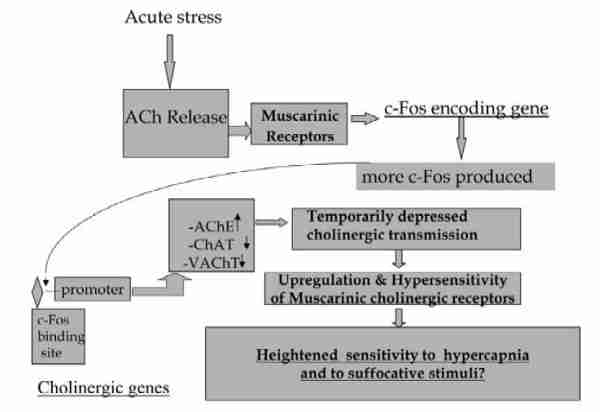
It turns out that central (brain) muscarinic cholinergic receptors are involved in our physiologic reactions to these stimuli (see the Battaglia chapter in Silman’s book for a short summary), including slight increases in CO2 in the bloodstream. The slight elevation of CO2 (hypercapnia) is what triggers the faster breathing and the racing heartbeat. And the acute stress causes an increase in the release of acetylcholine in the hippocampus in the brain (see Kaufer paper) that has a several-hours duration. Concomitantly, about 70% of people subject to panic attacks have increased sensitivity to lactate in the bloodstream, compared to healthy normals (Rosenbaum, p. 63). And that triggers faster breathing at lower blood lactic acid concentrations—at far lower levels of lactate than would cause hyperventilation in ‘normal’ unstressed people.

Also, recent research has shown that in panic attacks there’s an up-regulation of gene expression of cholinergic muscarinic receptors, cFOS, and other gene products. That up-regulation also lasts for hours—and is related to the increased sensitivity to CO2 and lactate.

In fact, since I’m not personally affected by panic attacks or stage-fright and since I don’t have any work-related reason to intensively follow the medical literature on the subject, I hadn’t previously seen the articles on anticholinergic drugs and panic attacks. But there’s actually quite a lot of new evidence for cholinergic causation of panic—accumulating evidence over the past 5 to 8 years or so. It’s not the sort of thing that your average GP would know about.

Curiously, inhibitors of the enzyme acetylcholinesterase (AChE) [for example, Alzheimer’s drugs, like donepezil (Aricept™), rivastigmine (Exelon™) and galantamine (Reminyl™); also neostigmine (Prostigmin™), pyridostigmine (Mestinon™) and other various cholinergic drugs used to treat myasthenia gravis] may induce sensations and cognitive changes that are reminiscent of post-traumatic stress disorder (PTSD), including de-personalization or feeling ‘distanced’ or unreal—very much like the symptoms described by the conservatory-student commenter above.

In other words, you can increase the number of acetylcholine receptors, or you can increase the sensitivity or binding affinity of the existing receptors, or you can increase the concentration of acetylcholine molecules available to bind to those receptors (by inhibiting AChE, the enzyme that metabolizes acetylcholine)—any of these changes can produce the same distinctive cognitive symptoms.

And, logically, you might think that doing the opposite—for example, using a drug that inhibits the binding of acetylcholine to the receptors, or a drug that enhances the activity of the AChE enzyme, or a drug that down-regulates the gene expression of the receptor or that post-transcriptionally changes the sensitivity of the receptors expressed—might offer some relief or prevent such symptoms. Yes, it’s been tried. Transdermal scopolamine and other strong anticholinergics don’t necessarily help panic attacks, though. But Battaglia’s work in Italy suggests that low doses of Akineton™ (biperiden, a weak anticholinergic drug) can help [see 2001 paper published in Arch Gen Psych ]. Anecdotal reports of the off-label use of biperiden for stage-fright also exist, although they’re not nearly as common as ones reporting the use of beta-blockers.

Of the various options, the biperiden should be relatively less likely to cause performance problems, compared to the others—compared to SSRIs, say. But, hours after the performance, brain cholinergic activity decreases below baseline. And then biperiden’s lingering activity (it has a 18 to 24-hour half-life) might be annoying—the day after your performance.

A  noradrenergic (catecholamine) mechanism of panic has been substantially repudiated in the past 15 years. Clonidine and other alpha-blockers are ineffective—that’s part of the evidence. And plasma and urine MHPG levels are not usually abnormal in the way one would expect if noradrenergic overactivity were the cause. And SSRIs are effective in panic attacks, which one would not expect if noradrenergic overactivity were the cause. In other words, the catecholamines in panic attacks seem to be the ‘effect’, not the ‘cause’. The beta-blockers mentioned in previous posts essentially address these ‘effects’, not the ‘causes’.

Serotonergic abnormalities are at least partly implicated—especially the 5-HT(1A) receptor—and this is the basis for the use of buspirone (Buspar™) or risperidone (Risperdal™) in panic disorder. GABAA / Benzodiazepine receptors (see Goddard, Gorman & Charney in Rosenbaum, pp. 57-92) have also been implicated—and that fact gives rise to another avenue of treatment/prevention possibilities.

The information on this page is not intended as medical advice and is not meant to be a substitute for individual medical judgment by a physician or other medical healthcare professional. The aim is to provide information and help in suggesting considerations for preventive care. The medications listed below should be used only after a medical examination and under the supervision of a doctor. Always consult a licensed healthcare provider for individualized advice on your health decisions.

    Medications that have been used in Panic Disorder
  • Anticonvulsants [levetiracetam (Keppra™, 500 mg bid)]
  • Serotoninergics [risperidone (Risperdal™, 4 mg qd, 5-HT(1A) and 5-HT(2) antagonist), buspirone (Buspar™, 10 mg bid, partial 5-HT(1A) agonist)]
  • SSRIs [paroxetine (Paxil™, 20 mg qd), sertraline (Zoloft™, 50 mg qd), fluoxetine (Prozac™, 20 mg qd), fluvoxamine (100 mg qd), citalopram (Celexa™, 20 mg qd), escitalopram (Lexapro™, 10 mg qd)]
  • Benzodiazepines [alprazolam (Xanax™, 1 to 4 mg qd), lorazepam (Ativan™, 2 mg qd), clonazepam (Klonopin™, 1 mg qd). ]
  • Anticholinergics [biperiden (Akineton™, 2 mg qd), possibly trihexyphenidyl (Artane™, 1 mg qd)]
Benztropine (Cogentin™, 1 mg qd) has a 36-hour half-life, far too long to be relevant to the stage-fright application. But trihexyphenidyl (Artane™, 1 mg qd) or other similar compounds should work effectively like Akineton™. The short 4-hour half-life of Artane might be an advantage. But there’s no journal literature on its use in Panic Disorder or stage fright, so far as I can tell. In any case, it would be prescribed off-label, low-dose.

Hope this helps. Let me know how things go, if you decide to pursue any of these things.

Incidentally, it’s unknown how occasional stressful events [like recitals] might mediate long-term neuronal plasticity in the brain. And it’s unknown whether repeated high-anxiety episodes of the sort experienced by some performing chamber musicians could lead to PTSD or, if they can in some cases lead to PTSD, how frequent or severe the episodes have to be to have a high probability of doing so. We won’t worry about it, since it seems not to have been examined in clinical trials or other studies. But the absence of evidence is not evidence of absence, and all that…


Prisoner Updates

30 Oct 07

For man is a man and master of his fate.
-Alfred, 1st Lord Tennyson “The Marriage of Geraint”

O fortune, fortune, thou art a bitch!-Sir John Vanbrugh The Relapse

Here’s what’s going on with most of the prisoners written about in this blog.

Repo is facing the death penalty for the recent murder of a prisoner on Yard 3. He is in the hole.

Iron Man is working toward his goal of becoming a fitness trainer. His earliest release is in March, 2010. He hopes to open an athletic center, and to become more proficient in mixed martial arts.

Xena is in the hole. Acting in self defense, Xena’s cellmate, Savage, was sent to the hole for breaking the jaw of an Aryan Brother (whose teeth had to be wired together and had to be fed through a straw). With Savage gone, Xena received threats of a sexual nature and was moved to the hole.

T-Bone is staying focused on the Bible and working out. His earliest release is in November, 2009. He hopes to become a construction manager.

Shane is receiving Interferon treatment for hepatitis C. His viral load is undetectable, and he hopes to be completely cured. His earliest release is in April, 2012, but he has asked the U.S. District Court to overturn one of his sentences, which, if successful, would get him out in 2010. He was recently moved back to Yard 4 after refusing to work in Yard 1’s kitchen.

Max is living in Las Vegas. He is working as an office coordinator for AppleOne.

Slingblade has been eligible for parole for the past three years, but he doesn’t have the competency or outside help to facilitate his release. He has written numerous letters to John McCain requesting help getting out of prison, and he recently wrote to Queen Elizabeth.

Kenny recently arrived at Yard 1, had his life threatened over unpaid drug debts, and was moved to the hole for his own safety. In the hole he had a seizure, which the nurse, Cornrows, accused him of faking.

Junior Bull Gravano had a fight with Duke, was sent to the hole, and is now on Yard 2. He is hoping to be moved to a federal prison to serve the remainder of his sentence for the Ecstasy case.

Duke is living with his wife in Phoenix.

Gina was moved to Buckeye prison after receiving sexual threats at Yard 4. Gina is fighting for hormone therapy and would eventually like vaginoplasty.

Weird Al has applied for clemency on the grounds that if he doesn’t get a liver transplant soon he may die. His earliest release is in June, 2008.

Long Island was set free and is rumoured by the inmates to have fallen in with the Russian Mafia.

Two Tonys was sent to the hole for refusing to share a cell with a certain murderer. From the hole he was transported to a maximum-security unit at Buckeye prison.

Ogre is at the same prison as his nemesis, Two Tonys. Ogre was moved after receiving multiple tickets, including testing positive for drugs.

Midnight was accepted by a halfway house in Tucson (Old Pueblo Community Foundation’s Casa Santa Clara http://www.oldpueblofoundation.org/ ). He hopes to be living there in January, 2008. He was recently diagnosed as SMI (Severely Mentally Impaired).

Frankie is still at a supermaximum prison due to the numerous violations he committed on Yard 4, including heroin possession and trying to incite a riot in the kitchen. When he gets out, he wants to establish himself as a leading pimp in England.

Kat’s earliest release is in March, 2009. He intends to live in Phoenix and to own and operate a greeting-card business.

Slope sees the parole board in September, 2008. He would like to work as a maintenanceperson at a hospital. Further out, he hopes to own a handyman business and to do tattooing on the side.

As for me, I’d like to express how I’m feeling by quoting from Tolstoy’s War and Peace.

‘Everybody says that adversity means suffering,’ said Pierre.‘But if you asked me now, at this moment, whether I wanted to stay as I was before I was taken prisoner, or go through it all again, my God, I’d sooner be a prisoner and eat horse-meat again. We all think we only have to be knocked a little bit off course and we’ve lost everything, but it’s only the start of something new and good. Where there is life, there is happiness. There is a huge amount yet to come…’


Let’s take a look at what else is going on here. An inmate on Yard 4 was recently gang raped and moved to the hole. A guard shot himself in the hand while holstering his gun. Getting high on cough syrup (sold at the inmate store) is all the rage. Heroin and crystal meth continue to flood this place and the prisoners remain far from rehabilitated. The taxpayers continue to be fleeced by prison contractors whose political contributions guarantee them contracts to provide shoddy or nonexistant goods and services at top-dollar prices. When and how will it all end?

Email comments to writeinside@hotmail.com or post them below

Copyright © 2006-2007 Shaun P. Attwood