Monday, May 26, 2008

26 May 08

Bucket of Blood (by Warrior)

Warrior - Serving fourteen years for kidnapping and aggravated assault. Half Hispanic and Scottish-Irish with family still in Mexico. Raised by a family heavily involved in drug commerce.

I was eighteen when I first stepped foot in prison. Thinking back I can only imagine to what degree I exuded fear and uncertainty. I’m sure it was transparent, like a cheap pair of Nike’s at the swap meet with the swoosh facing the wrong way. I was scared.

Late summer, I was stood in front of a fifteen-foot chain-link fence in an orange jumpsuit two sizes too large, waiting to be let onto my very first yard. The guard who escorted me off the bus was nowhere to be seen. He had stepped into a concrete bunker/tower to operate the opening and closing of the fence. All of a sudden, the fence clanged open about three foot. I looked at the officer and he waved at me to go in. Going through, the fence hit my shoulder as it closed shut. The officer approached the fence, gave me my cell and bed location and pointed to its direction. Clutching the standard-issue net bag with basic toiletries, and bedding underneath my arm, I set off with the bravest face I could muster.

The yard was out for recreation. Some guys playing basketball. Some working out. Others playing cards. Others pausing to observe the new addition to the population heading across the yard. If predatory stares could kill, I would have been dead twenty times.
I was approached by an older fellow, heavily tattoed, six-foot-two, fourtyish, smoking a rolled cigarette. “Hey kid, what’s your name?”
“Alex,” I said, watching him with a wary eye.
“The name’s Doc.” As he held his hand out to shake, many of the prisoners observing me went back about their business, which I took as a good sign. “Just off the bus are you?”
“Yeah.”
“What house they give ya?”
“4-C-18.”
“Come on. I’ll take you over there.” He exhaled the last of his cigarette.
Following him, we exchanged small talk on the way. “Well, youngster, since it’s your first time down, there are a coupla things you should know. First, never get involved in anything that doesn’t concern you immediately. Do your time, never let the time do you. Second, stay away from the gangs, drugs and prison politics. They’re all dead ends. Lastly, never lose sight of the following: your word, your mind, your identity and your life. Remember these things and you’ll do just fine.”
“Thanks for the advice. How long you been down?”
“Twenty-eight. I go home next year,” he replied, all nonchalant.
I couldn’t even begin to imagine what that felt like. I felt ashamed for complaining about the measly three-and-a-half years I had back then.
“Let’s take a detour, youngster. You’ll need stamps, envelopes, a pen to get a hold of your people. And screw that state soap, it’ll mess your skin up. We’ll go by my cell. You don’t have to pay me back. Just pay the shit toward the next guy in your shoes.”
“OK.”
We arrived at Doc’s living quarters, but before entering the run we stopped by two men stood puffing on cigarettes.
“Let’s wait here a second,” Doc said. “We don’t want to be in there right now.”
After five minutes, a man in his late twenties with long blond hair in a ponytail, wearing a ball cap, wheeled out a mop bucket and a mop. “All clear, guys,” he said.
“Right on,” one of the smokers said.
“Wait here. I’ll be right back,” Doc said, and disappeared down the maze of doors and halls inside the building.
The man in the ball cap picked up the mop bucket and motioned me over. “Do me a favor.”
Wanting to be accepted and acting like I knew a thing, I said, “Sure.”
“Keep eyes for me. Let me know if a cop comes while I dump this bloody mop water. It’ll only take a second.”
Shocked and stunned as I became an accomplice to the first of many such instances, I focussed around me with a more heightened awareness of guard uniform than prisoner garb.
He dumped the bloody water over a patch of dirt outside the building. He ran back in, then back out with water to toss over the bloody water to dilute the evidence. “Thanks, youngster,” he said, then disappeared into the building, mop and bucket in hand, leaving me wondering who’s blood was in the bucket and what he had done to deserve what had occurred.
Just then, Doc appeared with envelopes, stamps and a bar of Irish Spring. “Here you go, kid,” he said, handing me everything. “You look a little pale.”
“Uh, dude just emptied a bucket of bloody mop water a second ago.”
“Well, if that’s the only thing you see in here, you’ll be lucky. It’s almost time for head count, we need to get you over to your new spot.”
He showed me to my run and bunk, shook my hand and said, “If you ever need any advice, you know where to find me.”
I settled in that night, but didn’t sleep. It’s tough to sleep in any new environment, let alone prison. All I could think of was that mop water.

Everything Doc imparted to me that day turned out to be true. I never realized how true until much later. He was right about the mop water too. I’d be the luckiest man in the system if that were all I’d ever seen.
Strangely enough, I’ve been on both sides of that bloody mop water in the course of my prison travels. I’ve grown in awareness because of it, and learned what is unneccesary and not at all desirable. Trying to develop strong moral character is where I’m at today.

As this is Warrior's first story for Jon's Jail Journal, your comments and feedback would be greatly appreciated and shall be forwarded to him.


Email comments to writeinside@hotmail.com or post them below

Copyright © 2007-2008 Shaun P. Attwood

Friday, May 23, 2008

Josquin’s Modality, ‘Meaning’ Funnels, Modal ‘Budgets’

 Josquin portrait, © Naxos
A  lthough Josquin’s decision to repeat the opening words of the psalm after each verse owes a debt to Savaronola, the idea of making one of the tenor voices sing a motto melody during each of those repeats is entirely his own. No inflexible grid of durations is called for here. Instead, the tenor bides his time until the remaining four voices reach the end of a verse, then joins them in singing the refrain... The spareness of texture that results, together with the sober parlando of the word-setting, the dark minor modality, and the sheer length of the piece all contribute to the monumental gravity of the work.”
  —  Richard Sherr, Josquin Companion, p. 295.
R  ather than ‘proximity’ of modal theory and practice, I believe we should speak of ‘coincidence’ of two kinds of discourse (textual and musical) about the modes, acknowledging their closely-related, but not identical, manifestations... [The history of polyphonic modality] is a double discourse on the modes, because of teh two (principal) media involved, music and language. The term ‘discourse’, used here in a loosely Foucauldian manner, emphasizes the interaction between thought and language, and especially the role of language in the formation of thought. Further, this expression draws attention to the dynamics and the relative instability which polyphonic modality demonstrated during its history, while at the same time suggesting a way of ordering the variety of views.”
  —  Frans Wiering, Language of the Modes, p. 21.
T  he emergence of Renaissance polyphony from medieval modality appears to be one example of a culminating moment in which musical forms and textures responded ideally to their tonal basis. The simple grandeur of major and minor modes delicately inflected with musica ficta perfectly suits the project of floating and coordinating independent lines into a transparent and wholly absorbing unity. Surely the brains of Josquin’s listeners were inwardly delighted—if we permit ourselves to imagine that human brains have some separate, inner consciousness unavailable to the ebb and flow of surface awareness.”
  —  Alan Fletcher, Gramophone, Music and Neuroscience blog.
Sometimes, don’t you wish more composers were music theorists and vice versa? It just seems that too often music theory constructs analyses that neglect the improvisatory nature of much of composing and presumes that the as-delivered scores (or intermediate sketches and other documents) accurately reveal original composerly intentions, convictions, certainties. In reality, there is far more ambiguity and ad hoc innovation than most would care to admit, much less analyze. The notion is maybe a not uncommon one, but I was reminded of it again recently when listening to the new Tallis Scholars recording of some Josquin des Prez pieces.

Yes, we have fugal imitation at the octave, fifth, and fourth. Yes, each phrase of text is assigned a musical subject that is then taken up in turn by each of the voices. Yes, after finishing the subject each voice either drops out or continues in free counterpoint. Josquin avoids cadences while keeping the words clear. There are characteristic patterns that suggest ‘certainties’ and a ‘method’ to his modality.

But there are also passages whose modality is unclear or unstable—these are not in any way ‘defects’ in the writing but are instead apparently deliberate, composerly locutions meant to express semantic tension or uncertainty by means of modal instability. Later the same night that I listened to the Tallis Scholars CD, I dreamt about the pieces again and imagined each piece as a bottle that could contain a finite amount of liquid ‘meaning’ that was poured into the bottle through a funnel, liquid flowing into the bottle at varying rates from the beginning of the piece to its tidy end. The capacity of the funnel is finite, the maximum flow-rate through it is finite, and an aesthetically commendable, coherent composition ought not to overflow the funnel or over- or under-fill the bottle. While the flow is proceeding (while the music is being performed), we perceive the current state of the liquid in each compartment and understand/gauge the history of the flows (into the funnel; into the bottle) that have already occurred, and we intuitively anticipate the contingent future statuses that the present flow rates suggest are plausible.

 Liquid analogy for ‘modal budget’ dynamics in musical compositions
There are ‘budgets’ for the volumes and flow-rates in the physical liquid situation. And, as I want to suggest to you now, there are composerly ‘budgets’ for linguistic modality, too. If you construct your polyphonic piece in such a way that the semantic and cognitive ‘budgets’ are exceeded or mis-spent—either in terms of absolute amounts or dynamic rates of change in modality—you will get an aesthetically bad result. True for Renaissance music and everything subsequently. To my knowledge, there is no physics ‘hydrodynamics’ theory of modality in music. Maybe there should be such a thing!

Incidentally, Cristal Judd was concerned (about 25 years ago) with biased perspectives that arise when tonal analytical methods are applied to pre-Baroque compositions. She proposed a new approach that alternately considers text and mode and synthesizes the findings from both perspectives. Before Christal, most analysts believed that the text should determine every dimension of the musical form. Such a view is reinforced by centuries of tradition, of people insisting that printers put the text syllables precisely under the corresponding notes, never allowing a rest to interrupt a word or meme, allowing full cadences only at significant textual breaks, and so on. Text was king.

But in Josquin we hear what seem to be ‘evaded cadences’: voices give the impression they are about to cadence (usually with a suspension), but turn instead in a different direction. We have multiple ambiguous, tension-creating suspensions, and strategically placed dissonances.

Theoretical linguists would call this sort of thing ‘grammaticalization of evidentiality’, a fancy but evocative term. Makes me think that music theory people ought to read more of the theoretical linguistics journals and try applying to music some of the methods that have been producing results in linguistics. Interdisciplinary cross-pollination!

So, when a predominantly Lydian piece shows tendencies in a prevailing Phrygian mode, and a predominantly Phrygian piece from a ‘neighboring region’ shows tendencies toward Lydian melodies, those differences are maybe evidence of ‘autochthonous originality’, as Schoenberg put it (in ‘Symphonien aus Voksliedern’ in Stil und Gedanke: Aufsatze zur Musik, ed. I. Vojtech, 1976, p. 134). [See! Fancy but evocative! Linguists rampant! Or Schoenberg as interdisciplinary wolf in sheep’s clothing.]

 Modes
A u·toch·tho·ny: Pathology- found in the part of the body in which it originates, as a cancerous lesion; found in a locality in which it originates, as an infectious disease.
Psychology- of or pertaining to ideas that arise independently of the individual’s own train of thought and seem instead to have some alien or external agency as their source.
Sociology- aboriginal, indigenous.”
Apropos of these topics, Otsuka and co-workers at the Center for Evolutionary Cognitive Sciences at the University of Tokyo published an interesting neurophysiology paper this winter on cognition of tonal and modal structure in Western music. They found that tonic chords were judged to be ‘stable’, whereas the submediant chords were judged to be ‘unstable’. EEG dipole moments of N1m responses originating in the auditory cortex in the brain were larger in the left hemisphere for submediant chords than for tonic chords preceded by major-key tonal passages but not when tonic chords were preceded by minor-mode material. No difference in the N1m or P2m moment was found for chords presented without preceding (‘meaning’ funnel-filling; ‘meaning’ bottle-filling—) scales.

These results suggest ‘priming’ effects of tonal schemata interacting with contextual modality, on neural activity of the auditory cortex as well as on perceptual stability of the chords’ semantics. Otsuka and colleagues inferred that modulating the auditory cortical activity is associated with listeners’ attention actions that are induced by the tonal instability and modality shifts, and these are especially characteristic of submediant chords. The instability is temporally local within a piece, and is not necessarily idiomatic or ‘local’ to a composer or to the composer’s previous or characteristic solutions to compositional problems. The composer continues to discover and improvise and compromise until the day she/he stops composing. The composer continues to speculate or engage in conjectural musical statements, as part of the compositions’ gestural and locutionary plans, throughout the composer’s active composing life.

On this point, it’s interesting to note that, among Western languages, Basque is uniquely rich in grammatical ‘hearsay evidentials’. Reported evidence is in Basque marked with the particle ‘omen’. Omen-ous expressions appear before the tensed verb, as a sort of ‘reserved’ position in Basque syntax. Following descriptive and phrase-structure grammar theory, linguists remark on Basque modal/aspectual particles that occur in the same space, such as ‘bide’ (‘apparently’) and ‘ote’ (‘dubiously’). When ‘hearsay evidentials’ are carried by the text or by the mode, the funnel is filling; we are anticipating further evidence that will either corroborate or discorroborate our impressions so far—that will diminish the head of pressure that is building in the filling funnel. The continued flow—the discharge, tidy or otherwise, of evidence and meaning into the container, into the composition, into the performance—will either resolve the tension, or leave a residual ambiguity/poignancy at the end. Susan McClary has shown how 16th-Century composers used modality to create dynamic representations of subjective states, such as pleasure and pain. To me, it seems implausible that earlier composers did not have notions of subjectivity or 'interiority'. McClary and Korsyn and others probably agree with this; the performance of subjectivity just happened to become a dominant or explicit aim, beginning with Josquin. Stephen Greenblatt considered these things in the realm of Renaissance English literature. The era when representation of interiority was a time that held 'inwardness' as inherently ambiguous or conflicted, not as something simple or coherent. Our modern conception of modes takes the chromatic scale as a premise, and tends to view the modes as 'subsets' of this background system (the degrees of which are not so readily differentiated by intervallic properties) and views the intervallic qualities as characteristics of each of the modes. This biases our understanding of modality; the premise prejudices the interpretation. And this is what I am hoping might change in the future.

E  very good story is of course both a picture and an idea—and the more they are interfused, the better the [narrative/discursive] problem is solved.”
  —  Henry James, Partial Portraits: Guy de Maupassant, 1888.
 Wiering book
So what we have is this: Modality in linguistics is the expression of the speaker’s attitude regarding evaluation of a fact or an hypothesis or a real or ‘hearsay’ circumstance in positive-negative terms (evaluative attitude) or as evaluation of the probability of a fact or circumstance (validative attitude). To-date in music theory, modality has been variously but pretty narrowly conceived. But if we hold existing music theory definitions of ‘modality’ in abeyance, we allow that modality in music analysis could in the future come to have a number of correspondences with linguists’ conceptions, and might leverage some of the analytical methods that have been found useful in linquistic analysis of modal structures. The links below will be useful to those of you who are interested in this stuff.

 Judd book

B  y resisting the reductive, predictive, and generalizing tendency of ‘immanentist’ music analysis, imaginative close listening can encourage a social consciousness not wholly absorbed by what Georg Lukacs calls the 'reification' of capitalist rationality. In other words, imagination can supplement the gap upon which social conventions are founded and thus contribute to the devolution of power. For instance, if an analysis of Beethoven’s Violin Concerto is startled by the radical peculiarity of the D#s that interrupt the respectable tonal behavior of the first movement in mm. 10 and 12 ... then Beethoven’s organic connection to Machaut, Josquin, Monteverdi, and Bach cannot be taken with too much confidence.”
  —  Martin Scherzinger, in Andrew Dell’Antonio’s ‘Beyond Structural Listening’, p. 274.
I  mages of pleasure/pain evoke a quality of timeless, sustained hovering, produced by devices such as ostinato patterns or modal ambiguity. Images of desire, on the other hand, derive from the longing for the cadence.”
  —  Kevin Korsyn, Decentering Music, p. 19.
R  eminiscent of medieval music, marked by relatively noncoercive modal techniques that delight in the present moment.”
  —  Susan McClary, Feminine Endings, p. 119.
I  nasmuch as these pieces highlight the unstable status of the Self, they produce images of ‘modal’—that is, always provisional—subjectivities, which is why they do not translate easily into the imperative sense of ‘centered’ subjectivity that grounds 18th-Century tonality.”
  —  Susan McClary, Modal Subjectivities, p. 16.
I  have thought formerly that a playing with sounds could not be called ‘music’ if it wasn't based on a system of some kind. I am less sure of that today. Yet I think we should not jump to conclusions on this complex question. Usually, music theories have names for units (which may not always be pitches). Modality can be understood as a [probably nonsystematic, nondeterministic, improvisatory— ] discourse on the organization and the hierarchies of discrete pitches [and human experiences and subjectivity].”
  —  Nicolas Meeus, Sorbonne, 2004.
 McClary book


From Warrior (Letter 1)

5-3-08

Hello Shaun,

I hope all is well as you receive this letter. I hope your spirits are thriving as you embrace a newfound perspective on freedom and enjoying life in its entirity. You’ve earned it.

Two Tonys mentions you all the time. He speaks highly of you and quite often. In some ways, you’re a surrogate son, or perhaps the subconscious eqivalent of Donny Brasco (you, minus the FBI element, of course) and Sonny Black (him). In any case he really digs you and mentions all of your achievements in the time you were here. He says, “Da kidz gonna beez sumbaudy!” and that you are a true and genuine person.

I met Two Tonys last year at the end of summer. I’d barely arrived here, and in the course of being mutually present on the rec field, we started small talk, and kept talking for several laps around the track – one of those six degrees of separation type deals as to who we know despite our age gap. Since then, we’ve shared our likes, dislikes, highs, lows, struggles and better days. I’m sure you agree, the next best blessing to being around this guy would be freedom.

One day he shared with me your blog. It caught my attention. In my down time, when I’m not at work or have my nose in a book, I toy with writing. It’s something I’m really trying to cultivate these days. I feel I have a lot to say so I’m working on the how to say it.

Allow me to share a little bit about myself. I am 31. I landed in prison with a 14 year sentence for kidnapping and aggravated assault. I come from a line of family that has been in some way, shape or form involved in drugs. I’m half Hispanic and Scottish-Irish with family still in Mexico. Unfortunately, I’ve also been incarcerated at various points in my life since I was a youth. Perhaps because male role models in my life were always from the criminal element. My family in Mexico were transporters/smugglers. From a young age I learned about the demand and commerce of narcotics.

Before incarceration, I was involved in martial arts. I’ve done martial arts off and on since I was young. An avenue of escape that enabled me to channel the warrior spirit I’ve always possessed. I was about to start competing in MMA (mixed martial arts). I was training in ’98 and ’99 as I recognized the popularity blossoming, and an opportunity for my life to take a positive turn. I caught my charges in 2000, and landed in prison in 2002.

Since prison, I struggled with the idea of what my life would be like for the next 14 years. Initially, I thought it was over. But once I met someone with 125 years, it didn’t seem all that bad. I’m sure you remember. I battled my demons, inner and outer, that this environment thrusts upon you or brings to the forefront. I’ve tried to become a better man from it. I’ve tried to nurture that renaissance quality that resides in all of us. I was almost murdered in 2004, an event that put a new sense of value and perspective on my life.

I hope to put forth some experiences that may touch your readers. Share an experience and see where it goes.
I thank you and Two Tonys for affording me an opportunity to explore the craft of writing deeper at your blog.

Live your life to the fullest and be fearless in all your endeavors.

Thanks again.

Sincerely,

Warrior

Email comments to writeinside@hotmail.com or post them below

Shaun P. Attwood

Thursday, May 22, 2008

Medical Performanceworthiness: Concertizing While Fatigued and Sleep-Deprived

 Fatigue in Fallujah
O  ur ensemble’s touring schedule this year is just brutal. The airline flights and weather-related delays are the worst part of it. The de rigeur dinners with presenters and their sponsors exact an additional toll. Our sleeping quality sucks, and it seems like our reaction-times in critical passages in performances also are ‘off’. We are perpetually fatigued. Seriously, I think it must be very much like ‘combat fatigue’, this perpetual sleep-deprivation, fatigue, high-risk performance situations, and confinement. Brutal! I’m not sure there’s anything that can be done about this—it seems inherent in the nature of a busy performing schedule. Of course we feel lucky, in a perverse way, to have this ‘problem’. But, artistically, it [the fatigue-related impairment of aesthetic values] makes me feel guilty and dissatisfied. Maybe the performance schedules of one or two hundred years ago had more healthy down-time, because travel from city to city naturally took longer. Maybe my envy, my nostalgia, is for a time that never ever was like that. The physical demands and continuous stress are so much more than [Conservatory training] ever prepared us for. It’d be nice to have some way to assess how ‘off’ you are, before going on-stage—or, better, the day before your next performance… time enough to maybe do something about the fatigue. Is there any way to objectively figure out how bad your ‘deficit’ is, to know how much rest you might need in order to get half-way back to ‘normal’?”
  —  Anonymous.
The comment above is reminiscent of the issues in a growing body of research in aviation, on ‘medical flightworthiness’—quantitative assessment of pilots’ cognitive and physiologic readiness to fly and to perform with adequate safety and precision when flying. There are a number of recent books and other resources that provide new insight into the effect of sleep-deprivation and mental and physical fatigue on cognition, emotion, and on-task performance. But relatively little research has been conducted/published regarding the impacts of fatigue on professional musicians. However, aviation and overland transport industries have commissioned scientific psychophysiology studies of fatigue-performance relationships for many decades, and, not surprisingly, there is a wealth of science on this that has been generated by the military in various countries. Most of the findings from those contexts are likely to be generalizable and applicable to the performing arts, including classical music.

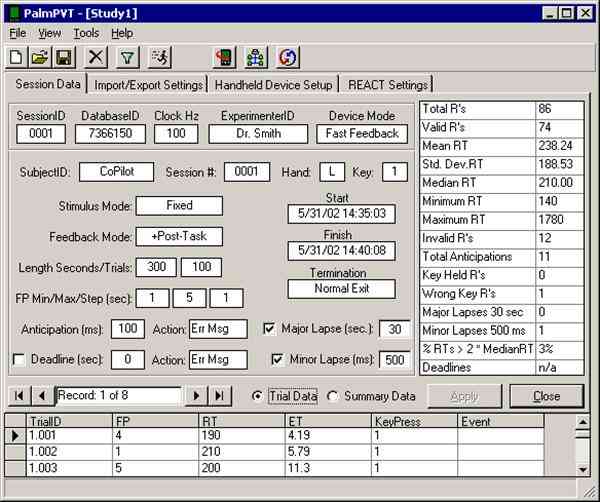
J ames Miller’s human factors / ergonomics consultancy has a number of webpages and services that are relevant to the topic of this CMT post. And the Walter Reed Army Institute of Research, Psychiatry & Neuroscience Division (WRAIR-PN) has a number of tools for measuring fatigue, including a Palm-based software application that may be helpful for doing serial, self-administered measurements to inform ‘prevention’ or ‘planning’ interventions of the sort that the CMT reader’s comment/question has in mind (see links and screenshots below).

Most of the ergonomics and psychophysiology fatigue-performance research journal literature addresses changes in ‘error rate’ on-task, as a function of fatigue. In addition to error rate, performance is also measured in terms of the time taken to make decisions and check reference screens (‘decision-time’ and ‘check-time’). Subjective measures are also made of workload and environmental resources (personal control and support), of levels of anxiety and fatigue before the task, and of cognitive effort expended during the task. Measurements like these could be made on performing musicians under various conditions of stress and fatigue but, so far as I can tell, no such research has been published to-date. We have to take the results from the existing research literature and extrapolate to what it probably means for musicians.

Heart rate increases with increasing fatigue—not a good thing. Long eye-closure rate (LCR), blink amplitude (BA), eye movement ‘saccade velocity’, saccade rate, and peak saccade velocity all tend to increase (see Morris & Miller 1996, link below). Your response speed slows, despite the increase in sympathetic and parasympathetic nervous system activation. The number of ‘lapses’ in attention per minute increases (see Lamond et al. 2008, link below). You experience more severe and earlier exhaustion of coordination/interaction resolution abilities (see Persson et al 2007). In other words, all of your subjective impressions of what’s happening to your performance are true, or at least are very likely to be true (if findings from aviation and other high cognitive-intensity fields generalize to music)!

Studies by Strang and Berg at Miami University of Ohio show that fatigue has no effect on postural stability during the ‘focal’ movement, and yet caused earlier ‘anticipatory postural adjustments’ (APA) onsets in various muscle groups. In spite of ‘hyper-reactive’ early APA activations, the APA electromyograms of the postural control muscles stay pretty much the same. The findings suggest that fatigue-induced early APA onset is compensatory—it may enhance postural stability by permitting a longer duration APA which in turn counteracts the fatigue-related decreases in the force-producing capability of muscles that contribute to postural stability.

What else? Fatigue causes a decrement in vigilance, not just the ‘penalty’ in terms of slower reaction times (RTs) appearing after a few tens of minutes’ performance, depending on the intensity of the cognitive demands during those minutes. Additionally, fatigue interferes with learning/memorizing new sequences, consolidating memory of sequences already learned, and reinforcing your memory of, or the timing and precision of recall for, sequences that your brain has previously consolidated and stored. In other words, fatigue not only impairs your performance of what you already know; it impairs your learning and rehearsal of new things that you haven’t yet perfected. (This is part of the ‘guilt’ the CMT reader was implying in the comment above: a heavy touring schedule taxes your artistic growth, and this seems intuitively, morally ‘wrong’ to many musicians.)

Walker et al. (2003) suggest that when consolidated memories are retrieved [from memory, during performance], they again are labile and susceptible to interference, and require a period of reconsolidation in order to be preserved intact. Recently consolidated memories also benefit from rest intervals (Hotermans et al., 2006) to maintain their integrity as memories. Scary how performance while fatigued, by preventing such reconsolidation, may actually erode the integrity of the performance-related memories that you’ve invested so much effort to create!

 Corware PalmPVT®  session parameters
If you’re really serious about undertaking the quantitative assessment of how far gone you are and how much rest you need, you can measure your own condition in the same way that the military does—with PDA-PVT (‘personal digital assistant psychomotor vigilance testing’), developed for Palm PDAs by David Thorne and coworkers at Walter Reed Army Institute of Research in Washington, DC.

 Corware PalmPVT®  stats: Pilot=Vln1, Copilot=Vln2, Gunner=Vla, Navigator=Vlc
Make yourself a spreadsheet or log, and record your measurements daily, just as you would do for your exercise regimen or weight management routine. Keep track of your hours of sleep/napping and other factors that you think are significant for your performance—and correlate these with your PDA-PVT measurements. Experiment with ‘recovery’ maneuvers (e.g., X extra hours of sleep, to recover from Y hours of sleep deficit) over a period of several months, and figure out your own personal program for mitigating the fatigue-related toll of your tour schedule.

 Corware PalmPVT® response screen
Here are some gleanings from James Miller’s website that you may find useful:
    Fatigue Countermeasures that Clearly Work
  • Adequate sleep;
  • Caffeine in moderate doses;
  • Napping;
  • Anchor Sleep (regular sleep period of at least 4h duration, obtained at the same time each night);
  • Performance Timing / Scheduling changes to provide ‘breaks’;
  • Good sleeping environment.

    Fatigue Countermeasures that Require Supervision by a Physician
  • Alertness Aids;
  • Sleep meds;
  • Bright light;
  • Melatonin.

    Fatigue Countermeasures that Do Not Work, or Cause Health Problems
  • Nicotine;
  • Ventilation or Air Conditioning changes;
  • Temperature adjustments;
  • Exercise (Do exercise for other health reasons, but not with any hope that it will help relieve the fatigue-related effects on your reaction-times or performance);
  • Diet and nutritional supplements;
  • White-Noise or other Ambient Sound maneuvers;
  • Odor/Fragrance aromatherapy.
Unfortunately, the fatigue aspect of occupational health in professional musicians is under-studied. I hope the links below are helpful. I’d be delighted to hear from you—one way or the other, good or bad—if you try the PDA-PVT software or other approaches. Thanks for the comments and questions!

 Any sleep is good sleep.


Wednesday, May 21, 2008

21 May 08

From Two Tonys (Letter 5)

Two Tonys - A whacker of men and Mafia associate serving multiple life sentences for murders and violent crimes. Claims all his victims "had it coming."


5-5-08

Hey pal from across the pond,

I received your letter of 4-20-08. It’s always good to hear from you.

Hey! Thanks for the pics of your lady friends, Posh Bird and Cat Eyes. Good lookers both. You sly dog you. Playboy of the Misty Isles. You go boy, but make sure you hone your video picking skills so Posh Bird don’t slap you around. Love is strange. Start off right, not on shaky ground. Listen to me, I’m such a success at love and marriage. 3 exes, and I can’t count the bimbos. Yeah, I’m one to give advice on relationships. Ha. You do what you got to do. Just don’t let no lady whimp you out. (Enough said.)

Now to answer Floyd’s question. Once again, we all change. If I ever got out – which I won’t – I like to think I’d do the right thing and stay out of trouble. And I probably would not seek to harm no one. I fantasize about fishing trips and ball games and playing with my grandsons at the park. But that’s a nice normal fantasy. Reality is this. That ain’t going to happen. Neither is me getting out and putting my hack defense attorney’s (who sold me out) grey matter on the inside windshield of his car. Which is also a fantasy of mine. But I choose to fantasize about my grand kids. It’s easier on my hate goiter (which is shrinking by the way due to my reading of good books and thinking straight). Thanks to you. You’ve helped me. Along with my age, mellowing thoughts, and love for my family.

Look, Shaun, I’ve detected a few of your readers’ responses in your blog, a sort of, oh, poor old Two Tonys, he’s sad and never getting out, poor old Two Tonys. Well that sucks. I did my thing out there. It’s done. Like what my son-in-law said when I first met him in a prison visitation room, “Hey, it is what it is.” I can do this time but only what I’ll be alive to of it. I can’t do it all. But I’ve got to do what I can. And I like doing it feeling good.

Let me tell you about today. I just got back from breakfast. At 5:30am I went to rec. It was still dark out so I walked 15 laps. That’s 2 miles at a good fast clip. Now it was dark when we went out and the sun hadn’t come up yet, and as I’m walking my laps, here comes the sun over the landfill area garbage dump. Man was it nice. I stopped and just watched it rise. I can understand a rice farmer on the Nile Delta 5000 years ago, tending his fields in the dark and all at once here comes this bad fucking sun. No wonder they worshipped it. It was a natural high. So I got all inspired by myself. There was about 10 guys out that early but I exercised alone. I did a 9:30am workout. Push-ups. Squats. Back arms. I even sprinted 40 yards a couple of times.
Now get this. As I’m at my workout station, these two schmucks are walking laps and as they approach me, they’re having a discussion and talking so I can hear them. Now one has a 5 o’clock shadow with plucked eyebrows, thinks he’s Gidget with a ponytail. A real swisher. The other is a big lanky guy who years ago they put me in a cell with and he lasted 10 minutes and pushed the buzzer for the C.O. and told him he didn’t want to live with me, so they took him out. So anyway, he’s now a Christian. So he’s telling this Gidget freak how much he loves mankind, loud so I can hear.
“Yes, I love all people and I tell them. I don’t care who they are or what they did, I’ve got love for everyone.”
I said to myself, Don’t let these scumbags ruin your morning, and I got my head right and went on with my workout. My hate goiter subsided.
Look, you know I did 5 years in that fucking lockdown hole CB8-2. Cold chow. Roaches. Mice. Indifferent C.O.s. Feces throwers around you. No, now I consider my options. You, Shaun, taught me that.

I just left the chow hall. I had French toast, scrambled eggs, cold cereal, fried potatoes, 2 oranges, 1 biscuit, 1 milk, syrup, coffee. Good rap at the table discussing Michelangelo and the Sistine Chapel and the pervert Pope Julius II.
I just got out of a hot shower. I’m writing you, then I’m going to the Wachovia golf tournament. I’ll bust open a rahmen beef soup a little later. Or maybe I’ll open a tuna and break out a bagel.
My daughter is happy and married to a great loving husband and father. My grandsons are healthy and loved. Hey, bro, there’s blokes laying up in cancer wards, burn wards.
Shaun, if I allow myself to get all sad and on the woe is me bullshit, then I’m a weakass motherfucker.

I got that graveyard shift sanitation job. I go out at 10pm and pick up trash with 4 other guys. I see this as part of my journey. It is what it is.
Yeah, you can let Avuncular Floyd know that if fate should move its huge hand and I got released I probably would not bother anyone. But then if a motherfucker really asks for it and he’s got it coming, fuck yeah, I’ll try to show him how the cow eats the cabbage. That option is always open. Options, that’s what it’s all about. Take nothing off the table. People respect that or at least they should.

Hey bro, this Obama lame can’t keep his fucking mouth shut. He’s fucking up. I thought this asshole had a shot but he’s making me think he’s only human. He’s got some fools for handlers like that whacked out preacher Wright. He needs to be smitten with the plague, or a good steady rainfall of frogs, or the Nile turn to blood, or how about a good locust invasion. Something to get this asshole’s attention that God is angry. I mean like pissed off enough to let Hillary or that hack McCain win. Only time will tell. But God and Ophry want Obama for prez and they know what’s best for the masses, the great unwashed. Maybe if Obama wins he would grant me a pardon, and I could get hooked up with a job as a greeter at Harrod’s or Wal-Mart’s. And perhaps work my way into the gun department, so I could show blokes the wonders of a 2 inch snub nose Colt. Hey! I can dream can’t I?

Give my L&R to Mums and Dad and Sis and you be a good guy. No wild parties.

Hey bro, don’t misconstrue what I just wrote. I don’t think I’m institutionalised. It’s just that I’m a realist. I’m here. I’m not going anywhere, so I’ve got to accept it and make the best of a bad situation. Much as a cancer patient does or a car wreck victim. Only my situation is self inflicted due to bad choices and not considering options and penalties. But so what. I should do this time sad and sniveling?
If you recall one time I told you about that asshole I took out down in Tucson, and after I was found guilty and called back to court for sentencing, the guy’s wife gets up acting like a loving victim and goes on about never wanting me to have a happy day again or to smell roses and all that bullshit, and that I should suffer. Well, if that dope dealing broad had a video camera on me today she’d be pissed. I ain’t got no roses to smell but fuck it. I’ll smell some aftershave and make believe it’s roses. Yeah, to quote our beloved asshole of a president, “Bring it on.”

Hey friend, seriously, how are you doing out there? Are you happy? Are you working? I know you’re staying out of trouble, you’re too smart not to. What about old friends? Is Wild Man around? I enjoyed your pics and I’m happy you’re gone from this shithole.
I talk about you to a lot of these guys. Some know you, some don’t. But when your name comes up it’s all in good recall. Believe me, I wouldn’t have it any other way. Besides, you did your time textbook style. No drama. I was and still am glad to say, Yeah, Shaun! Yeah, he’s a friend of mine.
So you stay strong out there. Watch for those curve balls life will throw at all of us. Just a little advice from an old lifer who was a tough guy for 20 seconds and an asshole for 112 years. Options, always consider your options.

Oh yeah, tell Richard I really enjoyed his books, specially Into Thin Air. Its’a mystery why people want to suffer on that mountain. I guess the answer to that mystery is because it’s there. He was very thoughtful in sending them to me. A good bloke as you Limeys say.

I enjoy your letters. You and your readers feel free to ask me questions about anything. Life’s journey. Religion. Pride. Prejudice. Politics.

Hey bro, enjoy yourself and don’t forget in the turmoil of life’s struggles it’s good to stop and smell the roses or in some cases – the aftershave.

“You’re my horse even if you never win a race.”

Two Tonys


Coming next: Two Tonys' friend, Warrior, introduces himself to us.


Email comments to writeinside@hotmail.com or post them below

Copyright © 2007-2008 Shaun P. Attwood

Monday, May 19, 2008

19 May 08

From T-Bone (Letter 4)

T-Bone - A deeply-spiritual and massively-built African American. A prison gladiator with more stab wounds than Julius Caesar. A good man to have on your side.


5-6-08

Hello,

My literati friend, how have you been, man? I’ve been hoping to hear from you these past weeks, and I must say it is good to know that you are applying yourself to doing what is right: writing.

I’ve been moved as you can see and it’s a blessing in a lot of ways.
Hey Shaun, do you remember that a-hole I had to put hands on? Well, when I got to Buckeye he sent this young chump to try me. I asked the guy to take it to shower 1 and I put it on him in about 17 seconds. He moved out that same night and tried to have his people send me some ends (money). I told him no.

My friend, I want to address this issue the person named Dirtos has with me because of my love and respect for you! As anyone knows who has ever done time or knows someone who has, it is essential to convey the truth and truth means facts! The fact of the matter is that we both have been down some extremely rough roads, and seen and heard some mighty nasty things, but we’ve also had some so called good times, or experiences and to whoever is reading this wake up! – when you care about someone you express your concerns, and from experience, going to bars and/or clubs leads to habits, and Shaun has just got out of the joint, and I am advising him to not get into drinking and/or people who want to hang out in places where there’s drinking and carousing. I consider Shaun more than just a friend and that bond I have with him has him in a position to where all he has to do is call me, and I’ll be there for him.
Case in point. On the yard I heard this big fat guy say Shaun’s a fag, and that he was going to Shaun’s cell to take his ass. I didn’t tell Shaun or anyone else. I reacted and caught the guy in a pod, and put the guy in a situation so to speak….
I didn’t have to hurt the guy but I would of if he didn’t understand, or should I say come to respect us.
In other words, when he disrespects Shaun he disrespects me. The fat guy is an addict, and the power of love is what sent me to deal with the asshole!
So Dirtos, I don’t have issues with dope, but I do with anyone who tries to harm my friend, and I’ll also have an issue with my friend if he tries to harm himself by doing dope or carousing. Honor is what makes friendships, along with love, and I honor my friends.

Things here are as usual, my friend, sitting, waiting, doing time, you know!

I am still waiting for you to hook me up with a 40ish or 50ish woman! Make sure to let her know that I am strong and not into playing games.

Thank you for sending the blogs!

Say hello to your people and you, you just stay strong and keep up the good work.

Strength & Honor – Each one, Teach one!

T-Bone


Email comments to writeinside@hotmail.com or post them below

Copyright © 2007-2008 Shaun P. Attwood

Sunday, May 18, 2008

Biava String Quartet: Too Much Is Never Enough

 Biava String Quartet
T  oo much is never enough.”
  —  Mick Jagger.
However big the repertoire for string quartets gets, it is not possible to have too many string quartets.

The Biava Quartet performed Saturday night at the annual black-tie gala/soiree benefiting the Friends of Chamber Music in Kansas City. Approximately 250 attendees enjoyed the concert-dinner-auction event in the Kirk Hall of the Kansas City Public (Central) Library, a 1906 historic building which was renovated/restored in 2004.

The Biava Quartet was founded in 1998 at the Cleveland Institute of Music. Its members were trained at the New England Conservatory of Music, the University of Southern California, Yale University, and The Juilliard School. Currently the Biavas are the Lisa Arnhold Quartet-in-Residence at Juilliard. They were also the winners of the Naumburg Chamber Music Award in 2003.

The Quartet is named after violinist and conductor Luis Biava, who has been a mentor to members of the group. Biava is Professor at Temple University Boyer College of Music and was previously Conductor-in-Residence with the Philadelphia Orchestra. A native of Colombia, Biava was a founding member of the Philarte String Quartet and continues to play first violin with the Philadelphia Chamber Ensemble.

The Biava Quartet’s repertoire features American composers John Harbison, Mason Bates, William Bolcom, and Ezra Laderman. Last year the Quartet premiered and recorded composer Stacy Garrop’s String Quartet No. 2 ‘Demons and Angels’.


    [50-sec clip, Stacy Garrop, String Quartet No. 2 ‘Demons and Angels’, Biava String Quartet, 1.2MB MP3]

The Biavas last night gave the gala attendees a dazzling 30 minutes of ‘bon-bons’.

  • Schnittke—Polka, 1980 (arr. Sergei Dreznin): parts alternately take on serious and jesting poses; extreme rubato propels the circus theatrics; sheet music available from Sikorski; 2 minutes 30 seconds of ironical hilarity in B minor;
  • Puccini—Crisantemi (chrysanthemums), 1890: a G minor caricature written in a single night, in memory of duke Amadeo of Savoy; Puccini later reused this work in his opera Manon Lescaut; ‘pneumatic’ phrasing heightens the lyrical and dramatic effects, which alternately call into question the authenticity of theatre and of so-called ‘real’ life; Biavas’ incisiveness succeeds in animating these questions in just 5 minutes; sheet music available from MusicForStrings;
  • Turina—Oración del Torero (Bullfighter’s Prayer), 1925: opens quietly with stealthy pizzicato (What is this bullfighter praying for?); pace progresses impulsively and reveals out-of-control impetuosity and narcissism, then gets a grip in an expansive and calming melody; sheet music available from MusicRoom;
  • Beach—Theme and Variations for Flute and String Quartet, Op. 80, 1916: sometimes paired with readings from poet Emily Dickinson or American Indian folk literature; coloristic American/Macdowellian whimsy at its finest; sheet music available from RecitalPublications.com;
  • Shostakovich—Age of Gold Polka (arr. Jason Calloway): incongruous dissonances that opine that ‘stuff happens’, humans are never really ‘in control’ of anything.
The Biava Quartet’s pacing is edgy and precise, neat, white-knuckled—exciting. Passages played expressively in other settings (conventional concerts; recordings) here come across as paradoxically stern (watch violinist Hyunsu Ko furrow her brow!), whereas rigid sections are in a festive mood read more lyrically and infused with humor and theatricality. The Biava Quartet devises a program that is perfect for a gala benefit!

The Biava Quartet’s members are:
  • Austin Hartman, violin;
  • Hyunsu Ko, violin;
  • Mary Persin, viola;
  • Jason Calloway, cello
This coming week the Biavas will be performing at the Juilliard String Quartet Seminar in New York. (Probably the repertoire there will be not quite so jocular as at the gala?)

It should go without saying that there is no ‘affluenza’ of string quartets, anymore than there is an affluenza of paintings or photographs or films: the threshhold of unmet market demand for excellent string quartets is still higher than the current supply. Instead of the growing classical musical wealth freeing us from ‘materialist’ preoccupations, it has the opposite effect—of making us more conscious of how much more there is to create and to have, and more conscious and less accepting of mediocrity. Not ‘acquisitiveness’ really; just a hedonistic joy in seeking out more of the experiences that the Biavas are providing!

Would there ever be ‘Enough’? If ‘enough’ means ‘satisfying desire’, ‘adequate to meet the need’, ‘sufficient’, I doubt it. What we have right now is, at best ‘in a tolerable but not super-abundant degree, denoting mere acceptableness or acquiescence, and implying a degree or quantity rather less than is desired’. As in, “This quartet was well enough, but I’m still hungry for more.”

There can never be too many string quartets—not compositions; not ensembles; not performances—especially when carried off with such panache. The Biava Quartet’s wonderful performance contributed significantly to reaching the Friends of Chamber Music’s fund-raising goals. A heart-felt thanks to the Quartet members for generously making a place for these sorts of promotional events in their busy schedule of teaching and concertizing! (It’s hard maybe for performing artists to place a value on promotion and audience development. But presenters know well how vital and valuable promotional events are. Without such events there would not be nearly so many commissions for composers, not nearly so many opportunities for up-and-coming performers and ensembles, and, ultimately, a less vibrant community in which publishers, recording companies, and presenters and other stakeholders also can thrive.)

Gala promotional events may not be ideal from acoustic or musical aesthetic perspectives, but they are a life-blood to the classical music community and privately funding chamber music in the U.S. These events are vital not only for retention and bonding with the usual, older philanthropist-patrons in the community; they are also vital for attracting new corporate sponsors, for whom the events have a certain desirable cachet.

F  ind an ‘in’. Find a Board member or even a LinkedIn connection who can introduce you [to the business person you intend to solicit for sponsorship of your chamber music organization] so you’re not ‘cold calling’. I always respond to people who come recommended by someone I know, and businesspeople do, too. Start your sentences [addressing potential corporate sponsors] in the right way. Instead of ‘This is what we do,’ say ‘[Look at this.] This is what we can do for you.’ ”
  —  Katya Andresen, NetworkingForGood, 17-MAR-2008.
Besides this, gala events also attract a fair number of under-40s who see black-tie experiences as a sort of musical ‘adventure travel’. (‘Tourism’ would be the wrong word; too passive. To this group, gala cultural events are ‘expeditions’—opportunities to visit an esoteric place and society that few members of the group would encounter otherwise; a cross-genre dual art of ‘elegant conversation and dining’-plus-‘chamber music’, ‘hybrid art’ as the Australians would say; an ‘extreme contact sport’.) Participating in a civic cultural event, clustered in dinner tables of ten, these under-40s actively create memories. The uncertainties and risks and thrills involved are very much the same sort as arise in travel abroad, to places where you don’t speak the language.

A  spirited and thoughtful volume. One of Bruner’s greatest contributions is his constructivist position, from which he views cultures as continually reinventing themselves. Tourist practices are seen as neither simulacra nor ersatz, but as active social performances in their own right. This position allows Bruner to free anthropologists from their previous impasse of thinking along the binary of authenticity-inauthenticity, a persistent focus of tourism scholarship ever since Dean MacCannell’s 1970s writing on ‘staged authenticity.’ Because culture is always emergent, alive, and in process, every cultural act is authentic.”
  —  Miriam Kahn, review of Bruner’s book, in American Anthropologist, 2004.
Not merely sight-seeing or posing as explorers, they immerse themselves; they talk with the Biavas and bid against socialites for choice live-auction items. Respectful amateur anthropologists, they conduct themselves politely and with earnestness and interest, as they would do when abroad in a foreign country. ‘Destination Culture’ enthusiasts, they take ‘tribal’ photos of the scene and of each other (discreetly on cell phone cameras, to be uploaded later and virally shared), recording the historical facts of their night’s expedition.

This sort of high-touch ‘face-to-face’ audience development (of Bruner-style active destination-cultural ‘explorers’) just doesn’t happen in conventional concert hall settings or tamer pre-/post-concert ‘socials’. There is no doubt that encounters like these are healthy for all concerned—the ‘natives’ and the ‘explorers’.

W  hat we have is a circuit of embodiments and disembodiments, a passage of vivid sensations through bodies—first extracted from perceptions and affections, then rendered perceptible in the expressive matter of the artwork, then engaged by audiences swept up into the artwork.”
  —  Ronald Boque, Deleuze on Music, Painting, and the Arts, p. 170.
Basically, vigorous, civic-minded ensembles like the Biava Quartet are, through gestures like their superb, unusual performance in Kansas City last night, helping to insure the future of chamber music in this country—by revealing wider, more improvisatory, and less ‘serious’ dimensions of chamber music—to a wider audience, many of whom never imagined that these dimensions existed. Too much gratitude from us for their generosity is impossible—too much is never ‘Enough’.

 Kansas City Central Library

 MacCannell book