Wednesday, February 13, 2008

I ♥ Different Enchantments: Unexpected Uses of Elliott Carter Recordings as Punk Repellant

 Newburyport, MA, perfectly nice punk w/ mohawk hair
A ll the Preludes to Felicity

It is Time that beats in the breast and it is Time
That batters against the mind, silent and proud –
The mind that knows it is destroyed by Time.

Time is a horse that runs in the heart, a horse
Without a rider on a road at night.
The mind sits listening and hears it pass.

It is someone walking rapidly in the street.
The reader by the window has finished his book
And tells the hour by the lateness of the sounds.

Even breathing is the beating of Time, in kind:
A retardation of its battering,
A horse grotesquely taut, a walker like

A shadow in mid-earth . . . If we propose
A large-sculptured, platonic person, free from time,
And imagine for him the speech he cannot speak,

A form, then, protected from the battering, may
Mature: A capable being may replace
Dark horse and walker walking rapidly.

Felicity, ah! Time is the hooded enemy,
The inimical music, the enchantered space –
In which the enchanted preludes have their place.”

  —  Wallace Stevens, The Pure Good of Theory, in Transport to Summer, 1947.
 Newburyport, MA, State St
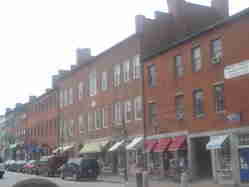
I ♥ you, too. Among the more unusual things you’ll ever hear is Elliott Carter’s ‘Enchanted Preludes’ being played on streetside loudspeakers as skinhead repellent ambient music, blaring down on the sidewalk from the eaves/soffits outside the Richdale Convenience Store on the corner of State Street and Pleasant Street in Newburyport, MA.

The kids scared the customers away. The kids loitered on the corner, crowded around the door so that you’d have to push your way through them to enter or exit the store. En masse, they filled the streetcorner outside the Richdale and blocked the Pleasant Street crosswalk, making it difficult to cross. The octogenarians were forced to walk in traffic or, better, avoid the location entirely. And then there was the occasional mention of shoplifting in the police blotter.

 Newburyport, MA, State St
First the store tried Lawrence Welk polkas. Didn’t work. Too jolly, and maybe just silly enough to be perversely amusing to the intended punker victims.

They tried Beethoven—probably mis-remembering Anthony Burgess’s A Clockwork Orange or something; a seat-of-pants reckoning that, if a toxin is strong in one application, then its toxic efficacy will likely generalize to other species. But the Sonata in E major, Op. 109 (1820), and the Sonata in A-flat major, Op. 110 (1821), seem like enchanted gardens of the blessèd, even to skinhead ears. The skinheads stayed put.

 Newburyport, MA, State St
Then the store tried Vivaldi. They’d read in the LA Times that Vivaldi was useful for this kind of infestation and had met with wide success in California. Yes, florid variations in dynamics and tempi did disperse the crowd at the Richdale for awhile. The fluorescent Mohawk-coifed punks moved down the street and began hanging out in front of Best of British. But over a few weeks they returned to the Richdale’s corner. They’d been able still to hear the Vivaldi all this time, faintly, from the 50 meters distance. And the fact was, it had ‘grown’ on them. Not to say that they liked it now. But they’d developed a high degree of tolerance for it. They knew the tracks on the Vivaldi CDs that the shopowner queued up, and they were now immune even to the outrageous juxtapositions that blared out when he put the player on ‘random shuffle’. They preferred to be close to their source of food, and to the frailer, more intimidatable souls on upper State Street.

 Newburyport, MA, State St
How the storeowner found this ultimate weapon—the super-strength Elliott Carter punk repellant—I do not know. Recordings of Carter are not plentiful, and they do not leap into your hand from record-store discount remainder bins.


[ John McMurtery, flute; Craig Hultgren, cello; video 2006 ]

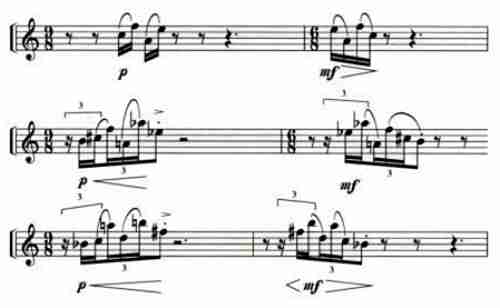
Carter’s ‘Enchanted Preludes’, for flute and cello, was commissioned in 1988 by Harry Santen for the 50th birthday of his wife, Anne Santen, the musical director of Cincinnati’s public radio station, WGUC. The duet contrasts the flute with the cello and roughly follows the ‘arc’ of the Wallace Stevens poem from which the piece takes its name. Each instrument follows its own moods and logic, and a constant tension pulls each in disparate directions: the world of the intellect and the world of the senses. The flute mostly propels the thing forward, with extroverted, Messiaen-like figures. The cello takes a mostly subordinate role until the end, when it finally accepts and inclines toward the flute’s dynamic.
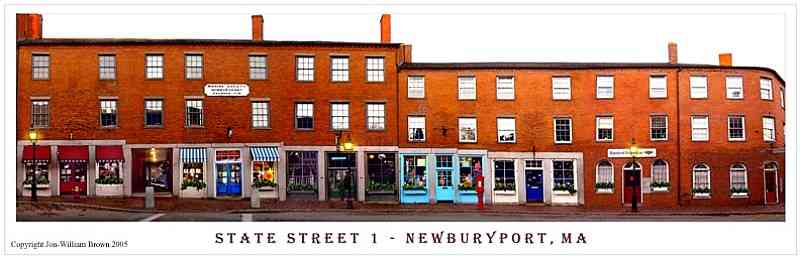
 Newburyport, MA, State St
The flute and cello have ever-shifting roles, but always with a sense of the evolving foreground and background. And the concession that the cello makes to the flute at the end is a gesture that is deeply offensive to the punk ethic of in-your-face confrontation. This is the feature that makes Elliott Carter’s writing so deadly to punks. The music mocks the punks’ poseurly faux dance along the societal fault-line. In a manner that resembles Stevens’s distinctive positioning of prepositions and prefixes and his demonstrative use of copular verbs, Carter plays with the disruptive metaphors and unexpected cadences. He dishes out developments unexpectedly pursued and developments unexpectedly abandoned.

The Stevens/Carter formula heightens the self-consciousness of the language/music. By making and unmaking the conventional patterns of language/music, the work draws attention to the temporal—the undeniably mortal, the inescapably transitory—nature of the text, of the performers’ personae, and of the listeners themselves. Twenty-something punks try to ignore this. But when the onslaught persists as an ambient acoustical feature it is like it penetrates their hardened carapaces and causes their systems to begin shutting down. It doesn’t have to be administered at high volume, in large doses that would interfere with commerce and the recreational life of others. No, low-dose continuous Carter is sufficient. Highly selective social death by musical alienation. Yobs, chavs, skinheads, punks, gangstas—gone. Selectively, nonviolently, quietly, voluntarily.

Newburyport, MA, State St
But it’s more than this, and the ‘more than this’ is why I bother to write about the ambient Carter at all. What I mean is, every spiritual alienation takes place within a space, within some enclosure, as does every spiritual union—even if the enclosure is an abstract or metaphorical one; even if the enclosure has no walls, really. When I walk by the Richdale, the ambient music outside defines a space, a space that is just as large as the radius within which I can hear the music. But not all enclosures are oppressive: the Beklemmt section of Beethoven’s Op. 130 is an example, and the Carter ‘Enchanted Preludes’ is also an example. They define enclosures that I long for, that I try frequently to return to. To me, they are ‘home’. In other words, ‘enclosedness’ isn’t alienating or confining; it may be an object of desire, a good place that protects and inspires and welcomes, ‘a place of refreshment for the exhausted hero, a foretaste of rewards to come, or the final goal and reward itself, where the beloved and the blessed society are waiting to receive you into their select company,’ as Auden put it. The door is open. It is not an exclusionary ‘gated community’ or a locked museum. The door is open, it’s a beautiful sanctuary, and there are lots of interesting people inside.

T  emenos (τέμενος , from the Greek verb τέμνω ‘to cut’) is a piece of land cut off and assigned as an official domain, especially to royalty, or a piece of land marked off from common uses and dedicated to a god; a sanctuary, holy grove or garden, or holy precinct.”
Baudrillard’s connection between alienation and the hyper-real is cited by Adam Possamai in his chapter in Lynne Hume’s and Kathleen McPhillips’s recent book. Hyper-reality is structured with signs and symbols such that people increasingly seek spectacle rather than transcendance. According to Possamai, hyperreality relocates personal identity within the domains of choice, individuality, aesthetics, and consumption. In Australia, Star Wars Jediism—a simulacrum of a religion created out of popular culture that provides inspiration for believers/consumers—constitutes a hyper-religion. Maybe Carter is, for me, a sort of hyper-religion. It pleases me to think so…

Is there an affinity between heroic characters in music and development of latent abilities? Could this affinity be motivated by a desire for sanctuary and for hyper-real re-enchantment of the world? For me, my taste for Carter’s writing involves a craving for ‘inner adventure’, not literally a search to become divine or super-human. It’s a quest for a higher self—maybe like a Westernized search for Buddhist enlightenment. It’s not a quest for abilities that would be instrumental in achieving other ends. It’s a search for illumination and wonder. How lucky for me that the Newburyport Richdale store owner inadvertently provides me with just the acoustical enchantment and spiritual nourishment I need as he simultaneously doses the multiply body-pierced, scarified and self-mutilated post-card punks, for whom wonderment is—evidently—poison.

“... grotesquely taut, a walker like
A shadow in mid-earth . . . If we propose
A large-sculptured, skin-headed person, free from time,
And imagine for him the speech he cannot speak.”

Imagine, too, the music he cannot play or sing or or write or even stand to hear. Just the same, I ♥ him, too.

T  he displacement of music-making by music-listening breaks the connection between creation and inspiration. Inspiration carries a motivation to act. And anyone who sits down and plays at the piano is inspired to act. The creative imagination motivates them directly. But once music is construed as a sonic equivalent of painting, the question arises—how does creativity inspire those who merely contemplate its products? What is it they are inspired to do?”
  —  Gordon Graham, p. 110.
P  roponents of [modernity-as-] disenchantment share with those who lament its loss the assumption that only a [human-centric] teleological world is worthy of enchantment. I contest that assumption. A world capable of enchanting need not be designed or disposed toward human happiness, or expressive of intrinsic purpose or meaning. It seems that there is musicological support for this, for chant is modal music, which means that it doesn’t have the powerful drive modern music has to arrive at a final [explicitly purposeful] harmonic destination.”
  —  Jane Bennett, p. 11.


Moore book


Tuesday, February 12, 2008

12 Feb 08

Month 2

I’ve been out of prison for two months. The mental breakdown my parents expected hasn’t materialised, but I've had some bouts with loneliness. I’m getting more used to living in England. I’m even acclimatising to the cold. My social life has picked up, but I’ll get to that shortly.

I write for up to ten hours a day, including weekends. Now that I’ve finished editing the blog, I’ve moved onto a second draft of my life story. I wrote the first in 2003, but I left out details that might have caused legal problems, or health problems for my parents. I’m thinking of dividing the book into three parts: stockbroking, raving and incarceration.

I’m continuing my education with courses from The Teaching Company. I just started The History of World Literature taught by Professor Grant L. Voth of Monterey Peninsula College.

Hammy read your comments out loud in the Ring O’ Bells. His drinking friends lapped them up. He wants to do a follow-up blog “to set the record straight.”

Some of you expressed worry over my pubbing and drinking – that I’m on the road back to my partying days. I appreciate your concerns, but I assure you that’s not the case. I’m fully focussed on moving my literary projects forward and becoming an author. Going out for a few drinks on the weekend has just been a way to expand my social life. My parents say I spend too much time at home on the computer, and they are conspiring ways to get me out of the house more often.

Aza took me for an Indian meal in Stockton Heath. Leaving the restaurant, one of the diners asked if we were a gay couple.

I've had two dates with Posh Bird, a former air hostess (or “trolley dolly” as she called it), who quit her job, enrolled in Chester University, and has nearly finished a degree in Early Childhood Studies. She starts studying for a Postgraduate Certificate in Education in September. She has pale-blue eyes, and brown hair in a bob that brings out the prettiness of her face.
She drove us to Warrington where we watched No Country for Old Men, based on the book by Cormac McCarthy (whose The Road I enjoyed reading in prison). While she munched on popcorn, I scoffed chocolate Brazil nuts. Frightened by the psychopath played by Javier Bardem, I insisted Posh Bird hold my hand.
After the movie, we went to the Horse and Jockey, a small pub packed with old men, pints of dark beer in hand. When we walked in, the room fell quiet, and everyone stared at us. Actually, most of them ogled Posh Bird in her jumper dress. As we wended our way through them to get to the bar, they remained stock-still as if they had all been suddenly frozen holding their pints in the air. Momentarily, Posh Bird’s face took on a hunted look, until the old men turned back to the business of drinking and blather.

Last Friday, I went to the Playhouse with two friends, Iain and Julian, to watch Kafka’s Metamorphosis, a book I’ve read five times. The book starts with Gregor Samsa waking up to discover he has turned into a beetle. At first, I was disappointed in the lack of a beetle costume. But the actor pulled amusing beetle faces, and it took great strength to hang from the ceilings and walls. The play added a new dimension to the book. When it ended the audience applauded for ten minutes.
After the play we stopped at two pubs in Liverpool. Gangs of women in skimpy attrire, some in fancy dress, were roaming the pubs and streets.
“These days they hunt in packs,” Iain said.
It reminded me of a tourist destination in Spain – especially with all of the promoters luring passers-by into bars – and not the Liverpool I went to university at.
Boarding the last train home at 11:30, Iain said, “’Cause of all of the pissheads, the inspectors are too scared to check tickets on this train.” It was standing room only, and directly below me two young women fondled each other. I had to ask some drunken youths doing cocaine in the restroom to step outside so I could use it.

After the Bells on Saturday, I took a taxi to Bar Reef to meet Posh Bird. She looked stunning in a dress low cut at the back that tied around her neck. That night, I drank a couple of pints of cider and one Red Bull and vodka. We talked into the small hours:
“You’re good looking, how come you’re not in a relationship?” I asked.
“I just came out of a long relationship, and I’m just not ready at the minute, or I need to find the right person.”
“Right person?”
“Someone who’s got a nice personality. Who’s sensitive, is a good listener, intelligent, and has a good sense of humour. I have to be attracted to him as well.”
“My Mum said you’re sensible and you’d be a good influence on me. How does that work?”
“I’m just naturally sensible of course, so I’m hoping it’s going to rub off on you. You’re someone who can be easily misled.”
“Easily misled!” I said, and gasped.“Where did you come up with that from?”
“I can just tell.”


Is Posh Bird right about me being easily misled? Is she the kind of sensible influence I need in my life?

Email comments to writeinside@hotmail.com or post them below

Copyright © 2007-2008 Shaun P. Attwood

Sunday, February 10, 2008

10 Feb 08

From Frankie (Letter 1)

1-28-08

Englandman My Friend,

It’s been a while since I heard from you. I thought for sure that you have forgotten me.

I’m glad you thought about me cuz right now they want to give me 15 to forty years for what happened at Santa Rita. I beat 2 charges already and in April 25 my trial starts. I ended up in Pima County Jail and I was running the whole place. I even got me a cheeto there. A black one.

Fucken Cuban Boy ain’t wrote me in months. If I beat this charge that I have left I will go home this year, so don’t forget I’m flying to England. I’m done with this USA, it sucks.

If someone who will stick with me wants to write to me, then put my name out there. And don’t take forever to write. Send me some pictures, and if you can take pictures of women, I want naked ones. Don’t let me down my friend.

Tell your Mom and everyone that I send my love and respects

Much Love

Frankie

PS Find me some gay guys who I can fall in love with

Take care my friend & I’m glad you’re out


Email comments to writeinside@hotmail.com or post them below

Copyright © 2007-2008 Shaun P. Attwood

Love’s Oboe: Chamber Music Idioms within Larger Forms

 Oboe d’Amour

    [50-sec clip, Toru Takemitsu, ‘vers, l’arc-en-ciel, palma’, John Williams, Gareth Hulse & London Sinfonietta, 2.2MB MP3]

Slightly larger than the oboe, the oboe d’amour has a darker, less assertive tone—an alto timbre and personality. It’s a transposing instrument, and it sounds a minor third lower than it’s written (i.e., C is A). The oboe d’amour uses a ‘bocal’ and has this pear-shaped bell, similar to the larger English Horn.

Among contemporary works for this instrument I especially like Toru Takemitsu’s ‘Vers, l’Arc-en-Ciel, Palma’ (Verse, Rainbow, Palma/Caliper) for guitar and oboe d’amore soloists with orchestra. It’s nominally Takemitsu’s homage to the painter Joan Miró whom Takemitsu met in 1970—but it’s an interesting piece in a variety of other ways as well.

To me, it urgently begs the question of what the boundaries of chamber music are. This symphonic piece encloses or encapsulates a duet between the oboe d’amour and guitar. Here we have chamber music sounds within orchestral playing. Hulse and Williams interact beautifully, authentically.


    [50-sec clip, Toru Takemitsu, ‘vers, l’arc-en-ciel, palma’, John Williams, Gareth Hulse & London Sinfonietta, 2.2MB MP3]

 Gareth Hulse
The piece is an essay on music’s cohesive social power, capable of guarding the lovers from the outside world and facilitating their growth as individuals and as a couple. The symphonic sound masses form the walls that define the intimate space that the couple occupies. Transparent textures and clear lines make the intimacy even more striking.

Takemitsu: vers, l’arc-en-ciel, palma
Maybe this music is too tepid for Valentine’s Day? The protagonists each in turn adopt an ironic stance, distancing themselves from their shared experience. The musical dialectic prompts us to likewise take a step back to contemplate the borders and limits of emotional experience and communication. Both the writing and the performance show great sensitivity to colors and drama. On second thought, the authenticity of the ‘Thou-ness’ that’s displayed here between the guitar and the oboe d’amour makes this an entirely appropriate piece for Valentine’s. The Takemitsu composition and these two performers clearly believe in a transcendental Self – and have a sense of the interiority and trueness to self that that transcendent belief implies – and the challenge and moral duty that it poses. And authentic subjectivity is always romantic. Valentine’s it is, then.

Another wonderful oboe d’amour player is Jennifer Paull—who performs oboe d’amour works by de Caix d’Hervelois, Marais, Bach, Telemann, Stölzel, Schurmann, Graupner, Böhm, Heinichen, Lotti, Fasch, Quantz, Kuhnau, Forster, Graun, Janitch, Chelleri, and Prowo. Her ‘Volume 2’ CD has oboe d’amour works by William Blezard, Edwin Carr, Wilfred Josephs, John McCabe, John Rushby-Smith, Leonard Salzedo, and Harold Schiffman. Some links below, for your interest.

B ach’s favourite tonalities for hautboy d’amour were A minor and D minor (23 solos in each). When he began composing a piece and had to decide the tonality to put it in, surely one of the important considerations was how it would sound on the obbligato instrument ... Bach usually kept the fingered key, even when he switched sizes of the hautboy.”
  —  Bruce Haynes, p. 217.

 Jennifer Paull


Saturday, February 9, 2008

Strengthening Lumbrical Muscles

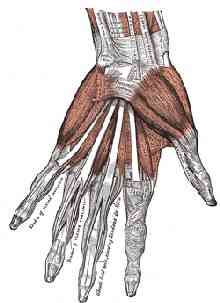
Lumbrical muscles
S till having tenderness and weakness in my left hand when I’m playing lute. What exercises should I try? Are there any exercises that I should stay away from—ones that could do more harm than good? Is there any exercise equipment that can make the muscles in my hand stronger, but not make the control coarser or less precise? Wrapping the wrist—would that help maybe? What about wrapping the fingers—especially the middle finger and the ring finger—how about that?”
  — Anonymous.
The lumbricals are four small muscles in each hand that interconnect the deep flexor muscles to the extensor muscles of the fingers. The lumbricals are the only muscles in the human body that have no direct bony attachments. They attach at both ends to tendons of these other muscles. The lumbricals are extensors of the proximal interphalangeal (PIP) and distal interphalangeal (DIP) joints. In addition, the lumbricals play a part in side-to-side and rotation movements of the fingers. They’re metacarpal phalangeal (MCP) joint flexors as well, but they’re relatively weak as flexors. They get fatigued easily in their flexor and abductor-adductor and rotator roles.

As each finger moves through its range of motion, each tendon slides a certain distance (An, 1983; Storace and Wolf, 1982). Excursion takes place simultaneously in the flexor and extensor tendons during joint motion: the tendons of the agonist muscles displace in one direction, while the tendons of the antagonist muscles displace in the opposite direction. Knowing what the tendon excursions are has applications for rehabilitation or enhancement of the hand (Brand and Hollister, 1999; Chao, 1989). Most of the time, your exercises should involve motions that cover most of the normal excursion that the tendon (and joint) moves through.


MuscleTendon Excursion (mm)
Interossei 30
Extensor pollicis brevis 30
Abductor pollicis longus 30
Lumbricals 40
Thenar muscles 40
Finger extensors 50-60
Finger flexors 60-70


Coordination is usually tested by counting the number of repetitions of a particular movement—such as rapid repeated tapping—that you can do in 30 seconds. Reduced ability to perform rapid, repetitive movements is often seen for movements that involve muscles like the lumbricals and interossei muscles. Try tapping with each finger of each hand and record your results. The repetitive movement is fatiguing, and you may find you need to concentrate more to perform the test on one side compared with your other side. Lack of precision and lack of smooth movement often are observed, with noticeable differences between fingers and between the two hands. Doing this testing is, admittedly, a bit tedious. But you’ll have a clearer and objective idea of your situation if you do these timed counts.

Subtle issues of coordination and endurance may be more of a problem in lute players than many other musicians—because of the geometry of the instrument. Correcting muscle imbalance requires stretching tight muscles—soft tissue massage. Often a particular area is painful, and ‘trigger points’ are found in the corresponding muscles. Common trigger point sites often include the dorsal first, second, and fourth interossei, the middle finger common extensor, the extensor indicis, the flexor carpi radialis, and flexor carpi ulnaris muscle bellies. You ‘find’ the trigger points by palpating with your right hand’s fingers while you make the left hand do the motions/excursions that are problematic.

Correcting muscle imbalance also requires strengthening the weaker muscles—extensor carpi ulnaris, common wrist extensors, and intrinsic muscles of the hand including the lumbricals. Specific lumbrical muscles surrounding a painful finger are often weak. If you have a lax, hyperextended thumb, it may have a weak extensor pollicis brevis. Often the thumb opponens and flexor pollicis brevis muscles are weak but the thumb adductor muscle is pretty strong. Treatment for hyperlaxity includes temporary supports and strengthening exercises.

Temporary supports to maintain a joint in a neutral position can be helpful. You can gradually wean yourself from them as your symptoms subside and the finger strength improves. Supports may include neoprene wraps or Lycra finger sleeves. These provide joint stability for hypermobile thumb, finger, or wrist joints. The tough thing is to find a support that’s not too bulky or stiff. The reinforced Lycra sleeves that are used for volleyball and other sports aren’t flexible enough. Some Lycra sleeves of the types that are sold in pharmacies are too flexible and don’t offer enough support. Other finger sleeves of the types sold by fly-fishing retailers have a millimeter or two of neoprene or other materials that are too bulky.

DigiSleeve™
Lycra finger sleeves
Stripee™ fly-fishing finger support
The DigiSleeve product is, for me, a reasonable compromise between support and flexibility. It comes as a length of Lycra tube that you cut with a scissors to the exact length that’s right for the dimension of your finger and the amount of the phalanges that you want to cover or support. It’s fairly inexpensive—you just discard the tube segments after several episodes of use and cut yourself new ones. I made a ‘template’ measuring guide on a postcard where I marked off the lengths that I need for the fingers I use the DigiSleeves on, and I keep this template card on my desk next to the box where I keep the DigiSleeve materal. When I need a new sleeve, I just lay the DigiSleeve material on the appropriate template “finger” on the card and cut with a scissors to the right length for that finger. Quick, easy, no re-measuring or guessing, and no wasted material.

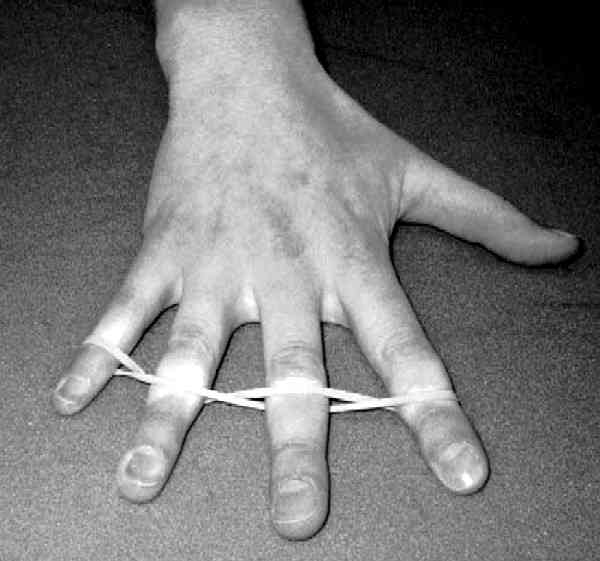
In general, it takes some months for joint stability and lumbrical muscle strength to improve significantly, so you’ll need some patience with the temporary splints or wraps and a modified playing schedule. ‘Stability strengthening’ exercises encourage co-contraction of the muscles surrounding a joint. Improved stability strength helps to compensate for a hyperlax joint. Stability strength training can include isometric and proprioception exercises on your instrument and on exercise equipment like the kinds shown here. For exercises away from the instrument, you can do muscle contractions with a support (such as Lycra finger sleeves) on.

DocZac™ exerciser
GripMaster™ extra-light tension exerciser
In later phases, your hand exercises can include strength training motions that are are concentric and eccentric (with respect to the center of rotation around the affected joint). The DocZac device works pretty well for this. ‘Proprioception’ exercises can include tapping and weightbearing—mostly in a mid-range, neutral joint position. Finger push-ups for hyperlax finger joints, for example—can be performed anytime, against a table or other convenient surface.

x
x
Warrington emphasizes that even the most conscientiously developed exercise program cannot reproduce exactly the action required from the various joints and muscles to play your instrument. And, yes, performing exercises that reproduce some of the actions and that aim to strengthen certain muscles, like the lumbricals, or aim to reduce the laxity of certain joints can be carried too far—excessive exercise can lead to further imbalance or overuse injuries or inflammation, can lead to different problems than the ones the exercises were designed to solve. You’ll be best able to judge your progress—and keep an eye out for problems that may develop—if you keep a log and record your daily hand exercise routine and other relevant details.

Stamina 2.5 output, with left_digit4.txt external input script file
There are fancy, expensive equipments that neurologists use to measure these things. But there are also some freeware/shareware programs that you can use on your computer to do pretty much the same measurements. One of these is Stamina 2.5 (Windows XP / Vista). You can create your own ASCII script files, tailoring the sequence of key-depressions to just those motions that you want to work on or measure, in each of the fingers you are having problems with. From the Stamina 2.5 pull-down Mode menu, choose Other Modes. Select the External File cascading menu choice and navigate to the .txt file you want. Here is one I created for the left ring-finger, and here is one I created for the right ring-finger. Download them and save them to a directory on your PC as you prefer, or to the c:\Program Files\Stamina\Data\ subdirectory where the script files for Stamina 2.5 reside. You can use these as-is, or, more likely, just examine them and see how you may want to set up your own custom script files. Besides revealing the characters-per-minute (cpm) count, which you can record in your daily log, Stamina 2.5 shows the graphical time-trend of how your fingers fatigue with prolonged action. As your stability-strengthening exercises proceed, you may notice that the rate at which your lumbricals-propelled fingers fatigue gets better as the muscles get stronger. And if you experience an injury, the graph is a sensitive indicator of the injury and its severity. The lower cadence achieved by the ring finger may be due more to a lack of independence at the level of voluntary neuromuscular control, than to any innate mechanical interaction with (‘enslavement’ to) the other fingers. Tapping cadence of each finger is lower for the double-finger mode than for the single-finger mode.

You can know for certain when your fingers are being moved by the lumbricals—just make your fingers do a harp-plucking motion. Generally, the lumbricals, flexors, and extensors will all be involved at once, in a way not under your conscious control. Change the finger movement—change the relative amount of straightening and forward motion—and feel your left forearm with your right hand. If the flexor and/or extensor muscles in your arm are contracting, you distinguish it easily because those muscles grow thicker and slide under the skin. When you’re moving your finger forward in such a way that you can’t feel much muscular action in the forearm, then the lumbrical muscle is doing almost all the work. Here are four basic rules for achieving accurate control and endurance:
  1. Do not make unnecessary movements or muscle contractions.
  2. Do the necessary movements as smoothly as possible.
  3. Use the strongest muscles that can do the job.
  4. Exercise to strengthen the muscles that have the potential to do the job.
Good luck!

Tubiana et al.