Saturday, December 22, 2007

Bach’s Polysemy: Happy Ambiguities, Joking, and Civility in Ensemble

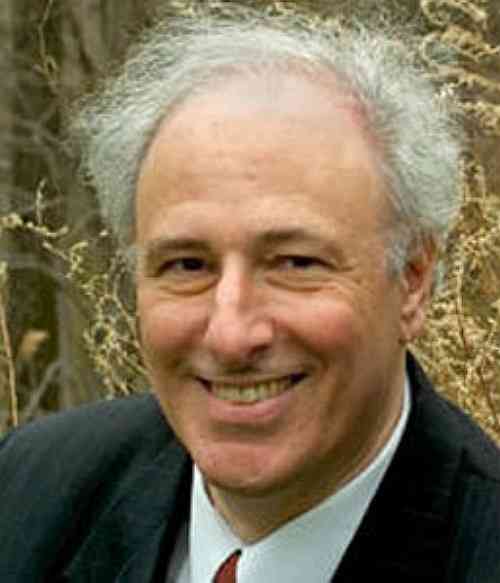
Kenneth Cooper, with twinkle of 18th-Century humor in his eye
The prolonged seicento-style harpsichord cadenza in the first movement of Brandenburg No. 5 has been much remarked-upon: it’s said to disrupt or intrusively challenge the movement’s formal order. That seems wrong to me. This past Tuesday evening I had an opportunity to rethink this while enjoying Kenneth Cooper and ensemble perform the Brandenburg Concertos at Lincoln Center’s Rose Theater in New York.


    [60-sec clip, Berliner Barock Solisten, cadenza, Christine Schornsheim, 2.4MB MP3]

E  nergy dipped during the opening movement of the Fifth Concerto, until Mr. Cooper’s mercurial harpsichord solo restored momentum. The flutist Paula Robison and the violinist Ani Kavafian offered dazzling interplay in the closing allegro.”
  —  Steve Smith, The Gifts of Bach’s Melodic Generosity, NYT, 19-DEC-2007.
T  he harpsichord part in Concerto No. 5 is a] wild card in this deck that calls all other parameters of the piece, and their attendant ideologies, into question... finally overthrows the other forces in a kind of hijacking of the piece... Bach composes the parts of the ensemble, flute, and violin to make it appear that ‘their’ piece has been violently derailed. They drop out inconclusively, one after another, exactly in the way an orchestra would if one of its members started making up a new piece in the middle of a performance.”
  —  Susan McClary, 1989, p. 27.
A  rebellious harpsichord solo comes close to wrecking the collaborative process.”
  —  Susan McClary, 2001, p. 116.

Rose Theater, Lincoln Center, New York
The harpsichord cadenza and the subsequent statements the harpsichord makes seem to me to be a coherent continuation of the No. 5’s musical narrative instead of an interruption of it. Rather than just a two-tiered hierarchy—concertino and ripieno—there is another layer. Each concerto gives a single concertino instrument the most responsibility for virtuosity. In the No. 2 Brandenburg, it’s the trumpet. In the No. 4, it’s the violin. And in the No. 5, it’s the harpsichord. But even with this consistent division of labor, the declamation by the harpsichord in the No. 5 is not a conquest, in the way that some analysts portray it. The flute and violin do not ‘own’ the piece, nor do they abandon their property rights. And the harpsichord does not ‘appropriate’ the piece or ‘steal’ it in the cadenza. No such robbery occurs. The good-natured discursiveness of the various parts’ counterpoint is in fact incompatible with ‘power games’, if the concerto is being thoughtfully performed. The transgressions of the cadenza are joking pseudo-transgressions among friends. Kenneth Cooper’s jovial treatment of the No. 5 Tuesday night (re-)convinced me of this.

The 1973 William Dowd instrument that Cooper played is voiced relatively loudly, but it has a sweet sound. Its color scheme is vermilion interior and black exterior, with an upbeat excerpt from an Alexander Pope poem decorating the underside of its lid.

T  o wake the soul / with tender strokes / of Art.

[To raise the genius, and to mend the heart;
 To make mankind, in conscious virtue bold,
  Live o'er each Seene, and be what they behold:
   For this the Tragic Muse first trod the stage. ] ”
  —  Alexander Pope, Prologue to Mr. Addison's Cato, 1713.
Cooper’s warm touch, the Dowd instrument’s sweet voicing, and the symbolic invocation of Pope’s exhortation to mindfulness, virtuousness, and communitarian ‘be-what-we-behold’ soulfulness—these all conspired to refute the prevailing ‘power games’ musicological understanding of the No. 5.

T  he harpsichord unleashes elements of chaos, irrationality, and noise until finally it blurs almost entirely the sense of key, meter, and form upon which eighteenth-century style depends. The harpsichord only allows itself to be reabsorbed into the final ritornello when the alternative seems to be madness.”
  —  Susan McClary, 1989.

 Rose Theater, Lincoln Center, New York
In fact, the prevailing musicological ‘power games’ sense of the cadenza in the first movement of the No. 5 Brandenburg seems inconsistent with Bach’s score. And the ‘power games’ meme is also inconsistent with what it feels like, to play in ensemble with players who are friends and colleagues and equals.

I  n a concerto grosso, the soloist enters between statements of the ritornello (Concerto No. 5, first movement)... almost invariably a virtuosic exhibitionist, the individualism of which flaunts the collectivity of the larger ensemble. It is the active agent in the piece; it is primarily responsible for dynamic motion, for destabilization,, the striving toward and achievement of each successive goal, which the larger group greets and punctuates with a ritornello. The convention itself, then comes with an agenda attached. Given the high value placed on closure in 18th-Century style, we already know prior to any particular piece (1) that the group will represent stability and the soloist, individual mobility; (2) that the two forces will operate dialectically, with the soloist providing movement, desire, and noise, the group acknowledging and appropriating the soloist's achievements; (3) that regardless of the oppositional tensions between the two in the course of the piece, the tonic key area and the group ritornello will have the last word, thus containing or absorbing the excesses of the soloist; and (4) that individual expression and social harmony will finally be demonstrated to be compatible... But the movement starts to present its own problems when the soloists enter. It begins as though it is going to be a concerto for solo flute and violin, but it soon becomes clear that there is a darkhorse competitor for the position of soloist: the harpsichord.”
  —  Susan McClary, 1989, p. 24.
It seems to me that the harpsichord comes forward drolly and gradually, not belligerently and suddenly. The harpsichord comes forward gradually over the course of more than 20 measures. The harpsichord executes the amazing cadenza and then resumes later with convivial demisemiquaver arpeggios, recapitulating the narrative that the harpsichord part had gently articulated earlier in the movement. The demisemiquavers continue for six measures before the dominant pedal returns. Of these measures, only two contain any chromaticism, and they’re a non-aggressive chromatic descent in diminished-7ths. In other words, this cadenza is in no way a ‘revenge of the frustrated continuo player who ain’t gonna take it anymore’. The harpsichord is not a mere accompanist, continuo-only. But neither in Concerto No. 5 is the harpsichord a terrorist.

Yes, the cadenza is dramatic, but it does give way to reprise the first movement’s cheerful main ideas. And the Allegro finale third movement resumes in rollicking high spirits, perfectly conveyed by the 2/4 triplets. The cadenza embodies multiple meanings simultaneously—it is polysemous, in the way that joking banter between friends is often polysemous. If you insist on taking the text of the No. 5 at its face-value—reading it in a doggedly literal, superficial way—then, yes, maybe it does look like a power struggle, or merely Bach’s way to show off the capabilities of his new toy from Berlin. But instead please consider the rollicking discursive style of it—and consider that the some of the statements may be comedic meta-references to the strictures of baroque concerto form and how those can produce funny, stilted relationships between the voices—and you may see the No. 5 in a different light, as I have. This Brandenburg No. 5 is, I think, Bach’s short, egalitarian, satirical essay on the absurdity of conventionality and conventional concerto politics. I’m happy to be wrong about this. That’s fine! I simply don’t think the No. 5 is anywhere near as serious or irrational as some musicologists think it is.
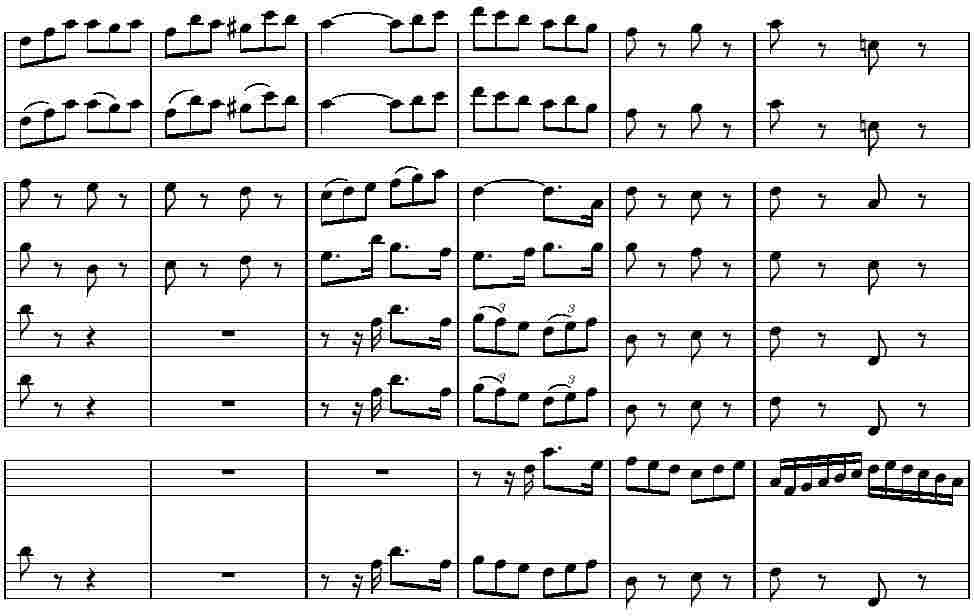
 Brandenburg Concerto No. 5, Mvt. 3, mm 37-42, Berliner Barock Solisten


    [30-sec clip, Berliner Barock Solisten, mm 37-78, 1.2MB MP3]

The Allegro finale of No. 5 also has detaché chords on the beat. Such detached chords don’t suit a 2/4 time-signature if the phraseology is longer than eight beats. But this finale is not long-breathèd music. The ‘stateliness’ of 2/4 time is there, surely. But the detached beats, the short phrase-lengths, and the unhurried charm of this movement are typical of a cheery 2/4.

 Brandenburg Concerto No. 5, Mvt. 3, mm 43-49, Berliner Barock Solisten
What’s more, the roll-ick-ing tri-pl-ets and demisemiquavers for decoration are entirely in-character for a cheerful, satirical piece. These are the ambiguous, casual gestures of an ensemble member who is entirely ‘at home’ with the other members. They are friendly gestures—not aggressive ‘shots across the bow’ by a renegade or tyrant, but playful teasing by a friend and colleague.

 Brandenburg Concerto No. 5, Mvt. 3, mm 50-58, Berliner Barock Solisten
Rollicking, jolly, sporting/sportive, merry, festive, playful, diverted and diverting. Mingling wit and wisdom and exploring their own fancy, Kenneth Cooper led the ensemble to indulge in some lively risk-taking Tuesday night. But, immaculate playing and all, their pace was never excessive. We were not rushed through the high-spirited Allegro so swiftly that there was not enough time to appreciate their wit, nor so swiftly that the joy in their boisterousness was weighed down.

 Brandenburg Concerto No. 5, Mvt. 3, mm 59-66, Berliner Barock Solisten
Cooper and the ensemble play in such a responsive manner with each other that they continuously re-earn each others’ friendship, admiration, and respect. It’s obvious to anyone in the audience that the ensemble members are comfortable with each other. They’re compatible personally, technically, and musically—and seem unanimously to look forward to a long association with each other. Balance between the voices was impeccable, and throughout there was cheerful give-and-take between the parts. Not McClary’s imagined belligerence and acquiescence; not fait accompli hijackings and recoveries.
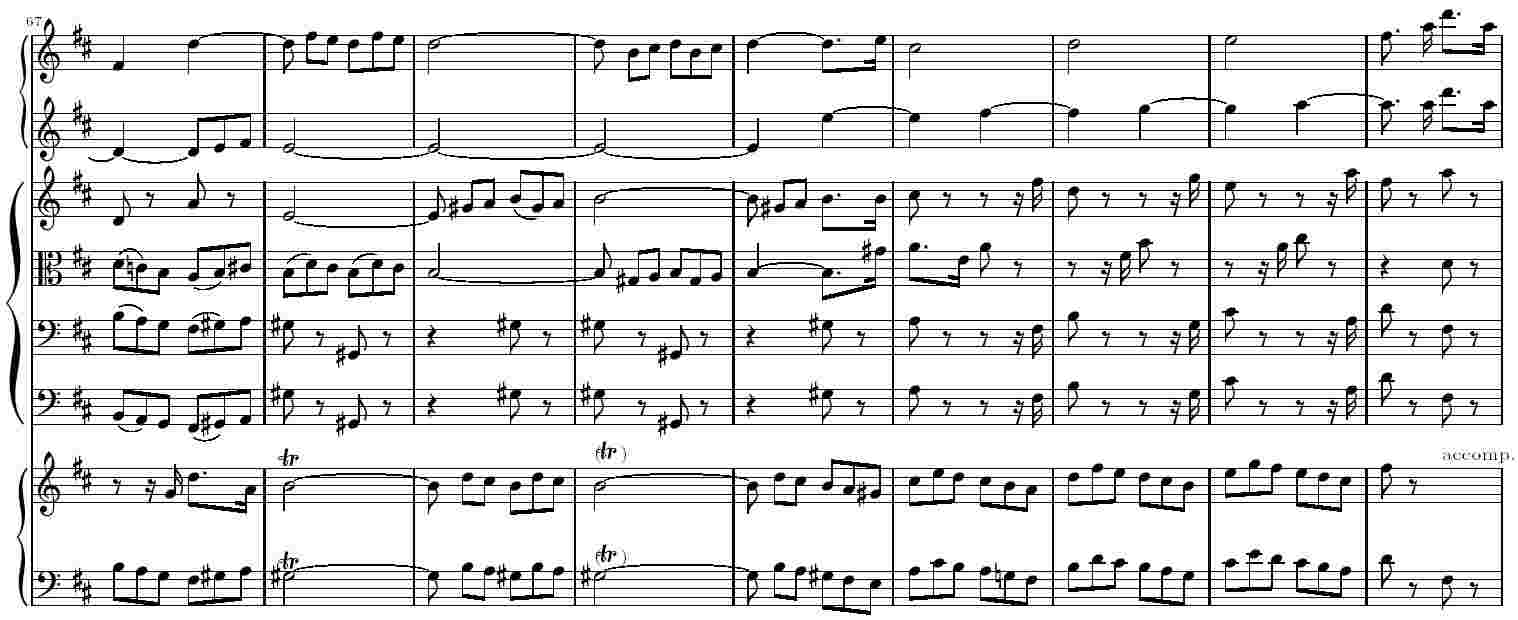
Brandenburg Concerto No. 5, Mvt. 3, mm 67-75, Berliner Barock Solisten
Attentive listening dispels the notion that the harpsichord part is the persona of a passive-aggressive virtuoso or a once-submissive accompanist gone berserk. Will you too discover that the harpsichord part can carry a sense of fun and self-mockery? Will you, too, find that in Cooper’s hands it can be slyly satiric of the culture-at-large and the concerto idiom in particular? After all, humorous or satirical mimicry denotes a confidence and emotional security that enables limits to be stretched and conventional bounds to be declared as absurd, without irreparably violating those bounds. No one was injured in the making of this concerto, nor the other Brandenburgs that were so beautifully performed this Tuesday evening.

I  t was the same, of course, as the Brandenburg he he had listened to so often in the past—the same and yet completely different. This Allegro—he knew it by heart. Which meant that he was in the best possible position to realize that he had never really heard it before. To begin with, it was no longer he, William Asquith Farnaby, who was hearing it. The Allegro was revealing itself as an element in the great present Event, a manifestation at one remove of the luminous Bliss. Or perhaps that was putting it too mildly. In another modality this Allegro was the luminous Bliss; it was the knowledgeless understanding of everything apprehended through a particular piece of knowledge; it was undifferentiated awareness broken up into notes and phrases and yet still all-comprehendingly itself. And of course all this belonged to nobody. It was at once in here, out there, and nowhere. The music which he had heard a hundred times before had been reborn as an unowned awareness—which was why he was now hearing it [as though] for the first time. Unowned, the Brandenburg had an intensity of beauty, a depth of intrinsic meaning incomparably greater than anything he had ever found in the same music when he’d regarded it as his private property. ‘Poor idiot’ came up in a bubble of ironic comment...”
  —  Aldous Huxley, Island, p. 329.
I  n effect, each member of the group is an internal coach. This, however, is a problematic role. If you come on too strongly and self-righteously, you may find yourself evicted from the room to contemplate the error of your ways.”
  —  Abraham Loft, p.185.
N  o musical rehearsal or performance preserves its real character when exposed to the eyes and ears of an onlooker... Paradoxically and depending on the character of the musicians, the enactment can become one of bravura display rather than of restraint. Those members who in the privacy of unobserved rehearsal are ready to impose their viewpoints on the rest of the ensemble can—under the gaze of the microphone or the ear of the live listener—present their opinions even more strongly than usual. In sum, an ensemble rehearsal reflects the personalities of the participants, and is true to life only when unobserved.”
  —  Abraham Loft, p.185.
H  ere’s an interesting instrument. I was looking through William Dowd’s essay on the extant Blanchet and Taskin harpsichords in the first volume of Howard Schott’s Hubbard Memorial series. Dowd was describing the Couchet-Blanchet-Taskin (1680-1758-1781) in the Boston Museum of Fine Arts, and he wrote, ‘The nuts bow away from the gap.’ Aside from the sheer unusualness of this, my interest was caught by the fact that I’m rather fond of deep-plucking-point instruments. There are those who call plucking point the soul of a harpsichord design. A close plucking point produces a nasal sound, a deep one produces a sweeter, plainer sound. It’s the difference between a front 8’ and a back 8’. Incorporated into a full design, plucking point will determine an instrument’s character. Factors influencing plucking point include bridge position and whether the string-band is closer to the cheek or the spine, but nut position is a clear and simple indication. The nut is straight, for instance, on the Smithsonian Stehlin, and it curves towards the gap on the 1769 Taskin. The Stehlin design produces a sweet sound; the Taskin design produces a sound with a cutting edge.”
  —  Edward Kottick, 1997.


[Cooper got his PhD in musicology from Columbia University, where he is on the faculty as well as the Manhattan School of Music. As a harpsichordist, pianist, musicologist and conductor, Kenneth Cooper is world-renowned for his expertise in the music of the 18th century, particularly for his expertise in ornamentation. As Music Director of the Berkshire Bach Ensemble, Kenneth Cooper has made a tradition of the holiday season performances of the Bach Brandenburg Concerti and has instituted a series of Concertofests in the style of Bach’s Collegium Concerts at Zimmermann’s Coffee-Haus.]


 Rose Theater, Lincoln Center, New York


Friday, December 21, 2007

17 Dec 07

Homecoming (Part2)

During the two days I spent being transported my vision worsened. By the time I got to the airport at Gatwick, I was unable to see my parents waiting at a gate crowded with hundreds of other people. Then suddenly, Mum came running at me, her jacket flying in the air and landing on the floor. I put down the box containing the few items I’d brought back to the UK, and I hugged Mum, lifting her off the floor. My sister, Karen, tears streaming down her face, joined the hug fest. And finally Dad.

In Dad’s Ford Mondeo we travelled to Karen’s flat in Fulham, London. I looked at this blog online for the first time. I posted a blog. Your comments made me smile. At Karen’s, I was inreviewed by a documentary maker who began to record my return to society. I met my sister’s husband, a tall and handsome photographer, who had recently survived an attack by the Taliban in Afghanistan. At night, we went out for an Indian meal, and I was still eating fifteen minutes after everyone else had stopped.

The next day, after doing two BBC radio interviews, we travelled home on the motorway system. The journey took five hours.

Seeing my hometown and hearing the accents of the people in a fish and chips place brought back all kinds of memories. I felt as if I were in a dream. Seeing inside my parents’ home brought back even more memories. I ate, went on the computer, and tried to sleep. But the cold made it hard to get to sleep even though I wore socks, a beanie, and a dressing gown, and I was buried under two fifteen-tog duvets in a room with the radiator on. My head trembled and my ears felt as if they had turned to ice. Allergies started, and I only slept for a few hours, making my vision worse.

The next morning my parents took me on a shopping spree at ASDA Wal-Mart. I loaded up on fruit, nuts, cheese, bread and beans. I haven’t stopped eating since I arrived home; it’s as if my body knows there is food available. The evening meals cooked by my parents seem to be coming from food heaven.

Claudia called and wished me good luck. She has a boyfriend now. My best friend from my hometown, “Hammy” stopped by with a bottle of Lanson champagne. Hammy and I used to copy Miami Vice fashions in the eighties, including wearing pink tops, white pants, and no socks. He offered to make me a key to his flat and to hook me up with some of the local nymphomaniacs. Hammy looked healthy and I enjoyed our talks.

I managed thirteen hours of sleep that night. My moods have been mostly up, but interspersed with tiredness. My mum is upset with all of the time I’m spending on the computer. I have begun the long task of editing the blog.

I’m happy to be home, and I feel no urge to sneak back into America. I’m enjoying concentrating on my literary projects, and listening to some tapes from The Teaching Company, a course called “Classics of Russian Literature”.

I’m going to be seeing plenty more of my family and friends over Christmas, including Aunt Lily and her numerous descendants.

More details of how I’ve been doing since arriving home are available at Mum’s blog:

Email comments to writeinside@hotmail.com or post them below

Copyright © 2006-2007 Shaun P. Attwood

Thursday, December 20, 2007

20 Dec 07

The Royo Romance (20)

Click here for Part 19A.
Recently received from Royo Girl:

I had no idea that you were back in England until I by chance wandered on to your blog page. My reaction was interesting to say the least and took me completely by surprise. If I gave this more thought, I probably wouldn't tell you, but I am just going to go ahead and tell you. I was at work when I was reading it and was shocked that I didn't know you were already there. Shock quickly turned into sadness and I was actually crying. I was and am selfishly sad that you were not in the states for me to go visit. I had sincerely wished that our last visit could have been more personal than through glass and that I only received 45 mins. I was down for the rest of the ENTIRE morning. Although I am happy that you are now a free man and are with your family, I wish that you were here and I could celebrate your new found freedom with you. Unfortunately I can not and will have to be content to write you and hopefully, talk to you. Speaking of which, I have a calling card and would LOVE to call you. You have my number, but I do not have a number to call you on. Would you give me one so I can or do I have to wait until you have your own mobile? Let me know ASAP and I will call you tomorrow morning. I MISS YOU

Email comments to writeinside@hotmail.com or post them below

Copyright © 2006-2007 Shaun P. Attwood

Tuesday, December 18, 2007

18 Dec 07

Podcast of Interview

Here is another interview I did recently. The interview begins seven minutes into this broadcast. It can be downloaded to your PC as a podcast or listened to as is.

Pods and Blogs

Email comments to writeinside@hotmail.com or post them below

Copyright © 2006-2007 Shaun P. Attwood
17 Dec 07

Homecoming (Part 1)

"Attwood, roll your mattress and bedding up. You're being deported," a guard yelled shortly after breakfast.
Another guard escorted me to Property to collect the release clothes my mother had mailed from England.
I spent the morning in a holding cell talking with some Mexicans who barely spoke any English. Around noon we were cuffed, leg shackled and belly chained.
Instead of opening up the entire bus, a redneck cramped me and dozens of Mexicans, some just teenagers, into a small front section. Many of them were drug criminals. They seemed fascinated when I explained I was an Englishman arrested in America for Ecstasy - las tachas. They asked me to ask the guard where we were going. The guard said it was none of our business. Leg cramps set in, and I had to stand up from time to time. The bus parked at a small airport near Phoenix.
"The plane isn't here yet," a guard said.
"It must have been delayed."
Ignoring our requests to use the toilet and be fed, the guards left us in the bus with no fresh air.

Hours later, I boarded the first "con-air" plane. Still in chains, we were seated in the middle rows. Guards filled the rows in front of us and behind. But they did not sit down. The ones in front turned around and glowered at us. The ones behind formed a second wall of eyes.
"You'll be offered the bathroom when we're in the air," one said.
Speeding up for take off, the plane's alarm sounded. The pilot hit the brakes.
We spent an hour on the plane, awaiting repairs. Vans arrived. They squeezed so many of us into each van, there was less room to move than in the bus earlier. Compressed into a row, I inhaled my neighbours' odours. It became hot and hard to breathe.
"If it's not repaired soon, we're gonna take you back to Florence, and we'll have to reschedule everything all over."
"I have a flight I've got to get in L.A.," I said.
"You're not gonna make it."
A tremor of anxiety shot through my body.
The guard made eyes at porn downloads on his phone, and ranted at guards passing by about having to work late.

It was getting on for nine when we reboarded. Some of the Mexicans had never flown before. They couldn't understand why they were being sent to California to be deported when they had been caught crossing into Arizona.
The plane zigzagged across California picking up Mexicans. The guards continued to lord it over us. Some of them praised Sheriff Joe Arpaio for doing such a wonderful job. I wanted to speak up about the conditions I had experienced at Arpaio's jails, then I thought better of it.
In the small hours, the plane landed near L.A.. The guards escorted me and an Asian-looking Australian to a van. In a lisp, the Australian explained he had no family or help in Australia, and he had no idea how he was going to survive. I slid around in the back of the van, trying to ignore the nagging pain of the cuffs and chains.

There was nowhere to sleep in the huge holding tank at the detention centre in L.A.. There I met Bo Stefan Eriksson, the Swedish businessman who had crashed a $1.5 million Ferrari Enzo into a pole in Malibu. He mocked the media reports that he was driving at 162 miles per hour. A big deal had been made out of a traffic accident, he claimed, because players in the local justice system were after his money. He said he had made millions from a video-game company, that he often stayed in London, and I was welcome to visit him there.
Whether they wanted to hear it or not, most of the detainees were being told the life story of an Argentinian. He had the physique of a wrestler, and his voice filled the room. He paced as he spoke: "I'm a personal trainer. My clients pay me hundreds of dollars an hour. They're famous people: actors, supermodels, artists. My girlfriend's a supermodel. She's six foot, and has perfect breasts - she paid one of Hollywood's top surgeon's for them. She's not fake like most of the women in L.A.. She's so kind, she always stops to help homeless people, and she makes me stop for them too. She's great in bed. She wakes me up every day with oral sex. She's the only one who understands me. She's giving up her career and family ties to move to Argentina to be with me, to come and marry me. What does that say about how much she loves me?"
His monologue lasted for hours. When I grew bored of it, I would go and pace at the other end of the room, and struggle to tune his voice out. And when I got bored of pacing, I would come and listen to him again, even going so far as to fake enthusiasm when his eyes, enthusiastic and bloodshot, met mine.

Shortly before noon, an officer transported the Argentinian and me to the airport.
"I've waited so long for this. I'm so excited. It's such a long flight to Argentina, but I just don't care. I'm free. I'm gonna see my family. I'm so happy." The look on his face said, If I wasn't in chains right now I would be hugging and kissing you.
The officer went inside the airport and returned shaking his head: “Your flights aren’t authorized. I’m taking you back to the holding tank. You’ll have to reschedule.”
I almost threw up.
“What do you mean?” the Argentinian asked, panic rising in his voice.
"I can't give you any more information."
Getting angry, he said, "What do you mean you can't give any more information? Are you saying I'm not going home? Answer me. Damn it!" He banged on the divide.
The guard ignored him.
"Do you know how long it takes to reschedule?" He turned to me, his face a picture of devastation.
"No," I said.
"It takes three weeks to reschedule - three weeks! Can you imagine having to spend three more weeks at these jails? This is one of the worst days of my life. I thought I was out of the system. I thought I was going home. I'm fucked. I can't believe this is happening to me.”
"Maybe he can tell us more when we get back to the detention center. The paperwork probably just got messed up somehow, and it'll get fixed."
"But my flight is in one hour. It'll be missed. I'm not going home. It's all got to be rescheduled. My girlfriend has flown to Argentina to meet me. Oh, God, how can this be happeneing to me?" He prayed. Every now and then he made the sign of the cross. Tears flowed as he entered the building. "I know I can't smoke in this building and you're not allowed to give me a cigarette, but please, please, give me a cigarette. I really need a cigarette right now."
"This is a federal building. We can't do that, sir."
"I just really need a cigarette," he said, sobbing. "Please, anyone, someone, give me a cigarette. I just wanna cigarette."
The guards put him in an isolation cell.
On the way back to the airport, the guard explained I had almost lost my flight due to a clerical error. The Argentinian had lost his, and was being rescheduled.

For hours, I remained cuffed in a van next to a United Airlines plane.
"I've gotta pee," I said.
"You've been well behaved so far, you're not gonna try anything funny are you?"
"No. I'm not going to jeapardise my flight back home."
"I'll take you then."
In the restroom, he said, "You pee first, then I'm gonna chain you to the rail in that toilet while I pee, so you can't escape."

An hour later, he said, "It's time. I'm gonna put you on the plane first so you don't scare the passengers. One time, I tried to put this big scary guy on the plane and the captain said, 'No way am I allowing him on my plane.' He had to be rescheduled."
There's still a chance I may be rejected and rescheduled, I thought, and said, "Tell them I'm a former stockbroker, and perhaps they'll be less frightened."
"Let's get your cuffs off then."

At the top of the stairs I was received by some of the crew.
"I'm Jonathan. If you need anything at all, Mr. Attwood, just ask for me," he said in a London accent.
"Thanks."
"Angela will show you where your seat is. Have a great flight, Mr. Attwood."
The passengers began to board. An attractive woman with tribal tattoos sat close by. I appreciated her perfume. Afraid of looking weird, I avoided looking at people. Then I figured that by not looking at people, I probably looked even weirder.
"Can I use the restroom?" I asked, and immediately felt stupid for seeking permission.
"The restroom is right there," an air hostess said, her face crinkled with amusement.
Taking off, I thought, You are free at last, free at last.
The flight went smoothly although I was convinced it was going to crash the whole way home. To take my mind off the crash, I watched five mindless movies.


Email comments to writeinside@hotmail.com or post them below

Copyright © 2006-2007 Shaun P. Attwood

Sunday, December 16, 2007

26 Nov 07

From Xena (Letter 1)

Dear Mr and Mrs Attwood

Hi, This is Xena. I hope this letter gets to you before Shaun does. I am sending a picture so he can remember me. I hope you like the pose. I want, and pray that your son accomplishes all that he sets out to do. He has a great mind. I am sure he inherited it from you two. He is such a good friend to me. I am going to miss him greatly. I already do!

Before I met him, I had not thought of, or believed in a larger spectrum of life than the one I was living. Prison has a way of robbing a person of self-identity. My identity although more lustrous than most others, was bland until I met your son. He has a knack with people like me, in surfacing qualities we knew not we had. Of this, I am so very grateful!

Keep a tight leash on him for a while. Prison time changes a person from normal thinking. He does need to readjust.

My love goes out to you.

Love
Xena
XXX


Email comments to writeinside@hotmail.com or post them below

Copyright © 2006-2007 Shaun P. Attwood

Francis Pott Beyond the Angle of Repose: Feeling Unreal, amidst Clouds of Unknowing

Francis Pott
A nd therefore lift up thy head with a blind stirring of love; For if it begin here, it shall last without end.”
  —  Psalm 90.

T he] first performance of The Cloud was attended by some who had been caught up in the tragic events of ‘07/07’ [terrorist bombing in London]. While it is mistaken to view the music as a reaction to that event, which its completion predated, such happenings offer melancholy confirmation of an enduring darkness at the heart of man, and of his capacity for acts of atrocity alongside selfless heroism. For as long as mankind continues to crucify its messengers of peace, it will fail to see the means of salvation which may always have lain in its own hands. Notwithstanding those who would decry bailing out humanity’s sinking ship through the exercise of artistic expression, the contemporary individual spared terror and suffering at first hand can neither turn away nor remain immune to words written by a surviving Polish Second War poet, Jerzy Ficowski, which resonate still as our world attempts today and tomorrow to rise above the mortal tide of its own suffering:

‘ I did not manage to save
  A single life
  I did not know how to stop
  A single bullet…
  I run
  To help where no one called
  To rescue after the event
  I want to be on time
  Even if I am too late.’

[Tr. by Keith Bosley, Krystyna Wandycz]”
  —  Francis Pott, Cloud of Unknowing, Program Notes.
D edicated ‘to Margaret Hassan and all innocent lives lost in Iraq or beyond’, Pott’s monumental, eloquent take on senseless violence and shameful hypocrisy offers a shield to the spirit against those who would destroy it. Unmissable.”
  —  Andrew Stewart, ClassicFM Magazine, SEP-2007.
O ne sometimes writes, hyperbolically, of a performance moving one to tears. But at the end of Francis Pott’s ‘The Cloud of Unknowing’, genuine tears were shed. …A heartfelt plea for reconciliation and tolerance is very much the theme of Pott’s oratorio. But the work is far from being simplistic peace propaganda. The [50-year-old] composer draws his texts from the psalms, war poets, Blake and other visionary writers, and a mystical mediaeval tract. These are arranged in such a way that mankind's instinctive tendency to lash out at enemies or perceived enemies is continually, and often ironically, contrasted with individual man’s capacity for heroism and self-sacrifice, as epitomised by the Crucifixion.”
  —  Richard Morrison, The Times, MAY-2005.
I  listened yesterday to Andrew Imbrie’s ‘Angle of Repose’, his famous choral work based on Wallace Stegner’s Pulitzer Prize-winning religious novel of the same name. And then, oddly enough, my iPod’s random shuffle served up Francis Pott’s ‘Cloud of Unknowing’.

In physics, the ‘angle of repose’ is a phrase denoting the angle or slant at which objects on an inclined plane cease to slide downward and instead come to rest and are stable at rest—the point at which the gravitational force urging them downward is offset by friction and mutual cohesion. The emphasis Imbrie places on the ‘angle’ concept in his religious choral work implies that the doxastic ‘angle of repose’ is not hospitable to growth of belief but is instead a concept of loss or curtailment or restriction. According to Imbrie, faith becomes less significant and less conventional as we move to that angle of stillness where the aporias of the human condition and immanent evil in the world stand in contrast to the notion of a beneficent God.

Some related philosophy-of-religion questions arise:
  • Can faith flourish if (through a person’s choices or through a chain of events not of the person’s choosing— ) it reaches a cognitive angle of repose? Can faith (or, for that matter, knowledge) grow if it’s tenuously positioned precisely at the angle of repose? Is there beauty and value in a windswept dwarf tree that clings to a cliff—or must we always prefer a farmer’s exclusionary concept of beauty-as-prolific-production, or an investor’s—one who values only perpetually greater and greater returns, alpha without end?
  • Conversely, is faith genuine if the minimum angle at which movement occurs is artificially increased by pouring a cement of church dogma on the surface of belief? What authenticity can faith have if you stay always in the flatland, far away from slopes and cliffs, and never venture into steep regions where the pitch of the epistemological terrain exceeds the angle of repose?
In medieval times, the text known as ‘The Cloud of Unknowing’ was meant to serve as a guide to the contemplation of God’s goodness—in a world obviously filled with suffering and evil. By contrast to the historical meditative purpose of ‘Cloud’, Francis Pott uses the text in his commission for the Vasari Singers to provide a withering critique of humanity’s heart of darkness. Pott’s ‘Cloud’ is an unrelenting 88-minute essay on a world riddled by dominionist, fundamentalist ideologies—Christian, Islamist, free-market capitalist.

Vasari Ensemble, photo by Canetty-Clarke
The libretto culminates in a brutal, ironic juxtaposition of ‘The Lord is on our side’ and Psalm 137:9——‘Blessed are they that taketh their children and dasheth the little ones against the stones’——while the tenor soloist futilely again and again tolls ‘The dead are all on the same side’, a line by the French WWI poet, René Arcos. We are way beyond any tenable religious angle of repose here. This is free-fall.

Particularly menacing in [Potts’ ‘Cloud of Unknowing’] fantastical design is ‘Is this He that was transfigured?’, an amorphous musical space that might have been filled by Arvo Pärt just as readily, or perhaps even Herbert Howells. In fact, it is the calculated exploitation of that most indispensable of musical building blocks – absolute silence – that fixes these choral and solo events together so utterly convincingly. The choir is never more stirring than in ‘In one little time may heaven be won and lost’, a chilling yet strangely conciliatory entreaty that trickles forward from an unending musical breath.”
  —  Mark Tanner, International Record Review, NOV-2007.


The original mystical/esoteric Christian text, ‘Cloud of Unknowing’, was written in the 1390s by an unknown English author, possibly Adam Easton, Cardinal of Norwich. Since God cannot be known by reasoning, the author tells the reader to dispense with any rational discourse entirely and to be submissive in a cloud of forgetting. The reader—a 24 year-old woman novitiate—is told to forget, forget, forget. Empty your mind. Blind, diffuse agape love is all that matters.

W   hat we have, then, in ‘The Cloud’ is a continuing polite bowing to the authority of traditional Augustinian sub-faculties of the mind—later to be rejected altogether by Descartes—but at the same time an entirely new sense of freedom of choice in stripping back to one key faculty of divine apprehension, in this case the [uninformed, anti-intellectual] will.”
  —  Sarah Coakley, p. 81.
There are parallels in the ‘unknowing’ quietistic memes of Zen and Zen Buddhism, of course. But those are not so adamantly opposed to or dismissive of discourse and reason as the ‘Cloud of Unknowing’. For the medieval author of ‘Cloud’, a mystical, pious, contemplative state of mind is the card that trumps all others. ‘Cloud’ exalts a pseudo-Dionysian annihilation of the self as the highest goal to which any human can aspire. It privileges solitary, anchoritic, quietistic, monkish ways—and disparages discourse. We are to give up our impious individual identities and assimilate ourselves into the Borg.

A  one-syllable workd such as ‘love’ is best. Choose one that is meaningful to you, then fix it in your mind so that it will remain there, come what may. This word will be your defense in conflict and in peace. Use it to beat upon the cloud of darkness above you and consign all distractions to the cloud of forgetting beneath you.”
  —  William Johnston, p. 56.
Have a look at Johnston’s translation. The 1390s Cloud is a zombie-like, self-mutilating cataphatism. We are told to renounce our social responsibilities for pious meditation—for neoplatonic, anti-intellectual self-absorption. (Or maybe it’s not cataphatic but instead apophatic—it doesn’t bind any specific Christian image of God; it’s imageless.) Cloud recommends that a pious will must rule the intellect. It maintains that bona fide spirituality involves the power of love only, and never the mind, never knowledge.

Francis Pott’s composition takes this medieval text and collides it with bible verses and canonical liturgical elements. The result is this stark and cautionary assessment of the role of religion in today’s world.

W   e want to believe that the culture we live in is stable and dependable, that the moral confusion and depravity we see around us are merely aberrations of settled and established moralities, deviations from the rule of social convention [but recent events and trends have made such belief untenable, except by ignoring/denying those recent facts and events and trends].”
  —  James Davison Hunter, p. 221.
Some people have difficulty thinking critically or are uncomfortable because reasoning troubles the heart. Reasoning reveals problems which may not be solvable but which nonetheless require human effort and attention to reduce them. So why not instead cleave to regimes that maintain that the process of thinking isn’t necessary? Why not instead cleave to ancient teachings that argue that thinking is forbidden by God and the prophets—teachings that ascribe unpleasant or demoralizing feelings to wrong thinking?

B efore the mountains came into being, or earth and world were created, Thou art, O God, from everlasting to everlasting.
Thou causest men to die and sayest: ‘Return, children of men.’
For a thousand years are in Thy sight as yesterday when it is past, and like a watch in the night.
Thou sweepest men to destruction. They are a dream. They are like grass which suddenly withers.
It blooms in the morning but is transformed at night. It is cut down and withers.”
  —  Psalm 90:2-6.
The adherent’s distress is reduced in proportion to the dumbing-down, the self-mutilation, the loss of identity. But what you don’t use you lose: the ability to think critically, the ability to remember the issues that pertain to the conflicts, the ability to remember who you are—these quickly atrophy. Eventually, the adherents no longer remember that they used to be able to think for themselves. According to van der Hart and colleagues, Wenninger and Ehlers, and others, such people tend to have more dissociative parts of their personality. They frequently have an ‘amnesia for their amnesia’, not recognizing that they have any impairment. They deny that any conflicts or trauma ever existed.

T o have a renewal of character is to have a renewal of a creedal order that constrains, limits, binds, obligates, and compels.... [Instead,] we want character but without effort or conviction.... We want virtue but without particular moral justifications that invariably offend.... We want decency without the authority to insist upon it.”
  —  James Davison Hunter.
Victims of trauma bring to the treatment setting an extreme level of emotional intensity and level of distress that touch, surpass and transform the empathic sensitivity of clinicians who listen to their stories. Clinicians providing care to the victims are overcome by the empathic strain. And that strain jeopardizes the effectiveness of subsequent care by blunting the clinicians’ understanding of patients’ internal psychological dynamics. This music is beautiful and cathartic for us care-givers. But it is also stressful in its own right and, therefore, to be taken in moderation. Read the package insert carefully. Use only as-directed.

I n the two months immediately after the events people’s characteristics of gratitude, kindness, hope, leadership, love, spirituality—strengths connected
through a virtue-based view—were all significantly elevated... ”
  —  C. Peterson & M. Seligman, Character strengths before and after September 11. Psych Sci 2003; 14: 381-4. (Survey of 4,817 residents of NYC in 2002)
.
[Francis Pott’s other sacred choral works, including ‘My Song is Love Unknown’, ‘Christus’, and ‘The Souls of the Righteous’, are less apocalyptic/iconoclastic than ‘Clouds’ or his oratorio ‘A Song on the End of the World’. He was previously Lecturer in Music at St Hilda’s College, Oxford, from 1992 to 2001, and since then has been Head of Music and Composition at London College of Music & Media, in Ealing, West London. In 1997, Pott won First Prize in the S. S. Prokofiev International Composing Competition in Moscow. ]

I n a final coup, Pott rudely interrupts the serenity with an anguished reminder of Christ’s cry from the cross, this time sung, harrowingly, by the soloist. But then a state of calm is reached at last as the choir sings an extended final Amen. The work ends with one last, enigmatic and hushed organ chord, which lasts for some 28 seconds and which, in the composer’s words, ‘enfolds all in its own seemingly eternal cloud of unknowing.’ I listened, enthralled, to this major addition to the choral repertoire. I can’t commend Signum highly enough for having the vision and the commercial courage to issue this recording.”
  —  John Quinn, MusicWeb International, OCT-2007.
I n character it is a work of pessimism and deep foreboding. The opening sections in particular pose a huge challenge for the choir, who are required to sing very quietly with every syllable stretched out to its fullest extent, often well beyond the point where the words become indistinguishable and we are indeed faced with a cloud of unknowing. But these clouds disperse to be replaced by visions of the Four Horsemen of the Apocalypse, intersecting with the mysticism of William Blake—potentially a powerfully heady mix, but one which I found to be perversely lacking in either menace or horror. An extended setting of Psalm 23, which the composer describes as a retreat from the noise of battle, marks a transition phase and the breakpoint between the two CDs. From here on the work settles into a quiet melancholy, a mood which sits very comfortably with Pott’s style, and a composition of significant stature emerges. Words become clear and telling, and in an atmosphere of gentle supplication the agony and the anguish of a conflict torn world are revealed.”
  —  Serena Fenwick, Musical Pointers, SEP-2007.

Simeon & Abugel book