T
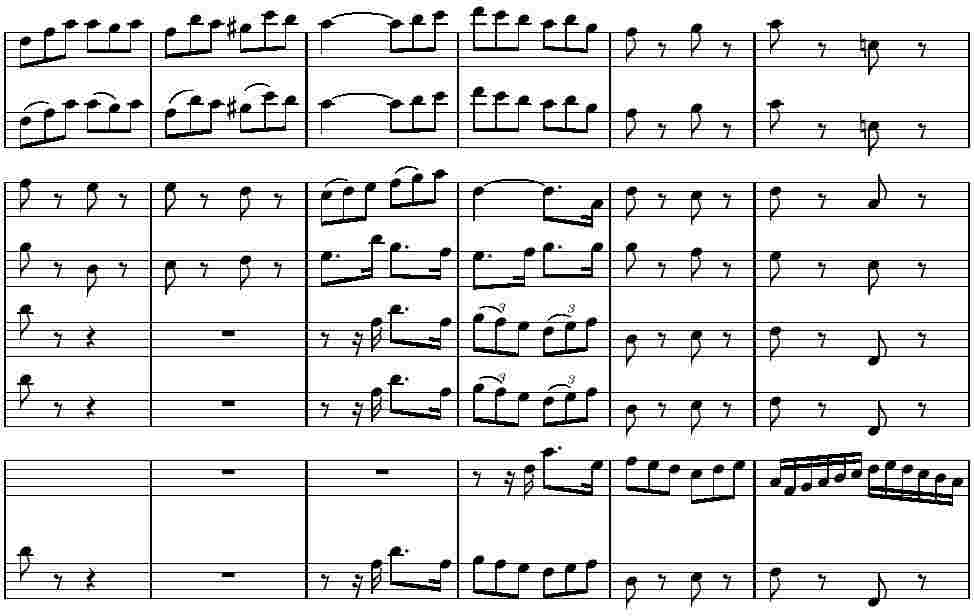
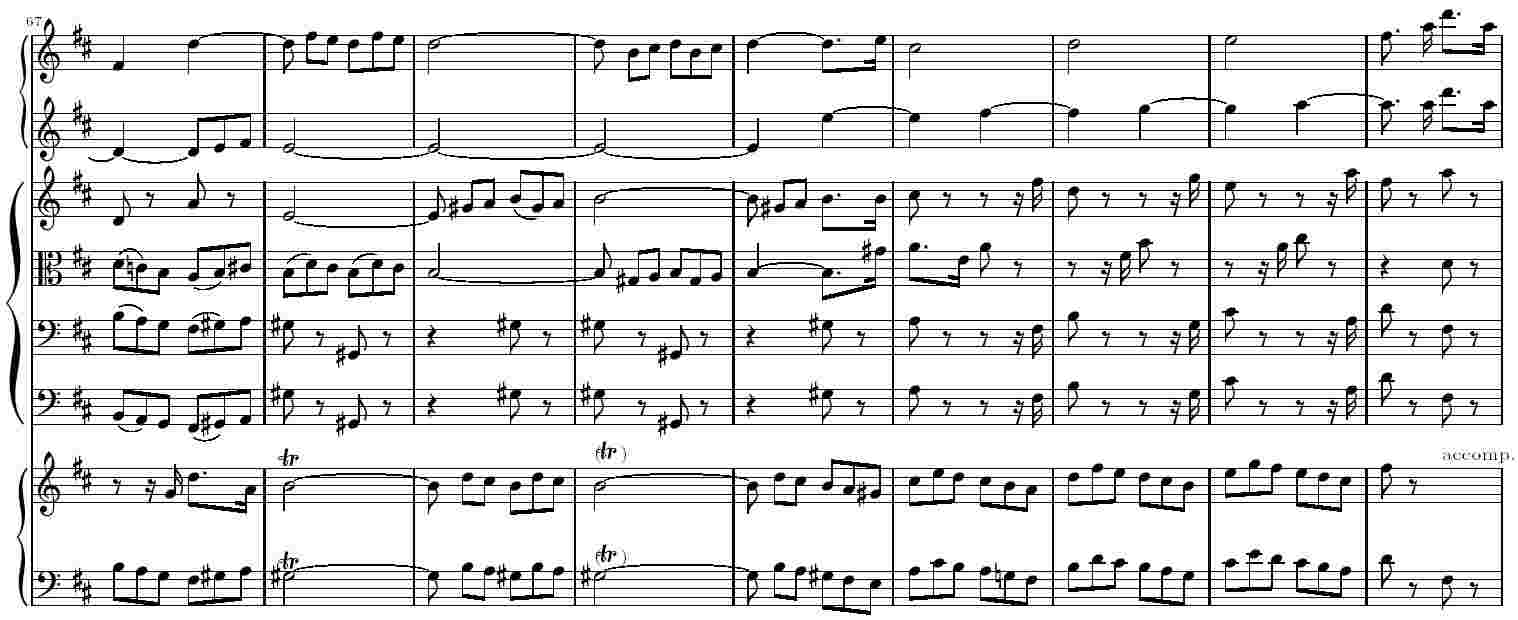
The prolonged seicento-style harpsichord cadenza in the first movement of Brandenburg No. 5 has been much remarked-upon: it’s said to disrupt or intrusively challenge the movement’s formal order. That seems wrong to me. This past Tuesday evening I had an opportunity to rethink this while enjoying Kenneth Cooper and ensemble perform the Brandenburg Concertos at Lincoln Center’s Rose Theater in New York.
[60-sec clip, Berliner Barock Solisten, cadenza, Christine Schornsheim, 2.4MB MP3]
E nergy dipped during the opening movement of the Fifth Concerto, until Mr. Cooper’s mercurial harpsichord solo restored momentum. The flutist Paula Robison and the violinist Ani Kavafian offered dazzling interplay in the closing allegro.”
— Steve Smith, The Gifts of Bach’s Melodic Generosity, NYT, 19-DEC-2007.
T he harpsichord part in Concerto No. 5 is a] wild card in this deck that calls all other parameters of the piece, and their attendant ideologies, into question... finally overthrows the other forces in a kind of hijacking of the piece... Bach composes the parts of the ensemble, flute, and violin to make it appear that ‘their’ piece has been violently derailed. They drop out inconclusively, one after another, exactly in the way an orchestra would if one of its members started making up a new piece in the middle of a performance.”
— Susan McClary, 1989, p. 27.
A rebellious harpsichord solo comes close to wrecking the collaborative process.”
— Susan McClary, 2001, p. 116.
 T
The harpsichord cadenza and the subsequent statements the harpsichord makes seem to me to be a coherent continuation of the No. 5’s musical narrative instead of an interruption of it. Rather than just a two-tiered hierarchy—concertino and ripieno—there is another layer. Each concerto gives a single concertino instrument the most responsibility for virtuosity. In the No. 2 Brandenburg, it’s the trumpet. In the No. 4, it’s the violin. And in the No. 5, it’s the harpsichord. But even with this consistent division of labor, the declamation by the harpsichord in the No. 5 is not a conquest, in the way that some analysts portray it. The flute and violin do not ‘own’ the piece, nor do they abandon their property rights. And the harpsichord does not ‘appropriate’ the piece or ‘steal’ it in the cadenza. No such robbery occurs. The good-natured discursiveness of the various parts’ counterpoint is in fact incompatible with ‘power games’, if the concerto is being thoughtfully performed. The transgressions of the cadenza are joking pseudo-transgressions among friends. Kenneth Cooper’s jovial treatment of the No. 5 Tuesday night (re-)convinced me of this.
The 1973 William Dowd instrument that Cooper played is voiced relatively loudly, but it has a sweet sound. Its color scheme is vermilion interior and black exterior, with an upbeat excerpt from an Alexander Pope poem decorating the underside of its lid.
T o wake the soul / with tender strokes / of Art.
[To raise the genius, and to mend the heart;
To make mankind, in conscious virtue bold,
Live o'er each Seene, and be what they behold:
For this the Tragic Muse first trod the stage. ] ”
— Alexander Pope, Prologue to Mr. Addison's Cato, 1713.
Cooper’s warm touch, the Dowd instrument’s sweet voicing, and the symbolic invocation of Pope’s exhortation to mindfulness, virtuousness, and communitarian ‘be-what-we-behold’ soulfulness—these all conspired to refute the prevailing ‘power games’ musicological understanding of the No. 5.
T he harpsichord unleashes elements of chaos, irrationality, and noise until finally it blurs almost entirely the sense of key, meter, and form upon which eighteenth-century style depends. The harpsichord only allows itself to be reabsorbed into the final ritornello when the alternative seems to be madness.”
— Susan McClary, 1989.
 I
In fact, the prevailing musicological ‘power games’ sense of the cadenza in the first movement of the No. 5 Brandenburg seems inconsistent with Bach’s score. And the ‘power games’ meme is also inconsistent with what it feels like, to play in ensemble with players who are friends and colleagues and equals.
I n a concerto grosso, the soloist enters between statements of the ritornello (Concerto No. 5, first movement)... almost invariably a virtuosic exhibitionist, the individualism of which flaunts the collectivity of the larger ensemble. It is the active agent in the piece; it is primarily responsible for dynamic motion, for destabilization,, the striving toward and achievement of each successive goal, which the larger group greets and punctuates with a ritornello. The convention itself, then comes with an agenda attached. Given the high value placed on closure in 18th-Century style, we already know prior to any particular piece (1) that the group will represent stability and the soloist, individual mobility; (2) that the two forces will operate dialectically, with the soloist providing movement, desire, and noise, the group acknowledging and appropriating the soloist's achievements; (3) that regardless of the oppositional tensions between the two in the course of the piece, the tonic key area and the group ritornello will have the last word, thus containing or absorbing the excesses of the soloist; and (4) that individual expression and social harmony will finally be demonstrated to be compatible... But the movement starts to present its own problems when the soloists enter. It begins as though it is going to be a concerto for solo flute and violin, but it soon becomes clear that there is a darkhorse competitor for the position of soloist: the harpsichord.”
— Susan McClary, 1989, p. 24.
It seems to me that the harpsichord comes forward drolly and gradually, not belligerently and suddenly. The harpsichord comes forward gradually over the course of more than 20 measures. The harpsichord executes the amazing cadenza and then resumes later with convivial demisemiquaver arpeggios, recapitulating the narrative that the harpsichord part had gently articulated earlier in the movement. The demisemiquavers continue for six measures before the dominant pedal returns. Of these measures, only two contain any chromaticism, and they’re a non-aggressive chromatic descent in diminished-7ths. In other words, this cadenza is in no way a ‘revenge of the frustrated continuo player who ain’t gonna take it anymore’. The harpsichord is not a mere accompanist, continuo-only. But neither in Concerto No. 5 is the harpsichord a terrorist.
Yes, the cadenza is dramatic, but it does give way to reprise the first movement’s cheerful main ideas. And the Allegro finale third movement resumes in rollicking high spirits, perfectly conveyed by the 2/4 triplets. The cadenza embodies multiple meanings simultaneously—it is polysemous, in the way that joking banter between friends is often polysemous. If you insist on taking the text of the No. 5 at its face-value—reading it in a doggedly literal, superficial way—then, yes, maybe it does look like a power struggle, or merely Bach’s way to
show off the capabilities of his new toy from Berlin. But instead please consider the rollicking discursive style of it—and consider that the some of the statements may be comedic meta-references to the strictures of baroque concerto form and how those can produce funny, stilted relationships between the voices—and you may see the No. 5 in a different light, as I have. This Brandenburg No. 5 is, I think, Bach’s short, egalitarian, satirical essay on the absurdity of conventionality and conventional concerto politics. I’m happy to be wrong about this. That’s fine! I simply don’t think the No. 5 is anywhere near as serious or irrational as some musicologists think it is.

[30-sec clip, Berliner Barock Solisten, mm 37-78, 1.2MB MP3]
The Allegro finale of No. 5 also has detaché chords on the beat. Such detached chords don’t suit a 2/4 time-signature if the phraseology is longer than eight beats. But this finale is not long-breathèd music. The ‘stateliness’ of 2/4 time is there, surely. But the detached beats, the short phrase-lengths, and the unhurried charm of this movement are typical of a cheery 2/4.
 W
What’s more, the roll-ick-ing tri-pl-ets and demisemiquavers for decoration are entirely in-character for a cheerful, satirical piece. These are the ambiguous, casual gestures of an ensemble member who is entirely ‘at home’ with the other members. They are friendly gestures—not aggressive ‘shots across the bow’ by a renegade or tyrant, but playful teasing by a friend and colleague.
 R
Rollicking, jolly, sporting/sportive, merry, festive, playful, diverted and diverting. Mingling wit and wisdom and exploring their own fancy, Kenneth Cooper led the ensemble to indulge in some lively risk-taking Tuesday night. But, immaculate playing and all, their pace was never excessive. We were not rushed through the high-spirited Allegro so swiftly that there was not enough time to appreciate their wit, nor so swiftly that the joy in their boisterousness was weighed down.
 C
Cooper and the ensemble play in such a responsive manner with each other that they continuously re-earn each others’ friendship, admiration, and respect. It’s obvious to anyone in the audience that the ensemble members are comfortable with each other. They’re compatible personally, technically, and musically—and seem unanimously to look forward to a long association with each other. Balance between the voices was impeccable, and throughout there was cheerful give-and-take between the parts. Not McClary’s imagined belligerence and acquiescence; not fait accompli hijackings and recoveries.
 A
Attentive listening dispels the notion that the harpsichord part is the persona of a passive-aggressive virtuoso or a once-submissive accompanist gone berserk. Will you too discover that the harpsichord part can carry a sense of fun and self-mockery? Will you, too, find that in Cooper’s hands it can be slyly satiric of the culture-at-large and the concerto idiom in particular? After all, humorous or satirical mimicry denotes a confidence and emotional security that enables limits to be stretched and conventional bounds to be declared as absurd, without irreparably violating those bounds. No one was injured in the making of this concerto, nor the other Brandenburgs that were so beautifully performed this Tuesday evening.
I t was the same, of course, as the Brandenburg he he had listened to so often in the past—the same and yet completely different. This Allegro—he knew it by heart. Which meant that he was in the best possible position to realize that he had never really heard it before. To begin with, it was no longer he, William Asquith Farnaby, who was hearing it. The Allegro was revealing itself as an element in the great present Event, a manifestation at one remove of the luminous Bliss. Or perhaps that was putting it too mildly. In another modality this Allegro was the luminous Bliss; it was the knowledgeless understanding of everything apprehended through a particular piece of knowledge; it was undifferentiated awareness broken up into notes and phrases and yet still all-comprehendingly itself. And of course all this belonged to nobody. It was at once in here, out there, and nowhere. The music which he had heard a hundred times before had been reborn as an unowned awareness—which was why he was now hearing it [as though] for the first time. Unowned, the Brandenburg had an intensity of beauty, a depth of intrinsic meaning incomparably greater than anything he had ever found in the same music when he’d regarded it as his private property. ‘Poor idiot’ came up in a bubble of ironic comment...”
— Aldous Huxley, Island, p. 329.
I n effect, each member of the group is an internal coach. This, however, is a problematic role. If you come on too strongly and self-righteously, you may find yourself evicted from the room to contemplate the error of your ways.”
— Abraham Loft, p.185.
N o musical rehearsal or performance preserves its real character when exposed to the eyes and ears of an onlooker... Paradoxically and depending on the character of the musicians, the enactment can become one of bravura display rather than of restraint. Those members who in the privacy of unobserved rehearsal are ready to impose their viewpoints on the rest of the ensemble can—under the gaze of the microphone or the ear of the live listener—present their opinions even more strongly than usual. In sum, an ensemble rehearsal reflects the personalities of the participants, and is true to life only when unobserved.”
— Abraham Loft, p.185.
H ere’s an interesting instrument. I was looking through William Dowd’s essay on the extant Blanchet and Taskin harpsichords in the first volume of Howard Schott’s Hubbard Memorial series. Dowd was describing the Couchet-Blanchet-Taskin (1680-1758-1781) in the Boston Museum of Fine Arts, and he wrote, ‘The nuts bow away from the gap.’ Aside from the sheer unusualness of this, my interest was caught by the fact that I’m rather fond of deep-plucking-point instruments. There are those who call plucking point the soul of a harpsichord design. A close plucking point produces a nasal sound, a deep one produces a sweeter, plainer sound. It’s the difference between a front 8’ and a back 8’. Incorporated into a full design, plucking point will determine an instrument’s character. Factors influencing plucking point include bridge position and whether the string-band is closer to the cheek or the spine, but nut position is a clear and simple indication. The nut is straight, for instance, on the Smithsonian Stehlin, and it curves towards the gap on the 1769 Taskin. The Stehlin design produces a sweet sound; the Taskin design produces a sound with a cutting edge.”
— Edward Kottick, 1997.
[Cooper got his PhD in musicology from Columbia University, where he is on the faculty as well as the Manhattan School of Music. As a harpsichordist, pianist, musicologist and conductor, Kenneth Cooper is world-renowned for his expertise in the music of the 18th century, particularly for his expertise in ornamentation. As Music Director of the Berkshire Bach Ensemble, Kenneth Cooper has made a tradition of the holiday season performances of the Bach Brandenburg Concerti and has instituted a series of Concertofests in the style of Bach’s Collegium Concerts at Zimmermann’s Coffee-Haus.]
- Pickett P. The Brandenburg Concertos: A New Interpretation. 1994.
- Cooper K, Berkshire Bach Society. Complete Brandenburg Concerti. (BBS, 1998.)
- Cooper page at Manhattan School of Music
- Cooper, guest with Lark Chamber Artists
- Sherman Chamber Ensemble website
- Cooper at Lincoln Center, NYC, 18-DEC-2007.
- Fauconnier G. Mental Spaces: Aspects of Meaning Construction in Natural Language. MIT, 1994.

- Fischer K. From Cognitive Semantics to Lexical Pragmatics: The Functional Polysemy of Discourse Particles. de Gruyter, 2000.
- Giddens A. The Constitution of Society. Polity, 1991.
- Hall E. The Dance of Life. Peter Smith, 1996.
- Huxley A. Island. Harper-Perennial, 2002.
- Loft A. How to Succeed in an Ensemble: Reflections on a Life in Chamber Music. Amadeus, 2003.
- McClary S. Conventional Wisdom: The Content of Musical Form. Univ California, 2001.
- McClary S. 'The Blasphemy of Talking Politics During Bach Year,' in Leppert R & McClary S, eds., Music and Society: The Politics of Composition, Performance, and Reception. Cambridge Univ, 1989, pp. 21-28.
- Nerlich B, ed. Polysemy: Flexible Patterns of Meaning in Mind and Language. de Gruyter, 2003.
- Pahud E, Berliner Barock. Brandenburg Concerto No. 5. (EMI, 2001.)
- Rademaker A. Sophrosyne And The Rhetoric Of Self-Restraint: Polysemy & Persuasive Use Of An Ancient Greek Value Term. Brill, 2005.
- Ravin Y, Leacock C, eds. Polysemy: Theoretical and Computational Approaches. Oxford Univ, 2000.
- Riemer N. The Semantics of Polysemy: Reading Meaning in English and Warlpiri. de Gruyter, 2005.
- Ward L. Dynamical Cognitive Science. MIT, 2001.