Sunday, April 6, 2008

Liquid Chamber Music: Inter-Voice Rhythm Slip and Non-Newtonian Shear-Dependent ‘Viscosity’ in BWV 1052

 Bach Concerto in D minor, Adagio, mm. 19 – 21, rhythmic slippage between harpsichord r.h. and other parts
W  here a rhythm is heard as anacrustic, moving from upbeat to downbeat, the downbeat exerts a kind of gravitational force, attracting notes of the upbeat to it. Since human beings experience gravity as a downward pull, [the rhythm] is readily felt as a downward fall or slide to the bottom of something. Downward slides are not constant in speed; they accelerate. And since any physical medium contains some friction, the rate of acceleration will not be constant, either; it will increase until the effect of friction is largely overcome.”
  —  William Rothstein.
Basically, polyphonic music is an emulsion. It is an ‘emulsion’ of the parts or voices that comprise it. And its physics closely resembles the physics of complex fluids in general. It has viscosity: the rhythmic rate at which the parts unfold and the rate at which rhythmic change can occur are not infinite. As a ‘liquid’, music has internal friction. And that friction or viscosity is not constant. It varies with tempo, with rhythmic velocity in individual parts, and with the biophysical possibilities and limitations of the interactions between the human flesh and the real-world instrument/voice.

 Rheologic regimes
 Viscosity (eta)
Individual musical parts embody shear contours and rhythmic isopleths in the composition—in the larger shear field that is comprised of the union of all of the parts. Layers in that sonic emulsion have different viscosities and velocities and shear rates, and the layers “slip” against each other, just as disparate layers in a physical liquid would slip.
 Epstein book
Yes, music is a liquid—it flows like blood. (The pulsatility of attractive compositions and performers’ interpretations is also subconsciously informed by the pulsatility of our hearts, our circulation?) A fancy word for the study of this sort of flow is ‘non-Newtonian rheology’. I realize that others have thought some of these thoughts before: William Rothstein comes to mind. But I think that no physicist or chemical engineer who specializes in rheology of complex liquids has ever done so—or, at least, has never done so and written about it. Why are there musician-mathematicians and musician-EEs but no musician-ChemEs?

 non-Newtonian rheology
There is shear-thinning or thixotropy in BWV 1052. (I suppose the converse, shear-thickening [‘rheopexy’], is also possible in music—although it must be rare, just as rheopexy is rare in physical liquids.)

Sometimes music is less like blood and more like paint—with lots of reverb (or, equally well, with lots of minimalist composers’ written short-timescale recapitulations of motifs), it flows and creeps after the performer (the ‘paint brush’) has passed that motif, onward to the next measure. The ‘relaxation time’ for viscoelastic effects in musical fluids can be similar to a nice latex paint.

 Rheology of paint
Sometimes music is like whipped cream—its viscosity is high enough to hold a “peak”? Maybe I am generalizing this idea of musical rheology further than I ought to do. But it seems empirically to be valid within some bounds. For example, the idea of accelerating through an anacrustic motive is a prevalent interpretation of much baroque and nineteenth-century music, if and only if the motive itself is frictionless. Rothstein said something that amounted to this, in one of his papers some years ago.

And our psychological response to ritardandos and fermatas—the rubato of the harpsichord in BWV 1052, for example, juxtaposed as it is with the rhythmic consistency of the other parts—is empirically an apprehension of vortices and rhythmic slippage.

 Flow Separation Vortices, BWV 1052 Adagio
Thixotropic liquids exhibit a time-dependent response to the shear strain rate over a longer period than that associated with the actual changes that occur in the shear strain rate. They may liquefy on being shaken and then solidify when the shaking has stopped. The analogous thing happens in music—at least in tonal music of the 20th Century and earlier. The shaking stops at the fermatas between the movements in BWV 1052. Liquefaction upon commencing the next movement amounts to a kind of psychic relief—resolution of a dramatic tension.

Linear and nearly-linear polymer liquids are predictable in the relationship of their viscosity to their structure and the polymer molecules’ conformation. In dilute solutions this relationship depends on the microscopic volume ‘swept out’ by the molecules as they tumble in the solution (their ‘hydrodynamic volume’). At low concentrations where there is minimal interaction between molecules, the viscosity may be about the same as water.

 Morrison book
Starches and other biopolymers are like this. Although attaching short sugar oligomers as branch-points to linear polysaccharides does increase their rigidity as the molecules are extended, this increases the molecular weight a lot. The effect of the molecular weight on the viscosity is dramatic as the hydrodynamic volumes of compact molecules increase approximately as the cube root of the molecular weight while the hydrodynamic volumes of branched/extended molecules increase about linearly with molecular weight.

The relationship between the intrinsic viscosity η and the relative molecular mass (Mw) is given by η = K ∙ Mw ∙ a , the Mark-Houwink equation where K and a are constants. Amylose and carboxymethylcellulose, for example, have exponents (a) of about 0.7. Knowledge of these constants allows the viscosity-averaged molecular weight to be calculated from viscosity data. A similar metric, it seems to me, could be calculated for music, such as this Bach Concerto in D minor.

Viscosity increases with solute concentration [multi-voice sixteenth-note pattern concentration transversely across parts and longitudinally, on a per-bar basis] until the shape of the volume occupied by the molecules [the rhythmic patterns] becomes elongated under stress causing some overlap between molecules [patterns] and a consequent reduction in the overall molecular volume with the consequent effect of reducing the amount that viscosity increases with further increases concentration (under non-zero stress across the bulk solution [across the polyphonal score] ). At higher concentrations (above some critical concentration C*) all the polymer molecules in the solution effectively overlap and interpenetrate (that is, their total hydrodynamic volume appears greater than the volume of the bulk liquid) even when the liquid is not under shear. When this happens, the solution behavior changes from predominantly-viscous to predominantly-elastic with the viscosity (η0 at zero stress) now governed by the small-scale rotational and vibrational mobility of the polymer molecules. This is the source of the individuality that is implied by the harpsichord ornamentations in BWV 1052: small-scale mobility in the larger ensemble-gel matrix.

C* is itself not a constant: it depends on the shear strain rate. At high shear strain rates, the rotational tumbling of the molecules sweeps out less volume. At higher concentrations the viscosity increases as about the fifth power of the concentration and this can cause synergistic behavior of mixtures, especially if there are phase separations with the attending concentration increases in some phases. Compare the highly motoric, high strain rate passages of the third movement of BWV 1052 with those in the Adagio second movement.

 Viscosity: elastic and sliding components
At high shear strain rates, molecules tend to become more ordered (oriented with respect to the direction of stress and flow, and oriented with respect to each other) and they tend also to become more elastic. Shear flow causes the molecules [the rhythmic patterns in each voice in a polyphonic composition] to become stretched and compressed (at right angles to the stretch) ... and what started out as an isotropic solution becomes anisotropic—physical properties are now strongly direction-dependent. After release from such conditions, the molecules ‘relax’ back to their unstressed configurations with a characteristic time-constant or relaxation time. Coordination within ensemble, especially in passages where there are rapid rhythms in most of the parts or all of the parts.

At low concentrations below the critical value (C*), the shear modulus of hydrocolloid solutions is mainly determined by the loss modulus at low frequencies (that is, G'' is relatively high for viscous materials). As G'' depends on the frequency but G' depends on the square of the frequency, G' becomes more important at higher frequencies. At higher concentrations in viscous solutions G' is generally greater than G'' throughout a wide frequency range. This difference is very large for strong gels when the frequency has almost negligible effect (in other words, G' is high for elastic materials). The continuo and some of the sectional writing in BWV 1052 amounts to a gel, in which the r.h. of the harpsichord part is embedded and from which it separates in various passages.

It’s convenient to express the relationship between the shear stress, the elastic stress, and the viscous stress (resulting from changing stress) in terms of a complex number ( (-1)1/2 = i) where the viscous stress is ‘in-phase’ and the elastic stress is out-of-phase and oppositely-directed:

  • shear stress = viscous stress - i ∙ elastic stress
  • complex viscosity = viscosity - i ∙ elasticity
  • tan(φ) = elasticity / viscosity
 Stress-Strain phase relationship
The shear modulus (resulting from changing strain in the liquid) is the ratio of the shear stress to the shear strain. It follows from the complex relationship similar to the above that:

  G* = G' + i G''

where G* is the complex shear modulus, G' is the in-phase ‘storage’ modulus and G'' is the out-of-phase ‘loss’ modulus; G* = Φ(G'2 + G''2). The frequency where these parameters cross over corresponds to a relaxation time (t) specific for the material [specific for the musical composition].

 Storage and Loss moduli, relation to shear
It follows that,

  tan(δ) = G'' / G'

where tan(δ) quantifies the balance between energy loss and storage in the liquid.

 Complex Shear Modulus
As tan(45°) = 1, a value for tan(δ) greater than unity indicates more ‘liquid’ properties, whereas one lower than unity means more ‘solid’ properties, regardless of the viscosity. In the motoric first movement of BWV 1052, δ ~ 0.7. And, in the Adagio δ ~ 1.3. Look at the slippage of those 64th notes. Look at the slippage between on-beat rhythms mutating to anacrustic rhythms. Turns and mordents and appogiaturas as eddies.
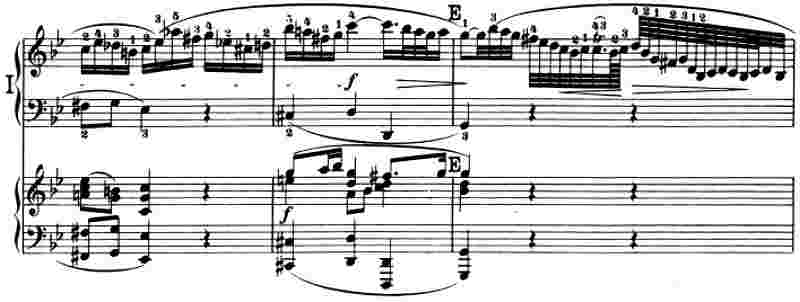
 Bach Concerto in D minor, Adagio, mm. 72 – 74, non-Newtonian shear-thinning between harpsichord r.h. and other parts
Here is a spreadsheet that illustrates some of the complex nonlinear functions that characterize the interrelation of viscosity and shear in a biofluid, human blood. It would be interesting to develop a quantitative theory of ‘viscosity’ in music. I myself do not have the time to do so, but maybe some music theoretician or PhD student will take it up as a dissertation topic. ( Music theory, it seems to me, needs more cross-pollination with other analytical/mathematical disciplines. Bill Sethares is one icon. ) Some links that may be helpful are provided below . . .

Spreadsheet to Calculate Blood Viscosity
 Witten book

 Comsol fluid dynamics software, false-color display of flow velocities in channel cross-section


Saturday, April 5, 2008

05 Apr 08

From T-Bone (Letter 3)

T-Bone - A deeply-spiritual and massively-built African-American. A prison gladiator with more stab wounds than Julius Caesar. A good man to have on your side.

3-26-08
4:01 PM

Hey,

What’s going on over there in merry old England?

Me, I am doing great. I am counting down now because next year I am out of here, and hopefully I’ll be able to visit you over there across the pond, or north in the B.C., you’d love Vancouver, Jon!

Before I go on, it’s good to hear that you have a good lady to hang with. Also it’s cool to know that you are doing a lot of writing and spending time with your loved ones.

Hey man, slow down on the pints or any other spirits, because you are too strong for that junk, meaning it will lead to other things eventually. It might start with weird sex, and then drugs once you become used to that feeling. That’s why we watch who we hang with and what they’re into. I’m not sorry for talking to you like that because I wouldn’t be a friend if I didn’t tell you to be careful with the pubs and all the coke that is everywhere nowadays!

Check this out Jon, when I was running around in my coke days, or like the brothers call it “yayo,” I ran into all kinds of people who did all kinds of things and some of the money they made went places to hurt people. Do you her me Brother!!!? No matter how cool it may seem it will only lead to the police, prison or death! That’s real man, and you need to keep yourself away from anyone that is associated with drugs in any way because it is wrong and dangerous – period.

Hey, I’ve completed all the requirements to receive my certificate from Pima Community College. Here are my grades and man does it feel good because like you I spend my time doing something that is positive and good. I could very easily take things from the lesser guys here or people in general but that will make me like them. I’ve risen above the bull-___! You know there are always going to be ups and downs in life but it is our choices that make or break us, and you know that within minutes of leaving this place I can get anything, from drugs to ______! But I won’t ever do that unless I have to save a life. There’s an old saying of the Tuaregs that started hundreds of years ago in North Africa in the desert, and it goes something like this: “There is nothing worth one day of freedom.” They said that because someone was trying to take their land. It happened again in the 60s when there was oil found all over the region. They simply told them that no matter what they offered them or did to them they would never give up their land because there is nothing worth one day of freedom. Remember that when the temptation to do dirt or drugs comes over you!

Years ago I was on a yard doing hard time having all the fellas look up to me, thinking I was something because I had the dope sack. I had anything I wanted, money, women to come see me, talking to them on the phone. I had the cops scared of me and I thought I was cool, you know, one bad ass dude. I found out that it was only my flunkies putting that stuff in my head for the dope. Anyways I was walking around during count, getting blow jobs from a couple of ladies in uniform, working out to impress, and I got away with all that because I had the dope sack! Now, Jon, you must realise that you are a good man and your potential is unlimited. So do not allow yourself to be lowered to the level of a dope!

It’s all a matter of choice and the wrong choices got you in prison my friend! But then again we wouldn’t have met if you hadn’t of come? I personally believe that we would of met regardless of circumstances. Remember this as well, we are judged by the company that we keep.

Brother I hope you are doing OK and that you realize I do care about you because you’re my friend. Say hello to your parents and spend time with them because Brother, only strength can do what they’ve done. Don’t forget to write back! Say Hi to Posh Bird, and

BE CAREFUL BROTHER

Peace to you and yours

Strength and Honor

Each one Teach one!

Yours

T-Bone


Email comments to writeinside@hotmail.com or post them below

Copyright © 2007-2008 Shaun P. Attwood

Ornamentation, Paradox and Temporality in Bach’s BWV 1052

 Akamus
E  very composer ... is entitled to ... [prescribe] a correct method according to his intentions, and thus to watch over the preservation of his own honor.”
  —  Abraham Birnbaum, quoted in Wolff et al., 1998 pp. 346-7.
I  n his transcriptions, Bach never proceeded in a mechanical way; rather, he strove to give the arrangement an identity of its own by subjecting the model to further development and exhausting its potential. This often involved the addition of fresh contrapuntal parts, the alteration of detail and structural modification.”
  —  Christoph Wolff.
Akademie für Alte Musik Berlin (Akamus) performs this evening in Kansas City. Among the works on the program is Bach’s D minor Concerto, BWV 1052.

There are all sorts of reasons for creating a transcription. Paying homage to the predecessor is one motive. Accomodating a particular instrumentation that happens to be available is another. Amplifying or extemporizing on historical themes is yet another. But in this piece one thing that strikes me is the focus on the personality—the personhood, the subjectivity, the existential situation—of the performers.

 J.A. Bach’s pedagogical table of ornaments, for his son, J.S.
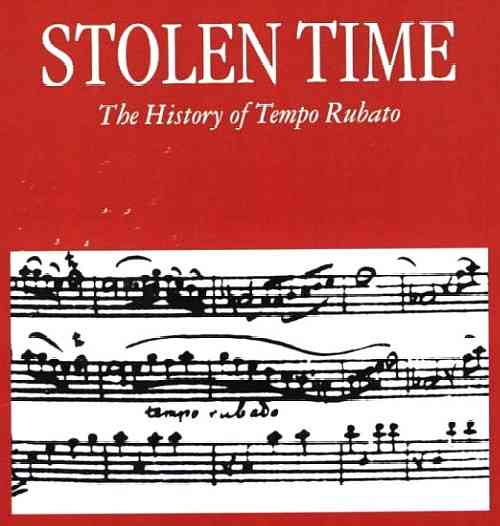
Agogic stresses (altered durations) and ‘stolen time’ are a way to create spontaneity. The appoggiaturas and anticipations steal time from the elements that they precede. And the improvisatory character of appoggiaturas alludes to individualism and ephemerality, as Richard Hudson says in his book, ‘Stolen Time’. Even the fingers’ dwelling on notes before releasing them borrows time, steals time.

 BWV 1052 II, Badura-Skoda, p. 408
Baroque experts maintain that ornamentation was just considered an aspect of the expression of the music, left properly to the performer’s discretion. That is, in general baroque composers weren’t obsessive about notating these embellishments explicitly—on account of the common musical language, a more homogeneous performance practice than existed before or since. Is BWV 1052 different from other baroque works in this regard?

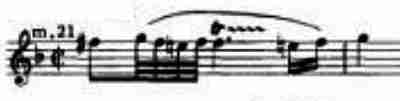
 BWV 1052 II, m. 21
Well, maybe. To me, there is in BWV 1052 a latitude for the anticipations that is especially large, and the notation provides no special clue to this. The anticipations in BWV 1052 can be played shorter than indicated or they can be played longer, without the risk of sentimentality or cliché that other pieces have. There’s a broad latitude, too, as to whether an anticipation can be slurred from the main note of the trill. There are instances where an anticipation can be both shortened and separated from the trill note by what’s called a ‘silence of anticipation’—détachè. These detachments naturally draw attention to the passage of time—what went before, what comes after, the ‘afterness’ enabled by the passage of a moment’s time. Whitespace.

 Silence of Anticipation
The effect of this latitude is to convey a sense of aloneness—as when one realizes that the constraints that have cramped one’s style have been lifted, but one now has no particular idea of what to do. You have awakened from sleep and are full of energy, but all of your friends are asleep and the shops are all closed. The ‘silences of anticipation’ carry this existential weight. Very D minor.

 BWV 1052 II, mm. 1 - 6
But the melancholy minor key doesn’t mean ‘dour’. For example, just before the final tutti, the two-bar Adagio has a solo cadenza for the keyboardist. It is an interjection of surprise and drama. Each of these things is an enactment of aesthetic imagination on a small temporal scale that draws attention to the discretionary freedom and subjectivity of the performer (and the composer, and the listeners). More than anything, BWV 1052 is a confession of unceasing surprise, insistent upon the human condition’s paradoxical and simultaneous ... desolation? fecundity? correlations discovered and then superceded/supplanted/obliterated? The stealer of time is, in turn, stolen from.

 Bach, BWV 1052, Adagio stealing time
I  n music, speeding up or slowing down does not affect the fundamental structure ... Before each cycle of a rhythm is produced, a preparatory process propagates a rate parameter down through the hierarchy [of timekeepers]. This involves specifying the interval for the timer at one layer in the hierarchy by multiplying the interval in the next higher level by the appropriate fractional constant to achieve the desired ratio between the higher and the lower layer. This multiplicative process introduces overall positive correlations.”
  —  Katinka Ridderbos, Time, p. 97.

 Hudson, Stolen Time book


Wednesday, April 2, 2008

Was Dallapiccola’s Piano Microtonal or Just-Tuned?

 Dallapiccola, Simbolo, mm. 1-4
W  hy are D-sharp, F-sharp, and G-sharp so horrible?”
  —  Anonymous.
M  any recent composers have come to feel that the compromise of Equal Temperament was a mistake. They feel that the musical logic of moving from any key to any other key became a priority at the expense of music’s sonic sensuousness. Equal temperament chords do have a kind of active ‘buzz’ to them—a level of harmonic excitement and intensity. Equal Temperament could be described as the musical equivalent to eating a lot of red meat and watching violent action films. By contrast, Just intonation intervals are much calmer, more passive. You literally have to slow down to listen to them.”
  —  Kyle Gann.
After my recent CMT blog post on Dallapiccola’s ‘Quaderno di Annalibera’ I have continued to explore these pieces, especially ‘Simbolo’. The dissonances in them are peculiar, unsettling. And the consonances in them are also peculiar—unsettling in their ‘tentativeness’, a quality that’s hard to put your finger on.

I revisited the late David Lewin’s excellent analysis of Quaderno, in hopes of finding a persuasive explanation of these pieces’ effects on me. But, rather than feeling convinced or reassured, I instead began to feel that Lewin’s erudite analysis may manifest certain ‘assumptions’ that were not acknowledged, namely, the assumption that Dallapiccola’s piano was tuned in the standard, modern way—with Equal Temperament (ET). Lewin’s analysis presumes that the piano was equal-tempered. It’s a natural assumption to make, but is it necessarily true? After all, Quaderno was composed during a period that was for Dallapiccola full of intensive exploring and discovery.

How would the tensions and dramatic consonances and dissonances in Quaderno work if the instrument had been tuned in Just Intonation (JI), I wondered? To find out, I downloaded a script to my MIDI keyboard / synthesizer, to change it to JI tuning.

The result was fascinating. The effective tonal dissonance is markedly different when Simbolo is played in JI tension structure instead of ET. In fact, Dallapiccola’s choice of register for the several lines or voices seems especially congenial in JI. The consonances in JI generally fall in Dallapiccola’s relatively long passages and very often dwell on long, now only mildly dissonant stases. In ET, the consonances are transient, and the stases are pretty strongly dissonant. ‘Violent’, to use Gann’s phrase. In my opinion, the contemplative quality of Dallapiccola’s Quadernos di Annalibera is far better in Just Intonation than in Equal Temperament. The JI has a primitive, crunchy-but-laconic, ‘communitarian’ feel. By contrast, the spectra and timbre of the ET—for the intervals in Simbolo, say—are, to my ear, too urgent.

In ET, it’s hard to keep Simbolo from sounding hurried, judgmental, aspiring, and self-referential. In JI, however, Simbolo exhorts the listener (and the pianist) to a zen-like composure, a stop-and-smell-the-roses alertness, a non-judgmental satisfaction with what one has. The former matches what we know of Dallapiccola’s politics; the latter matches what a father (Luigi) might reasonably express to his young daughter (Annalibera).

Modern composers using Just Temperament include Carola Anderson, Bill Alves, David Canright, Jon Catler, John Chalmers, David Doty, Tom Doughterty, Dean Drummond, Dudley Duncan, Adriaan Fokker, Glenn Frantz, Kyle Gann, Denny Genovese, Philip Glass, Eivind Groven, Lou Harrison and Michael Harrison, Norman Henry, Ralph Hill, Jim Horton, Ben Johnston, Joan LaBarbara, Anne LeBaron, Janis Mattox, David Mitros, Norbert Oldani, Harry Partch, P.Q. Phan, Larry Polansky, James Pugiliese, Robert Rich, Eric Ridgway, Terry Riley, Gino Robair, Daniel Schmidt, Carter Scholz, Bill Sethares, Jules Siegel, James Tenney, Toby Twining, Erling Wold, and La Monte Young.

But, so far as I can tell, there’s no documentation that Luigi Dallapiccola used JI when composing Quaderno. Nonetheless, the emotionally coherent effect that JI imparts to these pieces makes the JI conjecture at least plausible.

We have no way of knowing in mm. 2-3 whether the G-flat—A-flat—D is an order-segment of an emerging tone-row. We don’t know in ET, and we don’t know in JI. So we don’t hear the trichord { G-flat, A-flat, D } in mm. 2-3 as yet bound to an intervallic ‘context’ when we hear { G, D-flat, F } in m. 4. We are only ‘situated’ in-context later on. And yet… and yet in JI the ‘context’ looms in a more immediate, more rapidly apprehended, more hospitable and inviting way.

The sense of tension in this music is, I suggest, fundamentally linked to the temperament (and its timbre and spectrum, to use Sethares’s language) in which the music is played. The JI tuning is far less tense overall. Most of the tritones in Simbolo are less disturbing in JI than they are in ET. Often these JI tritones are more consonant than the thirds and the sixths—because of the particular positions of the intervals [see spreadsheet, below] used in Simbolo. (But, conversely, in JI some of the Major sixths are off by a whopping 32 cents. Even some of the Perfect fifths are as much as 24 cents out of tune.)

In other words, JI neutralizes some of the tensions that were present when the pieces that comprise Quaderno are performed in ET and simultaneously gives wolfish dissonances in intervals that would otherwise be warm and consonant. Rather than feeling disoriented, we are oriented in new and dramatically different ways. It is as though I am hearing Simbolo for the first time—and maybe understanding it for the first time? Did David Lewin ever think about this?

Dallapiccola, Simbolo, mm. 31-35
Lewin once wrote that the marking ‘oscuro’ in m. 33 is a hint that ‘something large’ should happen in mm. 34-36: a tone-row might appear; a new configuration may appear, or a new variation; or the piece may just end (which it does, soon afterward). Lewin maintained that the enigmatic effect of the writing here is not just due to a ‘stimmung’ but rather is due to an ‘incompleteness’—a withdrawing or withholding of the hoped-for tone-row.

Instead, I now think it plausible that Simbolo may have been intended to be played on a JI-tuned piano. Why? In part, I think this because then nothing ‘large’ is expected and frustrated in mm. 34-36; nothing so red-meatlike happens earlier in the piece as occurs in ET. Some of the gestural ‘questions’ and ‘problems’ that Lewin worries about are, in JI, not so puzzling or enigmatic. Instead, in JI we get the calm equanimity that Kyle Gann alludes to. It is a seductive conceit. It may be right or it may be wrong. But based on these little MIDI keyboard experiments it is now intriguing enough to make me want to look for evidence, talk to Annalibera.

And, while JI may be the best possibility, it is not necessarily the only alternative. For example, I think I will also try the temperament put forward by Giuseppe Zarlino, the Maetre de Chapelle of San Marco in Venice. In 1560 Zarlino proposed inverting the Major and Minor tones of the upper group in Aristoxenus’s classical scale. This gave him these intervals:

CDEFGABC 
0  20438649870288410881200 cents

He then reduced every fifth by 2/7ths of a comma to minimize the comma between the rest of the intervals. This was basically a Meantone (MT) temperament. The MT scheme redistributes the intervals such that the principal ones, such as fourths and fifths are uniformly near-perfect in most keys and other intervals are re-tuned so that they still fulfill their traditional intervallic role within the scale. The most common way of doing this involves flatting the first four fifths (C-G, G-D, D-A, and A-E), reducing them enough to give a true third.

This also eliminates the difference between the Major and Minor tones, producing a ‘Mean’ whole tone between the two, hence, the MT name. The major thirds and the minor sixths are then true, but most of the fifths are slightly flat. It enabled safe modulation from key to key but it left problematic intervals like the fifth G#-D# (viz, the Anonymous remark at the top of this post). The interval’s way too sharp, and its inversion (the perfect fourth) is severely flat.

This is known historically as a wolf tone, so called because the effect is like howling of wolves. There are other wolf tones, but this one is the worst. Apart from readability, the wolf tones are one reason why composers historically have tended to avoid using keys with a large number of sharps or flats.

Here is a spreadsheet you can download by clicking on the screenshot. The spreadsheet enables you to see the sensitivity of deviations from ET to scale position, for JI and for a variety of other historical temperaments, including Zarlino.


Spreadsheet with Temperaments and Intervals calculated

Interestingly, Mozart avoided C# (D-flat), F# (G-flat), G# (A-flat), and B Major. Correspondingly, he also avoided A# (D-flat) minor, D# (E-flat) minor, F minor, and G# (A-flat) minor, respectively. These keys display prominent wolf tones. Mozart also avoided F# (G-flat) minor and B minor. The latter is odd when you consider that one of his favorite keys was the relative D Major. And if you totalize across the various historical temperaments, both D Major and B minor are about as ‘wolfish’ as the more famously wolfish keys.

MajorMinor
C-sharp (D-flat)A-sharp (B-flat)
D-sharp (E-flat)C
F-sharp (G-flat)D-sharp (E-flat)
G-sharp (A-flat)F
A-sharp (B-flat)G
BG-sharp (A-flat)

Here is a spreadsheet you can download by clicking on the screenshot.


Spreadsheet tabulating Mozart keyboards works’ keys

I think I should take an inventory of Dallapiccola’s works, to see what patterns appear and to see whether any of it sheds light on the Quaderno, either corroborating or discorroborating the ideas about JI vs. ET. I’d be very grateful for comments from any of you Dallapiccola scholars out there ...


02 Apr 08

From Weird Al (Letter 2)

Weird Al - The most unlikely bank robber you are ever likely to meet. His true story of suicide by cop gives new meaning to the power of unchecked depression. His cutting wit would make a stoic monk giggle.

March 7, 2008

Dear Bloke,

You are of course correct in your letter when you proffer, “A letter from you would be more than I deserve.” Well said.
Nonetheless, I put pen to paper in an effort to show magnanimity and to maintain cordial relations with you war-mongering Brits.
Truthfully, I’d have written sooner but I’ve been swamped with legal work. Like venomous lava, legal sarcasms have been flowing forth from me at the rate of two-thousand gallons per hour.

Some Thoughts

Your seemingly prolonged presence on the dole is depressingly depraved. It must end.
My fellow countrymen and I want you to be aware of the fact that we hold you singularly responsible for our rapidly collapsing economy, the high price of gas, and our current housing-market meltdown.
In an effort to end this misguided charitable travesty, and to properly castigate you, I will shortly be contacting my dear friend/homeboy Jack Straw, the U.K. Justice Secretary, and request you be unceremoniously tossed into a Northumberland debtors prison where you will be waterboarded until you are both compliant and employable. Pack your bags!

On Prison Dorm Living

Sadly, in the mother of all understatements, I can not wholeheartedly recommend prison dorm living. Like a supermarket chicken stuffed full of campylobacter (look it up bloke! Too lazy? Okay, I’ll help. It’s an antibiotic-resistant germ responsible for 2 million cases of diarrhea per year – also about 120 deaths per year), it should be avoided whenever possible.
I pine for my previous single-cell living arrangements like a ten-dollar whore yearns for the ever-illusive hundred-dollar John.
There are only three toilet stalls for 40 prisoners, most of whom share, like kindred brothers, a propensity for long loud multiple movements per day.
Also, the huge amounts of secondhand smoke I am being forced to ingest into my frail, waiflike body at the rate of approximately one ton per hour is making me dangerously homicidal. I will likely be the first nonsmoker to be released from prison with a four-pack-a-day habit and expect to go into violent nicotine withdrawals moments after I’m released.

Krakatau Commode

The center toilet stall, my current favorite, also does double duty as a poor man’s bidet.
Due to some as of yet undiagnosed plumbing problem, the very second I flush, water springs upward onto and into my nether regions as I sit smiling, pleasantly perched on the porcelain throne.
This aberration provides all willing participants the opportunity to both take care of one’s business and be gifted with a high colonic at the same time, however redundant that might seem.
Like ones first sexual encounter, while often not the best, my premier trip to this volcanic toilet will forever be tattooed upon my brain. It’s one of those life-changing moments, not to be missed.
You might gleefully imagine my open-mouthed astonishment when upon first flush a somewhat unwanted, not to mention unexpected, blast of tepid toilet water shot upward like a rocket headed for Mars. It ascended rapidly through my colon, bounced off my spleen, and lodged itself, where it’s now found a new home, nestled snugly next to my left lung.

Politics

You’ll be pleased to learn that our beloved President Bush’s approval rating has cascaded upward to that of a bubonic-laden rat.

On Speaking To Youth

You mentioned you were asked to speak with young people about the possible dangers of drugs. Do so. Good karma.
Tell them this: The trouble with trouble is it starts out as fun. This is true with many forms of trouble, but markedly accurate when applied to drug use. This fact often blinds early drug users as to what lies waiting for them. Also tell them, “No” is a complete sentence, “Yes” is not.

Your Writing

Like many of your famous Irish bretheren to the West, I suggest you esconce yourself in a nearby pub and begin to drink heavily.
In that way you can become a drinker with a writing problem as opposed to the opposite.
Seriously, remember these two things: (1) I doubt there’s anything you’ve ever been successful at that you didn’t work on every day. (2) Good luck and hard work seem to follow each other around.

How I Avoided The Plague

Using my formidable clairvoyant powers to sense the oncoming epidemic which swept through my prison dorm like a nasty fart, I quickly changed my diet to nothing but barbecue potato chips and buttered popcorn, an ancient yet still effective curative for these type of things.
In all actuality, I began several months prior to the prison plague to cajole, beg, and threaten prison medical personnel for a flu shot. The less brainy here failed to do so. They were otherwise occupied.

On Kat’s Family Jewels

Your fallacious, aberrant interest in Kat’s genitals notwithstanding, her/his testicles, both of them, send their exuberant best wishes. As Mark Twain once said when told of a newspaper article stating he had died, “Rumors of my death have been greatly exaggerated.”

On Weird Al’s Pending Release

My unjust banishment to this malodorous noisome dorm is almost at an end. In anticipation of my triumphant return to humankind I have rented an apartment here in Tucson and sent out thousands of engraved invitations to my many female fans worldwide who fervently desire to help end my state sponsored chastity by deflowering me once again in a vigorous yet somewhat respectful manner which befits someone of my stature. Unfortunately, since my new place is not yet furnished, I am respectfully requesting each of the many applicants to come with a mattress strapped to their lovely back.
My alternative plan is to have a three-topping pizza delivered, eat the entire thing singlehandedly, and take a long quiet nap.
More on this later.

Love,

Weird Al


Email comments to writeinside@hotmail.com or post them below

Copyright © 2007-2008 Shaun P. Attwood