Wednesday, June 20, 2007

Bagby’s Beowulf: Musicological Sci-Fi, or Sound Historiography?

Bagby, Beowulf
CMT: Benjamin Bagby is a singer, composer, harpist, and renowned performer of medieval music. Educated at Oberlin and the Schola Cantorum in Basel, Bagby co-founded the ensemble Sequentia with Barbara Thornton in 1977. This group takes an innovative approach to medieval repertoires. Sequentia has released many fine recordings, of course. During the 1990s, the group specialized in the music of Hildegard von Bingen. Bagby’s new 2007 DVD performance of Beowulf is truly groundbreaking.

DSM: We were all sorry that illness prevented Benjamin Bagby’s travel to participate with Sequentia in the Boston Early Music Festival last week. I agree – this new DVD of his is phenomenal!

Benjamin Bagby
CMT: Although the Beowulf story does not take place in the future, and although the surviving Beowulf text is one of the foundations of Old English literature, I think this Beowulf production might qualify as science fiction (or perhaps speculative fiction would be more accurate) because at the heart of the performance lies the question “What if...?”

DSM: Only in this case, instead of a question like “What if we had faster-than-light travel?” all the questions revolve around alternative historical events.

CMT: What if Beowulf’s people had colonized Europe? As in science fiction, questions can be the seeds from which Bagby extrapolates a future and a wild narrative.

DSM: So, in the epic poem, Beowulf battles three antagonists: Grendel, who’s destroying Heorot and its inhabitants in Denmark; Grendel’s mother; and, later in life (after he’s King) ,the dragon. He’s mortally wounded in the final battle with the dragon. The dragon’ll get you every time.
Beowulf
CMT: The novel presence of an enemy in Beowulf’s territory was elevated into a major grievance that eventually is the undoing of Beowulf. It’s not obvious that it need have been elevated to such prominence, nor is it obvious that the outcome need have been what it was—with Beowulf dying, that is.

DSM: This Bagby DVD production opens our minds to alternative outcomes, and to the possibility that Beowulf contemplated these in advance of his historic conflict. The suspense and the angst that Beowulf probably felt are brought to life convincingly in this production.

CMT: The minimal presence of Beowulf’s warriors is maybe non-controversial. They attempted to stay out of politics. They didn’t interfere in colonial elections. Only with reluctance did they take on police roles, to establish civil order. They didn’t engage in nation-building or other hubristic adventures.

DSM: The flashpoints, the moments of Beowulf’s friction with the civilian population, were few.

CMT: The word ‘history’ is usually simplistically understood to mean a “rigorously” accurate account of past events. Yet the writing of history inherently depends on differing values-laden assumptions and inevitably leads to differing interpretations of events and processes.

DSM: But what the heck is ‘rigor’. It’s in the eye of the beholder! The phrase ‘alternative histories’ is itself a ‘loaded’ and ‘dismissive’ one in that it implies that there’s just one validated, bona fide history that has standing, to which all other accounts have secondary, inferior or dissenting status.

CMT: Yes, who decides what’s bona fide and conventional? Who decides what’s canonical? If I don’t accept the assumptions of convention, if I don’t subscribe to its interpretations, is my nonconformity grounds for censorship?

DSM: And if my heresy and wishful thinking are so radical and self-absorbed and refractory to evidence and reason, am I not backhandedly asking to be rejected by sane society and its norms?

CMT: While counterfactual questions are a routine part of how we learn as individuals (“What if I’d obeyed the speed limit?”), there remains a great deal of resistance—even hostility—to such musings among professional historians. In the dismissive phrase of E.H. Carr, ‘counterfactual’ history is a mere parlor game, a red herring. E.P. Thompson is even less charitable, calling counterfactual histories “Geschichtswissenschlopff, unhistorical shit.” And ‘Secret’-type mystical questions like “Was my speeding ticket predestined, or the fruit of my negative thoughts about Paris Hilton?” are way below that, totally off the conceptual shit-scale.

DSM: In fact, the answers to counterfactual questions can’t really be considered on their historical merits, because the evidence is so scanty. But if a certain highly conservative historian/musicologist elite arrogate to themselves the right to specify what criteria shall be used to determine the sufficiency of evidence, then that elite effectively serves as a censor and suppresses dialogue. Ah, but then there’s your ‘speculative fiction’—that catch-all category first used by science fiction writer Robert Heinlein in 1947. Not even trying to be history.

CMT: But virtual or speculative historiography can be honest. It doesn’t have to slide into speculative fiction or sci-fi. Speculative historiography can be valuable and illuminating, provided that it discloses its assumptions alongside its evidence. Yes, the First World academy tends to run roughshod over Third World and non-Western historians and archaeologists. Think about China! Musicology in China is hot now, a far cry from what it was 20 years ago. Enhancing the diversity and textures of historical analyses and narratives we create about other cultures by incorporating and honoring the richness of local histories matters! It’s essential for us to discover concerns and expose assumptions that have become entrenched in our Western canon. Archaeology and musicology are, after all, more than a set of practices and techniques. They’re historical social sciences that relate the study of past societies to the present and incorporate the historical value of oral and other non-written accounts, as well as the written record.

DSM: Without doubt, there are peripheral, marginal, and disenfranchised histories that may be as valid as the canonical history that holds sway. And it’s not just the Western canon! Think of the East! Think of the Chinese canon, for example! The work of official state historians under repressive political regimes can effectively erase evidence and suppress parts of the narrative. Speculative or virtual history then becomes a ‘recovery’ operation, to restore threads of the story that have been destroyed. Critical examination of musicological methods has the potential to demystify the practices of archaeology and history as well as to create ideological “space” for the practice of careful archaeology in (re-)constructing alternative histories. Such examination has at least three components: (1) an inquiry into what kinds of empirical evidence are uses and suppressed within the dominant historiography; (2) an analysis of the concepts used in interpretation; and (3) a critique of the power relation between those who have produced and maintained the evidence and those who interpret it and package it for public consumption.

E   verything must have a beginning. And that beginning must be linked to something that went before. The Hindus give the World an elephant to support it. But they make the elephant stand upon a tortoise.”
  —  Mary Shelley, Frankenstein, 1831

CMT: So Beowulf eventually becomes king of his own people. But late in Beowulf’s life, a slave steals a golden cup from a dragon’s lair at Earnaness. When the dragon sees that the cup’s been stolen, it leaves its cave in a rage and torches everything in sight. Beowulf and his warriors come to fight the dragon, but only one of the warriors, a brave young man named Wiglaf, stays to help Beowulf—the rest are too afraid. Beowulf kills the dragon with Wiglaf’s help, but Beowulf dies from the wounds he’s received.

DSM: The Beowulf poem’s purpose is, obviously, unclear. Arguments have been made for a naturalistic mythic allegory, a Christian allegory, a criticism of heroic culture, a mourning for the loss of heroic culture, a Germanic ‘Old Testament’, an allegory concerning contemporary politics in one or other of the Saxon kingdoms – just to mention a few. The title Beowulf itself is an editorial convenience – the manuscript copy of the poem is untitled. We also know almost nothing about Beowulf’s place in English literature in the Anglo-Saxon period – we don’t know what popularity, if any, the poem enjoyed.

CMT: Provenance of the Beowulf manuscript is, you realize, problematic in its own right. The author of Beowulf is totally unknown, as is the exact date of the composition of the poem. In its present form, Beowulf was possibly composed as early as the seventh century or as late as 1025. Beowulf survives in a single manuscript codex in the British Library. This codex is a composite codex assembled in the first half of the 17th century, itself consisting of two Old English codices: the first, the Southwick Codex; the second, the Nowell Codex.

DSM: The Beowulf MS in the Nowell Codes was written around 1000 C.E. by two scribes in late West Saxon (the posh dialect of the period). The first scribe writes in an Anglo-Saxon rounded insular minuscule hand with some carolignian features. The second scribe writes a more conservative Anglo-Saxon square minuscule hand.

CMT: And ‘orality’ affects even the written transmission of poems, you know. The Old English poems known as Cædmon’s Hymn and Bede’s Death Song are two instances of poems recorded in a number of manuscripts appearing over a sizeable span of time. In these multiple copies: (1) we find evidence for high levels of scribe accuracy over long periods of time; and (2) when we do find variation, it generally involves variations of “formulas”. We do sometimes observe significant scribal corruption in these and other poems. But in the cases of formulaic variations, what we see is that a scribe will substitute a semantically equivalent word or formula: “a scribe [may] consciously or unconsciously improve a received text from his own knowledge of the formulaic tradition...which has been described as the result of what is termed as ‘residual orality’ ” (Orchard, p. 117).

DSM: So, in the end, what can be known about a poem in a manuscript like this? What do we know about the circumstances of its composition? Is it literary, oral, or something in-between? What can we never know? To us, Beowulf is both strange and familiar: it has some links with ancient classical poems like Homer’s. Nineteenth century ideas of it have been received and reworked in the course of the 20th century in academe and in popular culture. And yet it remains an ancient artifact of a culture whose world we can never fully or confidently share.

CMT: The manuscript and its editions always present us with a linguistic obstacle: Old English has a different kind of grammar from Modern. Old English is like Latin or Russian, or many other languages whose grammar is expressed by inflection.

DSM: And can we agree that translation of a language removed in kind and in time is a process of exploration—not a neat matching of word and idiom to sense, or the grammar of one language to the grammar of another? What kind of overlap can be found between our written, literary, or DVD experience of the poem, and its earlier “live” oral delivery, which may have been memorized and reconstituted in different ways each time? Memory functions in different and often enhanced modes in oral cultures rather than written cultures, especially when supported by verbal patterns that evolved through centuries in a poetic or sung medium. When such poetry is written down or recorded on a DVD, it’s neither strictly oral nor textual.

A  bove all, (speculative) fiction is about what happens to us when we run into places and situations that just aren’t Kansas.”
  —  C.J. Cherryh, “Where Science is Taking Us”, www.sffworld.com/authors/c/cherryh_cj/interviews/200001.html

CMT: There are comparatively few historical documents to tell us about the period, and even extensive study and analysis of the extant wills, charters, diplomas, laws, and chronicles often lead to sparse results: information about what happens between humans, what values determine actions, and what objects and events are significant seems more readily available through literature. As a result, in addition to the literary scholars and general readers who over the years have absorbed from Anglo-Saxon literature what it expresses as art, archaeologists and historians have for generations turned to editions and translations of such works as Beowulf to discover new perspectives. One example is Simon Keynes’s ‘Diplomas of King Æthelred “the Unready” (978–1016): A Study in Their Use as Historical Evidence’ (Cambridge Univ, 1980). Keynes reassessed “the alleged incompetence of the king and the ineptitude of his military advisors” by studying the more than one hundred royal diplomas preserved from Æthelred’s reign. Keynes’s premise was that the literary sources from the period (most notably the Anglo-Saxon Chronicle) have given us only very negative impressions of Æthelred’s reign—impressions that might be changed if we examined the diplomas collectively. Keynes believes that these diplomas reveal “political developments within the kingdom which are barely hinted at in the literary sources.” So, too, Beowulf inadvertently advises us about politics, even if it wasn’t the author’s intention to do this. Hermeneutics/philology, stood on its head!


Beowulf


30th May 2007

Buggering a Blackberry with a Harley Piston

Circulating on the yard – thanks to Red – was a message from Slope: “Someone needs ta tell the goddam Limey to bugger his blackberry with a Harley piston.” The affront motivated me to go down to Yard 4 to see Slope.
“What’s this about buggering my blackberry with a Harley piston?”
“I wuz just feelin’ all patriotic,"Slope said. Like bashin’ you tea-and-crumpet-eatin’ motherfuckers. What do you guys do with that spotted dick anyways? Eat it or give it a jigger in your palms?”
“I feel the love, Slope.”
“From America with love, goin’ out to all of the spotted-dick-eatin’-fuckin’ weirdoes in the world.”
“What’s up with the Harley piston?”
“Shove it up your ass.”
“Lube or no lube?”
“You guys are crazy enough. You don’t need no fuckin’ lube.”
“Crazy! We of the tea and crumpets are known for being reserved. Americans seem to be a little crazier.”
“If Americans are the crazy ones, why are y’all tryin’ to buy up our motorceeckles, and come over here and live?”
“ 'Cause craziness can be fun.”
“Try and spill some crazy gas on yer thigh, and tell me it’s fun.”
“What are you on about?”
“It’ll give ya a rash. I’ve gotta hand it to the goddam Limeys for the Vincent Black Shadow though – helluva motorceeckle. Held the motorceeckle-land-speed record for forty fuckin’ years.”
“How long have you been down, Slope?”
“Twenty-three years, five months, and nine days.”
“Are you getting short?”
“I got a parole board in eighteen months.”
“If you get parole, you can become the militia man of your dreams.”
“No, 'cause it seems the CIA has a bounty on them now.”
“You could be a domestic terrorist armed with a Harley piston.”
“No 'cause the Homeland Security folks has a bounty on those.”
“I’ve got it.”
“What?”
“You can be an extra in movies like Deliverance.”

Coming soon: Slope threatens my 4th July meal.

Email comments to writeinside@hotmail.com or post them below

Copyright © 2006-2007 Shaun P. Attwood

Tuesday, June 19, 2007

28 May 07

Bon Voyage Balls (Part 2)

I'd heard of transsexuals in prison cutting off their own testes. And today I finally met one of them: Gina, who Xena told us about in Bon Voyage Balls. Gina looks like a woman. He has long black hair down to his waist, black eyeliner tattooed around brown eyes, a beauty mark like Marilyn Monroe’s, B-cup breasts (which may be about to increase in size pending oestrogen therapy), a twenty-six-inch waist, and long nails.

“England,” BHF said, “Meet Gina.”
“The famous Gina!” I said. “Well how do you do?”
“Very well,” Gina said in a convincing female voice. “I need to tell you I’m an Anglophile.”
“So you like all things English.”
“Yes. And your accent is making me feel like I’m talking to G3 in his coronation robes.”
“The pleasure is mutual. You’re quite the legend. Can I ask how you became an Anglophile?”
“Yes. It started with the connection I feel we Yanks have with you across the pond. My history lessons as a child were my first exposure to British royalty. When I first saw a drawing of George the Third in his coronation garb, I was hooked. The crown, the robe - ohh la la!” Gina rolled his eyes.“I knew I was an Anglo at heart, and tracing my family tree revealed that England is the home of my ancestors. Another exposure was when they taught us about the colonies and independence. From the start I’ve loved America, but it’s England that I fell in love with.”
“Back to your story that Xena helped me blog: some of the readers doubted that you did what you did. And I hope you don’t mind me asking, but what motivated you to cut off your balls?”

…to be continued

I’m hoping that readers – especially those who doubted Gina’s story – will post some questions and comments for Gina.

Email comments to writeinside@hotmail.com or post them below

Copyright © 2006-2007 Shaun P. Attwood

Monday, June 18, 2007

Coherent Symphonism: Paul Leenhouts and The Royal Wind Music Recorder Ensemble

Paul Leenhouts
Presentation is the performer’s task, and to divine and interpret to a modern audience the intentions of baroque [and earlier] composers.”
  —  John Mansfield Thomson and Anthony Rowland-Jones, 1995.


  • The Gods’ Flute Heaven
  •  Royal Wind Music, Paul Leenhouts, Director
  •  Boston Early Music Festival, 17-JUN-2007, Jordan Hall, Boston
  • Sweelinck (1562-1621), Est-ce Mars*
  • Susato (1500-1561), Pavane ‘Wenn durch Leiden’*
  • Adriaensen (1550-1604), Almande Prince*
  • Brade (1560-1630), Courante XXIV
  • van Eyck (1590-1657), Amarilli mia bella
  • R. Dowland (1591-1641), Amarilli mia bella*
  • Anon., ‘When Daphne’
  • J. Dowland (1563-1626), Lachrimae Antiquae
  • Anon., ‘En m’en Revenant de Sainct Nicolas’
  • Philador (1647-1730), Bourée d’Avignone
  • van Eyck (1590-1657), Boffons
  • Mainero (1535-1582), Salterello
  • V. Schumann (1520-ca.1559), Vater unser im Himmelreich
  • Steigleder (1593-1635),Vater unser im Himmelreich*
  • Praetorius (1571-1621), Vater unser im Himmelreich*
  • Scheidt (1587-1654), Vater unser im Himmelreich*
  • Bach (1685-1750), Vater unser im Himmelreich*
  • Schuyt (1557-1616), Padovana del secondo modo
  • de Cabezón (1510-1566), Tiento I*
  • de Arauxo (1577-1663), Glosada LXVI sobre la canción de Tomás Crequilion*
  • del Encina (1468-1529), Triste España sub ventura
  • Flecha el Joven (1530-1604), Ay que bino in tierra estrana
  • Lunenberg (1981-), Recercada sobre Mille regretz
  • Desprez (1450/5-1521), Mille regretz, de vous abandonner
  • de Morales (1500-1553), Agnus Dei III de la Misa ‘Mille Regretz’
  • Weck (1495-1536), Spanyoler Tancz*
  • Flecha el Viejo (1481-1553), Ensalada
  • Praetorius (1571-1621), Spagnoletta XXVII*
  • * - arrangement & diminutions by Paul Leenhouts

DSM: Some professional recorder groups provide programs that consist predominantly of arrangements and transcriptions of works originally written for different instruments — possibly because they feel that the baroque recorder repertoire is too limited? But in the case of the Royal Wind Music, Paul Leenhout’s programming makes no such admission. Arrangments are included so as to perfect the orchestration and to better illustrate the timbral range and choral textures of the ensemble.

CMT: We have little written record of these composers’ compositional ideas or techniques, in their surviving correspondence. And relatively few sketches of their compositions have been preserved, so attempts to reconstruct their compositional thought and formal logic must rely on evidence drawn from close analyses of the works themselves. It takes great effort to discover how these composers employed compositional principles to structure their forms; it takes careful scholarship to account for specific details of individual movements as well as the relationships between the movements. But the effort is worth it, and the analyses can have a larger purpose: to fully appreciate that compositions can’t be analyzed in a meaningful manner if the analysis is divorced from the works’ historical contexts.

DSM: And part of ‘context’ is how the acoustical physics of the instruments and the available 16th and 17th century performers’ abilities constrained the writing. We can know something of the former from examining surviving historical instruments. But it’s hard to deduce the latter; hard to do history when the written record is so thin.

CMT: And, of course, social forces and biographical realities are fundamental elements of any historical situation. From their performance, one gets the sense that Leenhouts and his RWM colleagues have a deep understanding of this.

DSM: The insightfulness of their scholarship is clear from the sound that they produce. And all of their arrangements and performances rest on careful analysis. We can ask of their analyses: Does it tell us something that we didn’t know before? Is that ‘something’ a recognizable component in the piece? Does the analysis account for anomalies in the composition? Does the analysis provide a rationale or justification for what we understand and feel about the piece? Listening to this concert, the answers are emphatically “Yes!” to these questions.

CMT: Think, too, about the orchestration of these pieces. These 12 recorder voices—I would say they correspond almost literally to an organist’s 10 fingers and two feet. Beyond recorder literature-proper, RWM performs arrangements that closely reproduce some of the organ repertoire, except with more independent motion and cadential structure than one human being could execute at one time. Besides instrumental works, a recorder choir like this may also perform arrangements of vocal literature.

DSM: In the opening measures of Robert Dowland’s Amarilli mia Bella there are successive statements of a melodic motive that foreshadows and then later accompanies the arc of the piece. This motive emerges from silence, swells through the bass recorders, ascends into the tenor and alto recorders, and then sinks into the stillness from which it came. Although our first inclination is to regard these various statements as “the same”, there are actually some expressive differences among them. The change in instrumentation contrasts with the distinct timbral quality that the motive has in the opening measures. There’s a diversity in the pitches through which successive statements are given voice. And, although there’re similarities in the rhythmic figuration used for the recurring statements, there’s a latitude of duration and accentuation to all of them as well. In sectional playing, one of the most important things is to try to achieve and maintain a common tone within the section. This can be difficult due to different levels of playing skill and different acoustical qualities, especially in the tenor and bass recorders. It’s important in sectional playing to come together in agreement on how the tone should be presented in the ensemble. RWM does this consistently.

CMT: To understand this music — to make sense of the sonic textures — requires us to be able to integrate these phrases into a coherent idea and hold that idea and turn it round and round in our minds.

DSM: Yes. There’s a contemplative, meditative aspect to many of these pieces, and that’s consistent with the process of conceptual integration and round-and-round reflection that you’re alluding to. It’s partly why applauding after these pieces seems to do violence to them — applauding obliterates our zen-like state, abruptly ending the reflection. The rhythmic contour is destroyed by applause.

CMT: I think that the motives in these pieces hang together not simply because their constituent parts are connected in time but because the connections emphasize similarities to other motives. So the musical coherence that we perceive reflects the attributes of whole collections of motives. The coherence isn’t a property of any one motive in isolation. These are sentences and paragraphs. This whole 2-hour concert that Royal Wind Music performed for us was something like a book-length anthology or novella, don’t you think? And, although skill in evoking coherence does matter to the composer or arranger, our apprehending coherence in these pieces fundamentally depends upon the performers’ incarnating that coherence.

The substance of ‘symphonism’ will make itself felt in the stratification of the qualitative element of diversity and the novelty of perception within the limits of the increase of sound, but not in confirming the conditions tested earlier. Therefore, diversity in unity — the emergence of new intonations with new significations and meanings — forms the substance of symphonism.”
  —  Asaf'ev, O Simfonizme, 1921, quoted in Tarasti, Musical Signification, p. 147.


DSM: In that regard, these pieces have what I would say is an ‘orchestral’ or ‘symphonic’ texture, a mass of sound, with RWM’s individual players’ egos mostly sublimated to serve the aims of the section or the orchestra as a whole. It’s almost homophonic, but the coherence isn’t ‘coerced’. There are ‘free’ exchanges between the sections of recorders in different registers. And there are the contrapuntal lines assigned to specific voices within the sections. But these are not individualistic dialogues like the ones we find in chamber music. It feels like the expression of one unified organism. The effect is orchestral or ‘organ-like’—which I suppose is fitting, considering the shapes of the recorders and the similarities that they bear to pipe organ pipes; in terms of the means of sound production and the geometry of their air columns and apertures; and so on. The voicing and balancing of melodies and inner voices are also organ-like and contribute to the coherence of the overall effect. But RWM’s performance is organ-like in another way. The effect is unified, as though there were one consciousness behind it, just as there is one organist seated at an organ. The coherence between RWM’s members is very high. But it is a happy, enthused, ‘assenting’ sublimation by the various members. You can see it in their body language—as they play, and as they search for the proper recorder in the rack-like stands and mats on the floor in between pieces. Each one joyfully relinquishes her/his individual diversity, for the duration of the performance.

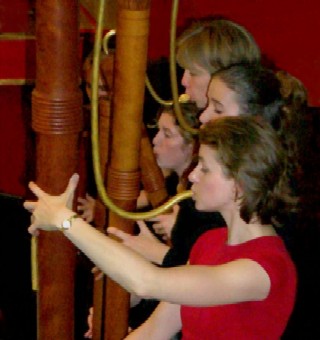
Royal Wind Music Bass Section
CMT: Symphonic, orchestral playing may sublimate individual egos and pre-judgments to a degree, yes. But, still, aren’t those egos and pre-judgments nonetheless necessary for a vibrant, meaningful, ‘whole’ performance? Gadamer, for example, once showed that our pre-judgments or prejudices are necessary and even desirable — a precondition for our understanding and communicating. New texts have to collide with meanings and ideas we already have, for new meaning to be produced. Dialogue and comprehension don’t occur if we merely suspend our ideas and passively accept another idea; they occur by a collision of ideas, our own and those expressed in the music.

DSM: Well, there’s clearly room for the individual, even in a symphony of recorders, with their sine-wave, flute-like timbres—so compliant and self-effacing as these instruments’ sounds are. The voices of the recorders in RWM are, I think, like ‘solute’ molecules that dissolve into a solvent, where the ‘solvent’ is the symphonic composite of all of the voices together. And you might say there is a ‘cratic’ entropy of acoustical mixing, much in the way that physical chemists speak of ‘cratic entropy’ of liquid and gaseous solutions. In ensemble performance, if the voices are the same ‘size’ and the interactions between them are identical, then the ‘entropy change’ for forming the ‘mixture’ (symphony) is smaller than it is if the voices are of different sizes, or have dramatically disparate energetics, or engage in dramatically different interactions. In this statistical mechanics analogy, some of the ‘particle’ differences (or lack thereof) inhere in the instruments themselves, and other of the differences (or lack thereof) are in the individual performers who play those instruments. The ‘particle’ is simply the voice that results from the ‘composite’: the player, plus the instrument, plus the text that the player executes. The tenor and bass recorders have inherently dark tones, while the alto and higher recorders are brighter, because of their geometry and acoustical physics. But the ‘player-plus-instrument-plus-text’ combinations that RWM represents have a much lower ‘cratic entropy’ than your typical ensemble . . .

CMT: That’s an interesting and novel notion—applying statistical mechanics concepts to sonic textures, treating polyphony as a physical mixing process—quantitatively accounting for musical textures in terms of ‘particle’ properties and energetics, as one would do in thermodynamics. Quite an exotic analogy. But, coming back down to earth, how can communication occur if the historical conditions separating us from these old texts are so wide as to preclude much of any common language or common base of ideas, between us and the composer? We’re talking not only of the player-particles’ submitting to a collective superego under the Leenhouts’ direction, but also of our own submission, aren’t we? Are we listeners not all sentient “particles” too—all of us endowed with somewhat different ‘sizes’, different ‘energetics’, different ‘interactions’?

DSM: I think so. And the answer emerges when we realize that our contextuality consists of more than just ‘fixed’, static, ‘horizontal’ cultural positions. There are also ‘vertical’ cultural contexts. Gadamer talks about synchronic and diachronic positions. Diachronic relationships are what we call ‘tradition’. Gadamer in fact tries hard to legitimize the concept of tradition. He says that our position in history entails our deliberate participation in evolving and creating traditions. A tradition is not merely a passive accumulation of artifacts; it’s something we cultivate actively. We produce it and further determine what it will become, regardless what it was that we’ve received. Tradition isn’t a permanent precondition that constrains us. It’s the awareness of historical conditions that influence our present understanding. Gadamer calls this the ‘wirkungsgeschichtliches Bewusstsein’, or ‘consciousness-of-being-affected-by-history.’ Gadamer sees interpretation as a single process, one that’s coextensive with understanding. It’s never achieved by subjectifying a text, but rather by ongoing societal mediation and interactions with each of us.

CMT: That sounds more mystical than sensible. How can we possibly ‘engage’ a musical text in conversation? In what sense can we ‘converse’ with a composer who’s long dead?

DSM: Well, a solution becomes plausible when we understand that ‘interaction’ in the hermeneutic sense is a bigger concept than the narrow linguistic activity we normally think of. A dialogue begins with the recognition that there’s another voice ‘out there’ (in the guise of a score or musical text). We try to reconstruct the thick ‘cultural web’ in which the text originated — to discover the questions and problems to which it served as an answer in its own time, and to discover the nuances of language and rhetoric that the text ‘pinged’ in its original community. We become receptive to new meanings by projecting ourselves against an historical ‘horizon’. None of this diminishes the role of the individual performer or listener. None of this reduces the range of textural ambiguity or timbral ambiguity that a performance may contain. What is striking about a homogeneous instrumentation such as RWM represents—what is striking about Paul Leenhouts’ conception of this music—is the very low amount of textural and timbral ambiguity in their performance. The distinctive meanings that RWM conveys are largely a consequence of their unique homogeneity in poetically rendering and coupling the motivic material in this repertoire; a consequence of their ‘cratic’ mixing of similar voices of recorders across the plurality of registers; and a consequence of the RWM members’ superb and consistent, shared vision of the historical horizon that’s pertinent to each composition. A beautiful and extraordinary kind of historical coherence is what RWM delivers! Kudos to Paul Leenhouts! Without someone of great vision, great ears, great interpretations, and great depth like his, you could have the greatest musicians on the earth and you wouldn’t achieve a great orchestral effect like this. We in the audience witness the inspired fascination that the created musical object exerts upon its creators. We experience a beauty compelling enough to cause RWM’s members to set aside their own individuality in service of this transcendent collective creation. What musicianship! What drama!

M otive is at any one time the smallest part of a piece or section of a piece that, despite change and variation, is recognizable as present throughout.”
  —  Arnold Schoenberg, The Musical Idea, in Carpenter & Neff, p. 169.


Royal Wind Music


26 May 07

Two Tonys on the Philosophy of Simone de Beauvoir

“Whattaya readin’?” Two Tonys asked.
“The Ethics of Ambiguity,” I said, “by Simone de Beauvoir.”
“Whothafuck's she?”
“She was an author and feminist existentialist philosopher. Her and Jean-Paul Sartre had an open relationship. When nihilists claimed life is meaningless, de Beauvoir responded that it is up to us to put meaning into our lives. I like that idea. It puts the meaning of my life in my hands. She also wrote The Second Sex.”
“Of course we hafta put meanin’ into our own fuckin’ lives, 'cause each and every one of us values different things. What is important to you isn’t important and meaningful to an ant. Findin’ a grasshopper’s leg and draggin’ it down a hole in the ground may be meaningful to an ant. Winnin’ an Academy Award may be meaningful to Dustin Hoffman. And I’m fuckin’ sure that developin’ the polio vaccine put meanin’ in Salk’s life."
“That’s exactly right. Just like talking to you and writing up blogs are ways I put meaning into my life. De Beauvoir had some other interesting ideas and quotes I’d like to run by you.”
“OK.”
“She wrote about women who mindlessly adopt the opinions and values of their husbands.”
“For thousands of years women were treated as fuckin’ prisoners. It’s thanks to women’s lib that durin’ the past two-hundred years women have been encouraged to think for themselves. All of the major religions – Christianity, Islam, and the Jews – claim God is a man, recruit men to be their top dogs, and have treated women as second-class citizens or worse for centuries.”
“Saint Ambrose claimed it was the feminine instability of Eve that caused Adam to sin,” I said. “And one of the Pope Leo's said the husband is the head of the wife who by nature is fitted for housework.”
“It’s been the same on all continents. The bottom line is: we’ve all gotta think for our fuckin’ selves. Look at how many dumb motherfuckin’ men there are in this world.”
“De Beavoir also claimed that ignorance and error are facts as inescapable as prison walls.”
“Ignorance and error are different from plain dumbness. The fucks who voted for Bush are plain dumb. But who hasn’t made mistakes? Have you ever been ignorant?”
“Yeah,” I said.
“Has your dad at some point in his life been ignorant?”
“Yeah.”
“Exactly. My point is: we all get a little ignorant from time to time.”
“What do you think about de Beauvoir writing that life imprisonment is the most horrible of punishments because it preserves your existence while preventing you from doing what you’d most like to be doing?”
“De Beauvoir is fulla shit on that one. What about the motherfucker workin’ for Intel in his cubicle? How’s life imprisonment worse than bein’ a corporate fuckin’ slave? So what if he gets a lunch break. He’s gotta punch in again at 12:30. So what if he gets to check out the women in business suits kickin’ it at Starbucks drinkin’ their frappuccinos. He’s still just a fuckin’ slave like I am. Instead of whippin’ him, they dangle him stock options. He’s fuckin’ his life off for the benefit of corporate slave drivers. It boils down to different degrees of slavehood, and there’s motherfuckers on the outs whose minds put them through worse punishments than imprisonment – that’s inner slavery.”
“She wrote that if your future is blocked off you can revolt and reject it via suicide.”
“When you’ve been locked up for most of your life, you learn that you hafta adapt. Who do you think lasted the longest in concentration camps?”
“People who put meaning in their lives, like Viktor Frankl.”
“Exactly. The ones who survived had adapted. Didn’t you say that de Beauvior encouraged people to put meanin’ in their lives?”
“Yes.”
“But now she’s sayin' if the shit hits the fan commit suicide?”
“Yes. Are you saying her theory is flawed?”
“I’m just wonderin’ where she’s comin’ from?”
“The way I read it, she meant that suicide is a choice that puts you back in control of the situation.”
“That makes sense.”
“The question of suicide seemed to weigh heavily on the minds of the French existentialists. Camus said the most import question was whether to commit suicide or not.”
“And the Schop said death is what makes most motherfuckers philosophise in the first place."
“Good point.”

“Death is the true inspiring genius, or the muse of philosophy…. Indeed, without death man would scarcely philosophise.” – Arthur Schopenhauer The World as Will and Idea: (1819)

Email comments to writeinside@hotmail.com or post them below

Copyright © 2006-2007 Shaun P. Attwood

Sunday, June 17, 2007

Hoeprich & Historical Clarinet: Searching for and Finding the Genuine Article

Eric Hoeprich
DSM: The performance of Nachtmusique at the Boston Early Music Festival (BEMF) illuminated several aspects of historical wind performance practice. Eric Hoeprich took a moment during the performance to explain to the audience the construction of 18th century clarinets and bassoons. Having only 5 keys, these instruments compel the performer to use a wide array of exotic “alternate” fingerings in order to realize the whole chromatic scale. And, as a result of these fingerings, the varying segments of the shaft of the instrument that are open, patterns of open tone-holes, and so on — the physics of the air column and the timbre of the instrument are tremendously different, not just across the registers but within each octave and from note to note. The timbral texture of the music is strikingly different when played on these period instruments, compared to performances of these same pieces on modern instruments. Fascinating – as well as beautiful!

  • Nachtmusique (Eric Hoeprich, clarinets; Toni Salar-Verdú, clarinets; Javier Zafra & Eyal Streett, bassoon; Erwin Wieringa & Gijs Laceulle, horn; Gonzalo Ruiz, oboe; Kristian Bezuidenhout, harpsichord)
  • Mozart, selections from Die Zauberflöte, K. 620
  • Mozart, Quintett in E-flat, K. 452
  • Duvernoy, Allegro pour deux cors
  • Kreutzer, Allegro pour deux clarinettes
  • Weyse, Allegro pour deux bassoons
  • Beethoven, Sextett op. 71
CMT: Eric Hoeprich is a founding member of several chamber music groups, such as Nachtmusique, which features these wind instruments of the 18th century (not just clarinets, but basset horns and other exotics). He also collaborates with the Salomon Quartet, Artaria Quartet, Festitecs Quartet, Aston Magnon, Turner Quartet, Apponyo Quartet, Da Camara Houston and other chamber groups. Besides his performing, Eric is on the faculty at Conservatoire de Paris and the Royal Conservatory in The Hague and lectures in Oxford and Cambridge, several American universities and conservatories in Brussels, Oslo, and Würzburg.

DSM: Eric has a new book published this year by Yale University Press, on clarinet history and performance practice. Richard Taruskin once wrote “I am convinced that ‘historical’ performance today is not really historical; that a thin veneer of historicism clothes a performance style that is completely of our own time, and is in fact the most modern style around; and that the historical hardware has won its wide acceptance and above all its commercial viability precisely by virtue of its novelty, not its antiquity.” But that was 15 years ago, and Taruskin’s once notorious views can now be applied not only to performance practice but to the instruments themselves. Eric’s passion for old instruments induced him to collect clarinets of the 18th and 19th century. Particularly interesting in his collection is the instrument of Heinrich Baermann for which Carl von Weber wrote his concerti opp. 73 and 74, and for which Mozart composed his concerto for clarinet KV 622 and his quintet KV 581. Sometimes, when it proves impossible to use old instruments, Eric Hoeprich plays on copies he makes himself. Eric’s attention to historical detail is exacting – he is clearly a purist. But his scholarship and high standards for authenticity don’t drive the life out of his subject.

CMT: I loved his remarks to the audience last night “How would Mozart feel about such a copy? Well, we have to acknowledge that these designs were, for Mozart and his contemporaries, ‘modern’ instruments in their day. And I’m not sure that Baermann or Lotz would necessarily have wanted to play a 250 year-old clarinet.”

DSM: There are quite noticeable differences between the technique of French and German clarinetists, and Hoeprich’s playing is faithful to these – as part of his historicism. By 1800, some specific, national characteristics in clarinet design had emerged, and he has published analyses of French and German instruments and given talks on these in recent symposia. In Paris, Frédéric Berr, for example, cited specific local clarinet makers in his Traité of 1836, as did several others, such as Fröhlich in Würzburg, Backofen in Darmstadt and Fahrbach in Vienna. With Hoeprich’s and Rice’s and Lawson’s and others’ careful study, the history of these wind instruments now approaches the depth characterizing strings, piano, and other instruments.

CMT: These books are a joy to read and a wonderful companion to the recordings and live performances. Bravo!


Friday, June 15, 2007

23 May 07

Outage

5:10 pm The prison is locked-down. The power has been off all day due to repair work. The temperature is in the eighties and the swamp coolers are off, so we’re lounging around our cells wearing next to nothing. Prisoners are restless because their TVs aren't working. Some are listening to Walkmans. Others are talking through their windows.
“I’m about to get butt-ass naked in this motherfucker.”
“Let’s see ya naked, boyyyy.”
“They sure as shit ain’t lettin’ us out – motherfuckers.”
“Whaaaa-whoooo!”
“Yee-haw!”
"The motherfuckers are lyin’ to us, dawg. The electricity is on in the store.”
“Nah, dawg. My fan ain’t on.”
“The motherfuckin’ po-lice said theyz changin’ a generator.”
“That don’t take all motherfuckin’ day, dawg.”
“Whatchu doin’, dawg?”
“Readin’ all motherfuckin’ day, when I should be writin’ letters.”
“Yee-haw!”
“I am sooo very gay,” Black Nine said.
“Suck my cock.”
“He needs a dick su-cker…a dick su-cker…”
Now they’re all singing, “…a dick su-cker…a dick su-cker…a dick su-cker…”
The only other sounds are birds chirping. Pigeons cooing. The wind spitting dust at my window. And a staccato of metallic coughs from a walkie-talkie heading this way.

With the kitchen being closed, breakfast was a cheese sandwich, and so was lunch. For dinner I’m expecting a cheese sandwich. Cheese-sandwich days like these make me dream of being home, making up for all of the curries I’ve missed over the years.


Email comments to writeinside@hotmail.com or post them below

Copyright © 2006-2007 Shaun P. Attwood