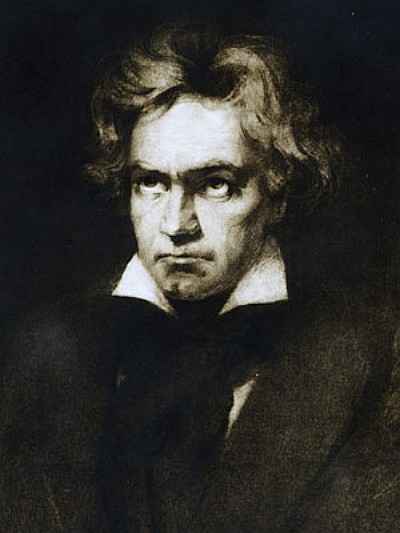
T he hypnotic effect of Beethoven’s variations on this obsessive figure is relieved by the A major middle section, marked Dolce, which withholds the spondees but retains the dactylic rhythm, now sounded in the lowest strings. It is as though the music is marking time (Riezler) before returning to the ostinato processional path... The Allegretto’s sequences of datyls and spondees [achieve their] quasi-hypnotic effect by repetitive incantatory and rhythmic means.”
— Maynard Solomon, regarding Symphony No. 7, pp. 110, 122.
A lthough some people with autism spectrum disorders play music, and some of them have reached a high degree of technical proficiency, they do not report being emotionally moved by music. Rather, the anecdotal evidence is that they are attracted to the structure of music. Temple Grandin, a professor who is autistic, has written that she finds music ‘pretty’ but that, in general, she just ‘doesn't get it’—she doesn’t understand why people react to music the way they do.”
— Daniel Levitin, p. 259.
T wenty-one minutes of sharply compressed music that shows him in all his violent, tragic, angry, plaintive, contemplative guises. It’s impulsive, defiant, pained, adversarial. It has qualities of conciseness, directness and instant confrontation of contrast. Op. 95 is called the ‘Quartetto Serioso,’ a rare instance in which Beethoven himself bestowed a subtitle… The F minor Quartet is not a ‘pretty’ piece, but it is terribly strong — and perhaps rather terrible… Everything unessential falls victim, leaving a residue of extreme concentration, in dangerously high tension. But strength, not strain, is the commanding impression.”
— Joseph Kerman,‘Beethoven Quartets’.
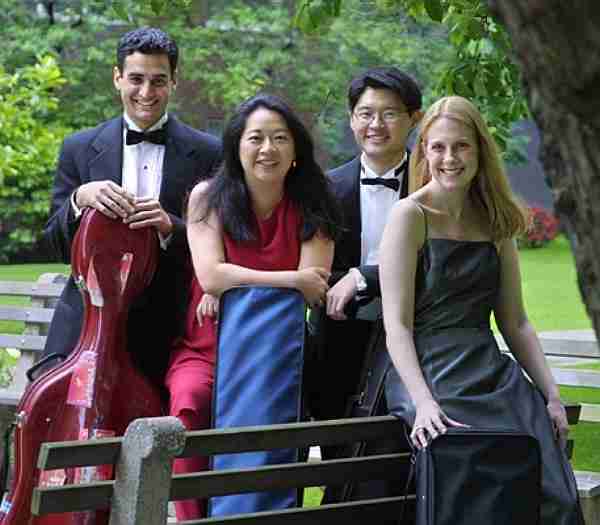
Bruce Adolphe renders a musical diagnosis: Tourette's Syndrome in Beethoven’s Op. 95, a program that he has given on 11-DEC-2007 at Curtis Institute of Music in Philadelphia and on 14-FEB-2008 in Joplin, Missouri—with the able assistance of the Daedalus Quartet. As a composer, Adolphe has been written works for many renowned artists (Itzhak Perlman, Yo-Yo Ma, Sylvia McNair, the Beaux Arts Trio, the Orpheus Chamber Orchestra, the National Symphony, St. Luke’s Orchestra, the New York Chamber Symphony, the Brentano String Quartet, the Miami Quartet, The Chamber Music Society of Lincoln Center, Chicago Chamber Musicians, etc.). Formerly on the faculties of the Juilliard School and New York University and a Visiting Lecturer at Yale, Adolphe has been a lecturer for the Chamber Music Society of Lincoln Center since 1992, and has been featured in national Live from Lincoln Center television broadcasts.
Adolphe has authored three books on music:
- The Mind’s Ear: Exercises for Improving the Musical Imagination;
- What to Listen for in the World; and
- Of Mozart, Parrots and Cherry Blossoms in the Wind: A Composer Explores Mysteries of the Musical Mind.
 D
Did Beethoven move his lips when he wrote Op. 95? Tourette-ish or not, the thing either works or it doesn’t. It’s successful for us as listeners or performers because it creates a coherent, if disturbing, atmosphere. Its beauty and comprehensibility lie in the simplicity and in the repetitions, which lead us to grasp a kind of endless and seemingly pre-ordained, hypnotic movement. If the thing were truly scatological—an illogical assemblage of Tourette-ish involuntary and disparate elements and dynamics—it wouldn’t ‘work’, except as an acoustical nuisance.
Op. 95 is (at the very least) an example of neurodiversity—defying musical conformity or elitism.
Did Beethoven make successive revisions to Op. 95? Yes! It was begun in 1810 and sketched and re-sketched several times within a year, but it was only finished four years later. It wasn’t blurted out, Tourette-style. And think, too, about 1810: more or less at the end of the Beethoven’s Middle Period, here is this new, compressed, chromatic language that flowers in his later quartets. Beethoven’s annotation ‘serioso’ really means, “En garde, performers and audience!” It’s a post-revolutionary existential assertion that the world is uncertain; there are no guarantees; and conventional resolutions are a thing of the past. If Op. 95 is a Tourette’s ‘tic’, it’s one hell of a tic!
 M
Musicologists write about how the first movement uses the tension created by a half-tone slide of the theme (a “Neapolitan step”) to throw things off-balance; about how Beethoven modulates to unexpected keys that create tensions around the key of D-flat; about how the D major second movement is incongruous with the F minor first movement, and what we feel is dislocation, a happy D major that we can’t trust. The Allegro assai vivace ma serioso is a perversely ‘grumpy’ scherzo: Beethoven scholar Joseph Kerman called it “a march – a serious, three-legged, tough little quick-march.” The coda bursts like a Rossini overture out of the shadows of F minor and hurtles the work into a major-key ending. All of these surprises and reversals: were they tics after all?
Lawrence Kramer’s book 20 years ago addressed idea that music means something, something we can talk about, and he mostly relied on Beethoven sonatas as examples. Kramer said that the semantic precision or imprecision of music simply doesn’t matter—because music, among other things, is a cultural practice. As such, it’s less an attempt to ‘say’ something than an attempt to ‘do’ something. If there are indeed Tourette-like stereotyped compositional features in Op. 95, maybe it’s best to consider them as actions with rewards that accrue to deeds, rather than as utterances with rewards that accrue to comprehensible texts.
 T
The repetitive, hypnotic figures in Op. 95—maybe they
are a kind of ‘mitigated echolalia’, a term coined by Pick in 1924 and still used by psychiatrists and neurologists today. The person (in this case, Beethoven) is aware of his own echolalia and tries to control it but doesn’t succeed? After all, neither fluent speech nor the ability to repeat speech is necessary for ‘echolalia’ per se. To require those would be too narrow a definition…
Anatomically, a lesion in the left medial frontal lobe in the brain can be a cause of what neurologists call ‘effortful echolalia’. But the cause doesn’t have to be structural or anatomical. In the cases of amphetamine-induced stereotyped behavior, Parkinsonism, the acute dyskinesias, and tardive dyskinesia, there’s evidence that some involuntary disorders of movement are biochemically mediated. In any case, ‘organicity’, in varying degrees and involving different anatomical and physiological/biochemical causes, is characteristic of Tourette’s Syndrome, Parkinson’s Disease and Huntington’s Disease and the vocal and motor abnormalities seen in each. But these conditions’ effects on writing have not been systematically studied—or at least haven’t been published so far as I can tell.
Is there any evidence of Tourette’s-type dysgraphia in the original manuscript for Op. 95? Is there evidence of Tourette’s-like episodic nonspecific urge resolution or labile non-resolution of themes in Op. 95? Adolphe seems to think so.
Note that the speech patterns described by Gilles de la Tourette can take two forms: they either turn around a specific theme and serves as a specific and repetitious commentary; or they take the form of arbitrary [scatological] ‘punctuations’. That the semiotic function of these Tourette patterns isn’t evident to the rest of us doesn’t mean that they have no semiotic function—only that we don’t understand what, if any, function they may have. In other words, ‘illogical’ is a judgment that depends upon what logic and axioms you assume; the motives that would explain whatever logic Beethoven may have been using are context-dependent—his context, his motives.
 T
There are two more sub-forms of echolalia: immediate echolalia and delayed echolalia. Immediate echolalia was once defined as ‘the meaningless repetition of a word or word group just spoken by another person’ (Fay & Schuler, 1980). But Prizant and others have shown that echolalia may serve several purposes for the person with autism or Tourette’s (therefore, it’s not ‘meaningless’, just inscrutable). Researchers find that immediate echolalia taps into the person’s short-term memory for auditory input. The crypto-semiotics of immediate echolalia are part of the extemporaneity of it in real-time. Its function is inscrutable because the rhythmic, punctuational, self-stim compensatory ‘memory’ purpose is alien to conversation between neurotypical normals. The need to repeat is not a compulsion, not really. It’s a rhythm; it’s a practice; it’s a ‘self-stim’ reflex. It just happens to be one that most of the rest of us ‘don’t get’. Beethoven: ‘stimming’ in Op. 95!
The semiotic function may, in fact, be clearer in written forms (including music) than in spoken forms. Written manifestations of repetitive, stereotyped self-stim exist. Poetry is full of this; ‘minimalist’ compositions, too. Stimming is repetitive stereotypic behavior of the types commonly found in autism and Tourette’s, but it’s also found in other developmental disabilities. These behaviors may involve any or all of the senses in various degrees in different individuals. Several examples are listed below.
- Visual – staring at lights, blinking, gazing at fingers, lining up objects
- Auditory – tapping fingers, snapping fingers, grunting, humming
- Olfactory – smelling things repeatedly
- Taste – licking objects, placing objects in mouth
- Tactile – chin scratching, clapping, thumb rubbing, feeling objects, nail biting, hair twisting, toe-walking,
- Vestibular – rocking, spinning, jumping, pacing
- Proprioception – teeth grinding, pacing, jumping
Some autism spectrum clues:
- Difficulty learning to ride a bike or ride a horse
- Clumsy, uncoordinated, and accident prone
- Walks with hands clasped behind back
- Difficulty walking on uneven surfaces
- Difficulty with fine motor tasks such as buttoning, zipping, tying, knitting, sewing, playing games with small parts, closing zip-loc bags
- Confuses right and left sides
- Prefers sedentary tasks like composing music, and avoids sports or physical activities
- Difficulty with handwriting; takes a long time to write things legibly
- Frequently bumps into people and things
- Easily fatigued with physical tasks
- Frequently slips or misses when putting objects on a table
- Messy eater, difficulty with eating utensils, spills and drops food
- Knocks drinks or other things over when reaching for them
- Frequently drops items
- Has to talk self through tasks
- Hums or vocalizes while concentrating on a task
- Difficulty learning to tie a tie
- Difficulty with motor tasks requiring several steps
- Difficulty lining up numbers correctly for math problems or tallying a bank account
- Difficulty learning new motor tasks... a new dance, a new musical instrument
 E
Every hinged object becomes a [self-stimulation] stimming toy; a wheel becomes something to spin for hours. Does Adolphe seriously think that Op. 95 is like this? Well, to a degree, yes. The obsessive intervallic figures in mm. 34-36, with reversals/inversions, for example.
 D
Disruptive echolalia and coprolalia are involuntary: what happens happens in real-time. But composition happens off-line. There’s plenty of time for censoring and editing off-line. Does Adolphe see evidence of echographia and coprographia in Op. 95? Does he think the limbic lobe of Beethoven’s brain was involved in ‘episodic productions’ in Op. 95? Yakovlev once wrote that the limbic part of the brain plays a role in ‘emotive motility’ which is essentially automatic. The involvement of the limbic lobe wouldn’t explain, though, why tics and echolalia and other repetitive behaviors aren’t censored by internal control mechanisms. It seems that Adolphe hasn’t explored these aspects yet…
Verbal impulsion, the classic feature of Tourette’s Syndrome, also occurs with frontotemporal dementia. People with this often are progressively unable to read silently. Externally triggered inner speech may be represented by silent reading. With frontotemporal dementia, loss of silent reading is equivalent to a loss of control over the verbal utterance of inner speech. The person’s ability to keep his/her inner speech ‘inside’ is lost, and the reader involuntarily now speaks out loud while reading.
Vercueil’s 2003 paper reviews the loss of control of inner speech in two Tourette’s Syndrome patients. Two adult patients with a diagnosis of Tourette’s since ages 7 and 10, respectively, commented on their present or previous abilities to read silently. The first patient never read silently as a child while the second patient did read silently but had a tendency to move his lips.
Vercueil speculates that the key role of prefrontal cortex, especially the orbito-frontal areas, in the inhibitory control of current behavior, can be responsible for the deficit in the control of inner speech. Recently, fMRI imaging performed in patients with Tourette’s Syndrome has shown a striking deficit in the activation of these areas during tics. It would be of great interest to address this specific question in determining the frequency of difficulties in silent reading in Tourette’s individuals as compared to those without Tourette’s. I will discuss this with Adolphe…
Tests that reflect reward—reduced ability to experience reward (anhedonia) and aversion (dysphoria)—are a ‘hot topic’ today because many psychiatric conditions that are currently intractable in humans (e.g., major depression, bipolar disorder, addiction) are characterized by dysregulated motivation. But Op. 95 isn’t dysphoric or anhedonic. Instead, it’s, if anything, hyper-hedonic. Has Adolphe thought about this aspect, I wonder?
S ometimes peoples’ disorders are what make them worth having as friends.”
— Bruce Adolphe, 15-FEB-2008.
What else? Autistic spectrum and obsessive-compulsive spectrum disorders may be viewed along a continuum, with purely compulsive or ego-dystonic disorders characterized by good insight and risk avoidance at one end, and purely impulsive ego-syntonic disorders characterized by poor insight and risk-seeking behavior at the other, with mixed forms in between. So is there evidence that Op. 95 shows poor insight plus risk-seeking aberrant compositional choices?
 R
Robertson at University College London and Kerbeshian and colleagues at the University of North Dakota have studied the roughly 10% association between Tourette’s and bipolar disorder. It’s surely possible that Beethoven’s bipolar disorder may have had some comorbid Tourette’s-type qualities. The estimated risk of developing bipolar disorder among the study group of children, adolescents, and adults with Tourette’s was more than four times higher than the level expected by chance, but this finding did not reach statistical significance. It was indicative of trends, however.
Depression is common for these people, with a lifetime risk of about 10% and a prevalence of between 1.8% and 8.9%. Depression and depressive symptoms are found to occur in 13% and 76% of Tourette’s Syndrome patients attending specialist clinics, respectively. Clinical correlates of depression in people with Tourette’s are these:
- tic severity and duration;
- echolalia and/or coprolalia;
- premonitory sensations;
- sleep disturbances;
- obsessive-compulsive disorder (OCD);
- self-mutilation;
- aggression;
- conduct disorder (CD) in childhood; and
- attention deficity hyperactivity disorder (ADHD).
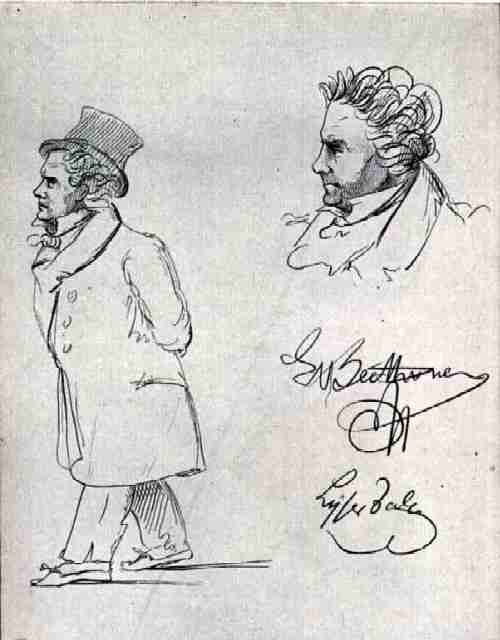
Tics typically diminish in severity as we get older, even for those of us who have relatively severe tic symptoms as kids. And we affected adults develop ways of unobtrusively masking our tics. Beethoven walked with his hands clasped behind his back—to mask the motor tics in his hands, and as a ritual OC gesture to keep himself from touching objects and people. A single string quartet in F minor does not a diagnosis make, but plausible clues, yes, they’re there.
To me, it seems that Adolphe is fitting Beethoven into a procrustean bed—cutting and adjusting facts to fit his theory. It’s not disparagement masquerading as a diagnosis—like the perennial suggestions that Mozart had Tourette’s. It’s more a romantic transfiguration of ‘Beethoven-as-martyrous-Tourette’s-sufferer’. Supposedly, Tourette’s only manifests itself in spoken unintentional tics, not in written ones. But that view’s only applicable to ordinary people in everyday situations, not composers and writers and artists practicing their professions. [How, after all, does this CMT blog post come to have the Tourette-ish quirks that it has? That is to say, if Tourette’s is one’s lot in life and one is creating a work of art that’s about Tourette’s, it’s inevitable one will select and preserve some features that epitomize the condition and its impact.] The Tourette-ish features of Op. 95 may have arisen unintentionally, but they were intentionally left-in through the 4 years of edits and revisions that Beethoven applied to the piece. They were part of Beethoven’s cultural practice, as Kramer might say.
 C
Click on the screenshot below to download a spreadsheet to estimate the likelihood of Tourette’s Syndrome.

- Wakin D. What's in a Beethoven Quartet? NYT, 12-FEB-2008.
- Daedalus Quartet with Bruce Adolphe in Joplin, MO (Promusica)
- Daedalus Quartet website
- Adolphe B. Piano Puzzlers on NPR
- Bruce Adolphe webpage
- Bruce Adolphe page at BesenArts Management
- Tourette Syndrome Association website
- Autism Spectrum Disorders page at U.S. NIMH (NIH)
- Tourette Syndrome page at U.S. NINDS (NIH)
- 'Institute' for the Study of the Neurologically Typical.org
- Barry Prizant autism website
- Sensory Processing Disorder website
- Beethoven site
- Adolphe B. What to Listen for in the World. Limelight, 2004.

- Adolphe B. Of Mozart, Parrots, Cherry Blossoms in the Wind: A Composer Explores Mysteries of the Musical Mind. Limelight, 2004.
- Adolphe B. Piano Puzzlers: Thirty Popular Melodies and Folk Tunes in the Styles of Famous Composers. Wannacracker, 2004.
- Adolphe B. The Mind's Ear. MMB, 1991.
- Ashoori A, Jankovic J. Mozart's movements and behaviour: a case of Tourette's syndrome? J Neurol Neurosurg Psychiatry. 2007; 78:1171-5.
- Bloch M, Peterson B, Scahill L, Otka J, Katsovich L, Zhang H, Leckman J. Adulthood outcome of tic and obsessive-compulsive symptom severity in children with Tourette syndrome. Arch Pediatr Adolesc Med. 2006;160:65-9.
- Bower H. Beethoven's creative illness. Aust N Z J Psych 1989;23:111-6.
- Budman C, Rockmore L, Stokes J, Sossin M. Clinical phenomenology of episodic rage in children with Tourette syndrome. J Psychosom Res. 2003;55:59-65.
- Calezon W, Chartoff E. Intracranial self-stimulation (ICSS) in rodents to study the neurobiology of motivation. Nature Protocols 2007;2:2987-95.
- Cameron L. The Music of Light: The Extraordinary Story of Hikari Oe and Kenzaburo Oe. Free Press, 1998. (Hikari Oe = autistic composer)
- Grandin T, Barron S. The Unwritten Rules of Social Relationships: Decoding Social Mysteries Through the Unique Perspectives of Autism. Future Horizons, 2005.
- Grandin T, Duffy K, Attwood T. Developing Talents: Careers for Individuals with Asperger Syndrome and High-Functioning Autism. AAPC, 2004.
- Grandin L, Alloy L, Abramson L. The social zeitgeber theory, circadian rhythms, and mood disorders: review and evaluation. Clin Psychol Rev. 2006;26:679-94.
- Hadano K, Nakamura H, Hamanaka T. Effortful echolalia. Cortex 1998; 34:67-82.
- Jankovic J, Kwak C, Frankoff R. Tourette's syndrome and the law. J Neuropsychiatry Clin Neurosci. 2006;18:86-95.
- Kalischer A, ed. Beethoven's Letters. Dover, 1972.
- Karhausen L. Weeding Mozart's medical history. J Roy Soc Med. 1998; 91:546-50. [500KB pdf]
- Kenny P, Chen S, Kitamura O, Markou A, Koob G. Conditioned withdrawal drives heroin consumption and decreases reward sensitivity. J Neurosci 2006; 26:5894–900.
- Kerbeshian J, Burd L, Klug M. Comorbid Tourette's disorder and bipolar disorder: an etiologic perspective. Am J Psychiatry. 1995;152:1646-51.
- Koizumi H, Ebi A. Music of Hikari Oe, Vol. 1 (Denon, 1995.)
- Kramer L. Music as Cultural Practice, 1800-1900. Univ California, 1990.
- Kranowitz C. The Out-of-Sync Child: Recognizing and Coping with Sensory Processing Disorder. Perigree, 2006.
- Lane W. Beethoven: The Immortal. 14-FEB-2008.
- Levitin D. This Is Your Brain on Music: The Science of a Human Obsession. Plume, 2007.
- Mai F. Diagnosing Genius: The Life and Death of Beethoven. McGill-Queen's Univ, 2007.
- Mai F. Beethoven's terminal illness and death. J R Coll Phys Edinb 2006; 36:258-63.
- Marston N. In the Twilight Zone: Beethoven's Unfinished Piano Trio in f Minor. J Roy Musical Assoc 2006; 131:227-86.
- Martin R. Beethoven's Hair: An Extraordinary Historical Odyssey and a Scientific Mystery Solved. Broadway, 2001.
- Ornes R. Beethoven dead from lead? ScienceNOW, 28-AUG-2007.
- Robertson M. Mood disorders and Gilles de la Tourette's syndrome: An update on prevalence, etiology, comorbidity, clinical associations, and implications. J Psychosom Res. 2006;61:349-58.
- Seemüller F, Dehning S, Grunze H, Müller N. Tourette's symptoms provoked by lamotrigine in a bipolar patient. Am J Psychiatry. 2006;163:159.
- Simkin B. Mozart's scatological disorder. BMJ 1992; 305:1563-7.
- Solomon M. Late Beethoven: Music, Thought, Imagination. Univ California, 2004.
- Tükel R, Oflaz S, Ozyildirim I, Aslantas B, Ertekin E, Sözen A, Alyanak F, Atli H. Comparison of clinical characteristics in episodic and chronic obsessive-compulsive disorder. Depress Anxiety. 2007;24:251-5.
- Vercueil L. Control of inner speech and Gilles de la Tourette's syndrome. Encephale. 2003;29:460-2.
- Zutshi A, Kamath P, Reddy Y. Bipolar and nonbipolar obsessive-compulsive disorder: A clinical exploration. Compr Psychiatry. 2007;48:245-51.
- DSM. Mozart: Affliction and Art. CMT blog 03-FEB-2007.
B eethoven is the friend and contemporary of the French Revolution, and he remained faithful to it even when, during the Jacobin dictatorship, humanitarians with weak nerves of the Schiller type turned from it, preferring to destroy tyrants on the theatrical stage with the help of cardboard swords. Beethoven, that plebeian genius, who proudly turned his back on emperors, princes and magnates—that is the Beethoven we love for his unassailable optimism, his virile sadness, for the inspired pathos of his struggle, and for his iron will which enabled him to seize destiny by the throat.”
— Igor Stravinsky.