Wednesday, April 11, 2007

Roger Reynolds: Following the Authority of Process + Intuition

Roger Reynolds
I  believe in as wide a range of musical involvements as is feasible given the Reality of Life.”
  —  Roger Reynolds, 1993

DSM: Cellist Rohan De Saram performed with violinist Mark Menzies and cellist Erika Duke-Kirkpatrick last month (16 March) at REDCAT (Roy and Edna Disney CalArts Theater at the Walt Disney Concert Hall) in Los Angeles —— Roger Reynolds’ ‘Focus a beam, emptied of thinking, outward... ’

CMT: And Reynolds’ ‘Angel of Death’ was performed a month ago as well (on 10 March) by the Columbia Sinfonietta at Miller Theatre, Broadway at 116th Street, in New York. These are fascinating pieces. But the taste for them is—What would you say?—an ‘acquired’ taste. They do get performed. But it’s hard to find the events, hard to find the opportunities to experience them. Currently on the faculty of University of California at San Diego. Roger Reynolds is now 72 years old but is still as ‘young’ as ever. Originally trained in Engineering Physics at the University of Michigan, he co-founded ‘ONCE Group’ with Robert Ashley. The ONCE Festivals in Ann Arbor in the early 1960s were renowned among avant-garde music events. And the ONCE Group included some of the most influential and imaginative composers of the day. Reynolds won a Pulitzer Prize in 1989 (for ‘Whispers Out of Time’ for string ensemble) and has accumulated many other honors over the course of his career. His works typically include text and electronic elements, plus theatrical and multimedia performance art. And he’s a pioneer in multi-channel spatial effects—dynamic antiphonal effects that change during the course of a composition and may have significant improvisational latitude for performers. Google around, and you find countless musicians and composers who cite ‘former student of Roger Reynolds’ on their curricula vitae. So, despite the acquiredness of the taste and the comparative scarcity of performances of Reynolds’ works, there’s tremendous ‘cachet’ associated with claiming some association with this Grand Not-Old Man of the electro-acoustic avant-garde.

DSM: He’s always been interested in antiphonal and aleatoric effects. Reynolds’ DVD of Watershed (MODE Records) was the first classical music DVD engineered and produced for surround-sound. Even up to today, MODE produces Roger Reynolds’ work, including his theater-piece ‘Justice’ and a collaboration with poet John Ashbery on a cycle of words and music, entitled ‘Last things, I think, to think about’.

T  he issue of self awareness is one of the most problematic things that any artist, perhaps any individual, encounters in his or her life. I would imagine that if you asked me, do I know myself better now than I did then, the truth is probably ‘No.’ What has changed is that [laughing] I care less about whether the connection between what I am ... It is folly to imagine that you are in complete control of what is happening. People use different metaphors, and the most common one in my experience is how composers talk about the work ‘taking over’. Of course, that’s nonsense. The piece doesn’t take over. But what does happen is that your ability to move things or to alter assumptions diminishes as the amount of material that already establishes normatives grows. Exactly how this relates to the question of self awareness I’m not entirely clear.”

  —  Roger Reynolds, on the issue of a composer’s self-awareness, at National Institute of Arts and Letters, 1973.

CMT: Reynolds has always ‘pushed the envelope’ rhythmically, too. Traditionally, western music has been dominated by binary structural elements: two-bar phrases, four-bar phrases, eight-bar, sixteen, and so on. That’s the normative pattern of the temporal structure of events and how they fit into larger units, assuming a coherent tempo. Of course, not all musical cultures deal with time in this way. But powers of base-2 are predominant. Regarding neurophysiology and cognition, Paul Fraisse’s book, The Psychology of Time, notes the importance of change—there must be change on a timescale that is neurobiologically congenial, for mammals to be able to perceive a stimulus. Constancy is ignored—it is part of how our nervous system automatically filters and reduces the sensory overload and makes it possible for us to attend to the things that matter most. In his compositions, Reynolds strives for novel aesthetic effects using hierarchical ‘self-similarity’ elements—to establish constancy where he wants it, and thereby to temporarily or progressively diminish the listener’s attentiveness to those voices that are exhibiting self-similarity or relative constancy. Each self-similar element may be echoed by subsequent statements in other voices, and those echoes in turn become transiently ‘new’ and attract a disproportionate amount of the listener’s attention for a time. The soloist plays, the ensemble plays, the synthesizer plays, and the soloist plays, but the relationship between solo and ensemble and synth starts shifting. In designing his unique polyphonal forms, Reynolds uses graphical compositional plans to manage the multiplicity of simultaneous layers of sound that he is composing.

DSM: One of Reynolds’ early works was ‘The Emperor of Ice Cream’, scored for three instrumentalists and eight singers. The score includes stage directions that show how, over time, the singers should redistribute themselves on-stage in order to alter the antiphonal ‘spatiality’ of their sounds. The entire process is depicted in his score and formal performance plan.

T his is a little difficult to see, but this is graph paper, and down here is a square, and down there is another square. That square represents the performance space, or it represents this room. What this represents - that curve, that curve, or this one - is a potential path that a sound can take. So let’s say that I say, ‘Abracadabra, abracadabra, abracadabra,’ that I say that continually, and that sound, ‘abracadabra,’ starts here and moves closer to you and then moves away. And what I’ve done is to design a variety of paths that aren’t just abstractly attractive, but that have actual, visceral effects on one. A fly-by is a very effective gesture in sound space. So I’ve become involved with the idea of using the spatial acuity of the human perceptual system as a component of my music. It involves, like everything else, a lot of planning and informed intuition.”
  —  Roger Reynolds
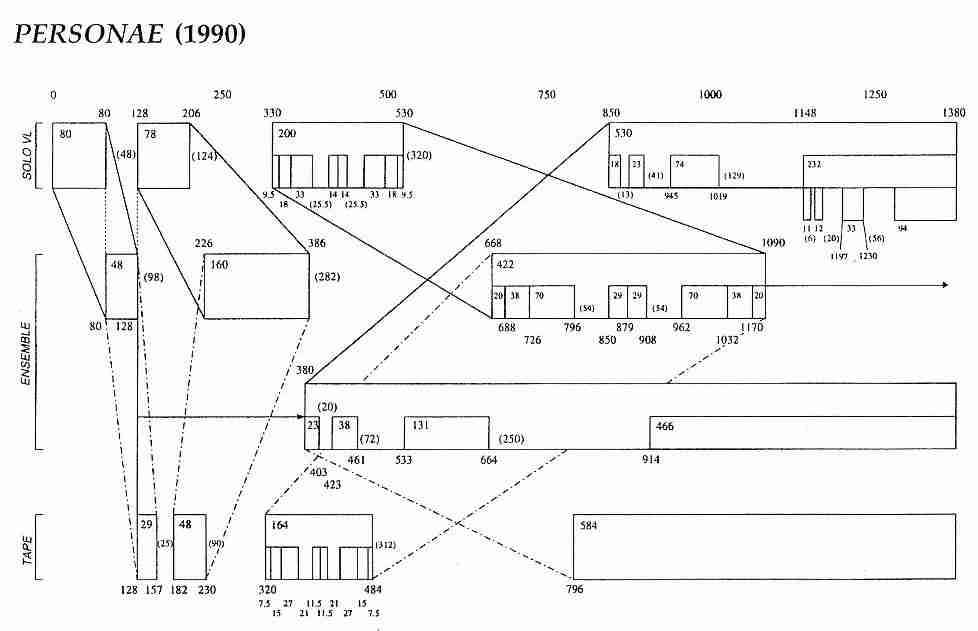
Plan of ‘Personae’
CMT: Roger’s fascination with explicitly scoring ‘processes’ leads me to wonder whether he’s ever used ProForma’s ProVision business-process modeling software to design one of his compositions. Or CaseWise or one of the other modeling languages. Just as the language standard for XML has been extended to MusicXML, is it not reasonable that BPML or BPEL might be extended to, say, MusicBPML or MusicBPEL to accommodate the music-specific syntactic and expressive requirements of music? Those BPM application packages include the possibility of Markov Chain Monte Carlo simulation (MCMC) and Discrete-Event Simulation (DES)—things that would be interesting and valuable to composers like Roger, I would think. These object-oriented BPM apps would help not only with the exploratory phases of composition—to make the process of discovering what process-flow works best for the aesthetic effects you’re after—but also with the practical staging and production phases—to “vet” or validation-test the performance implications of what you’ve written before you go and try to rehearse it.

If you think about a traditional musical score, you realize that a violin part to a Mozart sonata does not tell the violinist which way to move the bow, where to put his finger on the strings, how to hold the violin, how hard to push, how fast to pull the bow. It doesn't tell him any of those things. It just says: I want this note here, and then this one and then this one, and this should be louder than that one, and so on. What I’m trying to see, with a technical score, is whether there are parallel ways of addressing technological issues which are perhaps much more variable even than such a phenomenon as the technique of an individual instrumentalist.”
  —  Roger Reynolds, 1993

UCSD-CCRA Music Theatre production
DSM: UCSD’s $52 million New Music Center began contruction this January. Its 400-seat recital hall was designed by acoustical engineer Cyril Harris. Designed by LMN Architects of Seattle, the three-story, 47,000-square-foot design will have, among other things, configurable ‘black box’ theatre.

CMT: Yes. I visited the site earlier this winter, during a trip to UCSD. The flexibility that’s incorporated into the New Music Center’s design should be ideal for performance of multi-media works like Reynolds’ pieces. The UCSD New Music Center facility is due to open in early 2009.

UCSD New Music Center, architect’s model


Tuesday, April 10, 2007

Yahoo!Pipes: Complexity, Megacommunity, and Adaptation

LiveJournal tribe
T he concept of ‘megacommunity’ is another way to perceive ‘power to the edges’ thinking about emergent organization and leadership. Megacommunities are large multi-organizational systems that are oriented to multilateral action. The megacommunity approach acknowledges that no single organization or entity can make the decisions required by today’s complex social and infrastructural systems. The challenges facing community leaders are based on complexity: the growing density of linkages among people, organizations, and issues all across the world.”
  —  Mark Gerencser, Megacommunity Manifesto, 2006
CMT: There are data sources and RSS feeds, but until recently we bloggers had no pipes! Aggregating and integrating disparate data sources using JavaScript isn’t for those of us with regular day-jobs. But Yahoo! Pipes is a new object-oriented data manipulation and data mashup environment that can make it easy to do this. Other mashup environments are DabbleDB and Dapper.

Blogosphere Map
DSM: Yahoo!Pipes is a free hosted service that lets you mix RSS feeds and create data mashups in a visual programming environment. The name of the service derives from mimicking Unix pipes, which let programmers push output from one command to the input required for the next command and so on ad lib, to create simple utility programs from a series of daisy-chained procedure-calls on the command line. Yahoo!Pipes is not strictly serial, though. The input for one function can come from more than one upstream source. The Yahoo!Pipes drag-and-drop user interface makes it easy to set up your own pipes to deliver specialized remixed feeds to address special interests that you have. You can stuff the pipe output to your RSS reader or publish it to a website or to a file. You can set up your pipe applet to solicit interactive input from your keyboard or pointing device. Or you can set up your pipe applet to harvest and filter and sort and pre-process or slice and dice what it finds without any interactive input from you. If you want to find and sort all recent feeds concerning violas you can do that. If you want to build a very specific news clippings robot to capture all articles that concern a specific composer or composition, you can do that. The flexibility is really pretty remarkable. And all very simple and easy. You don’t have to have any programming experience. You just have to (1) know what you want to do, (2) know where the information will come from on the web [the URLs], and (3) have a rational, logical mind.

CMT Classical Music Pipe
CMT: What about error-trapping? Does Yahoo!Pipes have a compiler that checks that what you’ve dragged-and-dropped and hooked together is syntactically correct or semantically and logically feasible? Does Yahoo!Pipes have a performance optimizer or rule compiler to recast pipes that the user assembled naively? Can it make slow-performing pipes faster without the user having to know why her/his syntactically-correct but inelegant pipe is sucking so badly?

DSM: No. In this initial version, Yahoo!Pipes doesn’t seem to have any significant syntax-checker or compiler functions or error-trapping. You can build a pipe that may not work. But a non-functional pipe will not crash your machine or cause any harm. The Yahoo!Pipes service at least has that much bullet-proofing. And Yahoo!Pipes does not [yet] have any optimizer built in, so far as I can tell. If you put your filters upstream of your sorts, then the sort operations will run faster. But Yahoo!Pipes lets you chain things together in whatever sequence you wish, and it doesn’t complain or override the structures you build or replace it with run-time syntax or dispatcher sequences that reflect an optimized query plan. Likewise, there is no ‘plan’ command or compiler ‘hint’ capability such as you may be used to in Oracle or DB2 or other full-function relational DBMS systems.

French Blogosphere
CMT: The user interface, to me, resembles Insightful Corp’s iMiner datamining environment.

DSM: Yes. That’s a good analogy or resemblance to note. iMiner basically enables a statistics-naïve user to drag-and-drop various dataretrieval and statistical analysis functions onto a workspace within the iMiner application and then “connect” them to visually specify the processing that you want the software to perform. You do that instead of writing hundreds of lines of S-PLUS code. You can then ‘save’ your iMiner workspace with all of the process objects and connections and report templates and so on, so that it can be re-run in exactly the same way whenever you want. That’s the same way Yahoo!Pipes works. Once you’re satisfied with the output your pipe is producing you can save the pipe in your Yahoo!Pipes workspace, or you can publish it and make it available to others, or you can embed it in the HTML or CSS code for your website, or do other things with it.

CMT: What if I don’t quite know what I want to do? Or what if I just want to get a sense for the range of things that can be done with Yahoo!Pipes?

DSM: Well, the main Yahoo!Pipes page includes a gallery of ‘clonable’ examples of pipes that have been built by other people. Many examples involve remixes and filters of newsfeeds and iTunes and concert-listings and other kinds of applications that would enable you to quickly get a fairly comprehensive and practical notion of what you can do and how you go about doing it. You can ‘copy’ a generic example and change a few things in your copy to customize it to do just what you want. You don’t have to start totally from scratch . . .

Matthew Hurst, blogographer
CMT: Matthew Hurst has been producing some really cool computer-generated maps of the interconnections in the blogosphere, and his latest image is a beauty. He’s centered it on DailyKos (the bright white dot in the center) and says that the dense area of interlinked sites below it represents the socio/political community while the less densely populated but also highly interlinked area in the northeast quadrant of the image represents the heart of the ‘technical blogosphere’ with BoingBoing as the brightest node there. The size and brightness are proportional to the average number of hits per day that a blog receives. One of his blogosphere maps appears on page 22 of the May issue of Discover magazine, with green links representing one-way links (that is, blog A links to blog B) and purple links denoting reciprocal links (blog B returns the favor). Surely Yahoo!Pipes remix activity is not going to be counted in that sort of blogosphere mapping and social networking analytics.

DSM: You’re correct. Meta-processing and dynamic runtime inter-blog referencing is not (currently) being captured. Possibly in the future those types of dynamic “pulls” would be metered. But right now it’s just static blog-blog references that are counted.

CMT: This Yahoo!Pipes thing is pretty cool! I just set up a simple pipe for aggregating a number of classical music blogs’ feeds together, sorting them by date, then by blog name within date, then by blog post title within blog: CMT Classical Music Pipe. I bet our friends here may enjoy playing with this or creating custom ones of their own . . .

DSM: Because people communicate so easily across national and organizational boundaries, the conventional managerial decision-making style — in which a boss dominates decisions or delegates them to subordinates — is no longer adequate. A single classical music critic or powerful editor dominating decisions about what music events get coverage and how they get covered – is no longer adequate. A few non-profit commissioning organizations dominating decisions about what kinds of composing and performing get funding – is no longer adequate. Solutions require multi-organizational systems that are larger and more oriented to multilateral action than conventional cross-sector approaches are. In those future regimes, the most successful leaders are not those with the best technical solutions, the most compelling vision, the most impressive portfolio or ticket sales, or the most sensationalistic or charismatic style. “Winners” are those who manage – in whatever ways they can – to influence others in a larger system that they don’t control. Gerencser calls this type of non-hierarchical system a “megacommunity.”

CMT: So this is the kind of thinking that motivates the Megacommunity Manifesto! It resembles Hugh Brody’s study of indigenous cultures, The Other Side of Eden. Indigenous cultures are profoundly complex-adaptive. Rather than attempt to dominate the environment, they adapt themselves to its demands and become an integral part of it. Indigenous assistive technologies for classical music and new music, implemented in Yahoo!Pipes !


Monday, April 9, 2007

Cultural Colonies: Composers’ Integrity/Hermeticity vs. Markets

Pierre Bourdieu
A s a performer, however, it’s seductive to think that I can gain instant credibility with ordinary listeners by dropping some phat 808s. It’s natural to want to please an audience. Is it unethical to take advantage of their ignorance (in the most nonjudgmental sense) and cultural conditioning (in the most judgmental sense) to do so?”
  —  Colin Holter, NewMusicBox, 14-MAR-2007

CMT: The sociologist Pierre Bourdieu died in early 2002. But the Bourdieu book, ‘Distinction’, was just re-released in English this winter. Are you familiar with it? It first appeared in English in 1984. Do you think it relates to composing and the contemporary classical music situation?

DSM: Well, from this side of the Atlantic it feels like 2002 was an eternity ago. It makes Bourdieu’s research in 1963 to 1968 seem even more insightful and ahead of its time, in terms of cultural theory. “Über den Begriff Habitus folgendes: Dabei handelt es sich in erster Linie um das Produkt eines unbewusst erfolgten Lernens, das sich danach anscheinend auf ganz natürliche Art und Weise frei in einem Umfeld entwickelt. Der Musiker kann nur frei auf seinem Klavier improvisieren, wenn er lang genug seine Tonleitern geübt hat und die Regeln der Komposition und der Harmonie beherrscht,” is what Jean-François Dortier wrote in 2002 in his remembrance of Bourdieu, published in the journal Sciences Humaines. [trans: The musician can improvise freely on the piano if only he/she has practiced long enough and is sufficiently knowledgeable about its tonal capabilities and has mastered the rules of the composition and the harmony.] ‘La Distinction’ was published in France in 1979—a considerable while after Bourdieu concluded his research. I wonder if the delay was due to some perplexity Bourdieu felt about what his data meant. In the end, Bourdieu’s conclusion was pretty radical, far wider in scope than you might imagine arising from the surveys he conducted. Bordieu concluded that one only truly becomes oneself if one moves in a strange milieu, whose rules of the game we (initially) do not know. This ‘sealing off’ or isolation is not the result of totally free choice. The decisions are all conditioned and constrained. The social distribution of predilections that are determined by the Habitus lets persons who share the same aesthetic commune with each other. All of it is marked by the prevailing social hierarchy. But, still, Bordieu’s conclusion was that we need to be stretched, need to be outside our ‘comfort zone’ in order to fully become or be ourselves. We need to confront newness! By the way, have you seen “HBS Working Knowledge: Strategy—Six Steps for Making Your Threat Credible”?

CMT: That’s a tremendously disturbing article at many levels, by Deepak Malhotra of Harvard Business School. But it’s emblematic of our times. Unrecognized by Dr. Malhotra, though, is that the tactics of confrontation are only effective if your adversary is insightful enough to recognize the tactics’ meaning and intent. Increasingly in today’s mass culture, that assumption is invalid. These days, your adversary isn’t attentive and s/he may not be insightful. It’s possible for you to be too clever in your aim to divert or engage. Like business and politics, today’s cultural scene is a continuous barrage, and the cognitive overload is very great for many people. In general, their patience and attention span are small. And it is not a ‘blue-water’ opportunity. You’re not filling an ‘unmet’ need that people have; you’re attempting to displace some other choice(s) that they’ve previously made.

DSM: Composing new music or classical music is almost inevitably a self-isolating aesthetic position, don’t you think? A bit like Babbitt’s famous essay in 1958, ‘Who Cares if You Listen?’

Milton Babbitt
CMT: Well, there are some whose works are more ‘difficult’ than others. And some whose works are ‘easier’ or more accessible, you have to admit. Sometimes commissioned works bear the fingerprints of the commissioning organization or the specifications of the commission. Ultimately, though, each of us is inscribed by mass-culture. And all composers are would-be inscribing agents, whether they’re writing under commission or writing for themselves. It’s what they do.

DSM: And, as Bourdieu says, no judgment of taste is innocent. In his view, we are all snobs—tyrants of our own indigenous microcultures. My microculture may consist of my immediate family and friends. Or, increasingly in our online culture, it may consist of the virtual communities and social networks with which I engage on the web. But, ultimately, I suppose my indigenous community might consist of just me, the ‘null’ network with zero other members, a community of one. In ‘Distinction’, Pierre Bourdieu examines the French middle class and its tastes and preferences and seems to regress always back to a potentially hermitous, monastic, solitary concept of taste.

W hen you read, in Saint-Simon, about the quarrel of hats (protocol, as to who should bow first), if you were not born in a court society, if you do not possess the habitus of a person of the court, if the structures of the game are not also in your mind, then the quarrel will seem futile and ridiculous to you . . . Illusio is the fact of being interested in the game, of taking the game seriously, being caught up in and by the game, of believing the game is worth the candle, or, more simply, that playing is worth the effort. [It is] to recognise the game and to recognise its stakes.”
  —  Pierre Bourdieu, 1979

CMT: It’s nominally an ethnography of contemporary France, but, more significantly, it’s an ethnography of western middleclass culture. In the course of everyday life people constantly choose between what they find aesthetically desirable and what they find aesthetically undesirable. Bourdieu bases his study on surveys that took into account the multitude of social factors that play a part in a Frenchperson’s choice of clothing, leisure activities, and many other matters of taste. His analysis reveals that social snobbery and alienation are everywhere in the bourgeois world.

Pierre Bourdieu
DSM: In fact, that’s much like Benjamin Barber’s ‘Consumed’. The different aesthetic choices people make are all distinctions—that is, choices they make in opposition to those made by “others”. An individual’s taste isn’t ‘pure’ or independent. It’s always intertwined with other elements of the culture. Bourdieu identifies social meaning in such unremarkable acts as ordering from a menu. Meaning and signification are everywhere! We experience culture as a pervasive, endlessly self-replicating, machine-like system that produces individual selves, communities, and society. In that giant organism, all of us are human agents endowed with varying amounts of power and influence. We unconsciously replicate the system—the larger organism or society—at all of its levels, simply by living out our lives.

CMT: And alienation is an inevitable element in this process. Maturana’s ‘Autopoiesis’ comes to mind. And Sangren’s book is pertinent here, too. Sangren examines how alienation figures in Chinese religion. The gods are only one form of all the alienating idioms that people engage in, depending on their situations and interests. But when analyzing broader social systems, including cultural and musical reality, Sangren says that alienation is today a constant. While cultural idioms perennially conflict with each other and change through history, many times the changes serve only to replicate the original system as history repeats itself. Very much like Bourdieu’s position.

DSM: Sangren also offers a critique of Foucault’s concept of power, emphasizing that power is not a ‘subject’ itself with its own agency and intentions and should not be treated like one. An composer’s power derives from the compositions, but the compositions do not encode unambiguously the composer’s intentions and meaning. The power is not a ‘subject’. Sangren’s argument is a little like a sociological version of Gödel’s Theorem . . .

Q uestions:
  1. Should a modern composer be judged against only the very best works of the past?
  2. If a composer can write one or two or more great works of music why cannot all of his or her works be great?
  3. Why does the contemporary musical establishment remain so conservative or reactionary when all other fields of the arts and sciences readily embrace new ideas?
  4. Should a composer, if confronted with a choice, write for the musicians who will play a piece or write for the audience who will hear it?
  5. When is an audience big enough to satisfy a composer or a musician? 10? 100? 1,000? 10,000? 100,000? 1,000,000? 100,000,000?
  6. Should a composer speak with the voice of his or her own time?
  7. If there’s already so much good music to listen to what’s the point of more composers writing more music?
  8. Must all modern composers reject the past, a la John Cage or Milton Babbitt’s ‘Who Cares If You Listen?’
  9. Is classical music a quaint, passé idea, or is it, like the novel, still a viable cultural form?
  10. Can harmony be nonlinear?
  11. Artists are expected to accept criticism. Should critics be expected to accept it as well?
  12. Sometimes I’m tempted to talk about the role that corporate culture plays in the sale and distribution of illegal drugs throughout the United States and the world, and that the opium crop in Afghanistan has increased by 86 percent since the American occupation, and the fact that there are 126,000 civilian contractors in Iraq, but what does this have to do with music?
  13. When a visual artist can sell a one-of-a-kind work for hundreds of thousands of dollars and anyone on the internet can have a composer’s work for nothing, how is a composer going to survive? Does it matter?
  14. Should composers try to reflect in their music the truth of their natures and the visions of their dreams whether or not this music appeals to a wide audience?
  15. Why are advances in science and technology not paralleled by advances in music theory and compositional technique?
  16. Post-Post-Minimalism? Since Minimalism and Post-Minimalism we’ve seen a short-lived Neo-Romanticism, mainly based on misguided attempts to return to a 19th century tonality, then an improv scene which had little or nothing to do with composition, then a hodge-podge of styles: a little old ‘new music’, a little ‘60s sound colorism’, then an eclectic pomo stew of jazz, rock and classical, then a little retro-chic Renaissance ... even tonal 12-tonalism. And now in Germany some ‘conceptual’ re-readings of Wagner. What have I left out? Where’s the music?”
  —  Colin Holter, NewMusicBox, 14-MAR-2007

CMT: So, you’re a composer, say. If you don’t accommodate at least a few of the norms that are idiomatic for your intended listeners or players, then they might reasonably claim that your failure to do so is a deficiency: that it demonstrates either (a) your inability to do it [lack of skill] or (b) your arrogant refusal to do it [lack of respect] or (c) your utter ignorance of the norms and expectations of their culture [lack of knowledge].

DSM: Your aesthetics are what you decide you, as the composer, want your language and effects to be. It’s not that your aesthetics must be anti-economic—although, again, depending on the aesthetic goal, that might be a useful indicator or even a valid aim that you have. Instead, it’s that economics shouldn’t impact your aesthetics at all. Yes, there’s always an economic component to any real-world realization of a given aesthetic, but that shouldn’t be the criterion for making artistic decisions. You need to compartmentalize a bit, to avoid commodifying what you’re creating. Dissociating your musical concept from economics is pretty closely connected with authenticity of expression . . .

CMT: But the composer and her/his family have financial needs.

DSM: If so, the composer is compelled to create something that will be bought by a real audience, a real market, and one of sufficient size to match the income requirements! She/he does not have the luxury of creating for some future hypothetical audience. Either that, or you keep your “day job” . . .

CMT: You know, Milton Babbitt has always scorned passivity and reciprocity and pandering, as he put it. He held that these gain nothing either for the public or for the composer. But his safe tenured academic positions enabled a level of integrity and purity for him that not many of the rest of us could manage. With regard to his own esotericism and iconoclasm, he does acknowledge that few audience members and music critics have the technical knowledge to unravel radically new performances, ones with a complex mathematical or theoretical basis, or ones with an impenetrable sonic ‘front’. Considering my experience of my own family members’ reactions, I would say that, rather than “familiarity breeding passive acceptance,” familiarity often goes further to breed full-blown contempt. Through repeated exposure they weren’t “getting” the music, or appreciating it at all. ‘Stop that racket,’ my dad used to say, when I was still living at home . . .

DSM: I think we see this, too, in the reviews that some critics publish. It’s difficult for some of them to fathom how their readers would have a different reaction than the innate, uncomprehending, unsympathetic one that they have. Given their modest understanding or their lack of patience to exert themselves and enter into the unfamiliar music, the under-motivated critic tends to write vague generalities or jury-rig his/her reviews with coy clause-pairs like “Among the musical masterpieces that can make you physically ill, none is as renowned as Schoenberg’s . . .”

CMT: Even while being indoctrinated through university I found it difficult to fathom how a music that ostensibly no one wanted to hear—not just at its inception, but half a century later in the case of many of Babbitt’s own works—how this could represent the ‘future’ of music. But when presented with works they must review but of which they have little comprehension, some critics tend to take the tactic of flamboyance. They stage mock attacks. Or, if they sense that someone does appreciate this music, they trot out hollow semi-truths or descriptive prose. In this era of failing newspapers and dwindling readerships, they are concerned that to do otherwise could be potentially damaging to their authority as a critic or could jeopardize their employment. If they were seen by the public (or at least by that segment with interest in the subject) as being biased or uninformed, then their judgments would be undermined in areas in which they have more knowledge and authority and enthusiasm. Sad, really.

DSM: Sadly, too, reviews like that do little either to promote a more complete understanding of the works or to dispel inaccurate expectations that the public has. Such critics still insert the comments that they feel could be justified— “The concert was exceedingly long, and the performers were compelling . . .” But as to the quality of the works themselves or the meanings they evoke or how they achieve their effects, they’re without words to describe them. They either hide behind a false sense of necessity to support these works, however faint their praise may be, or they hide behind a false sense that they must be sensational. They must “pan” the works in a punchy, amusing way, no matter how inaccurate or unfair it may be.

CMT: Compared to a newspaper where a music review or column is generally under 500 words, magazines are quite a lot better. Magazines tend to offer more space. This additional space allows for longer articles, which suits a readership with more specific interests—people who might be prepared to read a 3,000-word article. Increased space also breeds a different kind of writing – that of the so-called feature article. They aren’t time-sensitive and needn’t reference any current event. These exploratory works take the reader deeper into composers and performers and concepts in the music world, and offer the critic the opportunity to expound on musical subjects that may not be related directly to a performance event. There’s an additional reason that magazines tend to involve more feature writing than newspapers: the issue of timing. Magazines aren’t published with the same frequency as newspapers, and so can be tailored to a monthly or bi-monthly distribution. Timely concert reviews would have little place here, since the performance and performers would be long gone by the time the publication even went into production, much less print. Feature pieces have a much longer shelf life than discussions of concerts. Blogs, though, have the great advantage of being able to address audiences much more flexibly than any print format can do.

DSM: These issues aren’t merely a concern for music critics and music presenters. They’re also a very real concern for classical music and new music composers! After all, we only truly become ourselves if we move in a strange milieu, whose rules of the game we (initially) do not know, as Bourdieu said. Acceding only to financially advantageous projects is not ‘wrong’ per se, but it does keep us from becoming something new, more fully ourselves!

A  nd I myself, a life-long classical music professional, find myself drawn away from classical music. As I started writing all this, I was listening to a Cuban singer from the 1950s, Beny Moré, who plays with rhythm in ways no classical musician would. Many non-classical musicians do that, and they offer a challenge to classical music. What have we shut ourselves off from? Or maybe—since classical music used to be just as rhythmic as Beny Moré, and classical performers just as willful and insistent—we should ask a more wistful question. What have we forgotten?”
  —  Greg Sandow, 28-NOV-2005


I  t is only the translation of boredom and puzzlement into resentment and denunciation that seems to me indefensible.”
  —  Milton Babbitt


Homo academicus