Showing posts with label character piece. Show all posts

Sunday, October 2, 2011

Richard Goode’s Emergent Chopin

Richard Goode
I    have a hard time with music I can’t hear and construe tonally. I suppose it’s a habit of ear.”
  —  Richard Goode, interview with Cheryl North, 2002.
R ichard Goode performed in Rockport today…
  • Schumann: Kinderszenen, Op. 16
  • Schumann: Kreisleriana, Op. 16
  • Chopin: Nocturne in E-flat No. 2, Op. 55
  • Chopin: Scherzo No. 3 in c-sharp minor, Op. 39
  • Chopin: Waltz in A-flat No.3, Op. 64
  • Chopin: Waltz in C-sharp minor No. 2, Op. 64
  • Chopin: Waltz in F Major No. 3, Op. 34
  • Chopin: Ballade No. 3 in A-flat Major, Op. 47
T he performance reminds me that the delicacy of Chopin involves not only the delicacy of touch but also delicateness of the mind. The Scherzo Op. 39, especially, illustrates this. The C# minor tonality is latent, deferred for a long time, 24 bars or so, depending on how you interpret some of the bars. This was composed during one of the periods when Chopin’s tuberculosis was exacerbated—a time when we naturally imagine his uncertainty about his health and what would come next was also exacerbated.

T   uberculosis was never confirmed, and the Chopin autopsy report has never been found. Both cystic fibrosis and alpha-1-antitrypsin deficiency are possible differential diagnoses that can explain his symptoms.”
  —  Ulf Kongsgaard, University Hospital, Oslo, 2011.
T he tension abates a bit when the original pattern is overcome by C# sonorities that are more persuasive both metrically/cadentially and tonally. The stable major harmonies that began the composition are transformed into contrapuntal chords, ones that evoke passing tones—naturals, flats, double-sharps—on the path toward a less-complex C#. The meaning of what’s gone before gradually emerges as the complexity recedes. The essayist’s/composer’s/performer’s ideas are not expounded so much as they’re ‘discovered’. (The Op. 39 Chopin descending D-flat major ‘sparkle’ figures in the upper register presage Ray Lynch’s celestial electronica by more than 100 years.)

I n other words, these ‘character pieces’ reveal the composer-as-discoverer or composer-as-kluger/tinkerer/experimenter, and stand in stark contrast to the usual notion of composer-as-omniscient-designer/architect.

G oode gazed out the windows at various moments during the Schumann, looking at the large waves crashing outside on the rocks. How could this scene not influence his next move? How could the liveliness of the waves not have an impact on the ‘Sehr lebhaft’! How could the excitement of the wheeling gulls not impart something extra to the ‘Sehr aufgeregt’!

O ne or two attendees asked whether the screen could be drawn, to darken the hall and “Could you please put a spotlight on Mr. Goode’s face?” David Deveau, MIT Senior Lecturer and founder and Artistic Director of Rockport Music, replied after the intermission that, no, no changes would be made: the lighting and the open view of the sea were precisely as Mr. Goode had requested. Goode finds the late afternoon light of the Atlantic stretching off to the northeast a fine and rewarding view to contemplate while performing these particular works.

I n summary, it was a performance that was intensely enjoyable, warmly recommended, with even more of the spontaneity and essayistic qualities for which Goode is so well known. Perfect for this complex, chilly, drizzly Sunday in October. The F-minor Chopin waltz and Bach’s Sarabande from the B-flat partita were Goode’s parting encore gifts to us all. We went away satisfied and grateful.

T he new Shalin Liu Performance Hall is very nice, by the way—acoustically as well as visually. The irregularities of the dry-laid stone walls on the main floor are enough to prevent any notable resonances or dead zones. And the multi-glazed windows and reception hall on the third floor provide excellent acoustic isolation. There was a 25-knot breeze blowing outside and 1-meter chop in Sandy Bay, none of which was audible inside the Shalin Liu hall. Delightful.

P .S.—Cystic fibrosis was only recognized as such in the 1930s [Andersen D. Cystic fibrosis. Am J Dis Child 1938;56:344-99] and alpha-1-antitrypsin deficiency was only discovered some 30 years after that. So the fact that Chopin’s death was attributed to “tuberculosis” is not surprising, given the minimal medical knowledge at the time.

Shalin Liu Performance Center
I   have a photo of Richard Goode in my office. I have known Richard for 25, no, 30 years. When my son was small, he asked ‘Dad, is that picture Beethoven?’ And I laughed and replied, ‘No, but almost. As good as if it were Beethoven. He plays almost as if he were Beethoven.’ ”
  —  David Deveau, pre-concert remarks.
Rockport Music


Saturday, May 31, 2008

Four Hands On-Deck: Peloquin-Hidalgo Duo at Bargemusic

 Bargemusic
The pianists, Marc Peloquin and Roberto Hidalgo (a.k.a. ‘Split-Second Piano Ensemble), gave an imaginative and exciting recital last night at Bargemusic at Fulton’s Landing in Brooklyn, to an enthusiastic audience of about 120 people.

 Paul St George’s Brooklyn – London ‘telectroscope’, open thru 15-JUN
  • ThomsonSynthetic Waltzes (1925)
  • LavistaSimurg (1980)
  • BurkeAlchemy (2007)
  • CrumbMakrokosmos IV (1979)
  • BarberSouvenirs (1952)
 Bargemusic programs, historical percentages by genre, on Instant Encore
Bargemusic is a vintage-1900 boat moored just south of the Brooklyn Bridge that is the venue for an extensive program of chamber music that runs year-round. Violinist-violist Olga Bloom and her supporters present more than 200 chamber music performances on the boat each year in the main salon, which has a seating area about 15 x 9 meters in size and a 5 meters-deep stage on the outboard/stern side.

 Bargemusic
The Virgil Thomson duet is a character piece, with abundant evocations of Americana; post-World War I moods; descriptive specificity of a self-prepossessed nationalism; and the supremacy of ‘idea’, in a way that seems sweet and untenable these days.

Simurg is Mario Lavista’s solo piano work that is a meditation on ideas in author Jorge Luis Borges’s Book of Imaginary Beings. In the book, the simurg is the ‘king’ of all birds. (From Lavista’s composition, we must conclude that the simurg is a raptor of unusual size. The simurg spends much of its pianistic time waiting, 13 minutes of atonal, percussive lurking-for-something-to-kill. It is obvious Hidalgo inhabits this creature with gusto; the piece provides an opportunity for aggression, indulging in acting-out that must ordinarily be kept in-check in normal civil society. I suspect the simurg may be the urbane Hidalgo’s alter-ego… ) The indolence of this piece accurately replicates the milieu in the Borges chapter on the simurg. Some imaginary beings are sentient, perhaps more so than many humans. But, by contrast, the imaginary simurg seems to have difficulty imagining its own purpose, other than doing what it does—lurking and killing, manifesting and preserving its malevolent power. It is anti-sentient: unfeeling, uncaring, destructive. (In Iranian legend, the simurg is so old that it has seen the destruction of the world three times already. The frightening timeliness and cautionary political relevance of this nihilistic image in today’s world could not have been clearer.)

 Roberto Hidalgo
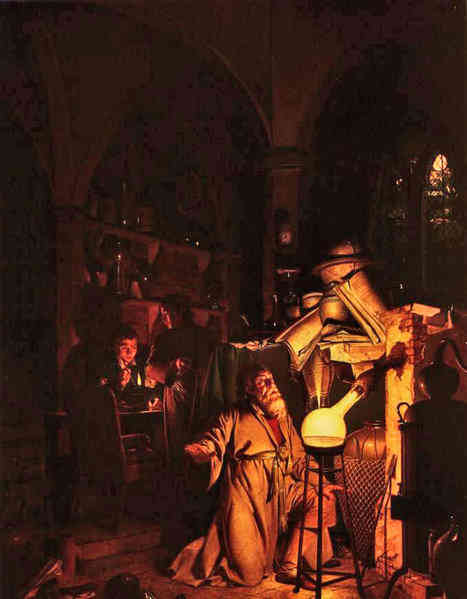
Peloquin’s world-premiere performance of Stephen Burke’s Alchemy revealed this post-atonal piece to be a sculptural essay in chromatics—ethereal, with no clear time-signature. The sustained pedal caused some of the passages to be pretty muddy, although the geometry/acoustics of the barge performance salon did Peloquin no favors in this regard. Alchemists notoriously search and search and fail to ‘find’ [the method to transmute lead into gold], a failure for which Burke takes them to task. The succession of Burke’s sculptural ‘mass-of-sound’ gestures reveals the quixotic nature of alchemical self-deceptions—truthy assertions of dubious trajectory, hermetical inquiries without a discernable rationale or story, abstruse but diverting exercises that, in the end, disserve humankind. (Stephen is a 1984 graduate of The Juilliard School, not the Steve Burke who is a prodigious video-game composer, including the score for Kameo: Elements of Power (Xbox-360).)


 Wright, Alchemist
The Crumb piece was superb. Makrokosmos IV is a 28-minute tour-de-force in 4 movements, for 4 hands playing a miked-amplified prepared piano (3 stainless steel rulers inside, laying on the tuning pins). Prolific sonic textures involving both pianists repeatedly up and off the bench and reaching inside the piano to pluck, damp, de-tune, thump upon, and otherwise tamper with the inner workings of the instrument to create myriad effects.

 Four Hands
At one point, even the page-turner was engaged to knock on the cast-iron armature of the Steinway and assist in evoking imagery of super-nova celestial processes. The emulation of stellar coronal flares was particularly impressive. It’s a violent-but-beautiful universe according to Crumb, and Peloquin and Hidalgo gave a faithful rendering of that naturalistic/pantheistic viewpoint, assisted with a single cardioid dynamic mike running into a 60-watt Roland guitar amp with a little bit of added reverb. (In a way, the Crumb piece was a continuation of the anti-anthropocentric political re-calibration that was introduced in the Lavista piece, Simurg. It is a universe in which humankind does not have a pre-designed, God-given place; indeed, in which humankind has no cosmic friend at all; beauty in the here and now, with difficulty and no possibility of redemption. )

 Marc Peloquin
The Samuel Barber piece, Souvenirs, is an amusing 4-handed character piece that is seldom performed in public settings—receiving here on the barge a convincing reincarnation in the hands of Hidalgo and Peloquin. (Barber evidently had a sardonic fit at the age of 42 when he composed this duet, a critical comment on the esoteric/illogical quality of what is collected: the very nature of what it is to be a ‘souvenir’ and what it means to ‘collect’ such things are lampooned. The ‘Hesitation Tango’ is itself worth the price of admission.)

 Peloquin (left) and Hidalgo (right) at Bargemusic
Peloquin and Hidalgo performed a wry, over-the-top Brahms Hungarian folkmusic send-up as a dazzling-humorous encore, as the barge swayed gently in the East River chop. One of the nicest chamber music outings ever for a delighted crowd ranging from 8 to 80 years old, in a charming, unusual venue. The illustrious and extroverted Olga Bloom gave warm, personal thank-yous to each of us as we departed via the gang-plank. Bravo!

 Brooklyn Bridge

 Olga Bloom, Mark Peskanov


Tuesday, January 1, 2008

Weber: New Year’s Invitation to a Pensive Dance

Constance Keene
I  t was wonderful [just as you played it], but you should speed up at the end... [because doing so would make for— ] good ‘box-office’.”
  —  Vladimir Horowitz, responding to Keene’s query about the rationale for his suggestion concerning Keene’s interpretation of Rachmaninov’s Prelude in E flat minor.
Charm, wit, optimism, comedy, and grace are what music for celebrating the New Year needs. And, for some, maybe this means Blue Danube and other waltzes, polkas, galopps, quadrilles and marches, csárdáses, mazurkas—Eduard Strauss, Josef Strauss, Johann Strauss I, Johann Strauss II. Not my thing.

Renoir, Dance at Bougival
So, for a New Year’s get-together with friends, how about Weber’s Sonata No. 2—just the Menuetto and Rondo movements of it? It’s not an easy piece to carry off successfully—there is tremendous risk that self-conscious, mannered or inappropriate nuances could wreck it. But, overall, the movements of this Sonata have a range of qualities that make them interesting as encores—or as short ‘character pieces’ for an informal gathering.

Carl Maria von Weber
They’re sparkling and not necessarily virtuosic—and they have an impromptu, almost improvisatory sense to them. But, more than this, they are not oblivious to the reality that there are serious problems in the world.

In this respect they’re unlike Weber’s Aufforderung zum Tanz (Invitation to the Dance), which is too self-absorbed and coy. Aufforderung is about wooing. The suitor declares his passionate love for the woman, the couple exchange parting words, and then part ways. It is full of evasiveness, flirting, uncertainty, ambition. And, yes, it’s sometimes performed for New Year’s. But, by contrast, Sonata No.2 feels pensive—as though we are dancing while guardedly mindful of other, more important events.

A  rt perhaps begins with the animal—with the animal at least who carves a territory.”
  —  Gilles Deleuze, in What is Philosophy?, p. 183
Character pieces like this require projection—decent acting ability and a good sense for the part—maybe as much so as more serious pieces. Performing a character piece with the intention of trivializing it would be inappropriate—life is too short. In immersing myself in this Sonata over the past several weeks, I revisited some well-known recordings of it. I especially admire Contance Keene’s and Mariaclara Monetti von Slawik’s. I think of Keene’s performance of this Sonata as a biographical sketch of Weber. Every ‘person’ she mentions gets a quick, sharp, devastatingly exact sketch.

Carl Maria von Weber
And, in Keene’s hands, the Rondo is clearly ‘about’ the audience not the performer. Admittedly, mine is an aberrant notion of ‘biography’, embracing not merely the conventional conceit of a life in book form but also less formal forms that life stories now take in movies, plays, and on the Internet and in music. Is the purpose of biography to celebrate the lives of the famous and notable and to provide exemplars for the rest of us, or to reduce them to their mere humanity and to comfort us in the knowledge that the too are imperfect? Keene’s account of this Sonata is no hagiography—no worshipful biography of Weber as a saint. It’s a tale of Weber and his likely views of the society in which he lived.

May auld acquaintance be not forgot!

van Gogh, Dancehall
Carl Maria von Weber composed the No. 2 Sonata in A flat major at age 30, with a 30 year old’s aspirations. The Menuetto capriccioso is fast and enthusiastic, the Rondo is lyrical and full of aspiration. I wonder whether Pavel Haas, Hans Krása, Viktor Ullman, Gideon Klein, or others imprisoned at Terezin ever wrote quite this way. I doubt it.

A  fter the Holocaust there can be no Art... experiences [are] superficial and unworthy of expression.”
  —  Joseph Amato, Victims and Values, p. 183.
In a Nazi propaganda documentary film about Terezin, Haas takes a bow after the performance of his Study for Strings. The propaganda project concluded, and Haas was shipped off along with 18,000 other prisoners—to Auschwitz where he was murdered in the gas chamber on 17-OCT-1944.

Producing complex but beautiful music under duress was (and is) a defiant and meaningful thing, in context. Music is emancipatory and powerful—much in the way that Cy Twombly’s abstract paintings are powerful and historical and contextual. Music is a valuable response to these times—better than any propaganda. And character pieces are needed now because they can be a force for humanity and sensitivity, against the lies and violence of our time.

T  he traditions of avante-garde art must be seen as responding to an unwanted and intolerable burden of autonomy through gestures that seek to either collapse the distinction between the institution of art and the world outside or to directly bring the political and moral concerns of social life into the center of the work of art itself... Conversely, each attempt to establish the social meaningfulness of art has been met with an equally pointed artistic critique that seeks to demonstrate that the value of aesthetic objects cannot be derived from their moral and political content.”
  —  J. M. Bernstein, in Kemal & Gaskell, Politics & Aesthetics in the Arts, p.53
By learning ‘balance’ in the face of everything inside and outside, we develop a healthy detachment. This detachment isn’t escapism or indifference to the problems of the world. It is a sort of zen-like meditation. That’s what this Weber Sonata enables. That is why I think it makes an especially fitting New Year’s piece, to help us transcend the banal capitalistic world and give a wider vision of an ethics and politics that is inclusive of private spiritual and humanistic themes in each of us.

Carl Maria von Weber
Weber, Sonata No. 2, Op. 39, Menuetto, mm. 1 - 8

    [50-sec clip, Keene, Weber Sonata No. 2, Op. 39, Mvt. 3, Menuetto Capricciosa Presto Assai, 1.2MB MP3]

Constance Keene
Weber, Sonata No. 2, Op. 39, Rondo, mm. 1 - 9

    [50-sec clip, Keene, Weber Sonata No. 2, Op. 39, Mvt. 4, Rondo, 1.2MB MP3]

I  was flabbergasted by the fantastic color, sweep and imagination, and last but not least, by the incredible technique ... I cannot imagine anybody, including Rachmaninoff, playing the piano so beautifully.”
  —  Artur Rubinstein, remarking on Keene’s playing.


Muller, Garden of Eden in Hell