Tuesday, April 15, 2008

Forensic Tuning-ology: Haydn’s Fork and 423 Hz vs. 415 Hz, Back in the Day

 Kohl, fork on resonator box, 1880
H  aydn tells us in his letter that he had to deal with more than one pitch. It seems that ‘Viennese Pitch’ was a recognized standard and that it was considered relatively high. The date of Haydn’s letter suggests that the pitch rose in Vienna in the late 1750s or early 1760s ... One thing is clear: there was no such thing as ‘Classical Pitch’. Different standards existed at different places.”
  —  Bruce Haynes, Mozart and the Oboe, p. 47.
T  oday most players think in 440-415-392 Hz pitch categories, not knowing that the so-called baroque pitch 415 is not older than 30 years, when two harpsichord builders introduced the transposing keyboard. There is a strong evidence that most early 18th century bassoons are much lower than 440 Hz, but I found as many on 408 or 421 Hz as on every other pitch around there. The 415 Hz is a good compromise, since one has to agree on something in a mostly free-lance music scene. But if you get to build a strong, stable ensemble, you can do it differently. A good example is Harnoncourt’s Concentus Musicus. They are playing on 421 Hz since 35 years, just because Jurg Schaetflein’s oboe was happy there.”
  —  Michael Dollendorf, Bonn and San Francisco, International Double Reed Society.
Following my recent post that wondered about Dallapiccola’s tuning, two CMT readers asked questions about baroque tuning, both specifically inquiring about the historical appropriateness of A = 415 Hz for works by Haydn. A415 is about a semitone lower than the modern A440.

One of the question-askers went further and opined that the matter is moot anyhow inasmuch as the answer would depend on the ambient temperature, and we couldn’t possibly know what temperature the rooms were where Haydn composed and performed.

I am no historian; some links below (to Bruce Haynes’s book and others) should prove useful to those of you who care. Haydn’s tuning fork does indeed exist. So does Handel’s. Careful measurements have been made, of their dimensions and of their pitches—at unspecified temperature, presumably ordinary ‘room temperature’ (about 20 °C).

I do know a thing or two about physics and engineering. And I can say without doubt that, unless Haydn were playing either on Pluto or on Mercury, the pitch of that stationary tuning fork would have been (to a likewise stationary listener) imperceptibly different from its nominal 422.5 Hz. The pitch of a fork simply doesn’t change very much, even through wide excursions in temperature.

Here is the equation that very closely approximates the dependence of frequency upon the dimensions, for a tuning fork that has cylindrical tines:

 Cylindrical-tine equation
where
  l is the length of the tines;
  E is the Young’s modulus of elasticity of the material the tines are made of (210 • 109 N/m² for tempered steel at 20 °C);
  ρ is the density of the material of the tines (7.8 gm/cm³ at 20°C); and
  R is the radius of the tines.

And here is the equation for forks that have ‘square’ tines (like the Kohl fork in the photo above), where A is the cross-sectional area of the tines looking down their shafts:

 Square-tine equation
These equations are simplifications. They totally ignore the many harmonics that are emitted when the metal is struck. (Those overtones rapidly die out and only the fundamental is left.) They also ignore any multi-axial anisotropy and any lengthwise or cross-sectional inhomogeneities that result from the particular method of manufacture or heat-treatment or finishing of the fork. They ignore any nonlinear or anelastic behavior.

Finally, here is the equation for how the length changes as a function of temperature in ‘normal’ temperature ranges:

 Delta-length equation
where the thermal coefficient of expansion α is 1.2 • 10-5 °C⁻¹ at 20 °C.

Once tuned, a tuning fork’s frequency does vary slightly with changes in E(T), l(T), and ρ (T), according to these equations. But if Haydn’s rooms were at 10 °C, the fork would only have been about 1.4 cents sharp, and if Haydn’s rooms were at 30 °C, the fork would only have been about 1.4 cents flat—too small a difference to hear.

 Cescotto, Young’s modulus of steel as function of temperature
Besides historical tuning forks, a lot of what we know of historical tunings comes from measurements of wind instruments—organ pipes, oboes, flutes. Yes, of course, the tuning of these is adjustable, but the scratches and markings on the organ pipes—the traces of forensic evidence as to the dimensions these were adjusted to when actually in use—and the comparative dimensions of the set of pipes (or, in the case of the flutes, oboes, and bassoons, the distances between the holes) provide ample guidance as to the actual historical pitch. Tuning forks used by orchestras between 1750 and 1820 mostly had a frequency of A = 423.5 Hz, although there were many forks, many slightly different pitches.

  • 1711: John Shore’s fork, A423.5
  • 1714: Strasbourg Cathedral organ A391.0
  • 1715: English tenor fork, A419.9
  • 1722: Dresden’s Catholic church organ, A415.0
  • 1750: London, inscribed ‘Common music shop fork.’ A424.3
  • 1751: Handel’s tuning fork; the box which contains the fork bears the inscription: ‘This pitchfork was the property of the Immortal Handel and left by him at the Foundling Hospital, when ‘The Messiah’ was performed in 1751.’ A422.5
  • 1772: Gottfried Silbermann Catholic church in Dresden, A415.0
  • 1780: Organ builder Schulz, A421.3
  • 1780: Stein’s fork, A422.6
  • 1780: Stein’s fork for Mozart, A421.3
  • 1780: Organ builder Schulz, A421.3
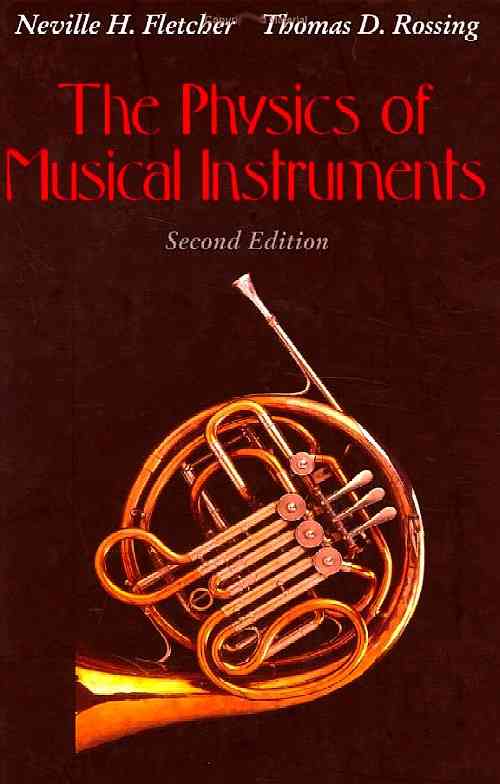
 Fletcher – Rossing book

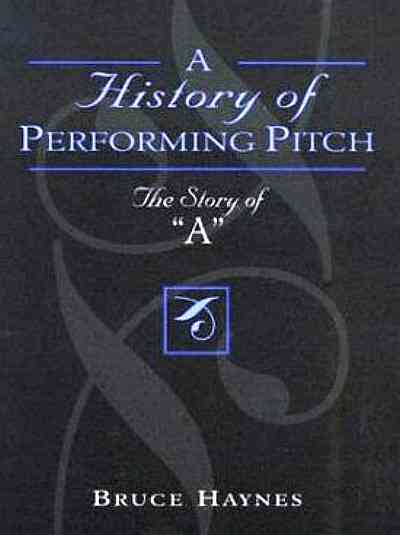
 Bruce Haynes book


Monday, April 14, 2008

14 Apr 08

From Two Tonys (Letter 3)

Two Tonys - A whacker of men and Mafia associate serving multiple life sentences for murders and violent crimes. Claims all his victims "had it coming." His acerbic wit may upset the politically correct.

3-23-08

Greetings & Salutations,

I received your letter of March 8th. Please forgive me for taking so long to respond. Yeah! Like you’re sitting on top of your mail box waiting for my letter. You cad, I know what you’re doing. Now that Mum and Dad are away for holiday (as you Limeys say) you’re playing house with Posh Bird (now that’s a classy moniker). Now let me be honest, I’d rather picture you laying up with Posh Bird than laying in that stinking fuckin cell eating your peanut butter as you wait for the door to crack so you can get to that fuckin chow hall and get your issue of whatever it was they were feeding you. It looked like some kind of rabbit or kangaroo food. No offense. I’ll always recall you out in the middle of that big field in the grass standing on your head or tying your skinny arse into some kind of figure 8.

Hey, I receeived some good books from one of your Brit friends in London. He sent me some Poe, some Into Thin Air, and Little Big Man. All 3 seem interesting, but my point is that was nice of the bloke.

Everything around this place is just as fucked up as normal. Ogre got out. Fuck him.

You asked about my highs and lows of the week here. My high of the week is Thurs night, I phone my kid in Phoenix. I talk to my grandboys ages 10 and 2 ½, sometimes my son-in-law. And I enjoy that call. They visit about every 4 months and that’s a lot of enjoyment. I love them all a lot. OK, that’s enough. I’m getting melancholy. I can’t afford to get melancholy in this shit hole. A man has to stay strong. Would Ivan Denisovich get melancholy? I don’t think Two Tonys can afford it.

You asked for my favorite movie. There’s a few. One is Unforgiven by Clint Eastwood. It was great. He was really fucked up. He did a lot of bad shit over the years. But in the end, when he pulled the plug and said fuck it, he really stepped up to the plate. I liked it. Also a movie called Ryan’s Daughter. Rent it. It’s good. This Irish guy is a rat and they blame his daughter and he lets her take the fall. It’s a good flick. You and Posh Bird will really enjoy it together. Look for the scene where the English officer is watching the sunset on the beach, missing the Irish girl. Like I said, it’s good. I wouldn’t steer you wrong. I’m the one who introduced you to Tom Wolfe when you were still reading Stephen King as you waited for your Big Mac and diet soda with fries. Besides it’s an English movie. Yeah, I said English. You guys do put on a much better flick than that Hollywood shit. Just look at Masterpiece Theater. My favourite was I, Claudius (16 weeks long). I was on the streets and had just got in a predicament where I was hurt and had to heal up for a few months, so I discovered Masterpiece Theater. It’s the best. You mentioned Tom Wolfe. Fuck yeah, he’s still my boy. If you run across a better author, please tell me.

If I could rewind any part of my life it would be a Saturday night in 1974, Anchorage, Alaska. I had a club called The Green Dragon, a rock ’n’ roll joint. It’s Saturday. It’s packed. I’ve had a few drinks. I’m feeling good and I go in the back of the bar to my liquor room to get a bottle or two, and my bartender, a dude named Joe Scanlon, is snorting some coke. So he offers me some and I try it. Bang! I grow about 2 feet. I get a lot handsomer, wittier and wiser. I love it. Then a short time later this hot chick hooks up with my sorry married ass and she loves it. And at first I could really bang, but in the end that shit affects your testosterone or something. It fucked up my whole life. That’s what I would rewind.
Drugs, what a fuck up they are. Look, I’m 67 years old now, and my daughter who I love more than anything in the world has two of the cutest boys I’ve seen, now you know I’d like to pick them up and spend the weekend, but no, I’m doing this time. It’s my fault, but it’s still fucked up no matter how I try to sugar coat it with my PMA.
I’ve been in crime since I was a kid. It was a neighborhood thing, a peer thing. But this other shit. This so called wackin thing. When the fuck did it show up? Sure we cracked a few heads and even broke a couple of arms, but this takin life thing started DD (During Drugs). Was it all business? No. Some was a get even for a so called affront to me. Yeah, I was a tough guy for 10 seconds and now I’m a shower porter and an asshole for 100 years give or take a few. It not only changed my life, but many other things. Victims got Mom, Dad, kids, sisters, but they got in de bizznezz or fucked with the wrong people. It boils down to bad decision making on all sides. Drugs, yeah bro, I’d re-do that shit. I’d keep my mind wired on success. I don’t want to sound like I’m snivelling because the world hates a sniveller.
I’ll do this time, or what I can do of it. I’ll have fun. I’ll watch TV. I’ll read books. I’ll visit my kids. I’ll joke with these jabronies. But if I could rewind, as you call it, I’d rewind the fuckin drugs. Don’t fuck around Shaun! But you know that don’t you?

Death penalty? We discussed this before but I’ll reiterate. Yeah, some motherfuckers need a good killing. People that hurt kids, old folks, nice ladies on their way to the mall, guys on their jobs or resting in their home. Kill kill kill the chomos, the rapos, the abusers of the weak. I faced a death penalty jury twice. They never gave it to me. Why? Because I killed scum. They knew it. The judge knew it. Even the sorry ass punk prosecutor knew it. That’s why I was blasé throughout my rigged trial. Yeah. The answer is kill the ones who have got it coming. Fuck their childhood, their old grey granny in the front row. Kill em. Let the worms eat their ass. Let God sort them out at the Pearly Gates. That’s his job.

Next president? Why New York Governor Eliot Spitzer of course. Any sorry bastard who can prosecute pimps and whores then go out and buy some $4000 ass in the fanciest hotel in D.C. has got balls. I’d vote for the shithead in a second. Seriously though, it’s got to be Obama. The future of the free world depends on his success. Is he a crook and a bullshitter? Hell yes. Aren’t they all? But he’s the best shithead for the job. It sure ain’t that prick McCain – woe is me, woe is me, I got shot down over Nam dropping nepalm on rice farmers, now I can be president with my charity robbing pill popping wife, I never had a real job in my life, I’ve lived off the taxpayers dole for years, let me lead, let me lead, we’ll never leave Iraq, it’s ours, we won it, we’ll never give it up – fuck him.
How about Hillary? – Let me lead, let me lead. I fucked Bill in the White House. I’m very qualified. I was even in the White House when Monica gave him head and he cigar fucked her. Let me lead. I’m qualified.
Bro, as you can tell, my goiter is throbbing. Those bastard crooks. They’re all crooks. But in my opinion Barack is the least crook. He’s the youngest. Let him get a few years and he’ll be Big Crook Obama, you’ll see.
“Power corrupts. Absolute power corrupts absolutely.” Who said that?

Hey mate, do good and know I’m pulling for ya. But let it be known from the East End to the West End – you’re my horse if you never win a race.

Hey! I miss ya,

Two Tonys


Email comments to writeinside@hotmail.com or post them below

Copyright © 2007-2008 Shaun P. Attwood

Sunday, April 13, 2008

Polyrhythms Inside Polyrhythms: Alojz Srebotnjak and the Transcultural Economy of Music-in-Slovenia vs. ‘Slovenian’ Music

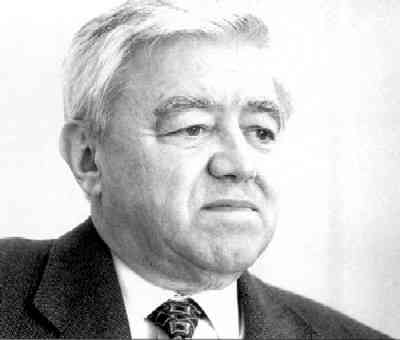
 Alojz Srebotnjak
L  abels, such as ‘traditional’, ‘modern’ and ‘post-modern’ are not oriented toward opposing ‘music in Slovenia’ and ‘Slovenian music’, but toward much more perplexed relations of the ‘cultural economy’—an economy of distributing certain values to the phenomena under discussion... In Slovenia, one could not speak of extreme examples of a ‘bricolage’ after whatever exists. It is not Cagean, but rather Feyerabend-esque ‘anything goes’: thus, we can rather speak of doubts regarding the slogans as ‘cross the border’ and ‘close the gap’. Nevertheless, the idea of openness is significant as an epistemological orientation point. If in fact the demand for differentiatedness is for the Slovenian composers permeated with a kind of (at least imaginary) ‘oceanic feeling’ of attachment to the world and its past, this Freudian metaphor seems ... to be increasingly shrinking the notion about oceans, often quite imaginary and, as a rule, partial. Hence, instead of a demand—there is a wish, or rather a necessity, for recasting the already-recognized ‘aesthetic capital’ by making use of one’s own creative potential through idiosyncratically understood cultural, ideological, aesthetic, or spiritual impulses.”
  —  Leon Stefanija, On the ‘National’ in Music: The Sloveneness of Slovenian Music, 2006.
Dubravka Tomšič (link to page on agent’s website here) gave a spectacular performance last night in Kansas City, to an appreciative crowd who began standing to applaud even before the interval. Her program included a performance of Macedonian Dances (1974), by her husband, the renowned Slovenian composer Alojz Srebotnjak.

Srebotnjak is best known for his film music from the 1960s and 1970s (see IMDB and Slovenian Film Fund links below), more than 60 scores in all. But he has written considerable choral music and a number of important twelve-tone and serialist pieces (link to Slovenian Composer’s Society website here).

There is Slovenian music (domača) and non-Slovenian music (tuja), but there is also music that is neither. This is “ex-home” music (bivša domača): suspenseful and ambiguous, at the boundary of Slovenian otherness. Macedonian Dances are pure Balkan “ex-home”.

The Macedonian Dances are rich with irregular rhythm patterns. These dances, intense and pointillistic, have figures that are, at times, reminiscent of Prokofiev, evoking frenzied Serbian-Macedonian feet striking the floor. Each of these pieces is highly motoric, with accentuated pulse and widely varied dramatic dynamics and tonal colors.

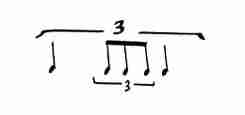
 Triplet embedding
The ostinato repetition of a single, insistent note—a sort of ethnic motivic minimalism—is a fascinating feature of these Dances. The first dance (Allegro vivace) is positively seismic, with percussive rhythms in 7/8 ? The next dance features a pensive motif in major seconds, fit into a bitonal (two different key signatures concurrently) context. The wandering melodic line moves in narrow intervals above the ostinato dance rhythms underneath.

 21-let, composed of 7 triplets
The third dance (Vivacissimo) is tremendously percussive—the sesquipedalian celebrants never trip, no matter how intricate their emphatic ‘steps’. The fourth dance (Adagio) is dark, ruminative, brooding—a meditation on a single note, drumming.

The fifth dance (Allegro rustico) boldly concludes Srebotnjak’s homage to Macedonian culture. This is not a sanitized ‘nice’ representational account of ‘folk music’ or of ‘Serbian-Macedonianness’. This is a raw, documentaristic collage of a cultural psyche in situ, the ‘real deal’, and we now realize that we have been, for these minutes just past, inadvertent anthropologist-observers of something very private, exotic-esoteric, and maybe taboo.

Presenters who wonder about the breadth of the appeal that a rhythmically esoteric and intermittently bitonal piece like Macedonian Dances may have for their audiences need not fear. This conservative Kansas City Friends of Chamber Music audience leapt to their feet in applause.

 Groys book
The Macedonian Dances ‘export’ succeeds, not only as a compelling ‘new music’ statement but also as an intercultural political-economic one. The ‘central banker’ in this polyrhythmic ‘economy of passion’, Dubravka and her interpretive ‘monetary’ powers are well-matched by Alojz and his creative and appropriational ‘musico-fiscal’ powers. It was a magical bivša domača evening, beginning to end: a most favorable balance-of-trade. Thank you, Dubravka. Thank you, Alojz.

 Insistent polyrhythm
F  irst of all, how many people off the street know who ‘Rach’ is? This uninformed notion that everyone likes Rach and no one likes ‘new stuff’ is annoying. The problem begins with the notion that ‘broad appeal’ is necessary for great art.”
  —  Greg Robin, Univ Alabama, NMB, 23-MAR-2008.
H  ave what it takes to write a Rach 2? Commission me and find out.”
  —  Phil Fried, ClassicalLounge.com, on the oppression of canonical works and people who obsess over them.
 Slovenian coat of arms


Saturday, April 12, 2008

Dubravka Tomšič and Beethoven’s Appassionata: How (Why) Does the Andante con Moto Work?

 Dubravka Tomšič
I  f experiences and only experiences have ‘intrinsic’ value, then it would seem that playing Beethoven’s Appassionata with great pleasure is no better, intrinsically, than a perfect hallucination.”
  —  Robert Audi, The Architecture of Reason, p. 99.
T  he ‘Appassionata,’ in common with most of the works Beethoven wrote in the first decade of the 19th century, is a study in thematic tenacity. His conceit at this period was to create mammoth structures from material that, in lesser hands, would scarcely have afforded a good sixteen-bar introduction. The themes, as such, are usually of minimal interest but are often of such primal urgency that one wonders why it took a Beethoven to think them up.”
  —  Glenn Gould, 1974 liner notes.
Dubravka Tomšič performs this evening in Kansas City. Among the works on the program is Beethoven’s Piano Sonata No. 23, Op. 57, ‘Appassionata’. Her performance and interpretation of this belovèd piece manifest a charming, distinctly Slovenian perspective.

Slovenia is this beautiful, mountainous place with about 2 million people—83% Slovenian, 2% Serb, 2% Croat, 1% Bosnian, a few Hungarians, Italians, and miscellaneous others. Approximately one third of them live in towns with more than 10,000 inhabitants—Ljubljana, Maribor, Kranj, Celje. The rest live in 6,000 villages—remarkably rural-alpinaceous (just 99.1 inhabitants per square km), a people whose birthright includes a vehement sense of individuality, urgency, and intense interiority. Not coincidentally, Gustav Mahler began his artistic career in Ljubljana, as conductor of the then Stanovsko gledališce (State Theatre) …

But the Slovenian ‘outward’ perspective is very much in sway today. Slovenia has the presidency of the Council of the EU during the first half of 2008, for one thing. It is the first post-communist country to hold the EU presidency, highly symbolic. And there are a phenomenal number of arts and cultural exchange events initiated by the Slovenian Culture Ministry, in this first half of 2008. It is part of the broader European Year of Intercultural Dialogue 2008.

 European Year of Inter-Cultural Dialogue 2008
And Dubravka Tomšič has, in years past, taken time out from her busy performing schedule to speak about her life in eastern Europe and about “Coping with Crisis: International Responses to Instability and Conflict in Eastern Europe and Eurasia” and the role of international music commissioning and touring and cultural exchanges in the sustainability of cities and societies. She is a veritable one-woman International Relations Council.

Each piece, each performance, is imbued with a remarkable inter-cultural wisdom that vivifies our understanding and appreciation of the piece. Beethoven’s Op. 57: the massive first movement; the brief, rapt variations in the middle; the massive bookend of a last movement—in Dubravka’s hands these have the effect of altering our perception of time. The fleeting middle movement makes me aware of the transitoriness of everything; makes me wonder how we humans can ever think that anything of value will last, at all. And yet, here is this sonata, standing as a testament to the durable, intrinsic value—in human endeavor, and in this music—transcending many generations. It’s an astonishingly optimistic feeling that Dubravka conveys to us through this Beethoven.

 Robert Hatten book
If there are intrinsically valuable things other than experiences, then our awareness of their value must be achieved through experience: what is ‘good’ in the Appassionata is appreciated in hearing it or playing it. In itself, it doesn’t enter our lives except by performance. And, if it’s unperformed, then (at least part of—) its value is unrealized. So non-experiential goods have ‘inherent value’, distinct from ‘intrinsic value’ and ‘instrumental value’. Robert Audi, a philosopher who has written about these topics, says that rationality allows, but does not require, that there are things of intrinsic value other than ‘experiences’. I rationally desire the intrinsic value of this belief in the durability of humanity that Dubravka expounds; I urgently want it. But there is this dramatic tension, a worry that it may not be so, a worry that some accident might prevent it. Dubravka the Acrobat, on a Beethovenian ‘tight-rope’, defies the odds, scoffs at danger.

 Robert Audi rationality book
O  ne way to see how construing some intrinsic desires as ‘rational’ makes sense is to consider how we assess rationality in people. Can we even conceive of rational persons who are indifferent to their own physical freedom or to their own happiness or suffering—not in the sense that they cannot sacrifice freedom or happiness or endure suffering for certain reasons, but in a sense that implies having no desire to achieve the former and to avoid the latter? It may be that we can be manipulated so as to have no desires whatever, at least for a time. But the question is whether one can conceive a rational person who has desires, but none that are both rational and intrinsic. This seems doubtful … The question here is whether there are rational intrinsic desires, not whether there are any that are non-egoistic.”
  —  Robert Audi, The Architecture of Reason, p. 72.
Just as a defensible belief need not be ‘knowledge’, rational action need not be ‘successful’—need not achieve the goals and intentions of the actor. Rational values and rational desires need not be ‘correct’. Just as one can rationally believe a falsehood or rationally seek a goal by insufficient means, one can rationally value or have a rational desire for something that turns out to have a different value or, ultimately, be unworthy of desiring. This thought occurs to us during this sonata…

N  ature is at once psychologically economical and normatively generous. Perception under-determines belief, producing far fewer beliefs than it can support. But it over-determines justification, providing justifying grounds for far more beliefs than we normally form and yielding far more justification than we need as warrant for the many beliefs that we do form. Hearing is quite like seeing in all this. There is the auditory experience of the music; there are certain beliefs evoked by it; and there are dispositions to form beliefs should appropriate needs arise.”
  —  Robert Audi, The Architecture of Reason, p. 14.
David Greene temporality book
And the thrills and spills in this piece get even more harrowing. The time-shifting in the second movement of the Appassionata is not ‘apocalyptic’ per se but it is intensely eventful, and it reveals to us the radical non-necessity of the human condition and the occurrences within a given life. Nothing has to happen. Everything is contingent. Some of it happens logically and is amenable to rational desire and action. And other of it happens illogically, uncontrollably, unpredictably. Dubravka launches herself from the platform, executing three turns in mid-air…

T  o say that Hegel and sonata-allegro form rejected Newtonian temporality is not to say that either one presented change as ‘apocalyptic’. Where one fears or hopes that change will be apocalyptic, the past is seen to have been completely repudiated and the future is regarded as a radically new beginning... The very popularity of sonata-allegro form suggests that most middle-class people of the time [1770s - 1830s] did not feel they were undergoing an apocalypse. In the temporality projected by sonata-allegro form, the present calls a future into being. This future is genuinely responsive to the past, unlike the future in an apocalyptic temporality. Yet it also feels like a fresh occurrence, an eventful occurrence, and not one that happens by logical or mechanical necessity—i.e., unlike future occurrences in Newtonian deterministic temporality... The thrust of Newtonian temporality is to see all occurrences as predictable and ‘uneventful’—as occurrences that cannot not happen.”
  —  David Greene, Temporal Processes in Beethoven’s Music, p. 18.
 Beethoven, Piano Sonata No. 23, Op. 57, Second Movement, mm. 1 - 4
The second movement, the Andante con Moto: a short theme and variations on a slow, reverential tune in D-flat, comprising two eight-bar sections with repeats. The second ‘section’ starts in A-flat major, with variations as follows:
  • derivative of the original theme, with the l.h. playing up-beats;
  • elaboration of this theme, in sixteenth notes;
  • embellishments, in thirty-second notes; and
  • a reprise of the original theme, with small, destabilizing changes.
Instead of resolving peaceably, the closing pair of diminished 7th chords, the first pianissimo and the second fortissimo, propel us right away into the third movement, quite unexpectedly, even though we have heard this and played it ourselves often. How is it possible that this can perpetually captivate us as it does?

 Beethoven, Piano Sonata No. 23, Op. 57, Second Movement
It does it, I think, by creating a special urgency—a sense that something eventful is ‘next’; a futurity that we feel intense desire to be part of and to find out about; something that we wish intensely to know or believe, and we don’t know what it is yet. Beethoven (Tomšič) will tell us, and we look forward to this, urgently.

T  he key to feeling the powerful pull of the future in the first movement of Op. 59 [and in Op. 57 and other works] is recognizing the shape of the first theme, of the exposition as a whole, and of the movement as a whole, and then realizing that these shapes are identical. The key to hearing this shape is to notice the discrepancy between the places where the note-to-note continuity is broken. In the sonata forms of Beethoven’s predecessors, the points where the flow halts usually coincide with the points where change occurs, and it is precisely these coincidences that create the identifiable entities or sections that are analogous to one another in the various sonata-allegro movements. In Op. 59 Beethoven gives his listeners clues enough to assure them that they are hearing a sonata-form movement, yet he deviates from the expectations the form implies by putting strong caesuras [half-notes, held, as though a pause in development, as though on one end of the arc of a trapeze ... ] in the middle of themes and in the bridges, while the note-to-note continuity is so strong that one does not hear articulated ‘sections’ that could be identified as a ‘bridge’ or as an ‘exposition closing’.”
  —  David Greene, Temporal Processes in Beethoven’s Music, p. 73.
You see, some things we believe are believed ‘through’ (and on the basis of—) one or more other things we believe. The former beliefs are indirect, ‘inferential’ beliefs. But what we believe non-inferentially through, say, perception is not believed on the basis of some other belief. We believe it directly, from the experience. These beliefs are ‘perceptual’ beliefs. Something outside us produces belief without needing any prerequisite justification. The priority isn’t temporal, although there may be (and often is) a temporal gap—the rapt variations of this second movement, bookended by the first and the third movements of the Appassionata. The first movement is an arc; the second movement is executed in mid-air; the third movement is the trapeze caught and a new arc again.

But each of us different people has different capabilities—different capacities for action and for belief-formation. It seems evident that the virtuosic playing of which Dubravka Tomsic is capable enables her to believe ‘directly’ and ‘perceptually’ what others of us can only come to believe ‘inferentially’. We marvel at this. The virtuosic acrobat, the mighty Dubravka, intuits directly where the trapeze will be, at the instant when it will be needed and met. By contrast, any acrobat who anticipates the trapeze through inferential belief is a bad, soon-to-be-injured acrobat. More than mere musical virtuosity, Dubravka’s account of the Appassionata is a consummate demonstration of the importance of primal urgency, and of mindfulness of time and of the future. She shows us that, in this era of inter-cultural flux and globalization, it is possible and desirable (necessary?) to be a virtuosically urgent futurist. Working without a net.

 Max Beckmann, Acrobat on Trapeze, 1940

 Slovenian coat of arms


Friday, April 11, 2008

11 Apr 08

The Removal (Part 1) by Xena

Xena - A transsexual giant and Wiccan priest. The charismatic leader of Cult Of Xena (COX). Tattoos include a wasp on his penis and ant trails running up his legs. Recently cut off a testicle, as told in this series.

Waking up on the morning of March 6/08 was nice. I had all the desire, when I rolled out of bed, to remove those unwanted glands which dangle between my legs. The surgery I would perform would test my mind and my ability to tolerate pain. The night before I had done a hydrocolonic so my intestines would be clean. Today I would be fasting and would continue to fast for several days after my surgery. Having to shit with dilated nerves connected to the prostate gland would be very painful. Of course, this was my first surgery.

I made my bed, then a cup of coffee. It was good coffee, made just the way I always make my morning coffee. I brushed my teeth, combed my hair, and shaved my face. Only this morning, unlike any other morning, I could not make a clean scrape without bleeding. I had so many bloody spots on my face it looked like I’d been hit with buckshot. I remember reflecting on this and thinking superstitious thoughts. Maybe Goddess was trying to let me know that today was not a good day. Had I had the TV Guide I would have read my horoscope. Or maybe I should have laid the cards. But I thought I was just being plain silly!

My cellie, this young gay boy everybody calls Bamby sat upright and asked, “What time is it?” rubbing his eyes and looking disorientated. He did not seem to be focussed within reality.
“Four thirty-seven,” I replied.
After placing his hand to his forehead and pressing for a moment, he said,”Oh.” Then he laid back down and fell asleep again.

I exercised, doing a warm up and stomach crunches. This is beginning to become a habit for me at 4:30 AM. I like it. I feel alert and energized when I am outside doing my yoga. I was just within breath 5 of downward facing dog when my door popped open. I thought this was kind of weird because I was usually done with my exercise before having to leave for the rec field. I looked at the clock but could not read the numbers. They were all jumbled as if the battery were going bad. I picked up the clock, removed the battery, then replaced it and now the screen was blank. I know I had just placed a brand new battery in it. Bad feeling, superstitious, I am getting worried. I had to shake my head and jostle the goosebumps from my body. “Coincidence, plain simple coincidence, that’s all!” I said to myself and looked at Bamby to make sure he did not catch me speaking to myself.

I put on my sweat pants and shirt. I made sure that my penis was properly tucked between my legs so as not to show when I was walking in front of other people. I put on my shoes and laced them then went to the sink and snorted some salt water waiting for me in a small dish. This is my morning ritual. I put on my coat, grabbed my I.D., and left the cell closing the door behind me with aloud clang!

It was time for yoga. I went to the small rec field and out there waiting for me were my other sisters. First was Angel. Angel is what anybody would believe without a doubt was a woman. She has long black hair, brown eyes, freckles, is thin with a very shapely body, small breasts and stands 5’11” tall. She even made the warden question why she’s on this yard and not within the women’s population. When she walks, every man on the yard stops and stares. No matter how long she has been here they still do.
“Hi girl,” I said as I embraced her within my sisterly hug.
She gave me a wink, and looking every bit a fashion model, she turned and began speaking to one of her friends.

Now Amber came up to me. She placed her hand under my chin and pushed my head up. This of course was purely customary. She did it in order to tell me to keep my head up. Smiling, I put my hands out in order to receive a hug. She complied. Amber is a friend I have known for about 12 years. We were lovers once. But now I don’t have any feelings of that sort for her. Amber has long blond hair balding on top. She, like me, is a (GID) [Gender Identity Disorder] who tried for many years to fit in as a man. When one day she decided, Screw it! She got real with herself and came out of the closet. And also like me she is covered in skin art. We are now very good friends.

Now Crystal came up to me, and we embraced. Crystal is tall – blond hair, green eyes, thin and also covered with tattoos. She is very wiry, and talks an awful lot. I, however, appreciate this because my mouth needs a break every once in a while so as to give my ears a chance to work.
She gave me a big hug and I, hugging back, said, “You’re lively this morning aren’t you?”
“Why should this morning be different from any other morning?” she said, flipped the hair from her shoulders, snapped her fingers and walked away from me.
I laughed. She sure did have her moments.

I turned, and standing there was Noonie, Angel’s soul mate but not lover. He’s a short stout Mexican. Black hair, brown eyes, and hairy. He’s a very good looking gay boy pretty boy. In my opinion, a very sexy man. One whom I have wanted to make love to since I met him. Keeping this in check is very hard indeed. I tell myself that thinking about it is not doing it, however wanting to is pretty damn close!

The four of us walked up to the basketball court, and each in turn gave Gina (of the Bon Voyage Balls blog series – of course we all know about her already), a big and glorious hug.

Yoga was fun as usual, we always seem to have a blast. Yours truly never seems to have enough sense to shut up. The whole time I kept talking about my titties vs Angel’s titties vs Noonie’s man titties. We were doing breaks in routine, feeling one anothers breasts and saying how much more we appreciate our own mams than the other while of course we were accentuating our bodily movements to look as seductive as possible for all the other Orangemen who were on the yard enjoying our display. Five firm and sexy asses all lined up and bouncing up, then down, up then down, then up where they would swing to and fro coupled with our combined oohs and ahs. This of course was completely unfair to all the Orangemen who share the yard with us every morning. Their hands rubbing their crotches and their eyes bugging out. It leaves me to wonder, Can a man get cancer from rubbing so much lotion on his penis every day? If this is true then every Orangeman here is susceptible.

After yoga we separated. We all live in separate pods and have our own cellies. Mine, Bamby, was waiting for me when I got back to my cell. He was sitting on his bed drinking a cup of coffee.
“So how was yoga?” he asked.
Before answering him, however, I glanced at the clock and noticed that it was working again.
“Is that the right time?” I inquired, while reaching over and picking it up.
“It should be,” was his answer as he pushed the up button on his TV, looking for a channel which displayed the time. CNN as usual had their display on and our clock was spot on.
I asked, “Did you do anything to this clock this morning or last night?”
“No. Why?” he said, looking thoroughly confused.
“I was just wondering,” I said, not wanting to talk about it any longer. I changed the subject and answered his first question as I began to get undressed and ready for a shower.

I showered and when I made it back to my cell the officer in the tower announced that we should standby for breakfast.
“Just in time,” I said to myself as I walked into the cell. I brushed my hair and put on my clothes. While I was tying my shoes all the other cells began to pop open, and the officer in the control room was yelling, “Chow time. Chow time.”
I went but did not eat breakfast.

During these times I often wonder how my friend Shaun Attwood is doing. He is one person in my life I truly miss as much as my own family. If he were here he would be holding his pad of paper and his pen going willynilly from line to line jotting down all the spirited hijinks I display on a daily basis. He would be commenting on things I say, laughing and saying how spontaneous I am. Now, however, those times are over. I usually just eat my meal and like most Orangemen just keep to myself.

However today was certainly beginning to jump off as a strange day indeed. When I left the chow hall, there was this young and good-looking Mexican named D-Boy.
“Hey Xena. What’s your name is!” he yelled from the rec field when he saw me exit the chow hall.
“What’s your name is!” I yelled back to him, shaking my hips and bending forward blowing kisses Marilyn Monroe style.

This of course was not unnoticed by the rest of the yard. Orangemen began to line up on the fence, and began yelling, “What’s your name is!” They looked like a chorus line of rough and tumble half dressed and tattoed men with their arms over one another yelling things like, “Xena, I want to be your man! Xena, I just want to live on your floor and serve you! Xena, you are my queen, and I love your country or none!”

The officers at this point were trying to establish some order by yelling onto the yard, “All inmates step away from the fence. Inmates leaving the chow hall must leave in single file including Xena.”
At this I looked up to the gun tower and said, “You will never be a cultist, nor know the reality of being free within your own mind.”
One officer said, “Since when do you know anything about being free?”
“Better than you’ll ever know anything about being free,” I replied.
“Yeah, and just how is that?” he asked as he began to hold his rifle in a menacing way.
“Because I am a prisoner, and yet I am free,” I replied and looking away I began to walk outside the line as was ordered.
The officer just watched not wanting or caring to repeat his order.

The Orangemen kept chanting and professing their undying lust and service to me while the guards had to listen. Things were beginning to become quite chaotic when an officer asked if I could ask the chanters to leave.
I began to blow kisses to one and all. Raising my hands into the air, I said, “My admirers, my children, my lovers, any and all of you are worthy of my devotion to your slavery and promises to me, your queen. Now you must dispense and lust me from afar. Your brave devotion to me this morning will be rewarded and my lusts pacified.”

At this point the Orangemen began to dispense and the guards could only gawk with awe at the sheer magnitude of representation.


Email comments to writeinside@hotmail.com or post them below

Copyright © 2007-2008 Shaun P. Attwood

Thursday, April 10, 2008

Chamber Music Economics: Divisibility of Time and the Monty Hall Problem

 John Tierney, Monty Hall Problem game
I  don’t know that there’s clean evidence that merely being asked to choose between two objects will make you devalue what you didn’t choose [in Monty Hall ‘Let’s Make a Deal’ choice situations]. I wouldn’t be completely surprised if this effect exists, but I’ve never seen it measured correctly. The whole literature suffers from this basic problem of acting as if Monty’s choice means nothing.”
  —  M. Keith Chen, quoted in John Tierney, And Behind Door No. 1, a Fatal Flaw, NYT, 09-APR-2008.
Most of the assumptions of normal mathematical models of exchange economies are violated in the case of arts markets, including live chamber music. The goods (the performances) are indivisible, yes, but the consumers’ economic ‘utility functions’ are nonlinear as well. The money that is used to pay for attendance is perfectly divisible, yes, but the time needed for attendees to consume the goods is only coarsely divisible (the performances are scheduled few and far between, and are often 90 minutes to 120 minutes or more in length), this in a competitive landscape where other goods’ consumption times are short, interruptible, and selectable ad lib. Thank you, Apple and iPod.

Despite the violation of assumptions that simplify mathematical analysis, live chamber music does constitute an exchange economy and does generate what economists call non-negative, superadditive transferable-utility (TU) games. As such, economic TU games usually exhibit price equilibria, in which case the TU game is said (mathematically) to be ‘balanced’. Conversely, if a TU game satisfies the mathematical criteria of ‘balance’, then it generates an exchange economy in which a price equilibrium exists. A recent paper by Meertens at the University of Nijmegen shows how this is so.

In fact, the ‘superadditivity’ property is a natural correlate of the at-best coarse divisibility of each person’s time. The time interval occupied by a concert may be considered to be the sum of smaller chunks of time. And the implicit total price or ‘opportunity cost’ of attending the concert is not merely the sum of the prices of the smaller chunks. The implicit total price is not less and, in general, is greater than the sum of the prices of the smaller chunks with which the concert competes. The whole is greater than the sum of the parts. Never mind the cash price of the concert ticket. That does matter, as to whether a person will attend or not and as to whether a price equilibrium for ticket prices will exist. Of course it matters. But a far larger component—one that’s been undervalued as a driver of the classical music market—is the value of large chunks of consumers’ time. None of the market research on this—the RAND / Knight Foundation studies, and many others—none of it has considered time as an economic variable.

Consider an exchange economy e with a finite set I of agents (whose elements are denoted by i, j, ...), a finiteset R of indivisible objects (whose elements are denoted by α, β, γ, ...), and a perfectly divisible good called money. Agents’ preferences are quasi-linear: the utility that agent i ε I derives from consuming a set of objects A can be characterized by a reservation value V(i, A) which represents the quantity of money that agent i is ready to sacrifice in order to consume the objects in A. The utility of agent i holding ei units of money and the set A of objects is thus For all i ε I, the reservation value function V(i, .), defined on the set P(Ω), is assumed to be weakly increasing [V(i,A) ≤ V(i, B)] and to satisfy V(i, 0) = 0. Agents’ endowments, (Āi, ēi), with ēi ≥ 0 are assumed to be such that ēi V(i, Ω), for all i . This assumption implies that whenever the price of a set A of objects is less than the reservation value V(i, A), agent i can afford to buy the objects in A.

An ‘efficient’ allocation or assignment σ of the goods to the consumer-agents must satisfy this equation, according to Beviá and colleagues:

 Efficient Goods Assignment
A price equilibrium exists if the agents have a non-zero utility for at most one good or if all of the choices are identical. But what happens if the goods are not equal and perfect substitutes for each other? Beviá and colleagues studied the situation where the marginal utility of an additional item in a “bundle” of items decreases when the bundle of goods to which it is added gets larger. This is called ‘submodularity’. They studied the following simple example, involving 3 consumer-agents and 3 goods.
  α  β  γ  αβ  αγ  βγ  αβγ 
V(1,A)  10  8  21311  914
V(2,A)    8  51013141315
V(3,A)    1  1  8  2  9  910

The only efficient assignment σ of goods in this economy is such that σ(1) = β, σ(2) = α , σ( 3 ) = y. Suppose that p supports this assignment. In order that buying { α β } is not better for agent 2 than buying only α, p must be such that p(β) ≥ 5. In order that saving the money and buying nothing at all is not better for agent 3 than buying γ, p must be such that p(γ) ≤ 8. In order that buying α is not better for agent 1 than buying β, p must be such that p(α) ≥ p(β) + 2. In order that buying γ is not better for agent 2 than buying α, p must be such that p(γ) ≥ p(α) + 2. Combining these inequalities gives 7 ≤ 2 + p(γ) ≤ p (α) ≤ p(γ) - 2 ≤ 6, which is mathematically impossible. So this 3 agent - 3 object example of an exchange economy is one where the optimal assignment of goods is not supported by a a price vector. The TU game exists and the exchange economy e exists, but a price equilibrium does not exist (with the utilities and reservation values / preferences, for these particular agents).

If agent 2 has objects α and β, then the marginal contribution of α is equal to its value V(2, α) since V(2, αβ) - V(2, β) = 13 - 5 = 8 = V(2, α), while if objects α and γ are combined the marginal contribution of α is much lower: V(2, αγ) - V(2, γ) = 14 - 10 < V(2, α). For agent 2, having object β at the same time doesn’t subtract any of the value of α while having γ lowers the desirability of α. So the exchange economy in these objects exhibits this funny type of inter-dependence. What you have chosen matters. (You are acting, in your chamber music consumption patterns, as if what your significant other, Monty, has chosen does mean something?)

Well, not exactly. This type of inter-dependence is unrelated to the Monty Hall Problem and its different type of interdependence. In Beviá’s example, money is infinitely, perfectly divisible. And the example implies that there is no good that was demanded by agent i by reason of its being particularly well-suited to accompany a good that agent i was already committed to owning and consuming, but instead implies that there are goods that agent i does not demand because the good that agent i already is committed to has become more expensive. Agent i declines to attend a chamber music concert, not because the ticket price and parking price are too high, but rather because of the time-cost in the context of existing commitments/choices.

In this regard, chamber music presenters should consider that ‘time is money’, as they say. Each potential concert-goer’s time is infinitely divisible, just as money is infinitely divisible. But a concert experience represents a considerable implicit time-cost, on account of the event’s duration, plus the durations of all of the logistical actions that are collateral to attending (driving, parking, etc.). As such, attendance at a concert—even a ‘free’ concert—carries a high and, over the past 10 years, increasing time-cost, relative to the other goods in the entertainment and cultural economy with which concert attendance competes.

There have been experiments—many of them over the past 10 years or so—in changing the length and format of classical music concerts. None so far has been particularly successful, and some have failed miserably, enraging long-time patrons who booed or revolted when their treasured, time-honored ‘good’ had, in their view, been tampered with beyond all recognition. So the aim of the game-theoretic ideas above is not to suggest that concerts need to be shorter or more numerous or scheduled on different days-of-week or times than is presently being done.

No, the aim of acknowledging recent developments in game-theory and mathematical economics modeling in this post is not to recommend game-theoretic analysis as a source of new, quantitative ways to address the situation that chamber music presenters (and classical music performers and agents, and the arts in general) find themselves in today. The aim instead is merely to say that game-theory can explain many aspects of why things are the way they now are.

There is little solace in this, I admit. Except, perhaps, the realization that the same long-duration time-indivisibility and tee-time quantization and ‘money-value-of-time’ factors have also led to progressively declining annual golf ‘rounds-played’ stats, as documented by the National Golf Foundation, over approximately the same post-internet time interval that has affected classical music events. The same factors are affecting the economic regimes of other long-duration event markets as well. Classical music is not alone in this.

Solace or not, the analyses by Beviá and Bikhchandani and Meertens and others do provide a rational basis for chamber music presenters’ not pursuing strategies that have little hope of succeeding in building audience and cashflow, and do provide a methodology for properly conducting analyses of new proposed strategies that come from brainstorming and other sources, before investing in and committing to those strategies.

 John Tierney, Monty Hall, Door-Goat-Car


Tuesday, April 8, 2008

08 Apr 08

From Xena (Letter 2)

Xena - A transsexual giant and Wiccan priest. The charismatic leader of Cult Of Xena (COX). Tattoos include a wasp on his penis and ant trails running up his legs. Recently cut a testicle off.

4/3/08

To my dearest friend Shaun,

I love you! I hope you and your squeeze are well. I am sending the first part of “The Removal” to you. I have been in a great amount of pain. The prison’s Health Unit will not allow me any pain pills since I’ve been back from the hospital. They are truly sadistic people.

The bastards who rolled up my property stole things which I had paid for before I did this. Most of my hygiene, stamps and clothing are gone. And for a very long time I was on self mutilation watch, which means a cell that has nothing in it + I was butt assed naked with an officer posted at the cell 24 hours a day. It sucked!

I’ve been out of lockdown for two days. I got these stamps from someone who has had them for 3 years. I lucked out. So now I am writing you this. I don’t know when I’ll be able to send you the next letter. It may be a while. I have no way of buying any stamps. Sometimes I wish I were a prostitute. But, I can not break that barrier in my mind.

I love you! I always think of you! I am glad you are doing well.

Love

Xena


In tiny handwriting, Xena wrote fourteen sides about the orchidectomy. After a certain point in the story, I couldn't stop squirming. It would take the rest of the day to type it up, so I am going to serialise it. I'll probably post the first installment in the next few days.

Email comments to writeinside@hotmail.com or post them below

Copyright © 2007-2008 Shaun P. Attwood