CMT:
CMT: Early Music History is devoted to the study of music roughly from the early Middle Ages to the end of the seventeenth century. But why stop there? Why not go back further, to Dark Ages, to Roman and Greek times, to Egyptian or Phoenician times, or to Neolithic times, to the extent the archaeological record provides evidence for us to base the work on?
DSM: The survival of some archaeological fragments of instruments gives us one type of evidence, but don’t we really require some scores or fragments of scores? Surely you don’t mean that “recreations” of early music should devolve into purely conjectural composition, relying only on the properties of the physical instruments—or fragments of them—to guide the composer and performers!
CMT: Whenever the historical record is thin there’s a temptation to extemporize, to fill in gaps in a speculative way, or to engage in revisionist historiography—‘revisionist’ in the sense that the account is fanciful or biased according to which bits enter into the musicologists’ consideration. The processes that led to the preservation of some bits and the destruction of other bits are highly susceptible to socioeconomic and political power and other factors that differ among various segments of a society. Topography and the progress of urban civilization somewhat delimit what is possible to do, in terms of musicological history. For example, the archaeological record is scanty in rural areas, so the process is predominantly one of urban musicologicoethnography. So the propensity for historical evidence to survive strongly favors those factions who were in locations that were centers of power and wealth—and these of course were, and are, mostly cities. Some exceptions are folk instruments in closely-knit cultures. Medieval Wales, for example.
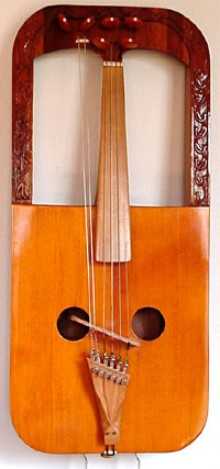
DSM: Oh, yes—the welsh crwth (“crooth”) evolved as a member of the lyre family. After about 800 C.E., a fingerboard was added and the crwth became, basically, a bowed lyre—a precursor to the modern violin. At one time crwths were widely used in Ireland, Scotland, and in Continental Europe, but by 1800 crwth playing was in decline, confined pretty much to Celtic Wales. But there’s been a recent revival of crwth playing in Early Music ensembles. And crwth-maker Hank Taylor was one of the exhibitors at last week’s Boston Early Music Festival. He played a medieval tune for me on one of his instruments when I visited him at his BEMF booth. Bwth?
CMT: Yes, I stopped by his booth too. The crwth bridge has this footed bridge — a ‘descender’ that extends through one of the bass ‘f-hole’ and serves as a
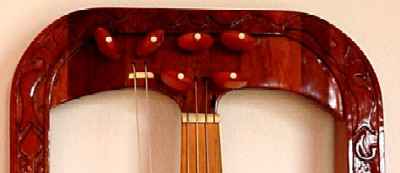
de facto sound-post. Over the fingerboard, there are four pairs of strings, which can be stopped. There’re also a pair of bass drones that can be bowed or plucked by the thumb. Several historical tunings for the crwth have been established.
DSM: The crwth’s back, sides, and yoke are made of walnut, the top is spruce, and the fingerboard and tailpiece are maple. Beautiful, delicate. The construction and placement of the tuning pegs do make it difficult to keep the instrument in tune. Hank Taylor mitigates this problem by using modern fine tuners. All other aspects of the instrument’s design and construction are faithfully reproduced from historical instruments. Taylor’s crwths are careful copies of the crwth in the Boston Museum of Fine Arts Historical Instrument Collection.
 CMT:
CMT: Besides Taylor, a number of other modern crwth reproductions have been made, by Guy Flockhart, Nial Cain, and Gerard Kilbride, to name a few. A handful of early music artists are reviving the tradition of playing this instrument, among them Cass Meurig, Bob Evans, and Dan Morris. The repertoire of surviving crwth tunes is tiny, but arrangements can readily be prepared of various traditional tunes. And new works are being written for crwth as well.
DSM: The crwth can be played on the shoulder like a violin, between the knees like a viola da gamba, on the lap (either upright or at an oblique angle across the player’s torso against the left shoulder), or braced against the chest and supported with a neck strap. While the crwth can be held at the shoulder, it’s hard to play the drone strings with it in that position. The sloping bridge strongly suggests that the oblique-upright position across the upper body was used to allow the bow to be pulled upward without rubbing against the bridge, and to allow easier plucking of the drone strings. The acute angle of the bow to the strings would have produced a harsh timbre, one that some performers actually prefer for the effect they want to achieve. But, because the art of crwth-playing died out so completely, the tunings employed and the details of performance technique will probably never be known with any certainty.
CMT: The tone of the crwth can seem rough compared to that of the modern violin. And the crwth can be played only in what string players refer to as first position, with the left hand at the far end of the fingerboard rather than moving up towards the bridge. Listening to Hank Taylor play, though, it’s clearly capable of a delicate sound. For all its technical limitations, the crwth is obviously much more than a historical curiosity.
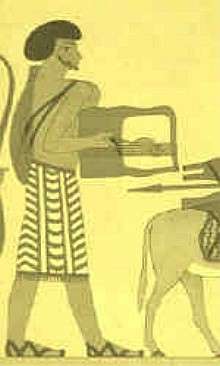
DSM: The ‘modern’ crwth appears to date from only the late fifteenth or early sixteenth century. Almost surely it’s not, as some accounts assert, the same instrument that was played by Egyptians or ancient bards. According to Taylor, the crwth’s close ancestors became instruments of the folk culture of Wales and the West Country and western Midlands following the phasing-out of minstrelsy in Britain at the close of the Middle Ages. And the crwth’s definitive form probably emerged around the end of the 15th century, confined to Wales. Although the modern crwth overtly resembles the classical lyre, it’s frankly more closely related to the plucked and bowed square and round lyres that paintings and sculptures show existed in northern Europe from as far back as the mid-700’s C.E. Any connections between the European round and square lyres and Middle-Eastern and Classical precursors are thought by many to be tenuous. Hank Taylor and others do maintain that ‘some connection’ to pre-Hellenic lyre prototypes is supported by physical anthropological and archeological evidence, though.
CMT: In view of
our previous conversation, how far should we (and can we) go toward the past, as opposed to trying to bring the past toward us? In practical terms, how far should we go in attempting to re-create the specific conditions (instrument design, vocal techniques, orchestration, tunings, etc.) of the time, as opposed to using the most up-to-date media available or making compromises between the two extremes? This fundamental question—with the many different ways in which musicians answer it and the controversies that result—is what makes ‘Historically Informed Performance’ (HIP) the most interesting (in the sense, perhaps, of that ancient Chinese curse?) and dynamic field in early music today. ‘Modern’ crwths!
- Taylor Violins website
- Crwth.info website
- Crwths of Sedayne, U.K.
- Meurig C. Crwth! (Fflach, 2004.)
- Andersson O. The Shetland Gue, the Welsh Crwth, and the Northern Bowed Harp. Unkn, 1956.

- Crocker R, Hiley D, eds. The New Oxford History of Music: Volume II: The Early Middle Ages to 1300. Oxford Univ, 2003.
- Donington R. The Interpretation of Early Music. Norton, 1992.
- Engel C. Music of Most Ancient Nations, Particularly of the Assyrians, Egyptians and Hebrews. Library Reprints, 2001.
- Engel C. Researches into the Early History of the Violin Family. Library Reprints, 2001.
- Falkenhausen L. Suspended Music: Chime-Bells in the Culture of Bronze Age China. Univ California, 1994.
- Heron-Allen E. Violin-Making: A Historical and Practical Guide. Dover, 2005.
- Iantorno G. Instructions for Building a Medieval Crwth. Consort, 1978.
- ICTM. The Archaeology of Early Music Cultures. Verlag fur systematische Musikwissenschaft, 1988.
- Kenyon N, ed. Authenticity and Early Music: A Symposium. Oxford Univ, 1989.
- Kolneder W. The Amadeus Book of the Violin: Construction, History, and Music. Amadeus, 2003.
- Maniates M, ed. Music Discourse from Classical to Early Modern Times: Editing and Translating Texts. Univ Toronto, 1997.
- Mass M, Snyder J. Stringed Instruments of Ancient Greece. Yale Univ, 1989.
- Myers J. The Way of the Pipa. Kent State Univ, 1992.
- Rowell L. Music and Musical Thought in Early India. Univ Chicago, 1992.
- Sandys W, Forster S. History of the Violin. Dover, 2006.
- Schueller H. Idea of Music: An Introduction to Musical Aesthetics in Antiquity and the Middle Ages. Univ Michigan, 1988.
- Sherman B. Inside Early Music: Conversations with Performers. Oxford Univ, 1997.
- Smith H. The World's Earliest Music: Traced to Its Beginnings in Ancient Lands, by Collected Evidence of Relics, Records, History, and Musical Instruments from Greece, Etruria, Egypt. Library Reprints, 2001.
- Stowell R. The Early Violin and Viola: A Practical Guide. Cambridge Univ, 2001.
- Thrasher A. Chinese Musical Instruments. Oxford Univ, 2001.
- Vyzralek P. Ancient Stringed Instruments: Musical Clues to the Past. Harcourt, 2002.


 S hort motifs predominate... any feeling of meter is, basically, ‘local’. The majority of sections are only 8 bars long, with strong downbeat emphasis. Each section/variation offers new and different kinds of transparency, some more arpeggiated, some less so. The music may be Irish and Scottish in origin, but through this 2-hour recital I am drawn more than anything toward comparisons with Indian ragas—evolutions of a series of waves progressing over the ocean’s surface for hundreds of miles.