A pianist friend of mine says that the 2-part Inventions are merely ‘steep hills’ but that the 3-part Sinfonias are ‘craggy mountains whose paths have lots of twists and turns’. Having lived with these pieces most of my life, I have to agree.” — Lee Ridgway, harpsichordist, BEMF 2011 Fringe Recital.
H arpsichordist Lee Ridgway performed all 15 of J.S. Bach’s 2-part Inventions and all 15 of the 3-part Sinfonias yesterday, in one of the ‘fringe’ recitals at the Boston Early Music Festival. He performed them in the sequence in which they originally appeared in W.F. Bach’s clavier-büchlein. His masterful and sensitive treatment of each provoked a number of reveries for me, for which I am grateful.
A mong these was a reflection on how the moment-to-moment agogic metric accents might be analyzed with mathematical and statistical signal processing and spectrum-analytic methods similar to those that have been applied over the past 20 years in cardiology, to understand heart rate variability (HRV) and develop predictive models of cardiac disorders. The pulse quickens; the pulse also slows! Quantitative details of small-scale dispersion of meter—and the abnormal, motoric diminution of HRV that occurs in stress and in disease states—can tell us so much! Just to see what interesting things may turn up, I begin with one of the simplest ‘variability’ measures—the root-mean-square standard deviation, RMSSD:
I look in the music theory literature and recent doctoral dissertations, and so far I am unable to find anybody who has pursued this sort of thing. If I am wrong, please email me or add a comment below.
O vernight, I download some MP3s of others’ performances of the 2-part Inventions and begin to run some analyses using the MATLAB signal processing toolbox software—the same modules that I use for analyzing digital electrocardiograms. I pick off beat-by-beat interbeat intervals in the left-hand part and the right-hand part. I exclude marked ritardando/accelerando bars; also exclude fermatas.
T here is more or less constant variation in articulation and timing... successive notes are crafted with varying durations—this is especially true on harpsichord more than other keyboard instruments, but it would be true as well for winds, voice, any instrument. The plot above is a composite across 2-part variations—a quick exploratory ‘look’ only; not what we would do for a proper analysis.
D etached releases ranging from ‘sharp’ ones to ‘lingering’ ones… this all shows up in the RMSSD and other time-domain variability measures. It also shows up in frequency-domain power-spectrum and other FFT- and wavelet-transform-based measures.
A nd, naturally, the variability and rhythmic power-spectrum measures change throughout the course of each piece. The power spectrum has ‘shoulders’ on it, on both the left (slower, longer IBI) and right (faster, shorter IBI) side of the median interbeat interval or rhythmic frequency. In principle, we would watch and measure the time-evolution of the power-spectrum from the beginning of a piece to the end of a piece—look at these evolutions or trajectories for different performers whose interpretations and styles differ. Then we would be better able to account objectively and quantitatively for how they do what they do!
L inkages across the bar-line are frequent, often involving small melodic voice-leading in one part (hand). These were particularly prominent in Ridgway’s accounts of the C-major, F-major, G-major, and C-minor 2-part variations. Beautiful, truly.
T hrough thoughtful, passionate application of agogic variations in small-scale timing, we get an acute sense of tension between (1) propulsion from ordinary and extraordinary accents in the metric frame and (2) propulsion from motivic and other phrase units. It is a major source of musical drama and beauty—not just in Bach but, I think, in all music. It was simply Ridgway’s fantastic playing yesterday that makes me think of these mathematical ways of explaining and understanding how it works.
R idgway is a solo organ and harpsichord performer, has performed for more than 40 years throughout North America and Europe. A native of Oklahoma, he received his Bachelor of Arts from the University of Oklahoma and Master of Arts from New England Conservatory of Music. Presently the organist and choir director at St. Chrysostom[s Episcopal Church in Quincy, MA, he is also Dean of the Boston Chapter of the American Guild of Organists. The instrument on which he performed yesterday at Emmanuel Church is one made by Boston’s Allan Winkler, a 2-manual adaptation of a 1716 design by Carl Conrad Fleischer… gorgeous sound.
B eyond their pedagogical applications, the Inventions and Sinfonias offer us wonderful, individual pieces of music… The similarities or contrasts between pieces in the same key; the [affective] characteristics of different keys; the characteristics of individual themes; … how the voices engage in dialogue or games of chase...” — Lee Ridgway, harpsichordist, BEMF 2011 Fringe Recital.
J esus said, ‘I have cast fire upon the world and, see, I am guarding it until it blazes.’ ” — Gospel of Thomas, v. 10, quoted by Eve Beglarian, ‘Until It Blazes’.
I am (you are) the light that shines over all things. I am (you are) everywhere. From me (you) all came forth, and to me (you) all return. Split a piece of wood, and I am there. Lift a stone, and you will find me there. Tend a sick sheep, and you will find me there.” — Gospel of Thomas, v. 77.
E very atom belonging to me as good belongs to you.” — Walt Whitman, ‘Leaves of Grass’.
L istening for the magic, as if our lives depended on it.” — Eve Beglarian, quoted in Hinkle, p. 148.
T he music and writings of Eve Beglarian are terse, capable of having radical impact for those who are amenable to attending to them.
[50-sec clip, Eve Beglarian, ‘Until It Blazes’, Segment 1, 1.6MB MP3]
[50-sec clip, Eve Beglarian, ‘Until It Blazes’, Segment 2, 1.6MB MP3]
E ve’s iconoclastic tendencies are endearing. Only phonies/fogies would consider them seriously threatening. And her compositional methods are wonderfully diverse—pushing envelopes that we didn’t know were there. I listen to some of the synth ‘chirps’ and tone-pips in several of her pieces...
[50-sec clip, Ray Lynch, Deep Breakfast, ‘Tiny Geometries’, 1.6MB MP3]
E ve’s use of ambient chirps and tone-pips is not like, say, Ray Lynch’s use of them. Many communication sounds, including those of primates such as New World monkey twitter calls, contain frequency-modulated (FM) swept-spectrum signals or tone-pips. Others have rhythmic pulses that are FM swept click-trains. Complex natural sounds (e.g., vocalizations or speech) can be characterized by specific spectro-temporal patterns the components of which change in both frequency (FM) and amplitude (AM).
B ut the timing and properties of Eve’s tone-pips are measurably, statistically different from Lynch’s—Eve’s are more like natural primates and birds—and therein lies, I think, a source of the radical, profound effects that Eve’s compositions have. She is ‘wired’ into a part of our innate neurophysiology—a part that is engaged in our reflexively apprehending patterns in our surroundings, and disambiguating and prioritizing the profusion of patterns. Upon a first hearing Eve’s music confronts us with and makes us aware of details of our own inner workings that we may not have known existed; upon subsequent hearings, we revisit what we learned about those details, and reflect upon what it means and how it matters.
I t’s interesting to find what the probability density function and statistical kurtosis of a music signal are, as a means to figure out why the music works or has the effects on us that it does. In a mixture of a Gaussian signal with a sub-Gaussian signal, the Gaussian signal will be significantly attenuated or suppressed, in terms of the pulse-train intensity and auditory evoked potentials in the brain [see links below].
T he probability densities of Beglarian’s music that I’ve examined with my signal-processing set-up tend to be super-Gaussian (kurtosis > 3.0). This generally occurs because there is a substantial amount of low-amplitude time in her compositions (tracks). By concentrating the energy near zero during these times, the probability density function (PD) becomes more peaked, and therefore becomes more super-Gaussian.
I f the raw, super-Gaussian music signals are admixed with others, they will have less ‘gain’ (in human auditory processing) than, say, a competing sub-Gaussian signal. One might want, therefore, to alter the probability density function of the music signals from super-Gaussian to sub-Gaussian. A frequency-modulated (FM) signal is always sub-Gaussian.
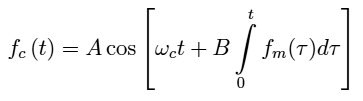
A n FM signal, fc(t), is mathematically defined by the function [see Dunlop & Smith]:
where A is the carrier-frequency amplitude, ωc is the carrier frequency, fm(t) is the modulating signal, and B is proportional to the modulation depth. This equation shows that the amplitude of the carrier never is changed, but the frequency varies according to the modulation signal. As a result, the probability density function is exactly the same as the probability density function of the carrier itself:
T his particular probability density function is the probability density function of a sinusoidal, and has a kurtosis of 1.5 (or an excess kurtosis of -1.5).
B ut there is no ‘law’ that says that the carrier has to be of a single pitch or frequency, that it has to be sinusoidal. Likewise, there is no ‘law’ that says that the carrier has to be many orders of magnitude different in frequency from the modulating signal. In FM radio it is true that the frequencies in the audio signal are many tens of thousands of times lower than the FM radio carrier frequency, but that is because of the radio broadcast use-case, which is not applicable in Eve’s musical-soundscape use-case.
S o all signals, whether super-Gaussian, Gaussian, or sub-Gaussian, are necessarily, obligatorily converted to a sub-Gaussian signal if they are frequency-modulated—and that is part of the physics that Eve’s compositions take advantage of, to achieve the effects and impact that they do. Gaussian and super-Gaussian signals do not give way to themes that are conveyed by sub-Gaussian signals; they are ‘taken over’ by the sub-Gaussians. Quasi-vivisectionist/neuroanatomist, Eve takes us apart: her pieces are fascinating lessons, revealing to us how we work, deep down inside. Different interpretation of chamber music as ‘intimacy’.
I n ‘Until It Blazes’, the latter part of the piece is overwhelmed by a high-frequency noise spectrum that, essentially, becomes an FM ‘carrier’ for the other musical signals with which it’s admixed and which it takes over. It’s not that the other signals are buried; no, the amplitudes stay the same. Rather, the admixture/modulation causes new processing by our hearing and auditory cortex—processing by which are able to detect and respond to FM acoustic signals. The musical result—and the gnostic text that inspired it—compel us to reprioritize what we believe, what we believe we know; re-think the evidence that is the basis for our knowing... This isn’t merely ‘edginess’ or gratuitous excitement. It’s politically interventional, potentially life-changing—features that are characteristic of Eve’s work. It’s an invitation to a self-styled, radically self-examining intimate community.
T he ‘gnostic’ gospels reference the Greek word ‘gnosis’, meaning ‘knowledge’. Arguably, Gnostic philosophy—finding answers to spiritual questions within oneself, without reliance on a church or priests; individuals learning to free themselves from the material world by way of meditation and enlightenment—did begin in pre-Christian times; either that, or it was a Jewish reaction to Judaism reacting to early Christianity. Some introductory comments about the apocrypha, gnostic Gospel of Thomas and the 114 ‘sayings’ it contains are here. A fine provocation for meditation, I think, on the occasion of Easter.
E ve started out as an Uptowner with a Princeton-Columbia education, but then jumped ship and began composing music her professors couldn’t countenance. Her approach to musical sources is omnivorous. She’s made collages of disco music, updated the 14th-century composer Guillaume de Machaut, made theater pieces out of Kurt Schwitters’ nonsensical ‘Ur-Sonata’, and quoted Gregorian chants along with the sounds of a couple having orgasms. One of her best pieces is ‘No Man’s Land’, a gritty poem to New York whose thoughtful text is accompanied by sampled sounds as grating as the city itself. Beglarian is an amazingly high-tech sampling artist, and much of her music—even orchestra pieces like ‘FlamingO’—uses brilliantly manipulated prerecorded noises.” — Kyle Gann.
I wanted it to have a feeling of spaciousness, and of ‘breath’ ... I was influenced by Marie-Claire Alain’s [interpretation of Bach’s ‘Goldbergs’] in Paris, who played a Bach recital... an incredible sense of rhythm, almost an organic sense of rhythm ... [to] these large rhythmic structures. But the smaller beats [in Alain’s interpretation] were very free. [The overall effect of Alain’s approach was such that] it had [qualitatively, an astrophysical] feeling—almost like the turning of the Earth [on its axis] ... that there was an inevitability to the way the pulse was going, but within it there was this kind of feeling of ‘give-and-take’ in the rhythm. And I think that [by contrast to Alain,] a lot of the approach to rhythm has [for other pianists] been very ‘motoric’, and influenced by having a very strong feeling of a ‘small’ pulse. And I wanted to experiment with freeing myself of the small pulse and feeling a larger pulse.” — Simone Dinnerstein interviewed by Sarah Dallas of www.moreintelligentlife.com, commenting on rhythmic freedom, breathing, phrasing, and why the silences in Bach, are as important as the notes, 2007.
S imone Dinnerstein catapulted to fame on the merits of her recording of Bach’s Goldberg Variations worldwide in August 2007. Her Berlin recording has also been very well-received, and she has a very busy touring schedule. Dinnerstein is a graduate of The Juilliard School where she was a student of Peter Serkin. Last night she performed in Kansas City in the Friends of Chamber Music’s piano series.
H er interpretation of Bach is highly unusual, as some reviews and the blockquote above attest. Despite the written time signatures, Bach’s ‘French Suite’ No. 5 gives the impression of a compound meter. The groupings into hierarchies of nested two-, four-, six-, eight-, 10-, 12-, 16-, 20-, 24-, and 32-bar structures contribute to this.
A rtists’ interpretations of these are widely varied, and the variations are especially pronounced where the hypermeter or polymeter structures change—for example, become more accentuated or obvious, or become less obvious, or become more or less competitive or conflictual. Some artists affirm or cooperate with the hypermetric and polymetric structures; other artists fight the imposition of a hypermeter by regularizing the rhythms and defeating the agogic and rubato cues that are in the score.
S imone Dinnerstein engages in a style of interpretation that alternately cooperates with and, at times, opposes Bach’s cues for improvisational and rubato freedom. At times, she also liberally expands upon the cues that are in the musical text. Characteristically in her playing she sheds light on longer-range, larger-scale hypermeter structures than might have been perceptible to us before. As a result of her emphases and rhythmic decisions, we hear what we might imagine to be the Earth spinning on its axis, one revolution every 24 hours. Maybe more accurately, we imagine the Earth’s axis precessing, one cycle every 26 thousand years. We hear celestial mechanics operating in timeless, wheels-within-wheels majesty. Music of the spheres...
P robably the most beautiful written-out rubatos in all keyboard music are those in the Andante of [Bach’s] Italian Concerto, BWV 971. With the aid of rhythmic notation of unparalleled subtlety, Bach wrote down the free rhythms that a contemporary singer or instrumentalist schooled in the Italian style might have improvised in performance... To be sure, even Bach’s notation cannot wholly render the infinite subtleties which characterize great artistry in performance. A sensitive harpsichordist will emphasize the B-flat here by playing it just a shade early in order to be able to sustain it slightly longer. This rhythmic flexibility enables good harpsichordists to overcome the relatively inflexible dynamics of their instrument and still play cantabile.” — Paul Badura-Skoda, p. 66.
M ost studies of agogicity and rubato address small temporal deviations with regard to the beat, as defined by the prevailing time signature as-written—they address the ‘shimmering’ effect on a timescale of tens of milliseconds up to several seconds, usually. But hypermeter also has a pulse—it’s just not an explicitly written one, and not readily apprehended on the timescales of our usual attention-span. There can be agogic and rubato effects that arise on the very long timescales of hypermetric patterns—what I might only half in jest call an astrophysical, nebula-esque shimmering on a timescale of tens of seconds to hundreds of seconds: eons, musically speaking. Here are the longest hypermetric timescales that occur in Dinnerstein’s account of BWV 816.
Allemande, 4/4, two 12-bar repeats: 104 sec
Courante, 3/4, two 16-bar repeats: 48 sec
Sarabande, 3/4, 16-bar repeat and 24-bar repeat: 130 sec and 196 sec
Gavotte, 2/2, 8-bar repeat and 16-bar repeat: 19 sec and 38 sec
Bourée, 2/2, 10-bar (4:6) repeat and 20-bar (8:12) repeat: 52 sec and 104 sec
Louré, 6/4 (2), two 8-bar repeats: 34 sec
Gigue, 12/16 (2), 24-bar repeat and 32-bar repeat: 86 sec and 116 sec
A century before Bach, Heinrich Schütz had perceived regular time to be ‘as it were, the soul of music’ [preface to ‘Auferstehungs-historia’, Dresden, 1628] ... It is revealing to compare the ‘slow beat’ mentioned here with the remarks about Bach’s conducting... Between the firm ‘pillars’ of the beats there was a large degree of freedom. With the exception of pieces in perpetuum mobile style, there were all kinds of rubato, breathing pauses, breaks, and thematic dovetailing running counter to the beat.” — Paul Badura-Skoda, pp. 16-17.
I f you were a listener who had never seen the BWV 816 score and you did not know that the dances that are “in 2” are separate movements, or that the dances with meters that are “in 3” are separate movements I suppose you might impute even longer-scale hypermetric patterns in French Suite No. 5—ones that transcend inter-movement boundaries.
G lenn Gould, Andras Schiff, Angela Hewitt, Piotr Anderszewski, Constance Keene, Edward Aldwell, and others—almost devoid of these hypermetrical effects and tremendously different from Simone Dinnerstein in myriad other ways.
T he spontaneity and greater temporal elasticity of, for example, Dinnerstein’s Sarabande—reduce our attention to the longer-scale structure. But the more motoric dances draw our attention to longer-scale hypermetric structure and the rubber-banding that Simone is doing with time and meter.
W e take a look at how this works quantitatively, using the mathematical/statistical formalism of ‘copulas’. Copulas are functions that link univariate (single-variable) marginal values to their statistical variations with multiple other variables—to their joint multivariate distributions. Copulas are useful because they allow us to discover concurrent or joint multivariable correlations with any set of univariate marginal distributions that may happen to exist. Each ‘voice’ in the left-hand part(s) and the right-hand part(s) in ‘French Suite’ No. 5 has its own rhythmic marginal distribution (of inter-beat time intervals, quantized to 4 millisecond time-resolution or better). Figuring out how Simone Dinnerstein makes this thing ‘breathe’ the way she does is possible by computing the copulas, and comparing them to, say, Aldwell’s or Goode’s or Gould’s.
C opulas are a way of quantitatively characterizing the dependence structures of vectors of multiple random variables. Although copulas were first studied more than 50 years ago, they were not extensively applied. Interest in copulas has been renewed recently in biostatistics, reliability engineering, and financial engineering, and other fields. Within the past 10 years in finance, copulas have become a standard analytical technique for multi-asset basket pricing (especially CDOs and other credit derivatives), equities portfolio modeling, risk management, etc.
A nja Volk, in her paper at the 2004 ICMPC meeting, considers all metric pulses arising from equally spaced notes’ onsets (the so called local meters). All external information (bar lines and time signature) was ignored. Only the internal relations of the actual as-composed notes were analyzed. Anja modeled the inner metric structure of music mathematically, and contrasted it with the outer metric structure given by the accent hierarchy of the as-written time signature. The inner metric weight for each note is calculated on the basis of the meters ms,d,k it participates in and which have a minimum length that is not smaller than a fixed value l. The variable s denotes the starting point, d denotes the period (the duration between consecutive onsets of the local meter) and k the length of the local meter. The contribution of each local meter to the metric weight depends solely on its length k, not on its starting point s nor its period d. She denotes ms,d,k= m(k) and gain for each note’s onset o the metric weight wl,p as the weighted sum of the length k of the corresponding local meters:
whereas the minimum length l and the weighting parameter p can be varied. The calculation of the inner metric weight of a musical piece (or a passage, a part, a passage from a part) can be easily understood from figure below.
A n algorithm calculates all local meters (i.e. arithmetic sequences) within the set of onsets under consideration (there are five such local meters in the short example). The metrical weight encodes the incidences of different meters, i.e. the metric weight of an onset is determined by the set of all local meters passing through it.
M aintenance of the metre depends on the basic rhythmic character of a work. An arioso allows greater rhetorical freedom—more rubato, that is—than, for example, a gavotte or a minuet. The greatest agogic freedom is permissible in freely structured forms such as the stylus phantasiticus of the toccata and the fantasia. Works of this kind had their origins in instrumental improvisation, such as the free invention of preludes.” — Paul Badura-Skoda, p. 18.
H ave a listen to Dinnerstein, remarking on her intentions with regard to Bach’s ‘Goldberg Variations’ (YouTube):
I n my day-job, among other things I perform signal-processing and mathematical modeling of time-series. Sometimes the timeseries are physiologic monitoring variables related to health and survival in critical care units; other timeseries I have modeled include financial trading timeseries and geophysics/seismic timeseries. I think that the spectral analysis software and mathematical tools that are used in those areas have broad applicability to quantifying what is going on in music, including helping to account for what is so unusual about Simone Dinnerstein’s Bach interpretations and rhythmic/metrical decisions.
S o-called ‘adaptive filters’ offer advantages over Wiener filters for time-varying processes. They are used for mathematical ‘deconvolution’ of seismic data which exhibit non-stationary, time-varying behavior, much like Dinnerstein’s ‘waves’ of slowly altering meter. Different algorithms for adaptive filtering exist. The least-mean-squares (LMS) algorithm, because of its simplicity, has been widely applied to data from different fields that fall outside geophysics. And that is what I have used, on my measurements of Dinnerstein’s Berlin recording—I bought her CD, ripped ‘French Suite No. 5’ tracks’ MP3s from it, and performed Fourier transform and Wavelet transform calculations on those digital audio files, annotating each bar against my pdfs of the score.
T he ‘stacking velocities’ I used to model the time-varying alterations of meter do not need to be known very accurately because—just as in deep-reflection seismography—the residual deviations (‘move-outs’) are small on a beat-to-beat basis and have only a minor influence on the results of the adaptive time-slicing.
W hat I discover is what amounts to a very low frequency (VLF = 0.01 to 0.1 Hz) ambient ‘seismic’ hypermetric architecture of Bach’s French Suite No. 5, something I think is heretofore unreported. Maybe it’s just Simone; maybe it’s really there; we will have to measure other elite performers’ interpretations and see if we can find (less pronounced) evidence of it. That such a thing should seem novel is particularly likely in recent years, as the trend has been toward highly ‘motoric’ species of virtuosity, especially with Bach interpretations.
B ut here in Dinnerstein we have ‘ocean waves’ that “couple” into ‘seismic waves’ through (what appears to be, from my measurements and analysis thus far—) a quadratic nonlinearity of the metrical surface boundary condition. The quadratic nonlinearity may be entirely under the artists’ conscious control; or maybe it is not, or at least not entirely. The nonlinearity couples pairs of slowly propagating metrical ocean-like waves of similar frequency to a high metrical phase-velocity component that has approximately double the frequency. These “approximately 2f” relationships are easy to discern in the FFT spectra of French Suite No. 5, with its hierarchical organization of phrases and repeats.
B esides seismology, gravitational wave physics also offers some useful tools and analytical methods for investigating metrical and hypermetrical phenomena in music. Waves familiar from other areas of physics such as water waves, sound waves, and electromagnetic waves are able to carry energy, momentum, and angular momentum. By carrying these away from a source, waves are able to dissipate energy and ‘rob’ that source of its energy and linear or angular momentum. Gravitational waves do the same thing in space. For example, a binary star-pair loses angular momentum as the two orbiting stars spiral towards each other: the angular momentum of the mutually-orbiting pair is radiated away by gravitational waves.
H ere’s what I think: a prevailing musical pulse and meter manifests a particular musical metrical ‘mass’ that exerts a quasi-gravitational force on the space-time continuum through which it passes and which we occupy. If the performer suddenly alters the pulse, it is as though a gravitational wave is created, which propagates forward and may make space-time seem to either dilate or contract, compared to the previous regime. If the performer imparts a hypermetric periodicity, that can be detected or sensed, via neurophysiological monitoring and analytics not too dissimilar from methods to detect gravitational waves.
T he transmission of hypermetrical ‘waves’ is not only through the ‘physical’ medium (sound through the air) but also through ‘cognitive’/’neurophysiological’ media. The latter media have an ‘impedance’ and transfer-function, with rate-dependent,time-dependent, remanent properties—almost like thixotropic or rheopectic non-Newtonian liquids and gels, or like non-Newtonian star-stuff in space. So the transmission of hypermeter waves is imperfect—the waves suffer delays and phase-lags; depending on its spectral properties, the waves experience more or less attenuation and dissipation as they propagates; they undergo refraction at ‘apertures’ (phrase boundaries; movement boundaries) and interferometric interaction with other hypermeters that exist concurrently in the same space-time.
W hen the musical polyphony is ‘shallow’, the hypermeter waves undergo wavefront-steepening and the wave amplitude increases like tsunami waves; and so on. This would seem to me to be a rich space for cross-disciplinary study in the future. To my knowledge, cross-pollination between music theory and physics has not explored these possibilities to-date. Maybe you will be intrigued enough to pick up this line of analysis and give it a ‘go’.
I t can be seen in accompanied recitatives that tempo and metre must be frequently changed in order to rouse and still the rapidly alternating affections. The metric signature is in many such cases more a convention of notation than a binding factor in performance.” — C.P.E. Bach, ‘Versuch über die wahre Art, das Clavier zu spielen’, Leipzig, 1753, p. 153 (trans, W. Mitchell, ‘Essay on the True Art of Playing Keyboard’, 1949).

 I look in the music theory literature and recent doctoral dissertations, and so far I am unable to find anybody who has pursued this sort of thing. If I am wrong, please email me or add a comment below.
 T here is more or less constant variation in articulation and timing... successive notes are crafted with varying durations—this is especially true on harpsichord more than other keyboard instruments, but it would be true as well for winds, voice, any instrument. The plot above is a composite across 2-part variations—a quick exploratory ‘look’ only; not what we would do for a proper analysis.
 A nd, naturally, the variability and rhythmic power-spectrum measures change throughout the course of each piece. The power spectrum has ‘shoulders’ on it, on both the left (slower, longer IBI) and right (faster, shorter IBI) side of the median interbeat interval or rhythmic frequency. In principle, we would watch and measure the time-evolution of the power-spectrum from the beginning of a piece to the end of a piece—look at these evolutions or trajectories for different performers whose interpretations and styles differ. Then we would be better able to account objectively and quantitatively for how they do what they do!