Showing posts with label kivy. Show all posts

Thursday, May 14, 2009

Jeff Herriott: ‘Dissipation of a Thought’, Emergence of Another, Yet Another

 Jeff Herriott
I    ’m working now with some very high-pitched material... It’s seeming likely that I’ll end up with something for two soprano saxes, with some high multiphonics cascading on top of one another. Right now, the form is seeming like it will consist of some close intervals that slowly open up and out, with focus on some intricate tuning adjustments or quarter-tones. There will likely also be a few little ascending and descending lines as the piece progresses, and the whole thing will probably end up being close to 100 seconds. My plan is to take my thin electronics part and try to flesh out the ‘live’ part a bit more.”
  —  Jeff Herriott blog, 28-APR-2009.
T  he thing that troubles me about the analysis in Peter Kivy’s new book is that it seems to crystallize both music and text—holds them, for the sake of analysis, to be ‘static’ when in fact they are dynamic and ‘emergent’, particularly when the material is new to us. Implicitly, the analysis undervalues the processes of remembering or forgetting—of retrieval, of dissipation. In other words, the ‘ancient quarrel’ between literature and music seems to depend on our ignoring major aspects of neurobiology and how our cognitive processes handle qualitative complexity. Dependent, too, on our ignoring not just the emergent aspects of reading, playing, and hearing the piece, but the emergent aspects of the compositional process itself—embodied by remarks like the ones that composer Jeff Herriott makes in his blog (blockquote above).

T  his thought occurred to me as I listened to Jeff Herriott’s ‘dissipation of a thought’, right after finishing reading Peter Kivy’s book.

H  erriott’s compositions are often surprisingly textual—even the ones that are wordless, instrumental pieces. How can we know this? Well, text linguistics studies structural and formal variants of textuality, for which separate descriptive and ontological models are developed beyond surface-level syntax. A ‘text’ is defined as an utterance or communicative occurrence that meets [most of] seven criteria of text-ness (Beaugrande & Dressler, 1981):
  • Expressive cohesion,
  • Coherence,
  • Intentionality,
  • Acceptability/Consensuality,
  • Informativity (conveying something or bringing about a change in [many of] the text’s readers/hearers),
  • Situationality, and
  • Intertextuality, including persistence and/or replication-publication.

[‘dissipation of a thought’, for flute, vibraphone, cymbals, crotales, voice and live electronics]

 Due East
T  he structure of ‘dissipation of a thought’ meets most if not all of the seven criteria above. It is not only a ‘text’ in the sense of a persistent, published, replicable, intertextual document. It is coherent, cohesive, and localized to a situation or context. The intentions... may be ambiguous, but the evocative title is enough to focus our reception of the piece, beyond what the music itself does.

T  he hermeneutic ambiguity in the first section of ‘dissipation’ arises in its complex harmonies, paradoxically at odds with the piece’s ‘primrose path’ development. It also arises in Herriott’s ingenious manipulation and deviation from prevailing electroacoustic topoi. Examples include a deviation from deceptive cadences and voice-leading, as well as Herriott’s use of subtle, remote tonal relationships—between the tonal base of ‘dissipation’ and the modulation in later sections.

E  ven the ambiguity that we experience can be assessed from the perspective of the seven standards of textuality:

  1. the musical text itself [‘dissipation’] as process and product, including harmonic relationships and voice-leading in cohesion and the relationships among underlying morphemes caused by the manipulated topoi in coherence (including novel, remote tonal relationships);
  2. the participants’ intentionality (manipulation and deviation from topoi) and the recipients’ [listeners’, performers’] acceptability concerning various approaching interests rather than contextual understanding (the reasons for the perceived ambiguity);
  3. the broader context of informativity (including the musical events based on the simulation of resolutions, the deception instead of fulfilling of expectations and the compensation for the deceptions as well as unexpected deviations from usual topoi), the situationality of the title ‘dissipation’ concerning its genre and intertextuality involving similarities to other mixed-ensemble electroacoustic compositions.
S  o how we interpret a piece while playing or listening should be decided not only by intuition but also by a contextual understanding of musical flow. We get clues from the application of rubato, for example; from the manipulation of expectation and deception in the management of rhythmic flows. Through the correlation of Herriott’s [explicit] ‘temporal management’ to his [implicit] ‘compositional plot’, the tension and relaxation of a composition become clear to us—become informative.

I    t may be crucial that some [sub-]systems stay constant or do not learn, whilst some must have ‘flexible-response’ characteristics, including learning and innovation and forgetting. Taken-for-granted movements of the hands and feet may be focused-on with uncustomary, acute consciousness in music, dance, visual art.”
  —  Jenks & Smith, p. 204.
T  o find a piece informative, we don’t need to posit a ‘persona’ or ‘personae’ who are engaged in a representational tableau. Nor do we need then to concede that a narrative piece that is not inhabited by personae is necessarily ‘program music’, a point that Kivy persuasively makes (Ch. 5). So here we have a case-in-point, this ‘dissipation of a thought’ by Jeff Herriott. Not that it doesn’t or couldn’t have personae represented by the parts; it could. My points are that we are not sure about this during our early engagements with it, and that our comprehension of the piece’s textuality ‘grows’ on us, emerges, is subject to ongoing revision as we absorb it.

P  eter Kivy is right in saying that there is nothing wrong with absolute music affording [empty] pleasure to the ear and mind—providing that and nothing more. Some music happily does precisely that. But it seems to me a mistake if we so narrowly define what a musical ‘text’ is in such a way as to rule out the possibility that it provides much, much more—define it so narrowly and statically as to rule out processes that routinely do happen to us… happen inside us as we perform or listen to absolute music, such as Jeff Herriott’s ‘dissipation of a thought’.

E  mergently, each thing leads to others.

O  ften [in a piece that is new to us, or that we have heard or played only a few times], we don’t appreciate what the meaning of a passage is until its successor is already upon us, or maybe not until much, much later. In some cases, our recognition of the meanings conveyed by a musical text takes a lifetime to emerge. How about you?

T   here is a kind of Gradgrindian mentality at work [when researchers report that listening to Mozart improves academic performance, etc], which must find a utility in every innocent pleasure, pleasure itself not being enough—perhaps a waste of time; worse still, harmful in some way or, at least the product of mere ‘amusement’, which Aristotle described as a form of rest, necessary ‘because we are not able to go on… and therefore not an end, since we take it as a means to further activity.”
  —  Peter Kivy.

U    nfinished Music’ draws its inspiration from the riddling aphorism by Walter Benjamin: ‘The work is the death mask of its conception.’ The work in its finished, perfected state conceals the enlivening process engaged in its creation… We need to rescue the experience of absolute music from the clutches of that damning word ‘pleasure’.”
  —  Richard Kramer.


Sunday, December 14, 2008

Latent Meaning: Performances as Authorship, Transcriptions as Intrepid Exploring

 Rachlin-Maisky-Imai CD
C    an Bach’s famous keyboard variations actually be improved? . . . it depends what you mean by ‘improved’. If ‘given a fresh new perspective’ qualifies, then the answer, according to this CD, is a resounding ‘Yes’! Hearing three distinct voices instead of one truly enhances the experience of listening to this classic. So how did Dmitry Sitkovetsky transcribe it? Violin & viola for the right hand, cello for the left? It would be nice if it were that simple. Sometimes the treble line involves the viola and violin, sometimes just the violin. In the case of Variation 19, Sitkovetsky does something quite impish. He sneaks pizzicato figures into the counterpoint mixture, so that when the violin and viola are conversing, the cello provides background plucking. But wait! That’s not all! A few bars later, the pizzicato is traded back and forth among the instruments, only to fade in and out of prominence. And it all happens in less than two minutes. Other dazzling feats occur in this performance. The centerpiece is the haunting Variation 25, the longest (7:39) adagio in the piece. Harpsichordist Wanda Landowska called it ‘The Black Pearl’, perhaps for its deeply affecting, melancholic beauty. The trioists inject it with an impressive array of dramatic techniques, like deft shifts from pianissimo to mezzo-forte and slight shadings in tempo. It almost sounds like a string trio piece from the late classical period. Why does this arrangement of the Goldberg Variations succeed so well? … the structure of the piece lends itself to three instruments, not one. When played on keyboard instruments, the two upper voices are virtually indistinguishable [but in string trio the voices are each more distinct].”
  —  Peter Bates, review of Rachlin et al., AudiophileAudition, 11-JAN-2008.
I f you haven’t previously heard Dimitry Sitkovetsky’s transcription of Bach’s ‘Goldberg Variations’ (BWV 988) for string trio [see links below], you will, I think, be pleasantly surprised. I particularly like the Deutsche Grammophon recording of the performance of it by Julian Rachlin (violin), Mischa Maisky (cello), and Nobuko Imai (viola).


    [50-sec clip, Julian Rachlin et al, Sitkovetsky transcription of Bach’s Goldberg Variations for String Trio, ‘Aria’, 1.2MB MP3]

It is amazing how well-suited the variations turn out to be for strings. Sitkovetsky’s transcription is an expecially thoughtful and innovative one, which teases out new expressive elements that previously have been only ‘latent’ and never realized when played on a harpsichord or a piano.

New meanings that have lurked in Bach’s text for almost 270 years become apparent, even obvious. New kinds of tension—melodic, harmonic, textural, and metrical—that contribute to the music’s overall effect begin to take hold of us.

Dmitry Sitkovetsky was born in Baku, Azerbaijan in 1954 and is a Russian violinist and conductor. He grew up in Moscow, studying at the Moscow Conservatory. When he wanted to leave the Soviet Union in 1977, he feigned mentally illness, was granted permission to emigrate to the U.S. and studied at Juilliard. In 1979 he won first prize in the Kreisler Competition in Vienna. From then on he has appeared as soloist with renowned orchestras around the world. He was the Principal Conductor and Artistic Advisor of the Ulster Orchestra from 1996 to 2001 and was Conductor Laureate of the orchestra during 2002. Since 2003, he is Music Director of the Greensboro Symphony Orchestra and Principal Guest Conductor of the Russian State Symphony in Moscow.

 Dimitry Sitkovetsky
Each of the trio parts avails the player the opportunity for an expansive response to the text, as well as challenges to maintain a good blend and ensemble. Rachlin sounds especially intense and personal here, which is what one always wants from a performer. The prodigious insight of Sitkovetsky’s compositional decisions is ample justification for what might otherwise have been thought to be an ‘unnecessary’ transcription of ‘Goldberg’. Once you have it, you realize that you needed it all along...

Bach’s two- and three-part keyboard writing for most of the ‘Goldberg’, so double-stops might be thought to be the natural approach to a string trio transcription that would render the harmonies in the original text. But there is far more here than that. Sitkovetsky emphasizes the dialogues in the counterpoint by exquisitely leveraging the timbral differences between the instruments. Rachlin, Maisky, and Imai are genuinely inspired by the ideas that Sitkovetsky has provided, as you will readily hear in their superb Deutsche Grammophon recording.

Variation 18 ending
 J.S. Bach, Goldberg Variations, V.18 mm. 23 - 32

    [50-sec clip, Julian Rachlin et al, Sitkovetsky transcription of Bach’s Goldberg Variations for String Trio, ‘Variation 18’, 1.2MB MP3]

Variation 19 opening
 J.S. Bach, Goldberg Variations, V.19 mm. 1 - 5
Variation 19 ending
 J.S. Bach, Goldberg Variations, V.19 mm. 28 - 32

    [50-sec clip, Julian Rachlin et al, Sitkovetsky transcription of Bach’s Goldberg Variations for String Trio, ‘Variation 19’, 1.2MB MP3]

Variation 20 opening
 J.S. Bach, Goldberg Variations, V.20 mm. 1 - 6

    [50-sec clip, Julian Rachlin et al, Sitkovetsky transcription of Bach’s Goldberg Variations for String Trio, ‘Variation 20’, 1.2MB MP3]

In trying to understand why the Sitkovetsky string trio transcription of the ‘Goldberg’—and the Rachlin et al. performance of it—are so novel and genuinely illuminating, I recall that Peter Kivy once noted that “the quality that persists through [Landowska’s] various performances of the ‘Goldberg Variations’: performance is to be valued not as process but for the interpretation it embodies.” Kivy argued that performances are full-fledged ‘versions’ of works in precisely the same sense as arrangements are—performance becomes a vicarious act of composing. It is that full-fledged creativity that we hear here.

S    o in the case of the Goldberg, there is in fact one pulse, which—with a few very minor modifications—mostly modifications which I think take their cue from ritards at the end of the preceding variation, something like that—one pulse that runs all the way throughout.”
  —  Glenn Gould, interview with Tim Page, 1982.
Rachlin plays the opening aria with what feels to me to be just the ‘right amount’ of circumspection. The introspective sensitivity and exquisite variety of touch that Maisky and Imai achieve are a joy to hear as well. The transitions between Variations are well thought-out and deliver a perfectly coherent, consistent sense of ‘pulse’ from one Variation to the next—consummately Bach-like. The rhythmic alignments, Variation-to-Variation, amount to a kind of [64-bar] hypermeter that threads its way throughout the aria, the 30 variations in all their diverse 2-beat and 3-beat and 4-beat meters, and the da capo restatement of the aria. Click on the image below to open an Excel spreadsheet showing color-coded alignments of the tempi between Variations, as they are rendered in the Rachlin et al. recording of the Sitkovetsky transcription for string trio.

 Raichlin et al., Goldberg Variations, Pulse Transitions between Variations (click image for Excel spreadsheet showing alignments)
To Kivy, music is never dominated by the text in front of us; music is performance and is therefore irreducibly ‘social’. It involves a direct and private communication from composer/transcriber to listener. The intelligibility of the piece is negotiated in real-time—none of the social participants has ‘omniscience’, or a privileged perspective of meaning and intelligibility.

How, after all, could we know would we know what Bach intended? All sorts of evidence, sure—some of it fragmentary, some flawed. So the musical text is under-determined with regard to performance practice, and performance interpretation can never be a matter of absolute ‘correctness’ but rather one of rigorous ‘coherence’ and thoroughgoing ‘genuineness’.

W hich is what we get here, in the Sitkovetsky played by Rachlin et al. Performers-as-composers/improvisers. Performers and transcribers as explorers, discovering new [historically informed] territory as they go.

This wonderful string trio transcription of ‘Goldberg’ convinces us that a piece of music is better considered as a ‘script’ rather than a ‘text’. We must not be relentlessly clinical or obsessively literal, focusing on the text as the ultimate source of truth and aesthetic value. To do that would be ruthlessly sterile and anti-musical, as Glenn Gould once said. This Sitkovetsky strikes me as one of the most ‘genuine’ transcriptions of anything, ever. Absolutely wonderful, and a fine ‘tool’ by means of which it’s possible to discover yet more meanings in a work that we might previously’ve thought we pretty thoroughly understood…

  • Julian Rachlin—Born in 1974 in Vilnius, Lithuania, his parents emmigrated in 1978 to Austria. In 1983, he entered the Konservatorium Wien and studied with Boris Kuschnir and Pinchas Zukerman. In 2005, Rachlin made his Carnegie Hall debut when he performed with the New York Philharmonic under Maazel. Rachlin also performs chamber music with such artists as Martha Argerich, Itamar Golan, Natalia Gutman, Gidon Kremer, and used to perform with Mstislav Rostropovich. In 2000, he joined Rostropovich and Yuri Bashmet, among others, in the premiere of Krzysztof Penderecki’s Sextet. The same year, Rachlin also founded his own music festival in Dubrovnik, ‘Julian Rachlin and Friends’. In 2000, he was rewarded with the prestigious International Prize of the Accademia Musicale Chigiana of Siena. Julian Rachlin plays the 1741 ‘ex Carrodus’ Guarnerius del Gesù violin.
  • Mischa Maisky—Born in 1948 in Riga, Latvia, Mischa Maisky began his musical training at Riga’s Music School and Conservatory. In 1962 he enters the Leningrad Conservatory. In 1966 he won first prize at the International Tchaikovsky Competition in Moscow and began his studies with Rostropovich at the Moscow Conservatory. He was imprisoned by USSR authorities for 18 months and emigrated to Israel in 1973. He has maintained a busy and illustrious performing and recording career ever since.
  • Nobuko Imai—Born in 1943 in Tokyo, Imai began her training at Tokyo’s Toho Gakuen School of Music and soon after came to the United States where she studied at the Juilliard School and Yale University. She won first prize at both the Geneva International Music Competition and ARD International Music Competition at Munich. She taught as a Professor at the Detmold Academy of Music from 1983 to 2003, and currently teaches at the Conservatories of Amsterdam and Geneva, and at Conservatoire Supérieur et Académie de Musique Tibor Varga in Sion.


Wednesday, July 23, 2008

Segmentation and the Limits of Representational Art: Elliott Carter Centenary at Tanglewood

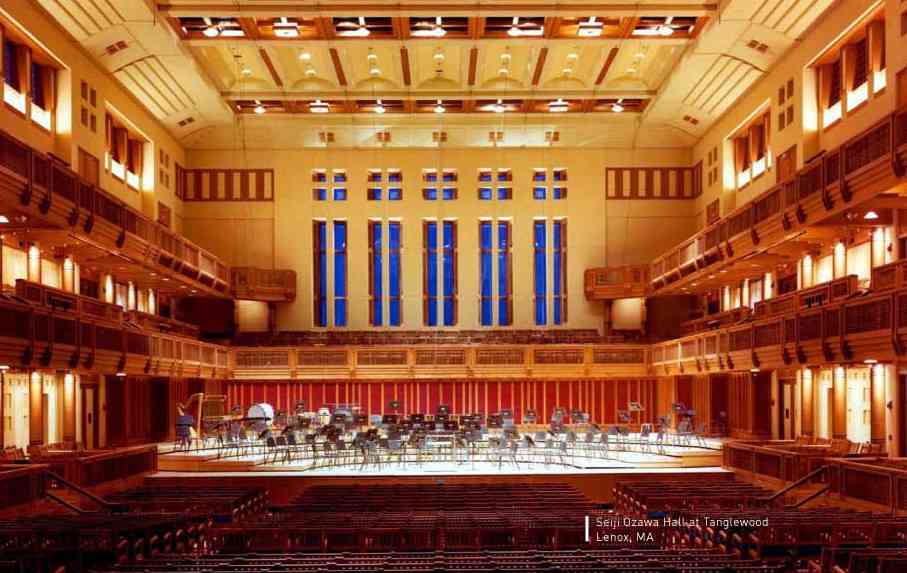
 Seiji Ozawa Hall, Tanglewood, Wm. Rawn Architects
H  ow are we to build emotional expression into music criticism? The new way is not to amplify criticism by adding interpretation to analysis but, rather, by amplifying analysis itself. For once one ceases to see expressive properties of music as semantic or representational properties, it becomes clear that they are simply musical properties ... and as such a proper subject of musical analysis.”
  —  Peter Kivy, Fine Art of Repetition, p. 316.
The BSO’s Festival of Contemporary Music at Tanglewood (Elliott Carter Centenary) on Tuesday had a diverse program of smaller pieces representing various phases of Carter’s career, performed by members of the New Fromm ensemble.

  • Enchanted Preludes
  • Figment I
  • Figment II
  • Esprit doux I & II
  • Au Quai [To the quay; quant ‘à [pour-]quoi’ c’est que nous allons ‘au quai’ je ne savons pas. Pour découvrir un mot français ironique?]
  • Trilogy
  • Two Thoughts about the Piano (Intermittences; Caténaires)
The thematic and compositional diversity in this program was delightful—warmly received by the audience filling the 1,200-seat Ozawa Hall. (A steady Berkshires rain beat down outside throughout the performance, but the acoustic baffling between the barrel-shaped roof and the ceiling of the hall prevented any acoustic interference. The sound engineering in the Ozawa Hall is really quite nice. The architects at Boston-based William Rawn Associates, Inc. who designed this performance hall are to be commended for their excellent design and engineering.)

Each of the pieces epitomizes the narrative and intimate dialogical idiom of chamber music. And each calls into question the conventional dictum that musical dialogue lacks specific semantic reference to the external world. Here, for example, ‘Caténaires’ has phrase-structure and lines between left-hand and right-hand that are clearly arcs—representational of curves draped in mid-air, in some parts with descender cables attached to the pylon-to-pylon catenaries, such as we see in bridge designs. You do not need to see the title of the piece to have the clear impression of the pendency, the evocation of gravity creating catenary curves in pendant strands.

 catenary curves Representational acoustic art! Pianist Sandra Gu performed this with intensity and grace. Likewise, ‘Intermittences’, performed with much feeling by pianist Jacob Rhodebeck, is an exposition of intermittent effects and an extended meditation on human expectations—the decay of notes once struck; the reverberation and decay in the Hall; the intermittency of rhythms, of textures, of harmonies that come, go, and reappear. We anticipate things as we do, for reasons we don’t fully understand. Carter’s ‘Two Thoughts about the Piano’ helps us not only to understand the instrument and the character of pianists who express themselves through it, but also helps us to understand ourselves—and our relations to those pianists, the composer, and the music.

The music on Tuesday’s program was full of internal references, linkages, and interactions among individual segments, lines, and parts. ‘Trilogy’ (Nick Stovall, oboe, and Megan Levin, harp), ‘Enchanted Preludes’ (Brook Ferguson, flute, and David Gerstein, cello), and ‘Esprit doux’ (Brook Ferguson, flute; Brent Besner, clarinet; Nick Tolle, marimba) are, essentially, reflection pieces on musical segmentation.

 Kivy book
We listen and answer these questions:
  1. Do individual segments form primarily within one part or across two or more?
  2. Do associations among segments develop within a part or between parts?
  3. How many distinct streams of association are active simultaneously?
  4. How do the segments, associations, and streams evolve over time?
In each piece a dialogue develops among the parts’ personae. At times, we have a collection of individuals, each with her/his own characteristic rhythms, articulations, and intervals; at other times, we have an ensemble in which the meaning-generating harmonic and motivic features emerge only as a group. Surprising how this can happen in an ensemble of only two people—a duet—or between the diverging-converging left-hand and right-hand of a single pianist.

In these Carter pieces there are diverse changes in the segmentation. These changes in segmentation are vehicles for changing modes of interaction among the parts. In ‘Esprit doux’, the dialogue between the clarinet and flute gives way to the trio section, in which the marimba is not so much a co-equal voice as it is an omniscient narrator—functioning much as the piano part often does in piano trios. The marimba ‘explains’ the context within which the segmentation and trill-swapping exchanges between the flute and clarinet parts makes ‘sense’.

We get what amounts to a series of shifts from individualism to ensemble collectivism, and from predominantly contrapuntal textures to predominantly harmonic textures. In the duets and trio, the interplay among individual personae is internal to the group. In the solo pieces (Figments I & II; Two Thoughts), the interplay references the soloist’s relation to the external world.

 Kivy book
Figment I, with its double-stopped figures, one note held constant and the other sliding up in pitch, evokes things suspected and feared true. It is the essence of anxiety, distilled. It conveys ‘anxiety-as-process’, not as ‘symptom’. Anxiety (and the troubling figments of imagination that accompany it) is, you see, not a ‘state’ or ‘condition’ but a succession of thoughts and events that, together, comprise the anxious self—alienated from comforts and reassurances, isolated existentially. Segmentation in the cello part, superbly played by Kathryn Bates, propels our understanding this existential discomfort. Beautiful, iconic, elegant, credible.

Have a look at Peter Kivy’s books, for detailed discussions of texuality and the limits of the representational in music—not in Elliott Carter’s music per se, although Carter’s music does illustrate or embody many of Peter’s arguments.

 Pople book

 Elliott Carter, ©2008 Boston Globe
I  love Elliott, but I loved his music first. (I can’t do this in reverse; I can’t love the music just based on a rapport with the composer.)”
  —  Conductor James Levine.