19 Oct 08
Fighting to Survive (by Shane)
Shane - After being denied psychiatric medication by ValueOptions, Shane turned to illegal drugs he financed with burglaries. The medication in prison caused him to suffer a period of spontaneous ejaculations. Shane is the author of the blog Persevering Prison Pages.
Sometimes even the most nonviolent and levelheaded person has to fight in prison. A fight-or-die situation will inevitably arise if you spend any length of time locked up. Oftentimes it’s not even your fight but a fight caused by STG’s [Security Threat Groups such as the Aryan Brotherhood] and their politics forced upon you.
I’ve worked in the kitchen numerous times over the years. At one point, I was with 13 other convicts working to prepare dinner for a yard of 450. The racial make up of the crew was six vatos, two blacks and five white boys. The whites and Latinos got along good. The blacks and whites or blacks and Latinos, not so much.
Oscar was a Latino shotcaller on the yard for La Emme [the Mexican Mafia]. Tommy Guns and Knuckles were torpedoes for the Aryan Brotherhood. The rest of us weren’t in the mix on the yard and simply did our own thing.
“Listen up, woods. Watch your back today, the toads are plannin’ something today,” Knuckles whispered to each of the white boys as we entered the kitchen at the start of the shift. There had been racial tension between the blacks and whites on the yard because of Motown, a new black on the yard.
Apparently, Motown ripped off an Aryan Brother for a pound of crystal meth in a drug deal on the streets. Now, the Aryan Brotherhood wanted Motown off of the yard and definitely out of the kitchen. Yeah, Motown was one of the two blacks working that day.
A couple of hours later, while I was washing pots, I watched Motown talking with the other black convict, then they both walked over to the tilt grill and began tending to the slop cooking.
Keeping a cautious eye on them, I noticed Motown’ grip tighten around the heavy handle of the stainless steel paddle used for mixing as Tommy Guns and Knuckles walked in their vicinity and headed towards the guards control room.
Looking back down at the pot I was washing, I missed Oscar and another Latino inmate quickly approach the two black guys.
In an instant, Oscar threw a barrage of punches, hitting Motown in the face and head while the other tow squared off with each other.
Motown absorbed the punches, staggered to the left, released the mixing paddle and ran directly towards my work area. With Oscar in pursuit.
Pot in hand, I stood as Motown rapidly approached and wildly swung a punch at me, which missed me altogether. Running into me, he began to wrestle with me. Suddenly, I felt a fist land on my left ear, causing stars to explode in my vision. Then I felt the two of us falling to the kitchen floor.
For what seemed like a few minutes, I wrestled with Motown on the floor. I ended up on top of him, and to my surprise, Oscar too. Somehow, Oscar had ended up entwined with us.
Now completely disoriented as to what was happening, I began throwing hard punches downward at Motown, whom I knew had punched me. Occasionally, a stray punch hit Oscar.
Rolling away from them toward the pot I had dropped at the onslaught of this melee, I grabbed it, swung it once at Motown as they both got to their feet. I could see the other black guy trading wild punches with the other Latino over Oscar’s shoulder.
Lunging at me, Motown tried to reengage me, but I swung the pot again, narrowly missing the top of his head.
Seizing the opportunity, Oscar swung a brutal punch, which landed flush on Motown’s jaw. Down he went.
Oscar kicked him at least ten times before turning towards the other black guy and heading to join that fight.
Looking down, I saw blood pooling around Motown’s head and took a step back. I dropped the pot in the sink as the guards flooded into the kitchen and pepper-sprayed Oscar and the other two fighters, who wouldn’t quit when the guards ordered them to stop fighting. I surrendered.
A few minutes after the fight had been stopped and all the inmates were zip-tied, each of us was seen by a nurse. Only Oscar and Motown needed medical care. Both of them had cuts and bruises on their face and head.
It turned out that the Aryan Brotherhood had asked for La Emme’s help instead of doing their own dirty work.
Tommy Guns and Knuckles conveniently located themselves with the guard, while the rest of the crew was unattended. They had known something would go down, but rather than the two blacks being up to something that day, it was them.
Email comments to writeinside@hotmail.com or post them below
Copyright © 2008 Shaun P. Attwood
Monday, October 20, 2008

20 Oct 08
Reading
I’m about to get the train from Runcorn to London, a two-and-a-quarter hour journey, because I am reading to an audience tonight at the Royal Festival Hall. Beginning at 7:55pm, I have 15 minutes to read “Amazing Grace,” my short story that won a first prize in the Koestler/Hamish Hamilton awards. Problem is, “Amazing Grace” is 16 pages long and takes over half an hour to read. So I’ve spent this week condensing the story down to 8 pages. According to my Olympus Digital Voice Recorder, my last practice reading came in at 14 minutes 23 seconds. And that includes a few things I want to say before I start. Like explaining that “wood” is what white prisoners call each other. And reading the story’s disclaimer, as it’s about a “shit slinger,” and is somewhat grotesque and obscene.
If you’re in London tonight, and that includes you Chris-H, you are welcome to join me for the reading. Further information is here:
http://shaunattwood.com/home/index.php?option=com_mamblog&Itemid=84
Coincidentally, today, the day of my first reading, has seen the site meter at Jon’s Jail Journal rise above 500,000. I’d like to thank you all for continuing to read Jon’s Jail Journal and for supporting my friends inside.
Email comments to writeinside@hotmail.com or post them below
Shaun P. Attwood
Reading
I’m about to get the train from Runcorn to London, a two-and-a-quarter hour journey, because I am reading to an audience tonight at the Royal Festival Hall. Beginning at 7:55pm, I have 15 minutes to read “Amazing Grace,” my short story that won a first prize in the Koestler/Hamish Hamilton awards. Problem is, “Amazing Grace” is 16 pages long and takes over half an hour to read. So I’ve spent this week condensing the story down to 8 pages. According to my Olympus Digital Voice Recorder, my last practice reading came in at 14 minutes 23 seconds. And that includes a few things I want to say before I start. Like explaining that “wood” is what white prisoners call each other. And reading the story’s disclaimer, as it’s about a “shit slinger,” and is somewhat grotesque and obscene.
If you’re in London tonight, and that includes you Chris-H, you are welcome to join me for the reading. Further information is here:
http://shaunattwood.com/home/index.php?option=com_mamblog&Itemid=84
Coincidentally, today, the day of my first reading, has seen the site meter at Jon’s Jail Journal rise above 500,000. I’d like to thank you all for continuing to read Jon’s Jail Journal and for supporting my friends inside.
Email comments to writeinside@hotmail.com or post them below
Shaun P. Attwood
Sunday, October 19, 2008
19 Oct 08
When Everybody Wants You Dead
I was mentioned briefly in this recent article in The Guardian Weekly.
Oddly enough, the article also mentions Ray Krone, an innocent man who my attorney, Alan Simpson, helped save from death row.
Grisly tales of prison this week as we mark International Day Against the Death Penalty, writes website editor Anna Bruce-Lockhart
October 10 was International Day Against the Death Penalty, and to mark this significant event I thought I would point you towards a host of relevantly themed stories right here on this website.
But first, some news: only this week an appeal was rejected by the US supreme court to save the life of death row inmate Troy Davis. He was charged with the murder of a police officer more than 20 years ago, and a date is now being scheduled for his execution. This is going ahead in spite of there being no DNA evidence to link him to the killing, no murder weapon, and seven of the nine witnesses who originally testified against him having since recanted. I'm having trouble working out why this man absolutely must be killed.
One person who knows all about cruel twists of fate is Ray Krone. Arrested one night as he pulled up outside his home and charged with a murder he didn’t commit, he spent 10 years on death row. You can read an interview with him here. When I spoke to Krone over the phone what really struck me as he told his story was his lack of bitterness – he didn’t even seem angry with the man who got him wrongly convicted, a prosecutor who knew there was evidence to prove him innocent but called for his execution anyway.
For a taste of what it’s like to do time in an Arizona prison, and for those of you with a strong stomach, why not take a look at the harrowing story of Shaun Attwood, a British stockbroker charged with drug offences while in the US. He spent two years in an especially rough county jail being crawled over by cockroaches and venomous spiders, and fed a red-hued slop whose only easily identifiable ingredients were human and animal hair. Well worth a read. Honestly.
The US ranks fifth in the whole world for the number of executions it carries out, but the vast majority of sanctioned deaths take place on the other side of the Pacific. China executes more people each year than all other countries in the world combined. Iran isn’t far behind. In a country where sodomy is punishable by death, homosexual men make up a significant portion of those put to death each year. Here you can read our interview with an Iranian man who narrowly escaped execution for being gay.
Anti-death penalty campaigners are great, aren’t they? And none more so than the heroic Clive Stafford Smith, who is also a human rights lawyer who provides free legal aid to prisoners in Guantánamo Bay. He, in a cheering conclusion to this collection of grisly death stories, gives an account of what it’s like to ‘kick the asses’ of corrupt justice systems and defend death row inmates who can’t afford to pay for legal aid.
Here’s the link to the article: http://www.guardianweekly.co.uk/?page=editorial&id=766&catID=21
To read what I wrote about Ray Krone’s case and how the State of Arizona purposefully set up an innocent man to be executed click here: http://jonsjailjournal.blogspot.com/search?q=ray+krone
Email comments to writeinside@hotmail.com or post them below
Shaun P. Attwood
When Everybody Wants You Dead
I was mentioned briefly in this recent article in The Guardian Weekly.
Oddly enough, the article also mentions Ray Krone, an innocent man who my attorney, Alan Simpson, helped save from death row.
Grisly tales of prison this week as we mark International Day Against the Death Penalty, writes website editor Anna Bruce-Lockhart
October 10 was International Day Against the Death Penalty, and to mark this significant event I thought I would point you towards a host of relevantly themed stories right here on this website.
But first, some news: only this week an appeal was rejected by the US supreme court to save the life of death row inmate Troy Davis. He was charged with the murder of a police officer more than 20 years ago, and a date is now being scheduled for his execution. This is going ahead in spite of there being no DNA evidence to link him to the killing, no murder weapon, and seven of the nine witnesses who originally testified against him having since recanted. I'm having trouble working out why this man absolutely must be killed.
One person who knows all about cruel twists of fate is Ray Krone. Arrested one night as he pulled up outside his home and charged with a murder he didn’t commit, he spent 10 years on death row. You can read an interview with him here. When I spoke to Krone over the phone what really struck me as he told his story was his lack of bitterness – he didn’t even seem angry with the man who got him wrongly convicted, a prosecutor who knew there was evidence to prove him innocent but called for his execution anyway.
For a taste of what it’s like to do time in an Arizona prison, and for those of you with a strong stomach, why not take a look at the harrowing story of Shaun Attwood, a British stockbroker charged with drug offences while in the US. He spent two years in an especially rough county jail being crawled over by cockroaches and venomous spiders, and fed a red-hued slop whose only easily identifiable ingredients were human and animal hair. Well worth a read. Honestly.
The US ranks fifth in the whole world for the number of executions it carries out, but the vast majority of sanctioned deaths take place on the other side of the Pacific. China executes more people each year than all other countries in the world combined. Iran isn’t far behind. In a country where sodomy is punishable by death, homosexual men make up a significant portion of those put to death each year. Here you can read our interview with an Iranian man who narrowly escaped execution for being gay.
Anti-death penalty campaigners are great, aren’t they? And none more so than the heroic Clive Stafford Smith, who is also a human rights lawyer who provides free legal aid to prisoners in Guantánamo Bay. He, in a cheering conclusion to this collection of grisly death stories, gives an account of what it’s like to ‘kick the asses’ of corrupt justice systems and defend death row inmates who can’t afford to pay for legal aid.
Here’s the link to the article: http://www.guardianweekly.co.uk/?page=editorial&id=766&catID=21
To read what I wrote about Ray Krone’s case and how the State of Arizona purposefully set up an innocent man to be executed click here: http://jonsjailjournal.blogspot.com/search?q=ray+krone
Email comments to writeinside@hotmail.com or post them below
Shaun P. Attwood
Autocorrelation and Agogicity: Measuring Goode’s Bach
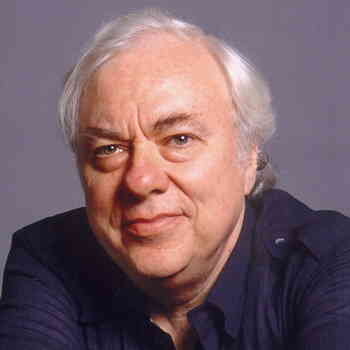
W hat one remembers most from Goode’s playing is not its beauty—exceptional as it is—but his way of coming to grips with the composer’s central thought, so that a work tends to make sense beyond one’s previous perception of it... The spontaneous formulating process of the creator [becomes] tangible in the concert hall.”To say exactly why we like or dislike a particular artist’s interpretation of a piece of music is difficult. And to compare and contrast two different artists’ interpretations in a way that can be objectively assessed and broadly agreed upon is also hard. The language of analysis and criticism readily devolves into nebulous descriptions or into abstruse technical terms that get in the way of conversation and real understanding. But the superb performance last night by Richard Goode in Kansas City in a Bach-Chopin program that was part of the Friends of Chamber Music’s ‘Master Pianists Series’ prompted me to take a whack at remedying this.
— David Blum, New Yorker, 29-JUN-1992.
I thoroughly enjoy everything Richard Goode does, always. But in this recital I especially liked his accounts of Bach’s Sinfonias (BWV 791-801) and Preludes and Fugues from Das Wohltemperirte Clavier, Book II (BWV 870, 878, 885, 889). And I very much admire his accounts of Bach’s Partitas... one of Richard’s encore pieces was the Sarabande from the D major Partita No. 4 (BWV 828). How to describe it? His interpretation is not as ‘dry’ as others’ Bach interpretations; it is optimistic and expansive—and it projects a distinctive, quintessentially ‘American’ attitude of curiosity and humor about life.
I confess I always feel that flowery, subjective descriptions are less than satisfying though. When I tell you why I like Richard’s interpretations, I want instead to be able to give you something that you can independently and reliably and objectively assess for yourself. I want to compare what Richard does quantitatively to, say, Glenn Gould’s and others’ interpretations—and calculate how they differ in various passages, and why those differences cause us to perceive and respond to the interpretations in such varied ways. How shall we do that?
One way to do it is to take digital recordings of the performances and perform a number of signal-processing measurements on them; examine the timings within critical phrases or across longer expressive spans; calculate various time-domain metrics from the digitized music; perform statistical tests on the metrics, to see whether and how they differ; and so on. I regularly do that, as a hobby—not just with baroque music but with other things, too, when I’m trying to understand why I am feeling a certain way about a piece. (Somewhat weird hobby, I admit, but it’s just in my engineer’s nature to want to take things apart and figure out what makes them ‘tick’.) Usually I use MATLAB or MAPLE or MATHEMATICA other fancy math software to do this. But it’s actually possible to do a number of interesting and useful analyses with something as simple as Microsoft Excel. Here goes!
Think, for example, about the difference between Goode and Gould when playing Bach. Actually, to make a clean ‘apples-to-apples’ comparison, let’s think about just Bach’s 6 Partitas and, within those, let’s think about just one of the movement forms that has a consistent time-signature—for example, the Allemandes.
As an historical dance usually in 4/4 time, an Allemande can have a tempo ranging from largo almost up to presto. Gould’s tempi are quite fast; Goode’s are generally more leisurely, at least ‘New Yorker leisurely’. But just noting the large-scale differences in tempi is too crude—it doesn’t explain very much about why their interpretations are so different. The ‘pulse’ is a function of time, operating and varying on a multi-dimensional, fractal time scale: rubato—small-scale, intra- and inter-beat and inter-measure variations; and larger-scale accelerando/ritardando decisions.

But the differences arise from more even than that. The durations that particular notes are held are also distinctively different. ‘Agogic’ is the fancy music-theory word that means varying a note’s (or beat’s) emphasis by varying its duration. A dry, flat, highly ‘motoric’ performance like Gould’s doesn’t have much agogic variation. A more romantic performance like Goode’s has many places where lots of agogic emphasis is used.
A •gog•ic [uh-goj-ik]So, gee, you can take an MP3 and use a cheap digital audio editor software app; you drag the cursor over the beginning of a note and then rubber-band-drag the cursor to the end of the note; you measure how many milliseconds that time-interval is. You can do that for all of the notes in 4 or 6 or 8 bars of a passage that contains what, for you, is emblematic of the interpretive difference you’re interested in. Do that for one artist’s recording, and then do the same thing for the same bars in another artist’s recording. You put the information into a spreadsheet or database. You then quantitatively calculate the ‘agocity’ of the two artists’ performances/interpretations.
(noun) the theory that accents within a musical phrase can be produced by modifying the duration of certain notes rather than by increasing dynamic stress.
(adj) stressed or accented through a variably prolonged duration.”
W hich is what I did, after being stimulated by Richard’s wonderful performance last night. I just had to figure out why it is that I like his Bach so much while I simultaneously like various other artists’ Bach interpretations very much, too. And I wanted to be able to say objectively how their characteristic personal rhythmic decisions differ in crucial passages. I wanted to put together a little ‘tool’ that I could share with you, which would enable all of us to conveniently figure these things out in the future—not just for Bach but for anything. That way we won’t be frustrated by nebulous words that don’t really say very much or that have hopelessly imprecise meanings.
Autocorrelation (of beat-to-beat time-intervals; or of note-to-note durations) is a statistical function that measures repeating patterns, such as the presence of a periodic signal which is (partly) obscured by variability.
It’s used frequently in signal processing for analyzing series of values, so-called time-domain signals or time-series. Mathematically, it represents the quantitative similarity between observations as a function of the time separation between them. The time-domain is divided up into units—in this case, my measurements were in milliseconds for note/beat durations over passages over various lengths (up to 6 bars at a time in the portions of the Partitas that interested me). Then I ‘normalized’ those values to the average milliseconds per beat across the number of measures in the passages I compared, and I set the normalized tempo for Goode to 100% and the normalized tempo for Gould to 100%. Next, to take into account that Gould plays almost everything substantially faster than Goode, I calculated the ‘within-performer-within-phrase’ autocorrelations from the percentage deviations from those by-performer normalized 100%-meter values. The autocorrelation can be expressed as an equation involving the covariance and variance of these time-series from time i to time t as a function of the beats in between (lag k):
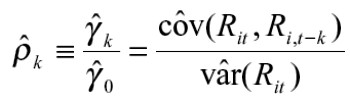
The results of this little experiment are in this Excel spreadsheet. You can click on the screenshot below to open the file or download a copy of it. If you like, you can use the spreadsheet to make your own measurements of selected bars of pairs of performances you’d like to compare.

To me, the significance is that I now understand much better what it is about Goode’s Bach that pleases me so much: it is this particular autocorrelation pattern—a characteristic species of agogicity that the autocorrelogram graphically shows. There are long-range, high, positive autocorrelations at various inter-beat distances that line up more or less on the first-beat-of-measure boundaries [and also the phrase and hyper-meter boundaries], and those autocorrelation peaks taper off quite slowly the further apart any two notes are (the more ‘lag’ units there are between them in the sequence of notes or beats). By contrast, Gould (and other ‘drier’ Bach interpreters) has a high autocorrelation for adjacent notes (at Lag = 1), which damps out pretty quickly the further apart any two notes are.
W hat the autocorrelation analysis tells us is that Goode’s playing manifests a high degree of ‘associativity’ of time intervals over longer time-scales—and this is equally true for intervals that he compresses to be shorter than the nominal meter, and for intervals that he agogically prolongs and stresses. The peaks in the autocorrelogram amount to a sort of ‘polymeter’ that is distinctively Goode’s.
By contrast, Gould’s playing manifests a ‘memory-lessness’—nearly devoid of associativity of rhythms and durations on long time-scales for non-adjacent notes. Both Goode and Gould perform these motoric Bach dance suite movements with motoric rhythmicity. But their motor-like rhythms are remarkably and measurably different—the differences in our cognitive and emotional perceptions when we hear these disparate interpretations arise from their deliberately different, highly personal and unmistakeably different autocorrelations. Here we have quantitatively different ‘agogicity’ as a measure of interpretive style.
I fixed the action in some of the instruments I play on — and the piano I use for all recordings is now so fixed — so that it is a shallower and more responsive action than the standard. It ... is rather like an automobile without power steering: you are in control and not it; it doesn’t drive you, you drive it. This is the secret of doing Bach on the piano at all. You must have that immediacy of response, that control over fine definitions of things.”Saying that Gould’s Allemande playing is relatively ‘memory-less’ or anti-agogic is not to say that his playing was ‘mechanical’ or automatic or that his vision of these Allemandes was ‘microscopic’ and eschewed a macro-scale rhythmic architecture. By no means! Goode has and Gould had—each of them—comprehensive conceptions of each of these Allemandes—of each of the Partitas’ and Suites’ movements. But the metric organization and fractal scales that they each use to build their interpretations’ rhythmic structure are dramatically different—in ways that, as you see above, can be measured and compared numerically and displayed graphically. By autocorrelation analysis, we find out exactly how Goode paints with a ‘broader’ somewhat impressionistic brush (Rembrandt?) and Gould with a magnifying glass and a ‘finer’ one (Vermeer?). Both are highly detailed and narrative in their delivery of the Partitas and Suites; both are illusionistic.
— Glenn Gould.
So here we have one good, objective way to measure and say how they do what they do, and how it works. Leigh Smith and other music theoreticians have examined things in similar ways in years past [see links below], not for Bach and not with quite the same purpose as what we’re doing here. They have used wavelet transforms and other frequency-domain methods, not just autocorrelation and time-domain methods. Smith in particular discusses the difference between measuring the actual timing (from waveform or other performance data) versus capturing the musician’s intention (from MIDI keystrokes datastream or other empirical data that precede the music being made audible). In my own experimentation to prepare this CMT blog post, I have (obviously) only the features in the waveforms digitized in the (audible) MP3 files to work with and have spent only a few hours working on it. This post and its Excel attachment are meant only as a quick demonstration that these things work and that they are useful to help us understand the music better. Enjoy!

[50-sec clip, Richard Goode, Bach, Partita No. 1, BWV 825, Allemande, 1.2MB MP3]
[40-sec clip, Glenn Gould, Bach, Partita No. 1, BWV 825, Allemande, 1.2MB MP3]
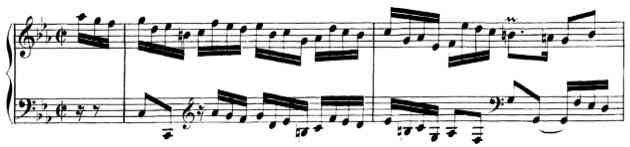
[50-sec clip, Richard Goode, Bach, Partita No. 2, BWV 826, Allemande, 1.2MB MP3]
[45-sec clip, Glenn Gould, Bach, Partita No. 2, BWV 826, Allemande, 1.2MB MP3]

[50-sec clip, Richard Goode, Bach, Partita No. 3, BWV 827, Allemande, 1.2MB MP3]
[45-sec clip, Glenn Gould, Bach, Partita No. 3, BWV 827, Allemande, 1.2MB MP3]

[50-sec clip, Richard Goode, Bach, Partita No. 4, BWV 828, Allemande, 1.2MB MP3]
[45-sec clip, Glenn Gould, Bach, Partita No. 4, BWV 828, Allemande, 1.2MB MP3]

[50-sec clip, Richard Goode, Bach, Partita No. 5, BWV 829, Allemande, 1.2MB MP3]
[35-sec clip, Glenn Gould, Bach, Partita No. 5, BWV 829, Allemande, 1.2MB MP3]

[50-sec clip, Richard Goode, Bach, Partita No. 6, BWV 830, Allemande, 1.2MB MP3]
[40-sec clip, Glenn Gould, Bach, Partita No. 6, BWV 830, Allemande, 1.2MB MP3]
In Goode’s Bach I hear a sort of Walt Whitman-esque, America-flavored ‘agogic freedom’—Goode’s rhythm and emphases and playing style represent to me a sort of ‘democracy trope’. I hear in him an enthusiasm for discovery; an ever-renewing openness for life’s ambiguities and ‘matters-arising’.
Goode’s affect or vision involves more rhetorical freedom than Gould’s concept of Bach, I think, in part because of the sentinel differences in their autocorrelation patterns and ‘agogic polymeter’. Oh, there is of course a difference between rubato (freedom ‘between’ the beats) and agogics (freedom ‘of’ the beats—in where the beats fall). Agogics are often applied at harmonic-pivot points. That’s just where they naturally and logically tend to go.
But Goode’s autocorrelated ‘agogic polymeter’ (or whatever you’d prefer to call it) I think ‘subverts’ or calls into question what we perceive the meter to be—by injecting variable, conflicting metrical structure and by modestly shifting the phase of the metrical accents. This is why it has the strong, friendly effect on me that it does. The initial events of each of these Allemandes provide evidence sufficient for us to establish contexts and referential schematics—mental ‘models’ for what we imagine will follow. The acoustic cues fit into the schematic or framework around which our subsequent anticipation is formed. Deferring or subverting the established meter, as Goode does, forces us listeners to attend to the present moment and continually revise and re-form our expectations. By contrast, with Gould, most of what we anticipate promptly materializes. Gould’s epistemological and perceptual effect and the impact on our cognition and emotions are quite different from Goode’s.
Cognitively, we subconsciously keep track of and group the conflicts and uncertainties/ambiguities that are caused by Goode’s mounting ‘phenomenal agogic accents’. Maintaining these multiple concurrent and conflicting suppositions in our heads as we listen to Goode play—asks that we put a considerable and peculiar sort of effort into it. It is a different sort of attention, I would say, than the attention that Gould’s playing asks of us. Goode’s agogically autocorrelated playing requires our listening strategy to allocate attention and memory toward establishing groupings and processing long timescale expectations. Goode engages us in a distinctive and different sort of conversation/meditation. And the autocorrelation analysis just helps to reveal a quantitative pattern that explains how it’s different.

Compared to Goode’s interpretations, Gould’s Bach has—I go out on a limb here—an ‘anti-expressionist’ aesthetic. From Gould (and others) we get unrelenting introspection, plus transcendent but psychologically ‘dissociative’ experiences, almost PTSD-like experiences.
To me, the ideal affect with Bach also involves a certain amount of rhetorical surprise as well as angst. Agogic accents—a ‘sung’ or ‘danced’ rhythm that either personalizes or depersonalizes—orients or disorients—can make the expression seem as though it were uttered by a particular and known ‘self’ (e.g., Goode; or Bach) or, alternatively, by an ambivalent or profoundly unknowable entity—(e.g, Gould; or God/TheDivine/TheCosmos).
So these Bach suites—and these Allemandes—are no mere dances. Goode ‘dances’ mostly ‘out’; Gould—and others—dance them in a mostly ‘inward’ way. The depth and the originality in the ways that Goode and other artists ‘dance’ them, while they are surely very diverse, never cease to delight and inspire and propel us to take hold of life and figure things out.
The two-hour program last night also included a wonderful collection of Chopin Mazurkas (Op. 6 No. 3 in E major; Op. 7 No. 2 in A minor; Op. 7 No. 4 in A-flat major; Op. 56 No. 2 in C major; Op. 56 No. 3 in C minor), Nocturnes (Op. 15. No. 2 in F-sharp major; Op. 27. No. 2 in D-flat major), and Waltzes (Op. 34 No. 3 in F major; Op 64. No. 2 in C-sharp minor; Op. 64 No. 3 in A-flat major)—24 pieces in all. Both the Op. 39 No. 3 Scherzo in C-sharp minor just before the interval and the Op. 61 Polonaise-Fantasie at the end of the program brought the appreciative audience to its feet. Bravo!

M aking a break from the first and second notes of a melody is to be recommended where the tempo changes from slow to fast. In passing from the Andante to the Allegro in the Sinfonia of Partita No. 2, for example, it is advisable to retain the slow tempo on the final G major chord and not to embark on the faster tempo until the two semiquavers which follow... A relative degree of independence of the beat also applies in the case of recitative.”
— WWPBSD? [What Would Paul Badura-Skoda Do?], p. 18.
- Richard Goode page at Mannes College The New School for Music, NYC.
- Richard Goode at Friends of Chamber Music Master Pianists Series, 18-OCT-2008.
- McDonald T. Pianist Richard Goode proves himself a poet of sorts at Folly Theater recital. Kansas City Star, 19-OCT-2008.
- Goode R. Partitas 1, 3 & 6. (Nonesuch, 2003.)
- Goode R. Partitas 2, 4 & 5. (Nonesuch, 1999.)
- Society for Mathematics and Computation in Music (SMCM)
- Journal of Mathematics and Music (Taylor & Francis Publishers)
- CoolRecordEditPro V3.0
- ALO AudioEditor V3.1
- CoolAudioEditor V3.22
- AudioRecordEdit V9.5
- Agon C, Assayag G, Fineberg J, Rueda C. KANT: A critique of pure quantification. IRCAM ICMC, 1994.
- Badura-Skoda P. Interpreting Bach at the Keyboard. Oxford Univ, 1995.
- Clarke E. ‘Rhythm and timing in music’. In Deutsch D., ed., The Psychology of Music. 2e. Academic, 1998, pp. 473-500.
- Desain P, de Vos S. Autocorrelation and the study of musical expression. Proc Intl Computer Music Conf, 1990.
- Feinberg T, Keenan J, eds. The Lost Self: Pathologies of the Brain and Identity. Oxford Univ, 2005.
- Feinberg T. Altered Egos: How the Brain Creates the Self. Oxford Univ, 2001.
- Hasty C. Meter As Rhythm. Oxford Univ, 1997.
- Huron D. Sweet Anticipation: Music and the Psychology of Expectation. MIT, 2008.
- LeDoux J. Synaptic Self: How Our Brains Become Who We Are. Penguin, 2003.
- Little M, Jenne N. Dance and the Music of J. S. Bach. Indiana Univ, 2001.
- London J. Hearing in Time: Psychological Aspects of Musical Meter. Oxford Univ, 2004.
- Palmer C, Krumhansl C. Mental representations for musical meter. J. Exp. Psychology: Human Perceptual Performance 1990; 16:728-41.
- Parncutt R. A perceptual model of pulse salience and metrical accent in musical rhythms. Music Perception 1994; 11:409-64.
- Parncutt R. Modeling immanent durational accent in musical rhythm. Proc 5th Triennial ESCOM Conf, 2003. [1MB pdf]
- Povel D, Essens P. Perception of temporal Patterns. Music Perception.1985;2:411-40.
- Purwins H, Brachten M, Herrera P, Haza A, Marxer R, Serra X. Computational models of music percetion and cognition - II. Physics of Life Reviews 2008; 5:169-82.
- Rothstein W. Phrase Rhythm in Tonal Music. Schirmer, 1990.
- Sethares W. Rhythm and Transforms. Springer, 2007. (see esp. pp. 111-14; 198-222)
- Smith L, Honig H. Time-frequency representation of musical rhythm by continuous wavelets. J Math Music 2008. [1MB pdf]
- Smith L. Modeling rhythm perception by continuous time-frequency analysis. Proc Intl Computer Music Conf, 1996. [1MB pdf]
- Stout M. The Myth of Sanity: Divided Consciousness and the Promise of Awareness. Penguin, 2002.
- Toiviainen P, Snyder J. Tapping to Bach: Resonance-based modeling of pulse. Music Perception 2003; 21:43-80.
- Tomita Y. The six partitas. Queen’s University Belfast, 2002.
- Troeger R. Playing Bach on the Keyboard: A Practical Guide. Amadeus, 2003.


Saturday, October 18, 2008
18 Oct 08
Royo Girl Responds To Your Comments
Royo Girl - An intelligent and attractive criminology graduate who used to visit me in prison. Whether her interest is based on love or she is writing a thesis on my criminality is an open question. She's flying from Tucson to visit me for my birthday week in October.
From today’s phone conversation with Royo Girl:
“You did get some adverse comments last week,” I said. “Especially from Zqwerty who recognises you as a user.”
“Zqwerty doesn’t recognise anything at all,” Royo Girl said. “He doesn’t know me. He’s just speculating from the side. He should not be such a bitter man. Anything else he says isn’t worthy of a response from me.”
“That’s a bit harsh isn’t it? I don’t think I should blog your last two sentences.”
“He called me a cock-teasing bitch! I think you should leave it in.”
“Jessica Lynn defended you at least.”
“She did, and I thanked her in my comment.”
“What about the person who asked if you’d been to Melbourne?”
“No. I have not, but I have done research into Australia and I think it’s a good fit for me.”
“Sue from Hull defended you, and wishes you a great time in England.”
“She’s obviously a very intelligent woman. That’s very apparent in what she said about Zqwerty.”
“Jason thinks you’re using me for career purposes, you’re noncommittal, but I shouldn’t necessarily stay away from you.”
“Given that I haven’t used you to further my career should speak volumes about myself and my honourable intentions with you. I am noncommittal due to the massive distance between us. If we were in the same country, we may find ourselves in an entirely different situation.”
“Then Zqwerty added a later comment saying you have ulterior motives and you’re doing things for your own reasons.”
“You don’t just do things to do them. You do them because it’s part of a greater scheme. Because you want something.”
“Now we’re entering into an area of philosophy. Do we all act selfishly? Even Mother Teresa, when she helped people, did she do so because she enjoyed helping them so much, thus giving herself what she wanted?”
“It’s the same with you. If you didn’t want something, you wouldn’t be entertaining the thought of seeing me either.”
“That covers the comments. Anything you’d like to add?”
“I thank the readers for their input – at least most of them. I think the world could do without the name calling and negativity.”
“Didn’t you just add to the negativity with what you said about Zqwerty?”
“It’s only fair for me to defend myself. There’s no need for his nasty remarks.”
Email comments to writeinside@hotmail.com or post them below
Shaun P. Attwood
Royo Girl Responds To Your Comments
Royo Girl - An intelligent and attractive criminology graduate who used to visit me in prison. Whether her interest is based on love or she is writing a thesis on my criminality is an open question. She's flying from Tucson to visit me for my birthday week in October.
From today’s phone conversation with Royo Girl:
“You did get some adverse comments last week,” I said. “Especially from Zqwerty who recognises you as a user.”
“Zqwerty doesn’t recognise anything at all,” Royo Girl said. “He doesn’t know me. He’s just speculating from the side. He should not be such a bitter man. Anything else he says isn’t worthy of a response from me.”
“That’s a bit harsh isn’t it? I don’t think I should blog your last two sentences.”
“He called me a cock-teasing bitch! I think you should leave it in.”
“Jessica Lynn defended you at least.”
“She did, and I thanked her in my comment.”
“What about the person who asked if you’d been to Melbourne?”
“No. I have not, but I have done research into Australia and I think it’s a good fit for me.”
“Sue from Hull defended you, and wishes you a great time in England.”
“She’s obviously a very intelligent woman. That’s very apparent in what she said about Zqwerty.”
“Jason thinks you’re using me for career purposes, you’re noncommittal, but I shouldn’t necessarily stay away from you.”
“Given that I haven’t used you to further my career should speak volumes about myself and my honourable intentions with you. I am noncommittal due to the massive distance between us. If we were in the same country, we may find ourselves in an entirely different situation.”
“Then Zqwerty added a later comment saying you have ulterior motives and you’re doing things for your own reasons.”
“You don’t just do things to do them. You do them because it’s part of a greater scheme. Because you want something.”
“Now we’re entering into an area of philosophy. Do we all act selfishly? Even Mother Teresa, when she helped people, did she do so because she enjoyed helping them so much, thus giving herself what she wanted?”
“It’s the same with you. If you didn’t want something, you wouldn’t be entertaining the thought of seeing me either.”
“That covers the comments. Anything you’d like to add?”
“I thank the readers for their input – at least most of them. I think the world could do without the name calling and negativity.”
“Didn’t you just add to the negativity with what you said about Zqwerty?”
“It’s only fair for me to defend myself. There’s no need for his nasty remarks.”
Email comments to writeinside@hotmail.com or post them below
Shaun P. Attwood
Thursday, October 16, 2008
Merge Two Competing Chamber Music Presenter Organizations?

T he effect of the economic downturn is already pronounced—in terms of our subscription sales and attendance so far this season, and in terms of corporate and foundation money. I wonder whether, if we merged with the other main chamber music organization in our city, we might do better overall. The reason I think the answer may be ‘yes’ is that our respective programs tend time and again to collide with and compete against each other for the same audience. For example, two pianists in one week--the other org’s program on Friday night, ours on Saturday night. Or two early music programs within a fortnight. The ‘supply’ [of chamber music programs] exceeds the ‘demand’ in our market area, or at least exceeds our audience members’ monthly budgets of time and money. CMT sometimes has spreadsheets and math [to illustrate how some process works or to provide a tool to help CMT readers’ decision-making]. Could you do something in Excel to show whether there would be financial advantages or disadvantages if we combined with our competitor? The assumptions would be that we would have the same number of events each season [Presenter P’s events + Rival R’s events]; the prices and expenses would be the same [P + R roll-up]; the staff would be the same [P + R, with executive co-directors and artistic co-directors]; and the corporate and foundation funding would be the same [P + R]. If we merged, we would just coordinate our programs to not compete—to more efficiently and effectively serve the demand in our community. Possible?”The performing arts market is tremendously fragmented. That fragmentation inevitably leads to inefficiencies. There are more than 520 presenter entities who are organizational members of Chamber Music America. And one thing that’s clear from examining CMA’s directory of chamber music presenters is that communities in the U.S. that have performing arts markets that are robust enough to have one presenter tend in fact to have two or more chamber music presenters. In many cases, that means that there is relatively intense competition for what is almost certainly a finite market—a finite monthly or quarterly consumer spend per household. Probably the same is also true in cities in Europe and the U.K.
— Anonymous.
For simplicity and to directly respond to the anonymous emailer’s question, I’ve put together a mathematical model that is for two competitors in a market—a duopoly. It would be far more complex to create an accurate, actionable financial merger model for three or more competitors. Actually, if the proposition were to simultaneously consolidate three or more competitors into one unified presenter organization, then you could still use this Cournot-Nash game-theory model as-is. You would simply put your own figures in as Presenter P, and then sum the figures for all of your competitors and put those sums in the Rival R column.
Basically, you need the ticket sales (earned income) figures for you and your competitor for last season's events—not the ticket drop numbers (with comp tickets and other imponderables) but the cash money taken in. You can exclude the events that each of your orgs produced that did not compete with each other at all—because they were far enough apart (say, more than 4 weeks) so that it’s implausible that a potential audience member would’ve decided to decline to attend your event because they were already attending your competitor’s event, or vice versa. Then you adjust the up-down arrows so that the accomodation figures match your last-season historical values, and so that the Cournot-Nash duopoly figures on the left more or less match the last-season actual average per event period figures on the lower right. (Just click on either of the screen-shot images below to Open or Save_as the Excel spreadsheet.)

Program ‘event periods’ means any interval of time during which the competitors’ programs compete against each other for consumers’ dollars. It doesn’t have to mean conflicting events on the exact same dates. It may be events on adjacent dates, such that attendees who otherwise would like to attend both programs probably will not buy tickets and attend chamber music concerts on two consecutive days. It may be events during the same week or fortnight, with the same criterion that most members of the target market may not attend two or more chamber music events within, say, 10 days of each other.
There are a number of assumptions and limitations of this simple Cournot-Nash model of financial competition:
- It doesn’t take into account the possibility of ‘curvature’ of the elasticity of demand;
- It ‘linearizes’ the [possibly non-linear] competitive interaction;
- It uses the statistical covariance cov(P,R) between the competitors as the measure of the ‘accomodation’ effect of the sales of one presenter on the competitor’s sales, which, while simple, may be a far-from-ideal metric of the competitive economic interaction between the two;
- It doesn't account for potential greater-than-additive ‘synergies’ in terms of induced greater demand or brand-recognition or marketing effectiveness that a merged entity might achieve;

With the insights you glean from playing around with this simple model, perhaps you will try to arrange your programming timing and content so as to minimize the numeric value (covariance) of your own ‘accomodation’ to your competitors—i.e., select your artists and programs so as to make your own ticket sales very insensitive to the programming that your competitors present, while simultaneously maintaining your ‘brand’ and maximizing the demand for the programs you select and book.
This simple model can be used to devise other strategies: to make your organization attractive for a merger or, conversely, to make your organization an unattractive target (by removing any appearance of financial advantage associated with combining and coordinating programming so as not to compete). ‘Accomodation’ values that are large (> 40% for one or both competitors) tend to predict financial gains for a merged entity that are upwards of 30% compared to the total annual sales with each competitor separate. Conversely, ‘accomodation’ values that are low (< 10% for one or both competitors) tend to predict that merging the competitors would not net much income growth for the merged entity—growth of 15% or less.
So please have a look at the model. Send me email or comment on it if you wish. And give us your thoughts in the poll that’s embedded in this post. (Note: Your participation in the online poll does not disclose your own identity or your organization’s identity, nor does it reveal anything about your community. It does not collect information other than which selection you click on.) Thank you!
- Andreff W, Szymanski S, eds. Handbook on the Economics of Sport. Elgar, 2007.
- Chen S-H. Evolutionary Computation in Economics and Finance. Physica Verlag, 2002.
- Cornuejols G, Tutuncu R. Optimization Methods in Finance. Cambridge Univ, 2007.
- Cowan R, Jonard N, eds. Heterogenous Agents, Interactions and Economic Performance. Springer, 2002.
- van Damme E. Stability and Perfection of Nash Equilibria. 2e. Springer, 2002.
- Fisher T. Managerial Economics: A Game Theoretic Approach. Routledge, 2002.
- Kolm S-C, Ythier J, eds. Handbook of the Economics of Giving, Altruism and Reciprocity, Volume 2: Applications. North Holland, 2006.
- Lambertini L, ed. The Economics of Vertically Differentiated Markets. Elgar, 2006.
- Neubecker L. Strategic Competition in Oligopolies with Fluctuating Demand. Springer, 2006.
- Nowak A, Szajowski K, eds. Advances in Dynamic Games: Applications to Economics, Finance, Optimization, and Stochastic Control. Birkhauser, 2004.
- Plott C, Smith V, eds. Handbook of Experimental Economics Results, Volume 1. North Holland, 2008.
- Salvatore D. Managerial Economics in a Global Economy. Oxford Univ, 2006.
- Smith V. Rationality in Economics: Constructivist and Ecological Forms. Cambridge Univ, 2007.
- DSM. Non-profit chamber music orgs and the recession. CMT blog, 17-JUL-2008.
- DSM. Chamber music economics: Divisibility of time and the Monty Hall problem. CMT blog, 10-APR-2008.
- DSM. Few chamber orchestras are too big to fail: Market size, scale and sustainability. CMT blog, 30-MAR-2008.

Video: Aryan Brother Slays Inmate In Sheriff Joe Arpaio’s Jail
Here’s a video of inmate, Robert Cotton, getting murdered by Aryan Brother, Pete Van Winkle, at Sheriff Joe Arpaio’s Fourth Avenue jail. The day after the murder, the Maricopa County Sheriff’s Office issued a press release, including this statement, "Nothing out of the ordinary appeared to be happening in or around that cell."
This lie was obviously fabricated to protect the guards asleep at the surveillance screens. It took twenty minutes after the attack began for the guards to respond.
Aryan Brother, Pete Van Winkle, was at the jail on a murder charge. He’d come from a supermaximim prison and should never have been housed in the same custody level as Robert Cotton. This is yet another example of how the gangs are running Arpaio’s jail, and certainly not the staff.
Click here for my jail survival tips
Here’s a video of inmate, Robert Cotton, getting murdered by Aryan Brother, Pete Van Winkle, at Sheriff Joe Arpaio’s Fourth Avenue jail. The day after the murder, the Maricopa County Sheriff’s Office issued a press release, including this statement, "Nothing out of the ordinary appeared to be happening in or around that cell."
This lie was obviously fabricated to protect the guards asleep at the surveillance screens. It took twenty minutes after the attack began for the guards to respond.
Aryan Brother, Pete Van Winkle, was at the jail on a murder charge. He’d come from a supermaximim prison and should never have been housed in the same custody level as Robert Cotton. This is yet another example of how the gangs are running Arpaio’s jail, and certainly not the staff.
Click here for my jail survival tips
Subscribe to:
Posts (Atom)